

6 min read
September 23, 2026
Top 5 Full-Cycle KYB Solutions (2026)
Key Takeaways

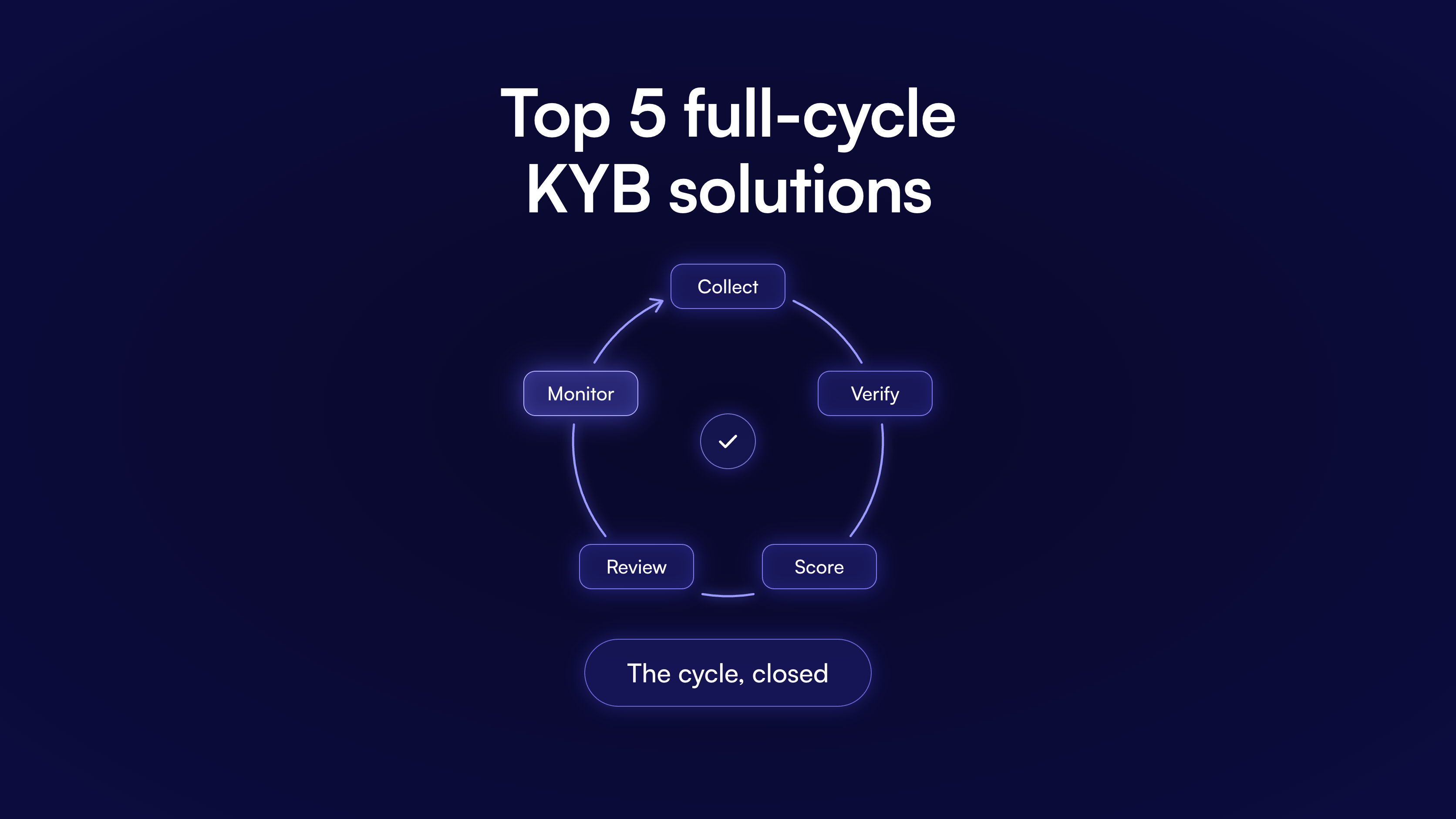
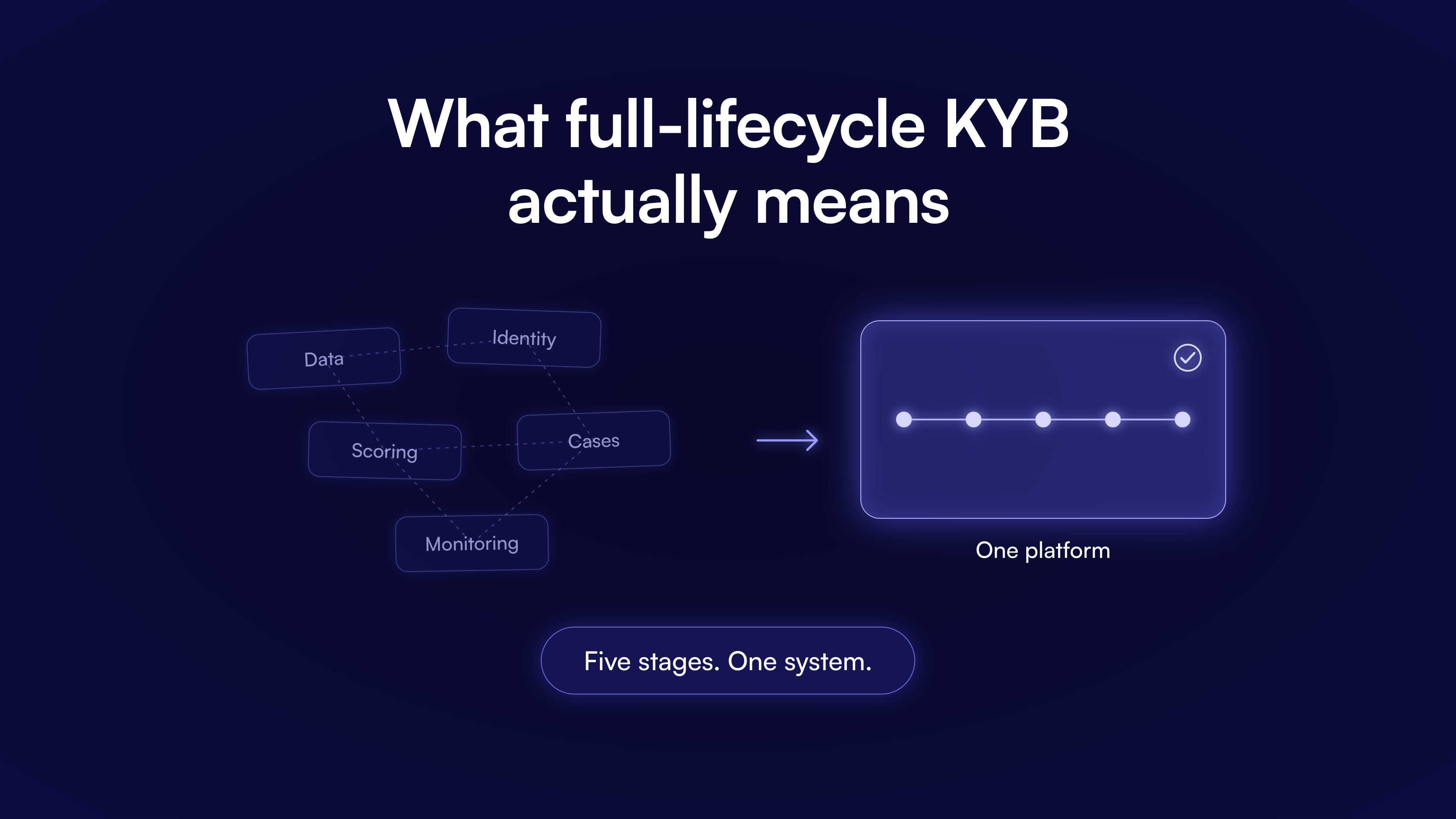
Full-cycle KYB means all five lifecycle stages in one system: collection, verification, risk scoring, review and decisioning, and ongoing monitoring.
Most vendors cover one or two stages well and leave the rest to your team, your engineers, or a second and third vendor.
The practical test is continuity: one record from onboarding to monitoring, one audit trail, and risk scores that update when the world changes.
Five platforms lead the category in 2026. Each is assessed below on how much of the cycle it actually contains, with an honest consideration for every one, including ours.
Bring one real business to every demo and ask to see its full journey, collection through monitoring, before you believe an end-to-end claim.
What Full-Cycle Actually Requires
A business relationship is not a check. It starts with an application, becomes a verification, turns into a risk decision, sometimes needs a human, and then lives for years while ownership, sanctions status, and registry standing quietly change underneath it. Full-cycle KYB means one system carries the whole arc. Anything less, and the gaps between systems become your team's job.
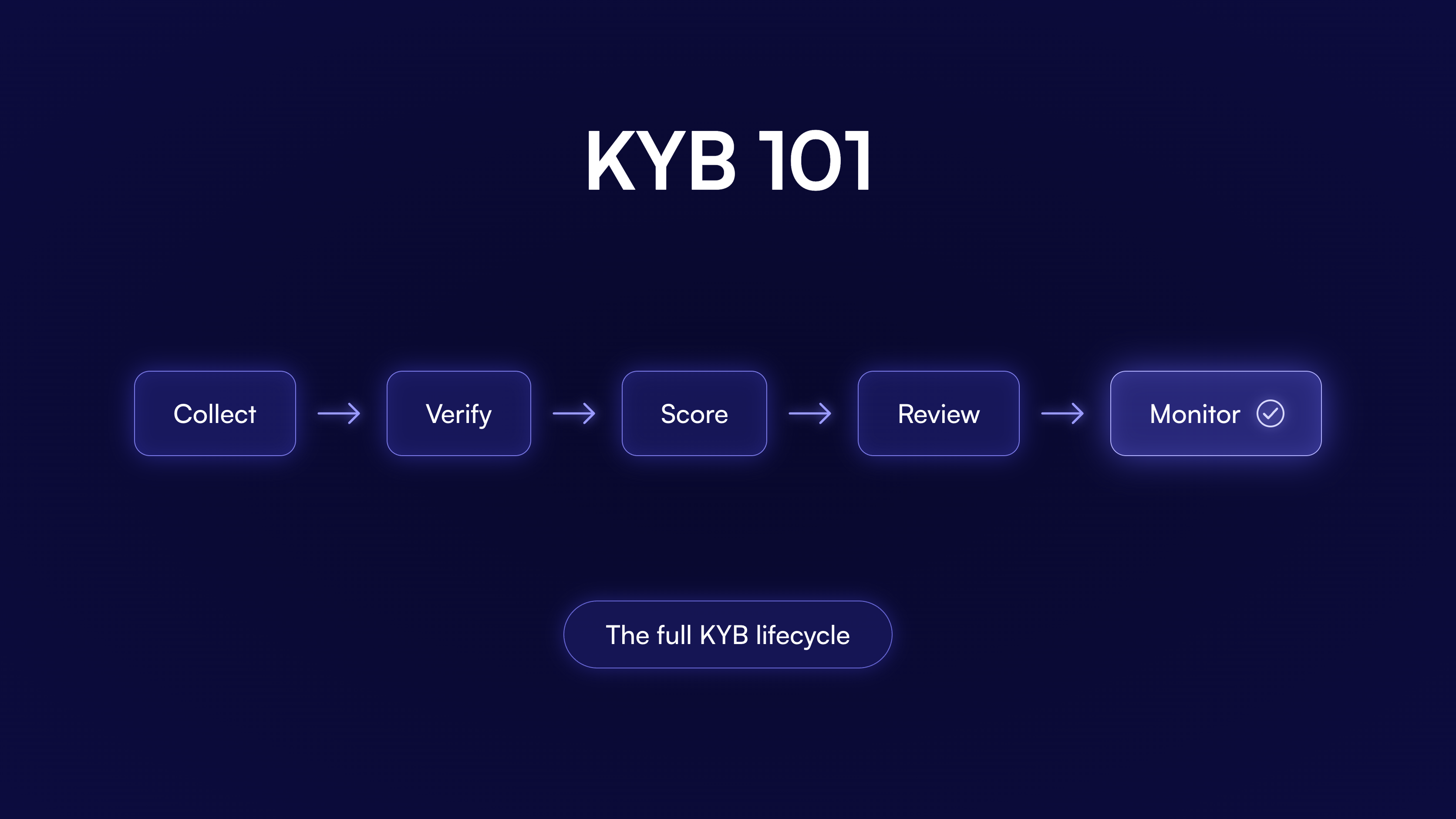
The five stages, in brief: collection, verification, risk scoring, review and decisioning, and monitoring. Our KYB 101 guide covers each in depth.
The Top Full-Cycle KYB Solutions
1. AiPrise
AiPrise is the AI-powered global compliance platform: KYB, KYC, AML screening, and AI agents in a single API and dashboard, covering 200+ countries with 100+ data sources and 800+ business data points per entity. Three things make it the strongest full-cycle platform.
The lifecycle is the architecture, not a bundle. Onboarding flows adapt by country and entity type, verification runs against registries and data sources, scoring is explainable, review captures reasoning on every decision, and monitoring watches registry status, ownership, watchlists, and website signals continuously. One record moves through all five stages. Nothing gets re-entered, and nothing falls between systems, because there is no between.
The audit trail is continuous. When a regulator or partner asks about a business two years after onboarding, the answer is one timeline: what was collected, what was verified against which source, how it was scored, who decided what and why, and everything that changed since. That is the artifact examinations actually want, and stitched stacks cannot produce it without a reconciliation project.
The cycle closes. A monitoring event does not open a fresh case from zero. It updates the profile, re-scores the risk, and lands in the same review queue with the history attached. Grey, a cross-border fintech, runs its verification through AiPrise and doubled its user approvals. Straightforward checks complete in 3 to 5 minutes, and customers automate up to 80% of verification workflows.
2. Sumsub
Sumsub covers a genuinely broad slice of the cycle: configurable collection flows, verification, screening, and case tooling in one dashboard, a common choice for crypto companies standardizing global onboarding. The consideration: the later stages are the ones to inspect closely in an evaluation, particularly how monitoring events flow back into risk scores and queues.
3. Persona
Persona's composable infrastructure can be configured into most of the cycle, with strong developer ergonomics and real flexibility. The consideration: configurable means configured by you. The lifecycle you get is the one your team designs, builds, and validates, which suits product-led teams with engineering capacity and patience.
4. Alloy
Alloy is the strongest pure decisioning layer: risk scoring and review workflows across data vendors you contract with separately. The consideration: it orchestrates the cycle rather than containing it. Collection arrives via SDK, verification depth depends on which data partners you connect, and the total cost includes those underlying contracts.
5. Trulioo
Trulioo is a verification data powerhouse with a very broad global footprint, and honest about what it is: the data layer of stage two. The consideration: collection, scoring, review, and monitoring are yours to build around it, which makes it a component of a full-cycle stack rather than one.
How to Run the Evaluation
Bring one real business from last quarter's onboarding and ask each vendor to walk its full journey: the application, the checks, the score, the review, and what happens when its ownership changes next year. Count the systems involved in the answer. Then ask for the audit trail as a single export. The vendor that produces one timeline is running a cycle. The vendor that produces three exports is selling you the stitching.
Frequently Asked Questions
Is full-cycle KYB the same as orchestration?
No. Orchestration coordinates separate vendors into a decision flow, which solves routing and leaves you owning the contracts, the gaps, and the reconciliation. A full-cycle platform contains the stages.
Can we adopt a full-cycle platform in stages?
Yes, and most teams do: verification first, monitoring second, collection and review as incumbent contracts expire. The audit-trail benefit arrives in full once decisioning moves over.
What is the single best test of an end-to-end claim?
Ask to see a risk score change because of a monitoring event, without anyone re-running a check. Platforms that close the cycle can show it in a demo. Platforms that do not will change the subject.
See the Full Cycle Run
Bring one business and watch it travel all five stages, with the single audit trail at the end. Book a demo.
You might want to read these...




AiPrise
KYB Compliance: 2026 Regulations You Should Know About
As organizations expand globally and face tighter regulations, adherence to Know Your Business (KYB) standards has become one of the most critical compliance layers for fintech, online marketplaces, and other companies that need to verify business customers before letting them perform financial transactions.










.png)

.jpg)

















.png)








.png)
.png)
.png)











.png)

.png)



AiPrise’s data coverage and AI agents were the deciding factors for us. They’ve made our onboarding 80% faster. It is also a very intuitive platform.

Head of Operations



See your full compliance picture in one place
Use AI agents and global data to review businesses and users faster and more accurately
