

10 min read
September 10, 2026
Best KYB Solutions for the Canadian Market (2026)

Key Takeaways

KYB in Canada is governed by the PCMLTFA and enforced by FINTRAC: confirm legal existence, identify beneficial owners at the 25% threshold plus directors and authorized representatives, screen for risk, and keep records for five years.
Since October 1, 2025, FINTRAC-regulated entities must consult Corporations Canada's beneficial ownership database for high-risk federal corporations and report material discrepancies within 30 days, which turns ownership verification into a continuous obligation.
Canada and the US moved in opposite directions: Canada built a public federal ownership registry while the US permanently exempted domestic companies from ownership reporting.
Most Canadian companies incorporate provincially, so real verification means covering Ontario, BC, Quebec, Alberta, and the other provincial registries, not just Corporations Canada, and reading French-language filings as reliably as English ones.
The best KYB solution for Canada combines registry-first verification, FINTRAC-aligned methods, continuous monitoring, and an audit trail built for examination, not just a database lookup.
Why KYB in Canada Is Its Own Problem
On paper, Canadian KYB looks familiar: verify the business exists, identify the humans behind it, screen everyone, keep records. In practice, five things make Canada different.
FINTRAC sets the bar, and it is specific. Under the Proceeds of Crime (Money Laundering) and Terrorist Financing Act, reporting entities must confirm a business's legal existence, identify every individual who directly or indirectly owns or controls 25% or more, and identify directors and authorized representatives. Records must be kept for at least five years and produced to FINTRAC within 30 days of a request. FINTRAC has also grown more assertive with administrative monetary penalties in recent years, so examination-readiness is not theoretical.
Ownership verification became a live obligation in October 2025. FINTRAC now requires reporting entities to consult Corporations Canada's beneficial ownership database for federally incorporated clients they assess as high risk, and to report any material discrepancy between what the client declared and what the registry shows within 30 days. Ownership information that quietly drifts out of date is no longer a data-quality issue. It is a reportable event, with a deadline.
The registry landscape is fragmented inside one country. A Canadian business might be incorporated federally under the CBCA or provincially in Ontario, British Columbia, Quebec, Alberta, or elsewhere, and most incorporate provincially. Each registry has its own records, fields, and access. Verifying "a Canadian business" actually means verifying against the right registry for that entity, which is a routing problem before it is a data problem.
Quebec adds a language dimension. Incorporation documents, corporate filings, and registry records from Quebec's Registraire des entreprises come in French. A verification stack that only reads English documents has a blind spot covering nearly a quarter of the Canadian economy.
Entity types change the playbook. A CBCA corporation has a federal registry record and, now, a public ownership filing. An Ontario numbered company has a provincial record. A sole proprietor may have little more than a business name registration and a bank account. FINTRAC's rules flex by structure (corporations, partnerships, trusts, and sole proprietorships each have their own confirmation paths), and a platform that treats them all like Delaware C-corps will either falsely reject the small ones or wave them through unverified.
Canada and the US Just Went Opposite Directions
The contrast is worth pausing on, because it changes how any team operating in both markets should think. In August 2026, the US permanently exempted domestic companies from beneficial ownership reporting, leaving no federal database to check. Canada did the reverse: a public federal registry of individuals with significant control, plus a duty on regulated entities to cross-check it and report discrepancies. If you onboard businesses on both sides of the border, you are now running two philosophically different programs: in Canada, verify against the registry and reconcile; in the US, build the ownership picture yourself. Our US KYB walkthrough covers the American side in depth.
What FINTRAC Actually Accepts as Verification
FINTRAC recognizes specific identity verification methods, and your KYB stack needs to support them for the humans behind each business: government-issued photo ID, a credit file that has existed for at least three years, the dual-process method (two independent, reliable sources), verification through an affiliate, and reliance on another reporting entity's prior verification. The dual-process method matters more than it sounds: it is often the only workable path for thin-file individuals, which is exactly who stands behind sole proprietorships and young businesses. When you evaluate vendors, ask which methods they support natively, because "we verify identity" and "we verify identity in a way FINTRAC recognizes" are different sentences.
What to Look For in a KYB Solution for Canada
Six criteria separate solutions that work in Canada from solutions that merely include it on a coverage map. If you are comparing providers beyond Canada, our top KYB providers breakdown does the global side-by-side.
- Registry coverage at both levels. Federal (Corporations Canada) and provincial registries, with the routing logic to check the right one for each entity.
- FINTRAC-aligned methods. Beneficial owner identification at the 25% threshold including directors and representatives, and identity verification through methods FINTRAC recognizes, including dual-process for thin-file individuals.
- Discrepancy-ready ownership workflows. Declared ownership captured, compared against registry data, and flagged when the two diverge, because since October 2025 that divergence can be reportable within 30 days. This is where risk scoring earns its keep: the high-risk assessment is what triggers the registry consultation duty in the first place.
- Bilingual document handling. French-language incorporation documents and filings processed as reliably as English ones.
- Entity-type flexibility. Different confirmation paths for corporations, partnerships, trusts, and sole proprietors, not one rigid flow.
- Monitoring and examination-ready records. Continuous screening and registry monitoring after onboarding, with a five-year audit trail that can be produced inside FINTRAC's 30-day window.
The Best KYB Solutions for the Canadian Market
| Provider | Known for | Fit for Canada |
|---|---|---|
| AiPrise | Full-lifecycle KYB and KYC across 200+ countries with AI agents | Regulated fintechs and platforms that need FINTRAC-grade verification at home and the same rigor in every market they expand into |
| Trulioo | Global identity and business data aggregation, headquartered in Vancouver | Enterprises wanting broad data access with a Canadian home base, building their own workflow layer |
| Sumsub | All-in-one KYC, KYB, and AML verification flows | Crypto companies standardizing global onboarding |
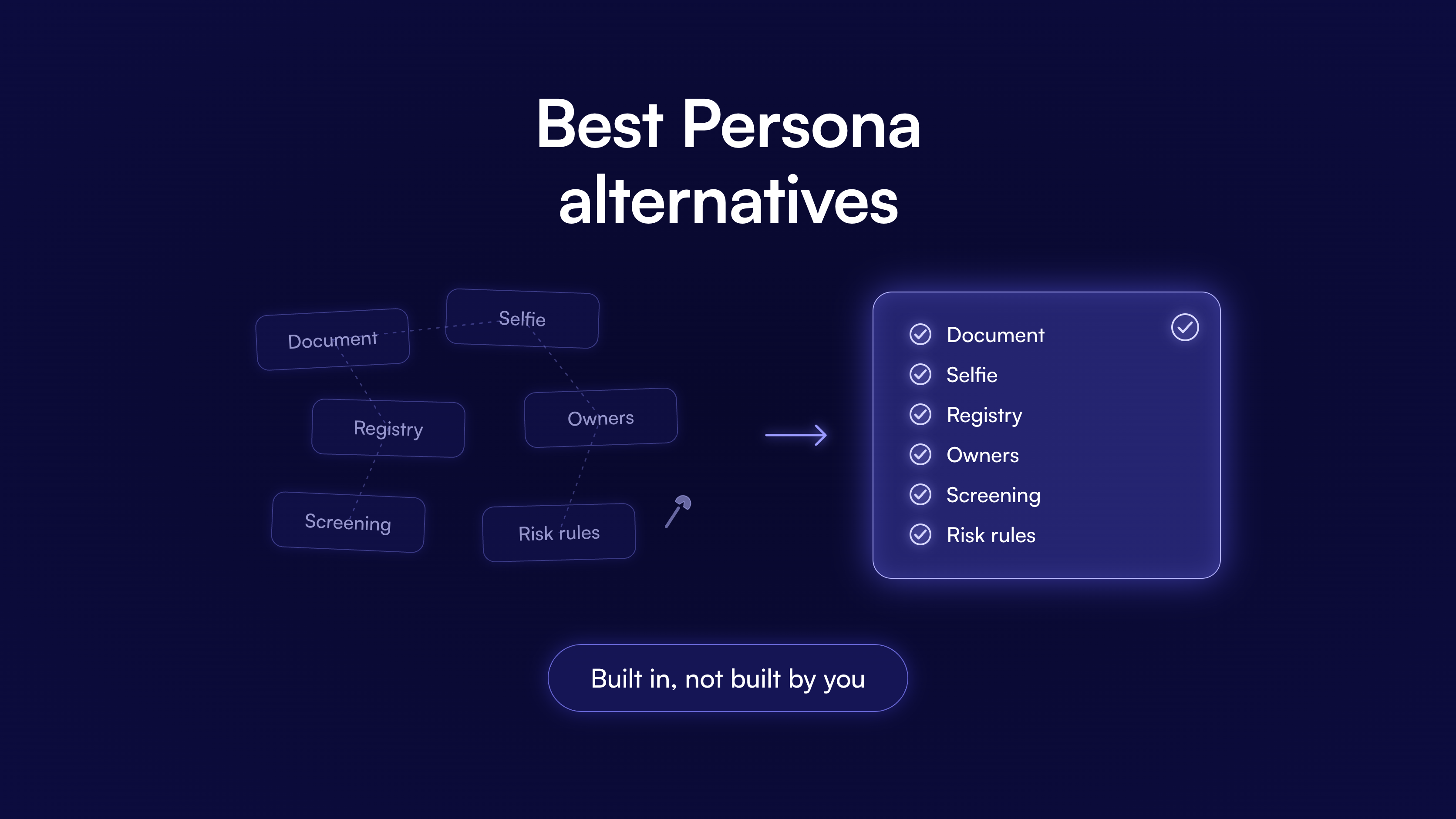
| Persona | Configurable identity workflows with KYB and KYC combined | Product teams that want to compose custom verification flows themselves |
| Alloy | Identity risk orchestration across multiple data vendors | Financial institutions orchestrating several data sources into one decision engine |
1. AiPrise
AiPrise is the AI-powered global compliance platform: KYB, KYC, AML screening, and AI agents in a single API and dashboard, covering 200+ countries with 100+ data sources and 800+ business data points per entity. Three things make it the strongest fit for Canadian verification specifically.
Canada's new rules reward continuous verification, and that is the platform's architecture. The October 2025 discrepancy regime assumes you can capture declared ownership, verify it against registry data, and notice when the two diverge, on an ongoing basis. That is not a feature you bolt onto a point-in-time checker; it is how AiPrise already works. Ownership is captured and structured at the 25% FINTRAC threshold including directors and representatives, verified against registry records, and monitored after onboarding, with alerts when registry status, ownership, or watchlist exposure changes. The regulatory direction of travel in Canada is toward exactly this posture.
Registry-first verification gets full value in a registry-rich market. Canada has strong public infrastructure: Corporations Canada, the provincial registries, and now a public federal ownership database. AiPrise verifies at the source rather than trusting submitted paperwork, because a document can be forged but the registry record either exists or it does not. In a market this registry-rich, that approach converts Canada's infrastructure into your verification advantage, including for the hard cases: multi-layer ownership resolved through 800+ business data points, and document processing across languages for Quebec filings.
Canadian businesses do not stay Canadian, and neither does the platform. The moment a Canadian fintech expands into the US or a global platform starts onboarding Canadian merchants, the single-market vendor becomes a second vendor. AiPrise covers both directions of the border and 200+ markets beyond it through the same integration, which is why cross-border companies run on it: Conduit cut business onboarding from 3 weeks to 72 hours running verification through AiPrise.
Operationally: straightforward KYB checks complete in 3 to 5 minutes, customers automate up to 80% of verification workflows, and AI agents do the first pass on documents, websites, and screening with audit-ready reasoning on every decision, which is precisely what a FINTRAC examination asks you to produce, five years later, within 30 days.
2. Trulioo
Trulioo aggregates identity and business data globally and is headquartered in Vancouver, which gives it deep Canadian roots and strong domestic data relationships. For teams that primarily need broad data access, it is a credible foundation. The consideration: Trulioo is fundamentally a data layer, so workflow, decisioning, ownership reconciliation, and monitoring are yours to build and maintain on top, which suits large enterprises with engineering capacity more than lean compliance teams.
3. Sumsub
Sumsub packages KYC, KYB, and AML into configurable onboarding flows with a single dashboard, and is a common choice for crypto companies standardizing verification across markets. The consideration for Canada: coverage comes as part of a broad global footprint rather than a Canadian specialization, so FINTRAC-specific mechanics like discrepancy workflows and entity-type routing deserve close inspection in an evaluation.
4. Persona
Persona offers highly configurable identity infrastructure where teams compose their own verification flows, combining business and individual checks with strong developer ergonomics. The consideration: configurability cuts both ways, and the Canadian specifics (registry routing, FINTRAC method support, French documents) are yours to configure and validate rather than defaults you inherit.
5. Alloy
Alloy orchestrates identity and risk decisions across many third-party data vendors and is popular with North American financial institutions. The consideration: orchestration presumes vendor relationships to orchestrate, so Canadian depth depends on which data partners you connect and contract with, and the total cost includes those underlying vendors.
How to Run the Evaluation
Test with real Canadian entities, not demo data: one CBCA corporation, one Ontario corporation, one Quebec company with French filings, and one sole proprietor. Measure four things: did the platform find the right registry record, did it surface the full ownership picture at the 25% threshold, how much manual work remained, and what does the audit trail look like when you are done. The provider that performs on the Quebec company and the sole proprietor is the one that will perform on your real portfolio, because those are the cases that break single-flow platforms.
Frequently Asked Questions
Is KYB legally required in Canada?
For FINTRAC-regulated reporting entities (banks, MSBs, securities dealers, and other covered sectors), yes, under the PCMLTFA. Foreign fintechs serving Canadian customers typically also need to register as money services businesses, which brings the same obligations. For marketplaces and platforms outside that scope, KYB is usually required contractually by banking and payment partners, and prudent regardless.
What is the beneficial ownership threshold in Canada?
25%: every individual who directly or indirectly owns or controls 25% or more of an entity must be identified, along with directors and authorized representatives.
What is the Corporations Canada beneficial ownership registry?
A federal database of individuals with significant control over CBCA-incorporated companies, launched in 2024. Since October 1, 2025, FINTRAC-regulated entities must consult it for high-risk federal corporations and report material discrepancies within 30 days.
How long must KYB records be kept in Canada?
At least five years, and reporting entities must be able to produce records to FINTRAC within 30 days of a request.
Verify Canadian Businesses With AiPrise
AiPrise verifies businesses in Canada and 200+ other markets through one API: registry-first checks, UBO identification at the FINTRAC threshold, screening, continuous monitoring, and AI agents doing the first pass with audit-ready reasoning on every decision. Book a demo to see a Canadian entity verified end to end.
You might want to read these...





AiPrise
6 min read
KYB Compliance: 2026 Regulations You Should Know About
As organizations expand globally and face tighter regulations, adherence to Know Your Business (KYB) standards has become one of the most critical compliance layers for fintech, online marketplaces, and other companies that need to verify business customers before letting them perform financial transactions.










.png)

.jpg)

















.png)








.png)
.png)
.png)
















AiPrise’s data coverage and AI agents were the deciding factors for us. They’ve made our onboarding 80% faster. It is also a very intuitive platform.

Head of Operations



See your full compliance picture in one place
Use AI agents and global data to review businesses and users faster and more accurately
