

AiPrise
11 min read
January 6, 2026
Automated KYC Verification vs Manual Process Explained

Key Takeaways

Grasping the difference between automated KYC verification and manual process directly impacts how effectively you prevent identity fraud and compliance lapses. Many teams still rely on slow manual checks that drain resources and expose you to costly regulatory risks. In 2025, the U.S. Department of Education reports it prevented over $1 billion in federal student aid fraud by enhancing identity verification systems, showing how stronger verification reduces fraud losses.
Fully understanding these verification approaches helps you cut operational costs, boost onboarding speed, and tighten fraud defenses. Choosing the right strategy equips your business to keep pace with tightening regulations and growing online fraud threats. With this insight, you can make smarter decisions to protect your organization’s reputation and bottom line.
Key Takeaways
- Manual KYC relies on human reviews, making it slower, cost-heavy, and harder to scale as customer volumes increase.
- Automated KYC verifies identities digitally using documents, biometrics, and risk checks, enabling faster and more consistent decisions.
- The biggest differences between manual and automated KYC show up in onboarding speed, accuracy, compliance consistency, and long-term costs.
- As regulatory pressure and fraud risks grow, automation becomes necessary to support high-volume onboarding without increasing compliance risk.
What Is a KYC Verification?
KYC verification is the process businesses use to confirm that a customer is who they claim to be. It involves validating personal information and government-issued identification to prevent fraud, identity theft, and financial crime. KYC verification is commonly required when opening bank accounts, accessing payment services, or using cryptocurrency platforms.
What Is Manual KYC Verification?
Manual KYC verification is a process where identity checks are conducted by human reviewers rather than automated systems. It typically involves collecting customer information and government-issued IDs, which are then reviewed, validated, and approved by compliance or operations teams. This approach relies heavily on human judgment, making it slower and more resource-intensive, especially as verification volumes increase.
Also read: Understanding KYC Verification Safety and Prevention Steps
To see why many teams are rethinking this approach, it’s important to understand how automated KYC operates differently from the ground up.

How Do Automated KYC Work?
Automated KYC works by using technology to verify identities digitally, reducing manual effort and speeding up compliance checks.
Here’s how automated KYC verification typically functions in real-world workflows:
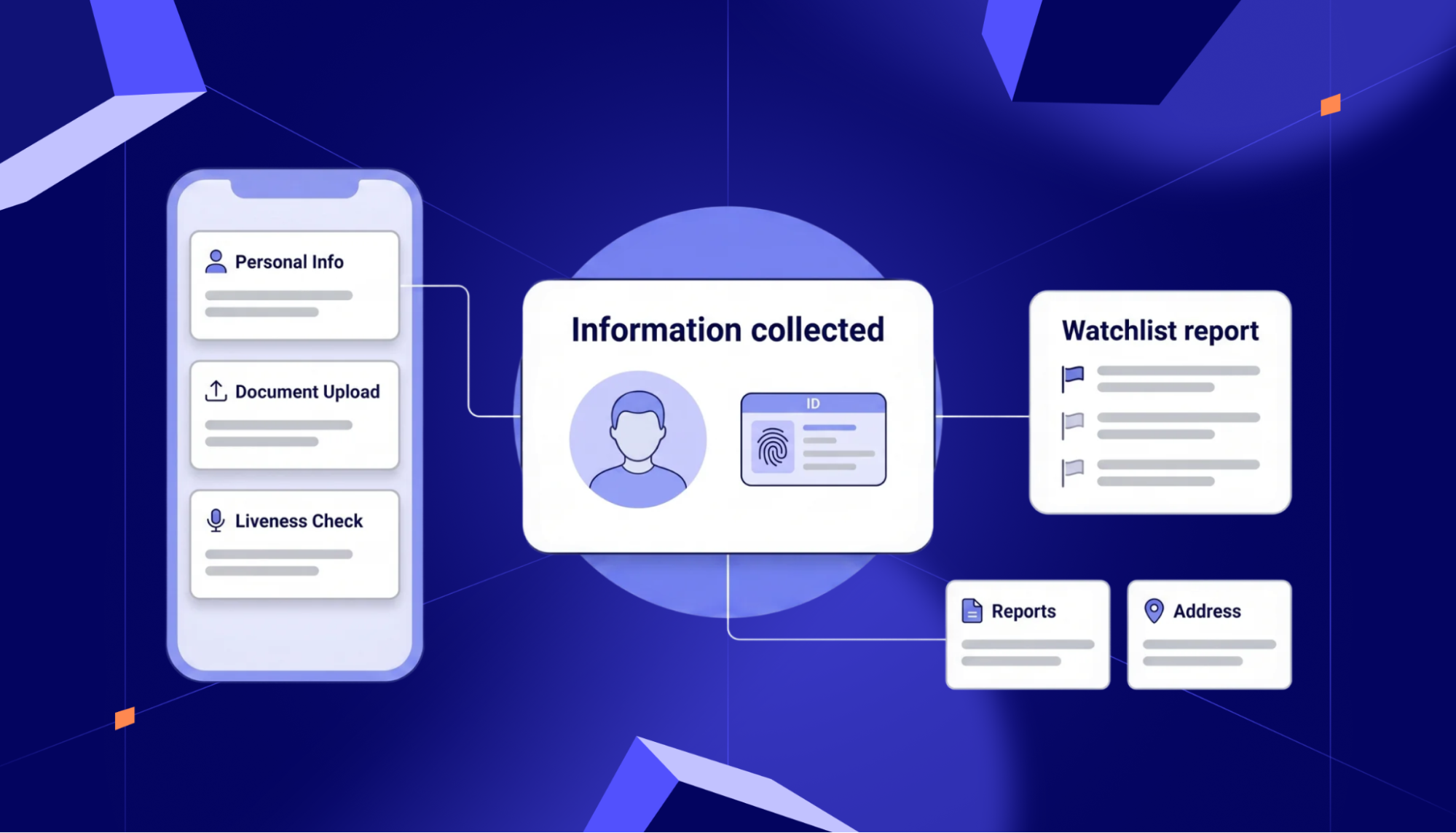
- You submit customer information digitally, including personal details and government-issued IDs such as passports, driver’s licenses, or national identity cards, depending on regulatory requirements.
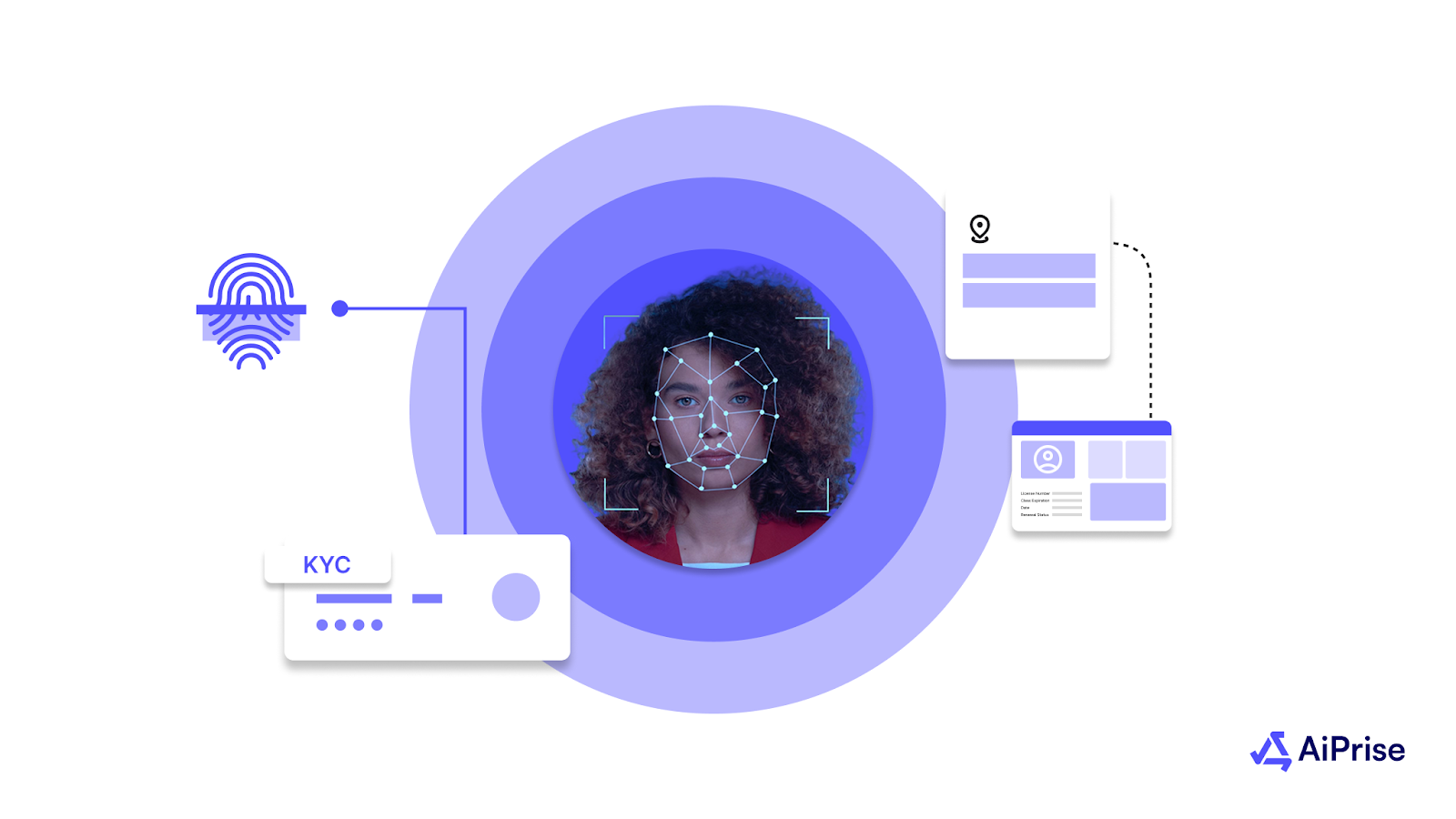
- Optical Character Recognition (OCR) extracts data from documents and cross-checks it against trusted databases to confirm authenticity and consistency.
- Biometric verification, such as facial recognition or liveness checks, ensures the person submitting the documents is real and matches the provided identity.
- Risk engines assess the customer using predefined rules, sanction lists, and watchlists to identify potential fraud or compliance risks.
- The system delivers a verification outcome in seconds, allowing you to approve, reject, or flag cases for further review without slowing onboarding.
Before comparing both approaches in detail, it’s worth looking at the documents and data points that form the backbone of any KYC process.
Documents and IDs Required for KYC Verification
KYC verification requires specific documents to establish identity, assess risk, and meet regulatory standards.
Here are the most commonly required documents used across manual and automated KYC processes:
- Government-issued photo identification, such as passports, driver’s licenses, or national identity cards.
- Proof of address documents, including utility bills, bank statements, or official correspondence, depending on jurisdiction.
- Date of birth and personal identifiers are used to cross-check customer records against trusted databases.
- Biometric data, such as facial images or live selfies, is used in automated KYC verification workflows.
- Business-related documents, including registration certificates or ownership records, are involved when KYB is involved.
- Additional documents may be requested based on risk level, industry regulations, or geographic requirements.
Also read: How Businesses Can Benefit from Free KYC Verification
With documentation requirements in mind, the next step is understanding how manual KYC actually plays out inside compliance teams on a daily basis.
How Manual KYC Verification Works in Real Operations?
Manual KYC verification relies on human reviewers to validate customer identities through document checks and internal procedures.
Here’s how the manual KYC process typically unfolds within compliance teams:
- You collect customer details and physical or digital copies of government-issued IDs, such as passports, voter IDs, or driver’s licenses.
- Compliance analysts manually review documents, compare data fields, and validate authenticity based on visual inspection and internal guidelines.
- Any mismatch or unclear information leads to back-and-forth communication, increasing review time and operational workload.
- Final approval depends on individual judgment, which can vary across reviewers and shifts, impacting consistency.
Seeing how manual workflows function makes it easier to spot where delays, errors, and compliance gaps begin to surface.
Limitations and Risks of Manual KYC Processes
Manual KYC processes introduce operational inefficiencies and compliance risks that grow as verification volumes increase.
Here are the most common challenges you face with manual KYC verification:
- Review times increase significantly as customer volumes grow, leading to onboarding delays and poor user experience.
- Human error becomes more frequent due to fatigue, inconsistent judgment, or a lack of standardized validation methods.
- Scaling requires hiring and training additional compliance staff, which directly increases fixed operational costs.
- Audit readiness suffers because documentation, decision trails, and evidence may not be uniformly recorded or easily retrievable.
Also read: Optimizing KYC Verification with Blockchain Technology
These challenges are exactly where automation starts to change the way KYC workflows are structured and managed.
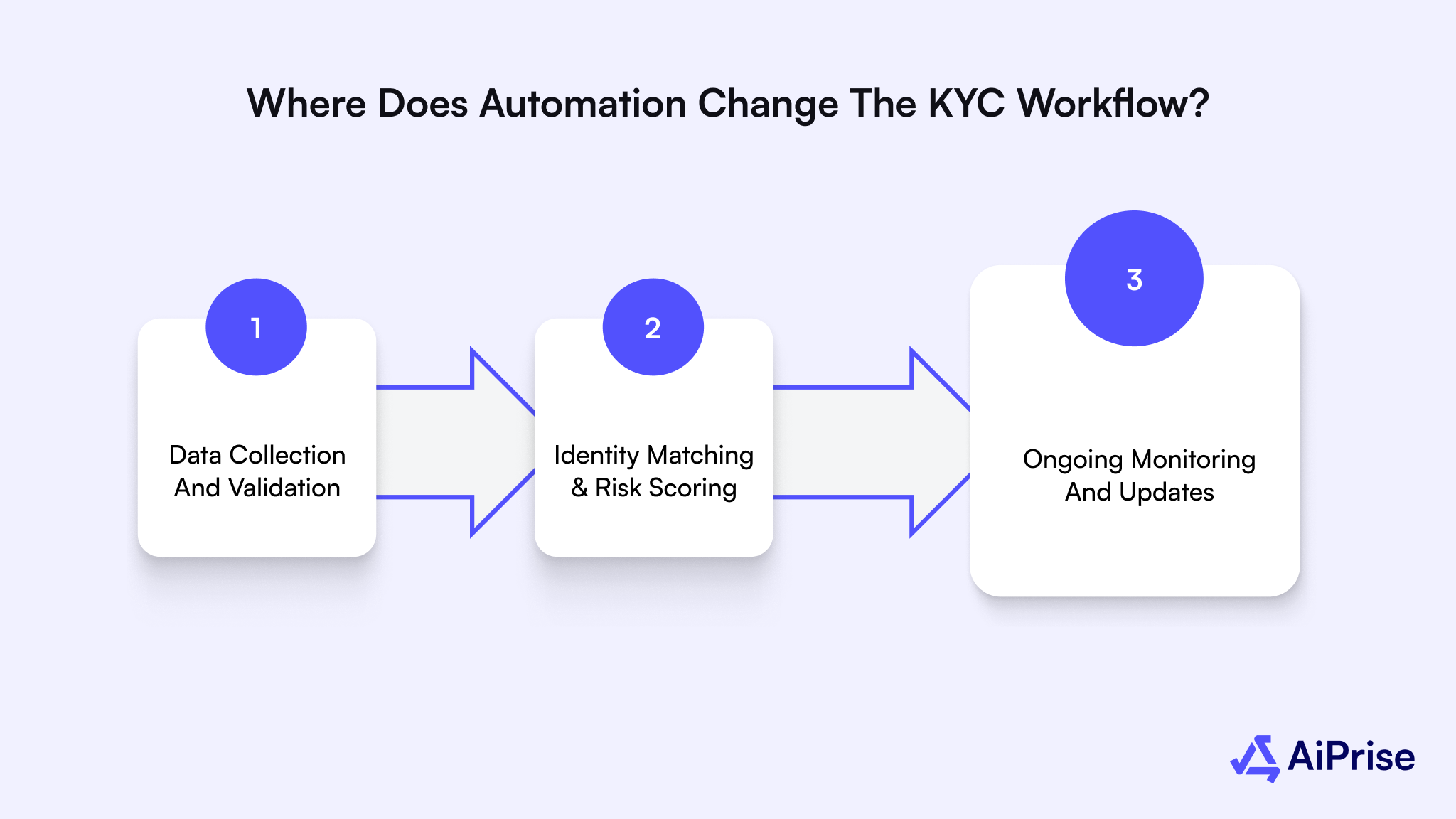
Where Does Automation Change the KYC Workflow?
Automation transforms KYC workflows by replacing repetitive human tasks with system-led verification and decision-making.
Here’s where automation fundamentally reshapes how KYC operates at scale:
1. Data Collection and Validation
Automation standardizes how customer data and IDs are collected and validated across channels. You eliminate manual data entry errors by extracting and validating information directly from documents. This ensures consistency across applications, geographies, and regulatory requirements.
2. Identity Matching and Risk Scoring
Automated systems instantly match identity data against multiple databases and risk indicators. You reduce reliance on subjective human judgment by applying consistent rules and scoring models. This leads to faster, more defensible compliance decisions during audits.
3. Ongoing Monitoring and Updates
Automation enables continuous monitoring instead of one-time verification checks. You can detect changes in customer risk profiles without restarting the entire KYC process. This approach strengthens long-term compliance while reducing operational rework.
This shift is where AiPrise fits in by automating document verification, biometric checks, risk scoring, and ongoing monitoring within a single KYC workflow, reducing manual intervention without breaking compliance continuity.
With both approaches clearly laid out, a direct comparison highlights where the differences truly matter for business outcomes.
Automated KYC vs Manual KYC: Key Differences That Matter
Automated and manual KYC differ significantly in how they impact speed, cost, accuracy, and scalability.
Here’s a clear comparison to help you understand how each approach performs across critical areas:
Also read: How KYC Is Done In Banks: A Step by Step Guide
Beyond operational differences, cost plays a major role in determining which KYC model is sustainable over time.
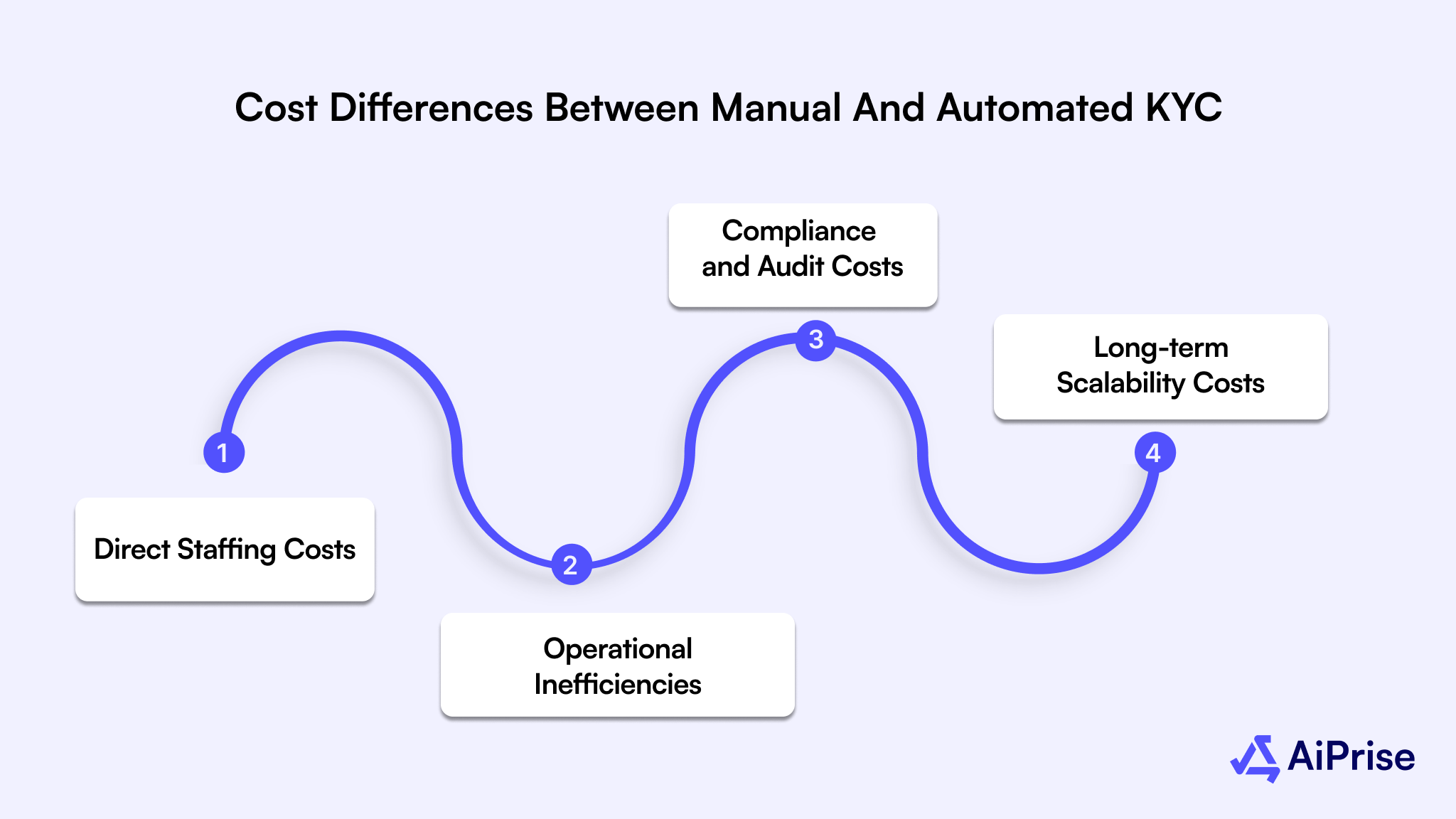
Cost Differences Between Manual and Automated KYC
The cost difference between manual and automated KYC becomes more visible as verification volumes increase.
Here’s how costs typically stack up when you compare both approaches:
Direct staffing costs
Manual KYC requires ongoing investment in compliance staff, training, and supervision, which increases with volume.
Automated KYC reduces dependency on large teams by handling verification digitally at scale.
Operational inefficiencies
Manual reviews create bottlenecks that increase turnaround time and customer drop-offs.
Automated workflows reduce rework, follow-ups, and repetitive tasks that inflate operational expenses.
Compliance and audit costs
Manual processes often lead to inconsistent documentation, increasing audit preparation effort.
Automated KYC creates structured digital records that simplify audits and reduce regulatory risk.
Long-term scalability costs
Scaling manual KYC means hiring more reviewers and managers.
Scaling automated KYC primarily involves infrastructure optimization rather than headcount growth.
Cost alone doesn’t tell the full story; speed and scalability often decide whether onboarding supports growth or holds it back.
Speed and Scalability Impact on Customer Onboarding
Speed and scalability determine whether your onboarding process supports growth or becomes a bottleneck.
Here’s how manual and automated KYC affects onboarding outcomes in real business scenarios:
- Manual KYC introduces delays because each application waits in a review queue, which grows longer during peak onboarding periods.
- Automated KYC verifies identities in real time, allowing customers to complete onboarding without waiting for human approval.
- Manual workflows struggle when onboarding volumes spike, such as during product launches or market expansion.
- Automated KYC scales seamlessly, maintaining consistent verification speed regardless of volume increases.
- Slower onboarding directly impacts conversion rates, as customers abandon sign-ups when verification takes too long.
- Faster verification improves customer experience and accelerates time-to-revenue without compromising compliance.
As onboarding pressure increases, many teams reach a point where automation shifts from an option to a requirement.
When Does Automated KYC Become a Necessity?
Automated KYC becomes necessary when manual verification can no longer balance compliance, speed, and scale.
Here are the most common signals that indicate automation is no longer optional for your business:
- Customer onboarding volumes grow beyond what compliance teams can manually review without delays.
- Regulatory expectations increase, requiring faster verification, better documentation, and stronger audit trails.
- Manual reviews lead to inconsistent decisions across teams, locations, or time zones.
- Operational costs rise due to continuous hiring, training, and managing compliance staff.
- Fraud risks increase as manual processes fail to detect patterns across large datasets.
- Business expansion into new markets demands scalable verification without rebuilding processes from scratch.
Once automation becomes part of the equation, the focus turns to choosing a platform that can support compliance without adding complexity.
How AiPrise Supports Scalable KYC Compliance?
AiPrise supports scalable KYC compliance by combining identity verification, risk intelligence, and automation into a single operational layer that reduces manual effort without weakening regulatory controls.
Here’s how AiPrise enables you to run KYC at scale with clarity and control:
- Multi-layer identity verification in one flow
AiPrise verifies customers using document checks, biometric validation, and database cross-referencing within a single workflow.
This ensures identity authenticity is confirmed through multiple signals rather than relying on one verification method.
- Document verification with OCR and tamper detection
The platform extracts and validates data from government-issued IDs such as passports and driver’s licenses using OCR.
It checks document structure, data consistency, and signs of manipulation to reduce acceptance of forged or altered IDs.
- Biometric matching and liveness checks
AiPrise confirms that the individual submitting the documents is physically present and matches the ID provided.
This prevents impersonation, deepfake attempts, and replay attacks that manual reviews often miss.
- Real-time risk scoring using multiple data sources
Customer profiles are evaluated using data from government registries, financial records, and risk databases.
This allows you to identify high-risk individuals early instead of discovering issues after onboarding.
- Built-in AML screening and sanctions checks
AiPrise screens customers against global sanctions lists, watchlists, and politically exposed persons (PEP) databases.
This ensures KYC and AML requirements are addressed together rather than handled as separate processes.
- Automated decisioning with exception handling
Low-risk cases are approved automatically, while higher-risk profiles are flagged for manual review.
This allows compliance teams to focus only on exceptions instead of reviewing every application.
- Continuous monitoring beyond onboarding
AiPrise monitors customer profiles over time to detect changes in risk status or regulatory exposure.
This supports ongoing compliance rather than treating KYC as a one-time onboarding task.
- Centralized case management and audit trails
Every verification step, decision, and data point is logged and stored in a centralized system.
This creates clear audit trails that simplify regulatory examinations and internal compliance reviews.
- API-first integration for scalable deployment
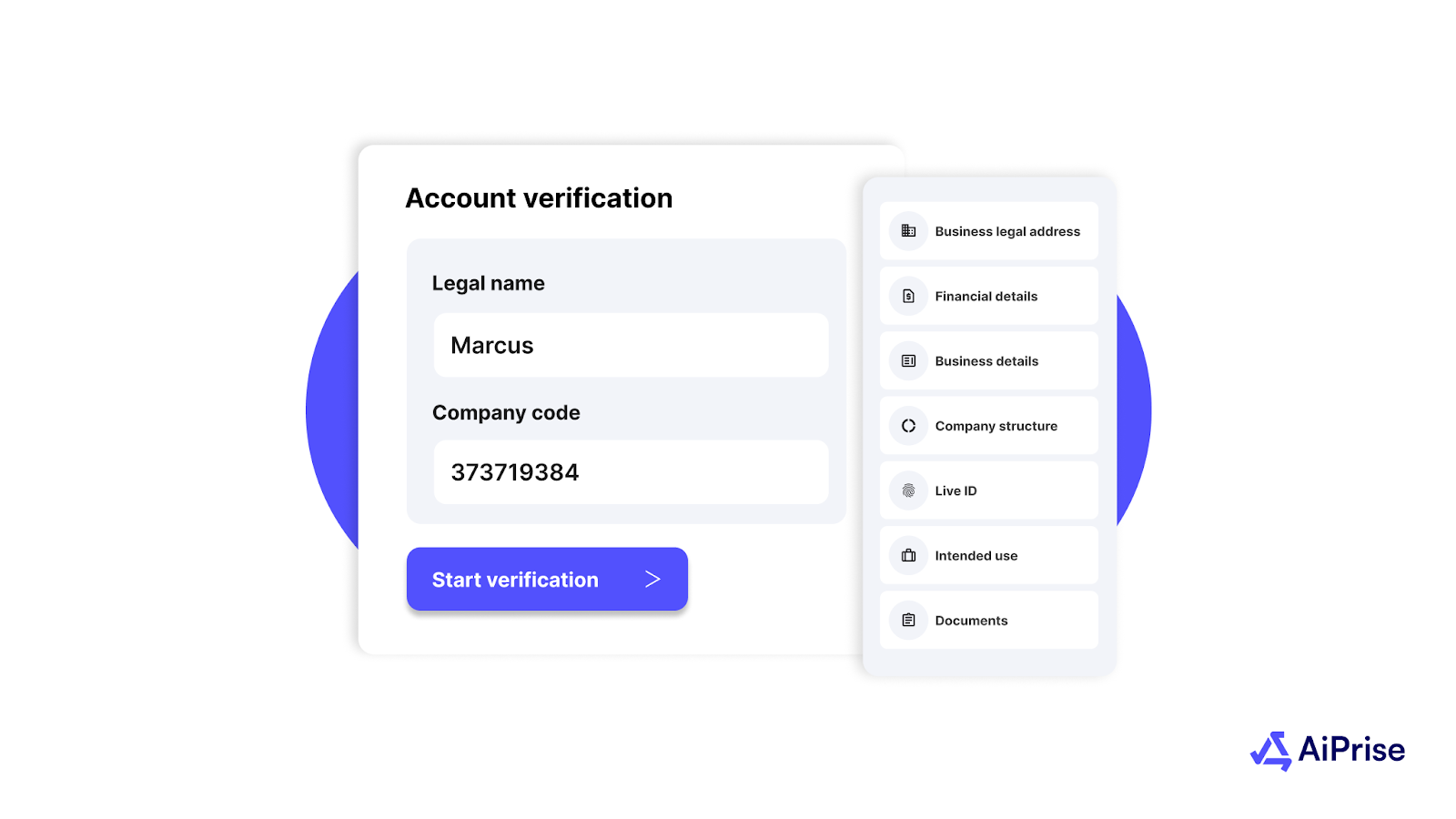
AiPrise integrates into existing onboarding, payments, and compliance systems through APIs and SDKs.
This allows you to scale verification volume without rebuilding workflows or adding operational complexity.
- Designed for U.S. compliance with global readiness
The platform aligns with U.S. regulatory expectations while supporting international identity verification needs.
This enables expansion into new markets without redesigning your KYC framework.
By combining verification, risk assessment, AML screening, and automation in one platform, AiPrise helps you move from manual, volume-limited KYC to a scalable compliance model that supports growth without increasing risk.
Wrapping Up
Manual and automated KYC verification serve very different needs, but the right choice ultimately depends on how fast your business is growing and how much operational risk you can afford to manage. Understanding the trade-offs between speed, cost, accuracy, and scalability helps you make informed decisions that support compliance without slowing customer onboarding.
This is where AiPrise helps by enabling scalable, automated KYC verification that strengthens compliance while reducing manual effort and operational friction.
If you’re evaluating how to modernize your KYC processes without compromising regulatory standards, Book A Demo to see how AiPrise supports faster onboarding and scalable compliance.
FAQs
1. Is automated KYC verification compliant with regulations?
Yes, automated KYC verification is compliant when it follows regulatory requirements such as identity verification, recordkeeping, and risk assessment. Automation applies standardized checks, audit logs, and screening against watchlists, which regulators accept when implemented correctly.
2. Can automated KYC completely replace manual KYC?
Automated KYC can handle the majority of low- to medium-risk cases, but manual review is still needed for exceptions and high-risk profiles. Most businesses use a hybrid approach where automation processes standard verifications and humans step in only when required.
3. What documents are required for KYC verification?
KYC verification typically requires government-issued photo IDs such as passports, driver’s licenses, or national identity cards. Some cases also require proof of address documents like utility bills or bank statements. Automated KYC may additionally use biometric data such as facial images or live selfies.
4. How long does automated KYC verification take compared to manual KYC?
Automated KYC verification usually takes seconds or a few minutes to complete. Manual KYC can take several hours or even days due to document reviews and follow-ups. Faster verification significantly improves onboarding speed and customer experience.
5. Is automated KYC secure and safe to use?
Yes, automated KYC platforms use encryption, secure data handling, and advanced fraud detection techniques to protect sensitive information. They also reduce human exposure to personal data, lowering the risk of internal misuse. When implemented properly, automated KYC is often more secure than manual processes.
You might want to read these...





AiPrise
KYB Compliance: 2026 Regulations You Should Know About
As organizations expand globally and face tighter regulations, adherence to Know Your Business (KYB) standards has become one of the most critical compliance layers for fintech, online marketplaces, and other companies that need to verify business customers before letting them perform financial transactions.










.png)

.jpg)

















.png)








.png)
.png)
.png)

















.png)
.png)





AiPrise’s data coverage and AI agents were the deciding factors for us. They’ve made our onboarding 80% faster. It is also a very intuitive platform.

Head of Operations



See your full compliance picture in one place
Use AI agents and global data to review businesses and users faster and more accurately
