

AiPrise
February 5, 2026
KYC Verification Guide for Crypto Companies 2026

Key Takeaways

One weak identity check is all it takes for a crypto platform to inherit someone else’s fraud, regulatory risk, or illicit funds problem. As enforcement tightens and fraud techniques become harder to detect, relying on outdated or surface-level KYC processes can quietly put your exchange, wallet, or payment platform in a position where compliance failures surface only after real damage is done.
In 2025, the FBI’s Operation Level Up identified over 8,100 victims of cryptocurrency investment fraud and helped avert more than $511 million in potential losses, underscoring the real risk exposures U.S. firms are confronting.
These trends show that weak or outdated KYC practices can directly erode user trust and operational resilience. By understanding what KYC verification truly means for crypto platforms and how it should be applied in real terms, you can build systems that better protect your users and your business. This deeper clarity not only helps you reduce fraud and meet compliance expectations but also positions your operations for sustainable growth in a complex digital assets landscape.
Key Takeaways
- KYC in crypto verifies user identities using IDs, biometrics, and risk checks to prevent fraud and meet AML obligations.
- Most centralized, custodial payment, lending, and high-risk crypto platforms are required to apply KYC under regulatory oversight.
- Effective KYC combines onboarding checks, sanctions screening, risk scoring, and ongoing monitoring to detect misuse early.
- Strong KYC reduces fraud losses, regulatory exposure, and onboarding friction while supporting trust and sustainable growth.
What Is KYC Verification in Crypto?
KYC verification in crypto is the process of confirming user identities to prevent fraud, money laundering, and sanctions violations. It requires collecting government-issued IDs, biometric proof, and risk data before allowing trading, withdrawals, or account access. For crypto companies, effective KYC reduces regulatory exposure, blocks illicit actors early, and supports compliant onboarding at scale.
Why KYC Is Critical for Crypto Companies in 2026?
Crypto companies that treat KYC as optional risk up front often discover too late that regulatory scrutiny and sophisticated fraud schemes can undermine platform trust and business continuity.
Here are the key reasons why robust KYC matters for your crypto operations:
- Ensures compliance with evolving U.S. and global AML/CFT expectations, helping your platform withstand audits and enforcement reviews.
- Reduces exposure to identity fraud and synthetic accounts that frequently escalate into major losses for exchanges and wallets.
- Protects against escalating illicit activity, as illicit cryptocurrency flows reached an estimated $158 billion in 2025, the highest in at least five years.
- Strengthens user trust by blocking bad actors before they can exploit deposit, trading, or withdrawal functions.
- Improves operational efficiency by flagging high-risk profiles early, lowering manual review burden across your compliance team.
Also read: Top KYC providers for Crypto Companies in 2026
Knowing why KYC matters sets the stage for understanding who regulators expect to implement it.
Which Crypto Businesses Are Required to Perform KYC?
KYC obligations apply to crypto businesses that facilitate financial transactions, custody assets, or enable value transfers under regulatory oversight.
Here are the types of crypto businesses that are typically required to perform KYC, based on their risk exposure and regulatory classification:
- Centralized crypto exchanges
- Required to verify user identities before allowing trading, withdrawals, or fiat conversions.
- Subject to U.S. AML regulations due to their role in asset custody and transaction execution.
- Custodial wallet providers
- Must perform KYC because they hold and manage customers' private keys and digital assets.
- Considered financial intermediaries with responsibility for preventing illicit fund movement.
- Crypto payment processors
- Required to verify merchants and users to prevent money laundering through payment flows.
- Often classified similarly to traditional payment service providers under compliance frameworks.
- Over-the-counter (OTC) trading desks
- Obligated to conduct KYC due to high transaction volumes and exposure to institutional counterparties.
- Enhanced scrutiny applies because OTC trades can bypass public market transparency.
- Crypto lending and yield platforms
- Required to identify borrowers and lenders to assess risk and the source of funds.
- Increasingly monitored as regulators focus on consumer protection and financial stability risks.
- Certain DeFi platforms with onboarding controls
- May face KYC requirements when offering front-end access, custodial features, or fiat on-ramps.
- Regulatory expectations rise when platforms exercise control over user interactions or transactions.
With responsibility established, it’s equally important to understand what information these checks involve.
What Information and IDs Are Required for Crypto KYC?
Crypto KYC requires collecting specific personal, document, and verification data to assess identity legitimacy and financial risk accurately.
Below is a structured breakdown of the information and IDs commonly required during crypto KYC verification:
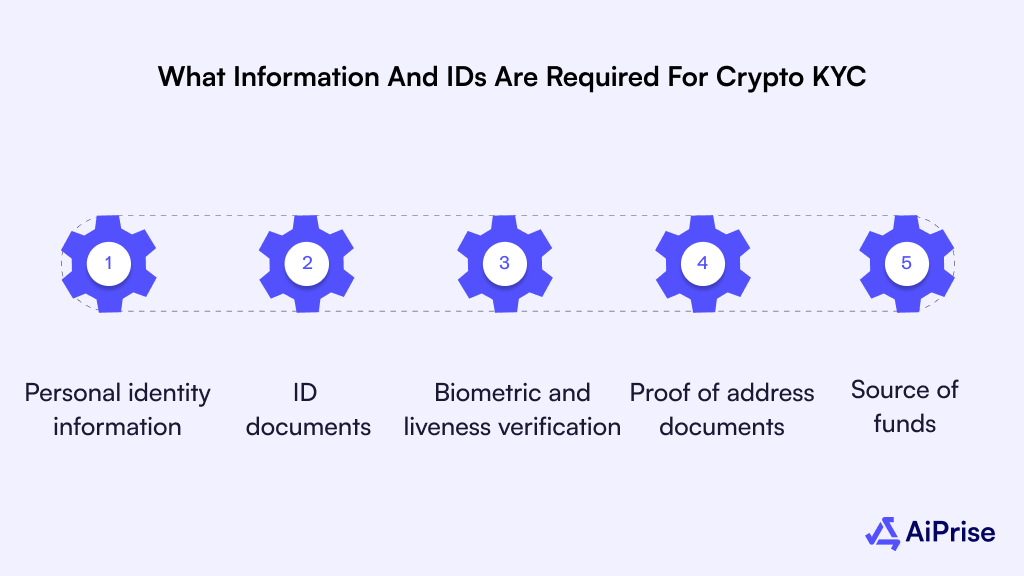
1. Personal identity information
- Full legal name, date of birth, and nationality are collected to establish a verified individual identity.
- Residential address is required to assess geographic risk and comply with jurisdictional regulatory requirements.
2. Government-issued identification documents
- Passports are widely accepted due to global recognition and higher assurance of identity authenticity.
- Driver’s licenses are commonly used for domestic users, especially within the United States.
- National identity cards may be accepted depending on the user’s country and regulatory acceptance.
3. Biometric and liveness verification
- Facial recognition or selfie verification confirms the user matches the submitted identity document.
- Liveness detection prevents spoofing attempts using photos, videos, or deepfake technologies.
4. Proof of address documents
- Utility bills or bank statements are used to validate the user’s declared residential address.
- Documents must usually be recent to ensure address accuracy and regulatory relevance.
5. Source of funds or wealth information
- Transaction history or financial disclosures may be required for high-risk or high-value accounts.
- This information helps identify potential money laundering or illicit financial activity risks.
Also read: Optimizing KYC Verification with Blockchain Technology
Collecting the right data is only part of the equation; how that data is verified determines whether KYC succeeds or fails.
How KYC Verification Works for Crypto Platforms?
KYC verification on crypto platforms follows a structured, risk-driven flow designed to block illicit actors without slowing legitimate user onboarding. Here’s how the process typically works in practice for U.S.-focused crypto businesses handling regulatory pressure and fraud exposure.
1. User Onboarding and Data Capture
During onboarding, identity data is collected at account creation to prevent risky users from accessing wallets or trading features prematurely. This stage is optimized to balance regulatory compliance with conversion rates, especially for exchanges and custodial platforms.
2. Document Submission and Authenticity Checks
Users submit government-issued IDs that are scanned and analyzed to confirm validity and detect tampering attempts. Advanced verification flags mismatched data, expired documents, or altered images before accounts progress further.
3. Biometric and Liveness Verification
Biometric checks confirm the person submitting documents is physically present and matches the provided identity. Liveness detection is critical for crypto platforms facing deepfake abuse and account takeover attempts.
4. Sanctions and Watchlist Screening
Identity data is screened against U.S. and global sanctions lists, politically exposed person databases, and enforcement records. This step helps crypto firms meet AML and counter-terrorist financing obligations without manual screening delays.
5. Risk Scoring and Approval Decisions
Each user is assigned a risk profile based on geography, behavior signals, and transaction intent. High-risk profiles trigger enhanced checks or manual review before enabling deposits, withdrawals, or trading access.
6. Ongoing Monitoring and Reverification
KYC does not stop at onboarding and continues as user activity and regulatory expectations evolve. Continuous monitoring helps crypto companies detect account misuse, unusual transaction patterns, and compliance breaches early.
Even well-designed processes can break down when exposed to modern fraud patterns and operational pressure.
Key KYC Risks Faced by Crypto Companies
Weak or outdated KYC controls expose crypto platforms to regulatory, financial, and operational risks that scale quickly as transaction volumes grow.
Below are the most critical KYC risks crypto companies face in 2026, based on enforcement patterns and fraud behavior seen across U.S.-regulated markets:
- Exposure to synthetic identity fraud, where partially real and fabricated data passes basic verification checks and enables long-term account abuse.
- Increased likelihood of sanctions and AML violations when screening fails to detect restricted individuals or high-risk jurisdictions.
- Regulatory enforcement risk, as U.S. authorities reported over 1.2 million suspicious activity reports tied to digital assets filed in 2025, reflecting heightened scrutiny of crypto platforms.
- Financial losses from account takeovers and mule networks are often enabled by weak identity validation during onboarding.
- Operational strain caused by manual reviews and false positives, which slows onboarding and overwhelms compliance teams.
- Long-term reputational damage when fraud incidents trigger user distrust, partner hesitation, or restricted banking relationships.
Some risks require deeper scrutiny than standard checks, which is where enhanced due diligence enters the picture.
KYC vs Enhanced Due Diligence in Crypto
Standard KYC and Enhanced Due Diligence serve different risk-management purposes in crypto, depending on user behavior, transaction patterns, and regulatory exposure.
Here’s how these two approaches differ in real crypto operations and when each becomes necessary.
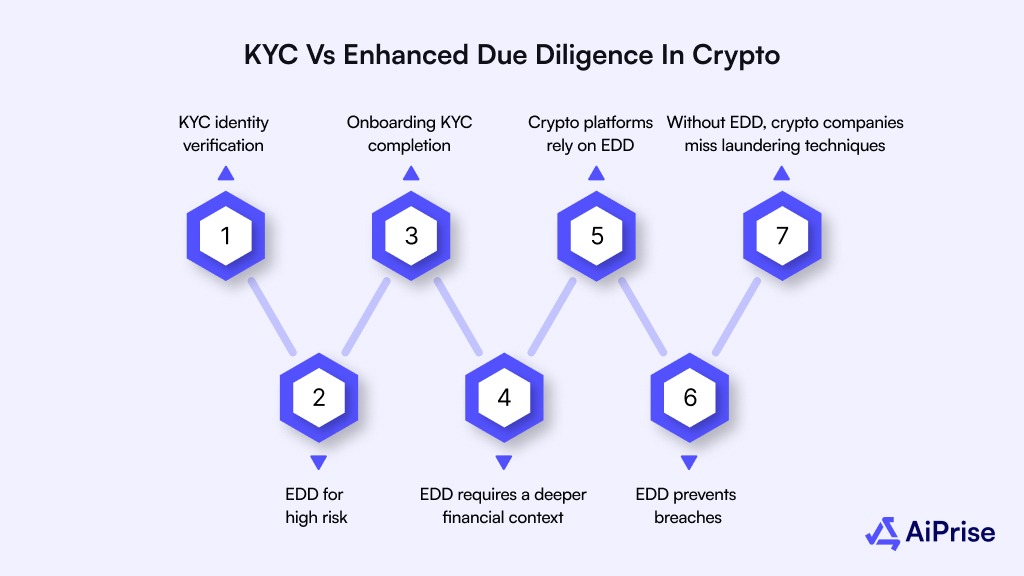
- Standard KYC focuses on identity confirmation, ensuring users are real individuals before allowing basic platform access and low-risk transactions.
- Enhanced Due Diligence applies when risk exceeds normal thresholds, such as high transaction volumes, cross-border fund flows, or exposure to high-risk jurisdictions.
- KYC is typically completed at onboarding, while EDD is triggered dynamically based on account activity and evolving risk signals.
- EDD requires a deeper financial context, including the source of funds, the source of wealth, and detailed transaction explanations.
- Crypto platforms rely on EDD to manage institutional and whale accounts, where higher exposure demands stricter oversight.
- Risk-based application of EDD helps prevent regulatory breaches, especially when transaction behavior diverges from expected user profiles.
- Without EDD, crypto companies risk overlooking layered laundering techniques, which often pass initial identity checks unnoticed.
Also read: Understanding KYC Verification Safety and Prevention Steps
Understanding the difference is helpful, but applying it consistently is where many crypto teams run into friction.
Common KYC Challenges in Crypto Operations
Crypto companies face unique KYC challenges that stem from high transaction velocity, global user bases, and rapidly evolving fraud techniques.
Here are the most common operational hurdles that directly impact compliance efficiency and business scalability:
- Balancing fast onboarding expectations with stringent identity verification requirements, especially for retail and high-frequency traders.
- Managing false positives that increase manual reviews, slow approvals, and strain compliance team resources.
- Verifying users across multiple jurisdictions where ID formats, data availability, and regulatory expectations vary widely.
- Detecting advanced fraud methods such as synthetic identities, mule accounts, and deepfake-assisted onboarding attempts.
- Keeping KYC processes aligned with changing U.S. and global regulatory guidance without frequent system overhauls.
- Maintaining a consistent user experience while applying enhanced checks for high-risk profiles and transactions.
To address these challenges, AiPrise’s AI-powered KYC verification solution helps crypto platforms automate identity checks, reduce false positives, and adapt verification workflows to evolving risk and regulatory demands.
Because not all verification models work equally well, choosing the right KYC approach becomes a practical decision.
KYC Approaches Compared for Crypto Companies
Different KYC approaches offer varying levels of security, scalability, and regulatory readiness, depending on a crypto company’s risk exposure and operating model. The table below compares the most common KYC approaches used across crypto platforms.
Selecting an approach is only effective if you can measure whether it’s actually working.
How Crypto Companies Measure KYC Effectiveness?
Crypto companies evaluate KYC effectiveness by tracking outcomes that reflect both compliance strength and operational efficiency.
Key performance indicators commonly used across regulated crypto platforms include:
- Verification completion time measures how quickly legitimate users gain access without unnecessary friction.
- False positive rates indicate how often valid users are incorrectly flagged as high risk.
- Fraud detection accuracy assesses how effectively illicit or synthetic identities are blocked during onboarding.
- Manual review volume highlights operational strain on compliance teams and workflow efficiency.
- Regulatory audit outcomes, showing how well KYC controls withstand supervisory and enforcement reviews.
- User drop-off rates during onboarding reveal the impact of verification design on conversion.
Optimize these metrics using AiPrise’s automated KYC verification workflows built for regulated crypto platforms.
How AiPrise Helps Crypto Companies With KYC Verification?

AiPrise enables crypto companies to verify individuals and businesses, mitigate fraud risk, and meet compliance requirements through a single, scalable platform.
Its AI-driven infrastructure is built to support high-growth crypto platforms operating across jurisdictions without adding onboarding friction or operational complexity.
- Unified KYC and KYB verification: Verify individuals and businesses within one platform to meet KYC, KYB, and AML obligations consistently.
- Risk-based decisioning: Apply customizable rules to assess risk dynamically and trigger step-up checks only when needed.
- Advanced fraud detection: Detect synthetic identities, deepfakes, duplicate users, and mule accounts using biometric and device intelligence.
- One-click and document-based KYC: Support fast onboarding with ID-and-selfie verification while extending coverage to local ID documents globally.
- Seamless onboarding workflows: Design customizable onboarding flows that balance compliance requirements with conversion and user experience.
- Continuous monitoring and reverification: Reassess users during high-risk actions such as withdrawals, device changes, or unusual activity.
- Compliance Co-Pilot: Use AI-assisted reviews to reduce manual case handling time and generate audit-ready EDD reports.
- Case management and audit trails: Centralize reviews, decisions, and reporting with full visibility across users, businesses, and vendors.
By strengthening your KYC strategy with the right technology, you can reduce fraud exposure, meet regulatory expectations, and scale your crypto platform with confidence.
Final Thoughts
KYC verification has become a foundational requirement for crypto companies that want to operate securely, compliantly, and at scale in 2026. By understanding how KYC works, where risks emerge, and how effectiveness is measured, you can design verification processes that protect users while supporting long-term growth.
AiPrise supports this journey by enabling crypto platforms to verify identities intelligently, manage risk dynamically, and meet global compliance demands without slowing onboarding.
Book A Demo to see how AiPrise strengthens crypto KYC with speed, accuracy, and scalability.
FAQs
1. What is KYC verification in crypto?
KYC verification in crypto is the process of confirming user identities to prevent fraud, money laundering, and regulatory violations.
2. Why do crypto exchanges require KYC?
Crypto exchanges require KYC to comply with AML regulations, reduce illicit activity, and protect users from financial crime.
3. What documents are required for crypto KYC?
Crypto KYC typically requires a government-issued ID, proof of address, and biometric verification such as a selfie.
4. How long does crypto KYC verification take?
Crypto KYC verification can take anywhere from a few minutes to several days, depending on verification depth and risk level.
5. Is KYC mandatory for all crypto platforms?
KYC is mandatory for most centralized and custodial crypto platforms, while requirements vary for decentralized services.
You might want to read these...







.jpeg)


.jpg)

















.jpeg)








.png)





.png)












AiPrise’s data coverage and AI agents were the deciding factors for us. They’ve made our onboarding 80% faster. It is also a very intuitive platform.

Head of Operations



See your full compliance picture in one place
Use AI agents and global data to review businesses and users faster and more accurately
