

AiPrise
10 min read
December 15, 2025
AML Chile: Essential Steps for KYC and Secure Identity Verification

Key Takeaways

Chile’s booming fintech and crypto sectors bring exceptional opportunity and a growing risk of money-laundering vulnerabilities. The recent 2025 reforms require banks and financial firms to report all suspicious activity and cash movements above USD 10,000 to the Unidad de Análisis Financiero (UAF), tightening compliance demands. Many companies struggle with manual KYC and outdated verification processes, leaving them exposed to regulatory penalties and fraud. Understanding Chile’s AML law and identity-verification best practices lets you strengthen compliance, build customer trust, and safeguard your business against evolving fraud and regulatory risk.
Key Takeaways
- Chile’s AML system is built on Law 19,913, UAF oversight, FATF-aligned standards, and ongoing updates shaped by GAFILAT evaluations.
- Businesses across banking, fintech, crypto, real estate, payments, and insurance must follow AML and KYC rules using approved IDs and documented verification steps.
- Strong compliance relies on risk-based due diligence, beneficial-owner checks, sanctions screening, continuous monitoring, and audit-ready recordkeeping.
- Automated KYC/AML tools outperform manual reviews by improving accuracy, reducing onboarding delays, strengthening fraud detection, and supporting regulatory expectations in Chile.
What is The AML Law in Chile?
Chile’s primary AML law is Law 19,913, which created the Unidad de Análisis Financiero (UAF) and established the framework for detecting and preventing money laundering. It sets obligations for reporting suspicious activities, performing due diligence, verifying customer identities, and maintaining internal controls across a wide range of industries. For any business operating in Chile’s financial or digital economy, this law forms the baseline compliance requirement you must align with to avoid regulatory risk.
Chile’s Evolving AML Compliance Framework
Chile’s AML framework strengthens national controls by aligning Law 19,913 with global FATF Chile standards and updated UAF requirements.
Here are the key components shaping AML regulations in Chile today:
- Law 19,913 defines the core AML compliance Chile obligations, requiring firms to identify suspicious behavior, verify customer identities, and maintain internal controls that reduce money laundering risks.
- UAF guidelines introduce stricter monitoring expectations, especially for fintechs, payment processors, and crypto platforms managing high-volume transactions.
- GAFILAT and Chile mutual evaluation report findings influence regulatory tightening, pushing companies to adopt risk-based Customer Due Diligence (CDD).
- International alignment ensures Chile's anti-money laundering laws match FATF expectations, increasing pressure on organizations to modernize verification processes.
- Recent updates from the Comisión para el Mercado Financiero (CMF) emphasize beneficial-owner transparency and stronger reporting structures for digital businesses.
Also read: Understanding KYC to Prevent Identity Theft
These evolving standards affect a wide mix of industries, so it’s worth seeing which sectors face these obligations most directly.

Who Must Follow AML and KYC Rules in Chile?
AML Chile regulations apply across industries where financial transactions, asset movement, or identity verification create exposure to laundering risks.
Here are the business groups most affected by AML compliance in Chile and UAF oversight:
- Banks, financial institutions, and credit cooperatives must comply deeply, due to their constant exposure to large-value transfers and high-risk accounts.
- Fintechs and payment service providers face strict AML compliance Chile requirements, especially platforms offering digital wallets, peer-to-peer transfers, or cross-border services.
- Crypto exchanges and virtual asset companies are key targets, as regulators focus on preventing anonymity risks tied to digital currencies.
- Real-estate brokers, casinos, factoring companies, and insurance firms fall under Law 19,913 because their activities can disguise illegal funds.
- Any business onboarding customers or handling significant financial value must ensure identity checks meet Chile UAF requirements and international review criteria.
Once you know who must comply, the next step is understanding which IDs and documents are used to verify customers properly.
11 Essential IDs and Documents Required for Verification
Identity verification in Chile depends on standardized documents that prove legitimacy under AML Chile and KYC Chile processes.
Here are the verification essentials required by Chile's anti-money laundering laws:
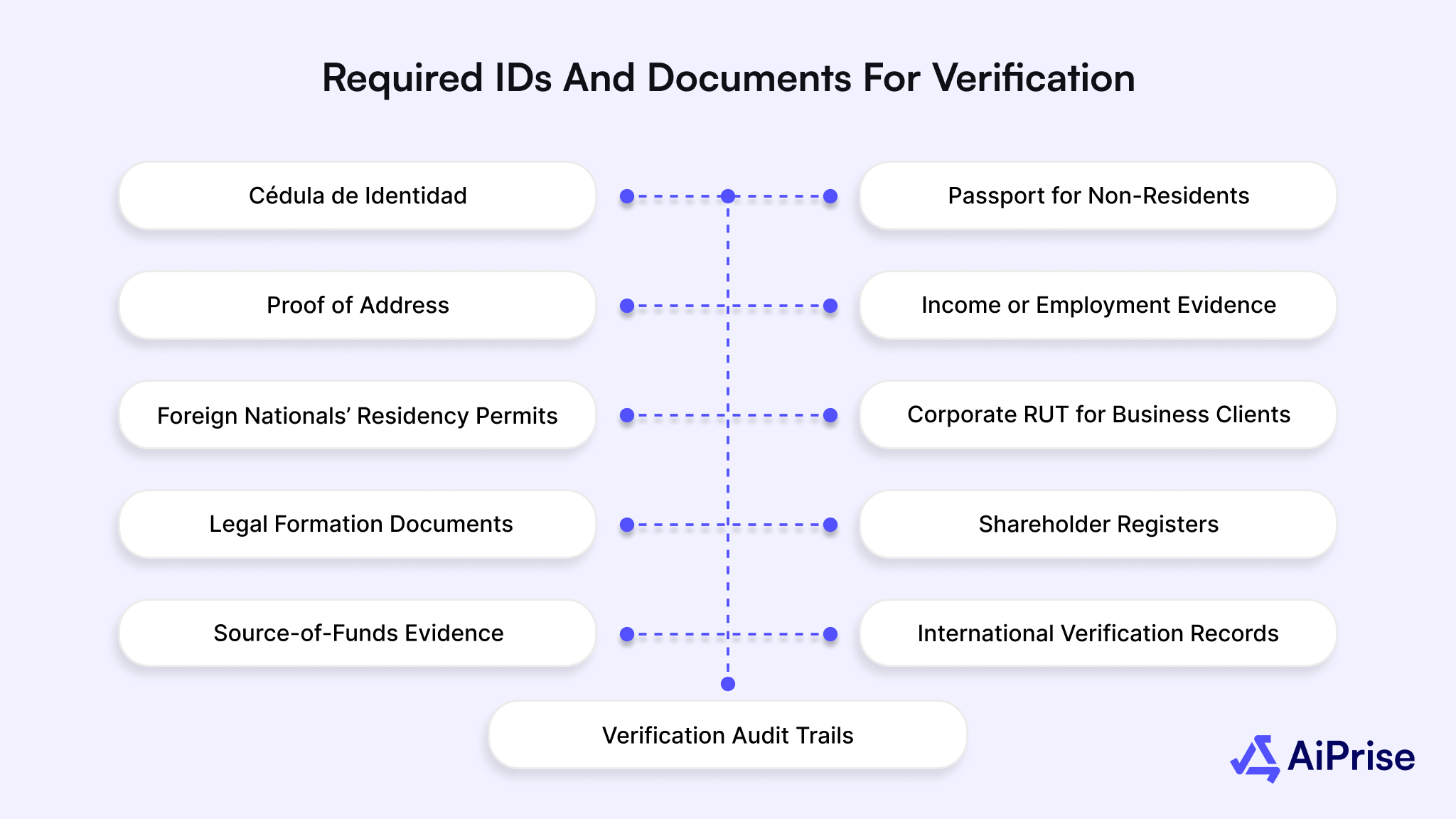
- Cédula de Identidad (Chilean National ID): Commonly used for individual verification and accepted across banking, fintech, payment services, and regulated industries. Helps you confirm identity details quickly and reliably during onboarding.
- Passport for Non-Residents or Dual Documentation Needs: Critical when verifying foreign clients, expatriates, or users transacting through Chilean fintech or crypto platforms. Often paired with address proof to strengthen risk-based checks.
- Proof of Address (Utility Bill, Bank Statement, or Rental Contract): Supports residential verification during standard KYC Chile workflows, especially when assessing risk tiers or completing enhanced due diligence requests.
- Income or Employment Evidence (Pay Slips, Contracts, Tax Certificates): Useful in higher-risk scenarios where you must validate financial behavior or confirm a customer’s ability to conduct certain transactions under AML compliance Chile requirements.
- Foreign Nationals’ Residency Permits or Immigration Records: Required when onboarding non-Chilean residents who operate in digital ecosystems or financial services. These documents help reduce identity mismatch risks during verification.
- Corporate RUT (Rol Único Tributario) for Business Clients: Essential for KYB verification and used to validate legal status, tax identity, and registration under national databases.
- Articles of Incorporation and Legal Formation Documents: Help you confirm business legitimacy, structure, and authorized representatives in line with Chile UAF requirements.
- Shareholder Registers and Beneficial-Owner Declarations: Required to identify individuals with ownership or control, reducing fraud risk and supporting FATF Chile and GAFILAT transparency expectations.
- Source-of-Funds Evidence (Bank Certificates, Tax Filings, Investment Proof): Necessary when onboarding high-risk profiles or monitoring unusual financial activity, ensuring compliance with AML regulations in Chile.
- International Verification Records for Cross-Border Clients: Used when verifying users or businesses with global footprints, especially relevant in crypto, fintech, export, or investment-related transactions.
- Verification Audit Trails (Digital Logs, Timestamped Documents, Workflow Records): Critical for regulated industries that must demonstrate compliance during UAF inspections or internal audits. These trails protect your organization by showing how verification decisions were made.
Also read: Identity Verification for Digital Onboarding: The Complete Guide
With the right documents in place, it becomes easier to apply the verification practices that strengthen AML compliance across industries.
Best Practices for AML and Secure Verification In Chile
Following best practices helps you maintain strong AML compliance with Chilean standards while reducing onboarding friction.
Below are the core practices that bring structure, clarity, and efficiency to secure KYC Chile processes:
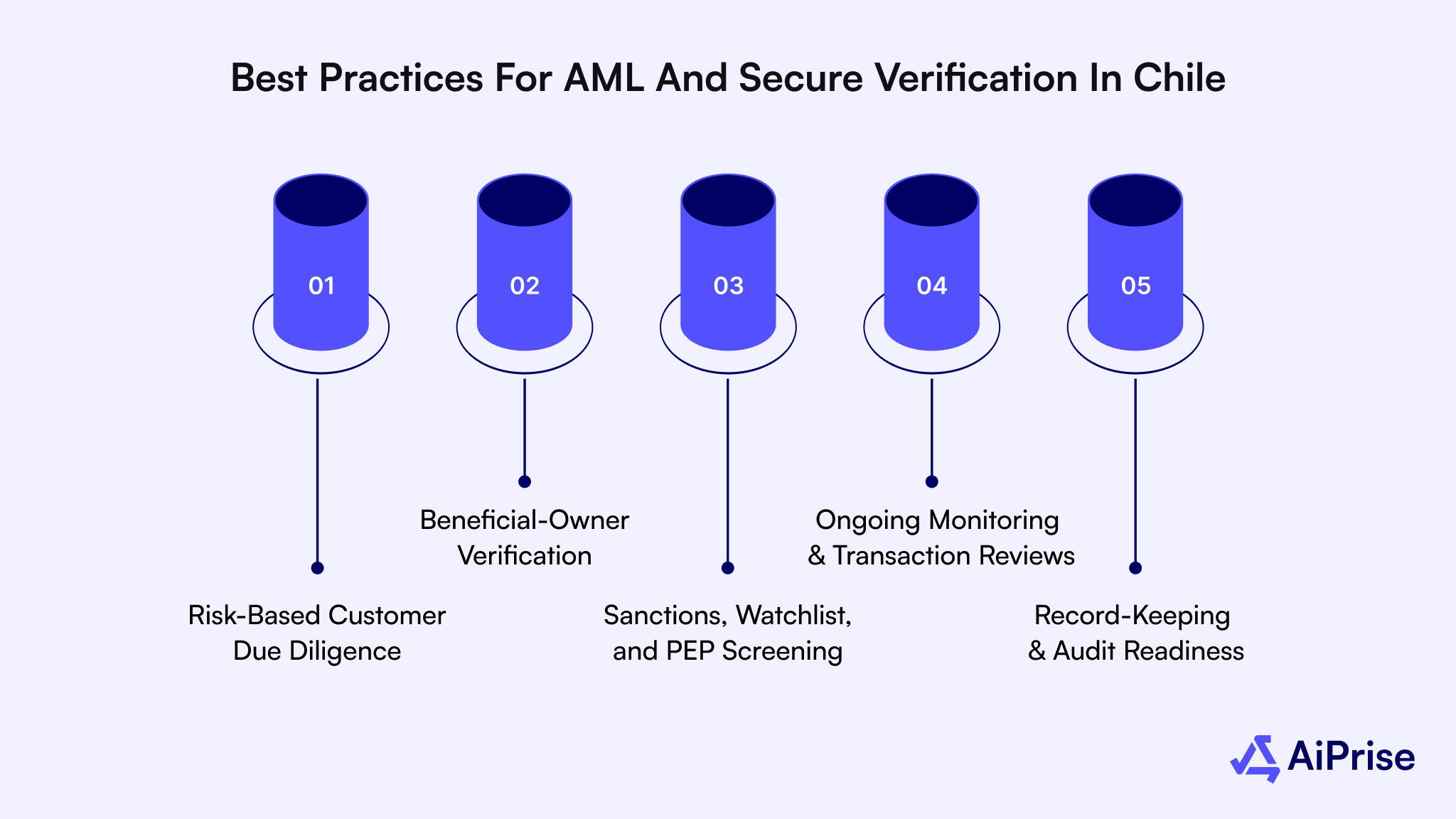
1. Risk-Based Customer Due Diligence (CDD)
Risk-based CDD ensures verification depth matches the customer’s activity, transaction patterns, and exposure level. It allows you to focus resources on high-risk individuals or businesses while maintaining compliance confidence. Strong CDD also serves as the foundation for all ongoing AML Chile and identity verification efforts.
2. Beneficial-Owner Verification
Beneficial-owner transparency is essential when working with corporations, partnerships, or international entities. This step helps you uncover hidden ownership structures that may raise money-laundering concerns. Regulatory expectations based on FATF Chile criteria make beneficial-owner checks mandatory for most sectors.
3. Sanctions, Watchlist, and PEP Screening
Screening customers against sanctions, GAFILAT lists, and PEP databases helps prevent high-risk onboarding. This practice protects you from unknowingly engaging with prohibited or politically exposed individuals. Reliable screening helps maintain compliance and integrity and prevents major regulatory violations.
4. Ongoing Monitoring and Transaction Reviews
Ongoing monitoring ensures transactional behavior continues to match each customer’s risk profile. This process becomes critical when activity changes unexpectedly or when thresholds trigger extra scrutiny. Monitoring also supports UAF reporting obligations aligned with Chile's anti-money laundering laws.
5. Record-Keeping and Audit Readiness
Strong record-keeping practices help you maintain transparent audit trails across all verification stages. Audit readiness ensures documentation is accessible during inspections, internal reviews, or inquiries from regulators. This structure supports long-term compliance stability and aligns your operations with AML compliance Chile requirements.
AiPrise supports these practices through One-Click KYC, helping you verify identities instantly with government-backed accuracy. These practices set the foundation, but the real difference shows when comparing manual workflows with automated verification systems used in Chile today.
Manual vs Automated KYC/AML in Chile
Automation plays a major role in meeting AML Chile expectations efficiently while avoiding gaps common in manual verification.
Here is a comparison highlighting where automated KYC Chile workflows significantly outperform traditional methods:
Even with better systems, businesses still face common challenges, and knowing these early helps you avoid unnecessary setbacks.
Also read: Comprehensive Guide to AML Transaction Monitoring Scenarios
Common AML and Verification Challenges
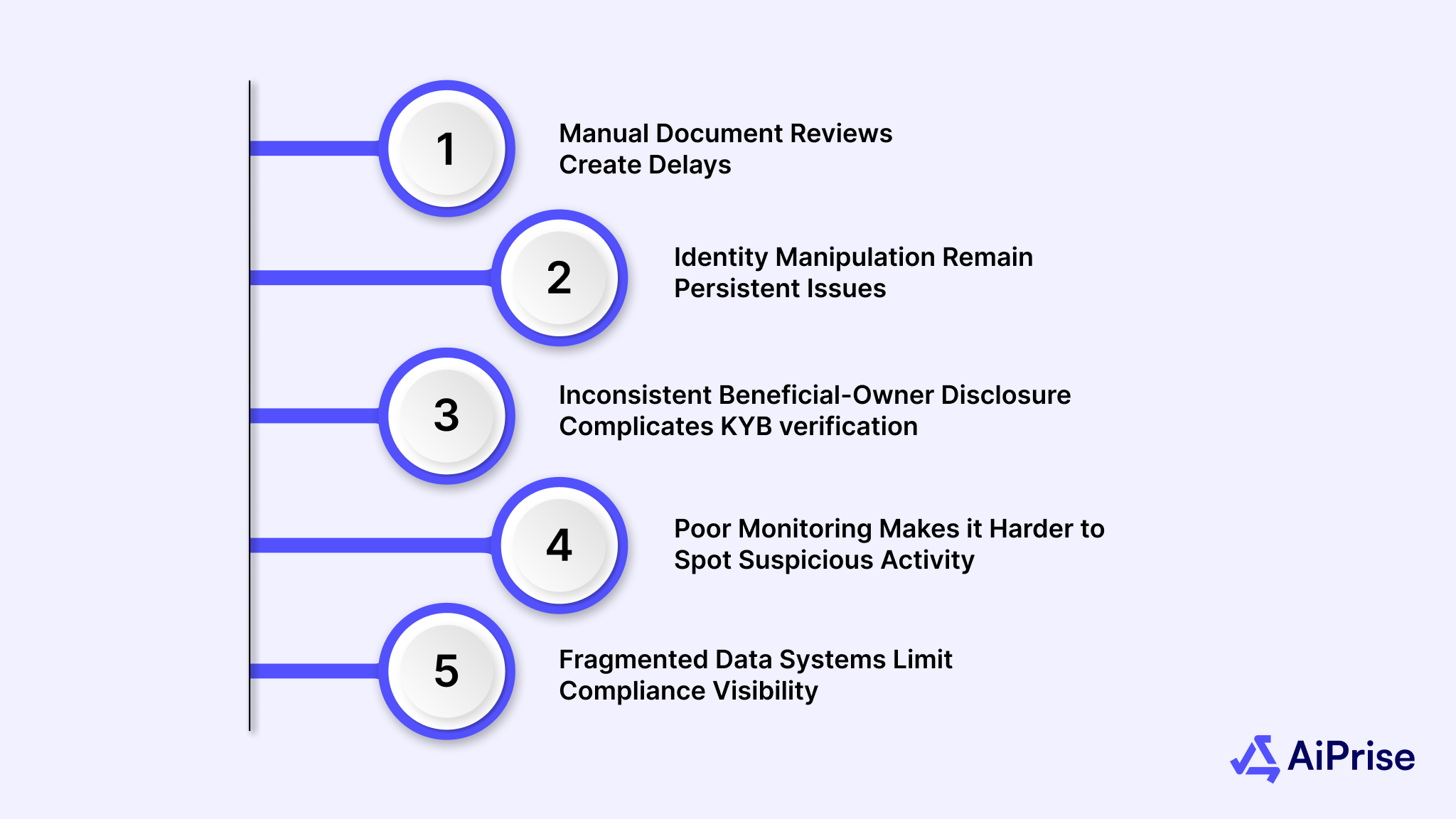
Businesses in Chile face recurring obstacles that complicate compliance under AML regulations in Chile and the KYC Chile frameworks.
Here are the challenges you often encounter when managing identity verification:
- Manual document reviews create delays, increasing friction for customers and slowing down your onboarding pipelines.
- Forgery and identity manipulation remain persistent issues, especially when dealing with foreign clients or digital-first platforms.
- Inconsistent beneficial-owner disclosure complicates KYB verification, making it harder to maintain FATF Chile alignment.
- Poorly structured monitoring processes weaken your ability to detect suspicious activity, exposing your business to regulatory scrutiny.
- Fragmented data systems limit compliance visibility, preventing you from building a unified fraud-risk management workflow.
Strengthen your process by using AiPrise’s Fraud and Risk Scoring to spot these challenges before they turn into compliance failures.
Solving these challenges becomes much easier when your verification tools support Chilean regulations directly, which is where AiPrise fits in.
How AiPrise Supports AML Compliance in Chile?
AiPrise brings together identity verification, risk screening, and continuous AML monitoring so your compliance stays airtight and efficient, even under Chile’s evolving AML regulations.
Use these AiPrise features to lock in compliance and minimize risk:
- One-Click KYC / Instant Government Database Checks: AiPrise can verify IDs against government registries in real time, ensuring identity validation meets Chile UAF requirements and avoids manual errors.
- Automated KYB & Beneficial-Owner Verification: For business clients, AiPrise checks corporate registrations, ownership structure, and director data to comply with Chile's anti-money laundering laws and ensure transparent beneficial-owner disclosure.
- Sanctions, PEP & Watchlist Screening: AiPrise runs real-time screening against global sanctions, politically exposed persons (PEPs), and adverse-media lists, aligning with FATF Chile standards for risk-based AML compliance.
- AI-Driven Fraud and Risk Assessment: The platform uses AI and machine learning to detect high-risk profiles, document tampering, synthetic identities, or suspicious patterns, giving you stronger fraud prevention under Chilean AML compliance.
- Continuous Monitoring & Transaction Screening: Even after onboarding, AiPrise monitors transactions and user behavior, alerting you to potentially suspicious activity so you meet ongoing AML regulations and Chile reporting obligations.
- Centralized Case Management & Audit-Ready Reporting: All verifications, alerts, and user history stay logged and accessible, making audit trails easier, supporting compliance documentation and transparency required under Chile UAF requirements.
A setup like this gives you a clearer, faster, and more reliable way to stay fully compliant as Chile’s AML expectations continue to evolve.
Wrapping Up
Chile’s evolving AML landscape demands stronger verification standards, sharper due diligence practices, and a compliance system that keeps pace with regulatory change. Strengthening your KYC and identity-verification workflows helps you reduce risk, protect customer trust, and operate confidently in Chile’s fast-moving financial environment. AiPrise supports this journey by giving you the automation, accuracy, and continuous monitoring you need to stay compliant without slowing down growth.
Explore how automated identity verification and AML workflows can simplify compliance and protect your business in Chile from evolving risks. Book A Demo
FAQs
1. What is the AML law in Chile?
Law 19,913 forms the backbone of Chile’s AML framework and sets strict expectations for reporting, monitoring, and verifying customer activity. The law also established the UAF, which oversees compliance and guides how KYC Chile processes should function across regulated sectors.
2. Is Chile part of FATF?
Chile is not a direct FATF member but participates through GAFILAT, the regional FATF-style organization. This connection ensures Chile's anti-money laundering laws follow global FATF Chile standards and remain aligned with international evaluation criteria.
3. What are the reporting obligations under AML regulations in Chile?
Regulated entities must report suspicious transactions and any cash movements above thresholds defined by the UAF. These reports help prevent laundering attempts and reduce risks that could otherwise lead to compliance penalties.
4. Which institutions are subject to AML compliance in Chile?
Banks, fintechs, crypto exchanges, real-estate brokers, casinos, insurers, and other financial intermediaries fall under AML compliance Chile requirements. Any organization handling customer transactions or financial flows must adhere to Chile UAF guidelines.
5. What documents are needed for KYC in Chile?
Individuals generally submit a Cédula de Identidad, a passport, or an address verification to complete identity checks. Businesses provide RUT details, incorporation documents, shareholder information, and beneficial-owner data to satisfy Chile identity verification requirements.
You might want to read these...








.jpeg)


.jpg)














.jpeg)





.png)




.png)











AiPrise’s data coverage and AI agents were the deciding factors for us. They’ve made our onboarding 80% faster. It is also a very intuitive platform.

Head of Operations



See your full compliance picture in one place
Use AI agents and global data to review businesses and users faster and more accurately
