

AiPrise
11 min read
July 16, 2026
Top KYC Providers for Crypto Companies in 2026 (Compared)
Key Takeaways

In 2025, 1Konto, a global fintech company that offers crypto and stablecoin trading, was onboarding clients through Google Forms, despite having fewer than five compliance staff members. As a result, most of their KYC onboarding process was manual. While KYB and sanctions screenings ran through different platforms, other processes were fairly manual. It took them five to seven business days to onboard a single client.
Unfortunately, this is the situation most crypto platforms deal with. They use three to five tools for one workflow. The result is unnecessary manual coordination that slows onboarding and chips away at your conversion rates.
When 1Konto consolidated its entire stack into a single platform, it achieved 85% faster onboarding and 25% higher conversion rates. That’s what the right KYC provider does.
This guide covers how crypto KYC works today, what to evaluate in a provider, and how the top five crypto KYC platforms compare for 2026.
Key Takeaways
- Crypto KYC needs to cover more ground than most teams realize. Identity verification is just the entry point, but ongoing monitoring and transaction-level analysis are a huge part of the compliance lifecycle.
- It’s important to ensure your crypto KYC solution verifies user identity, as some don’t, leaving gaps in your KYC process.
- Every additional vendor in your compliance stack adds a handoff point that slows down onboarding. That’s why you should look for a platform that has all the features you need.
- Regulatory frameworks are tightening in real time. Recent MiCA, FinCEN guidance updates, and expanding Travel Rule requirements show that your provider's compliance coverage needs to evolve alongside the rules.
- AiPrise handles the KYC or KYB verification process for crypto companies end-to-end with agentic AI and automation.
How Does KYC in Crypto Work Today?
KYC in crypto today involves a combination of digital identity checks, risk assessments, and ongoing monitoring aligned with regulatory expectations.
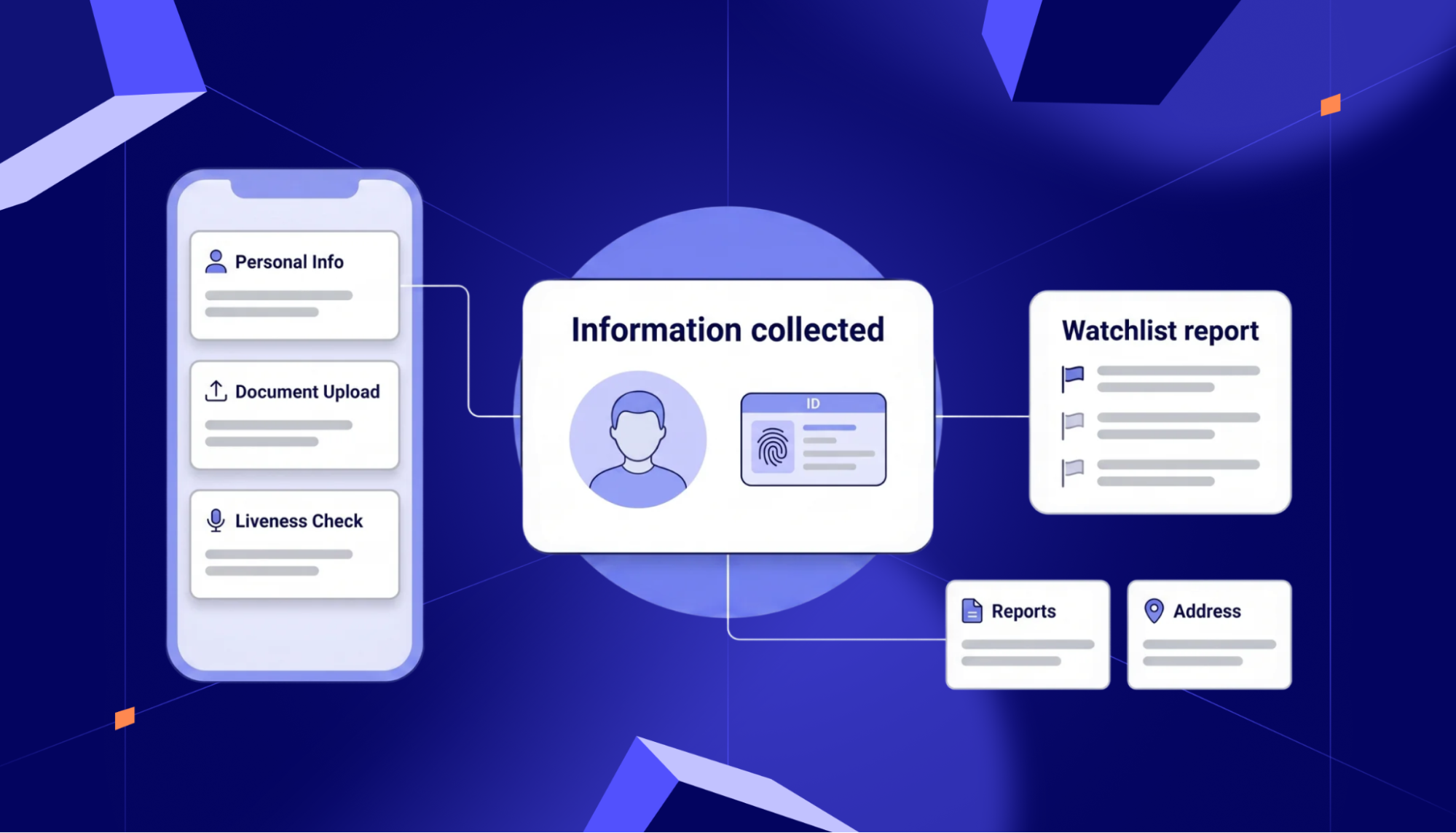
- Users submit personal details such as name, date of birth, and residential address during account registration.
- Government-issued identity documents, such as passports or driver’s licenses, are uploaded for authenticity and validity verification.
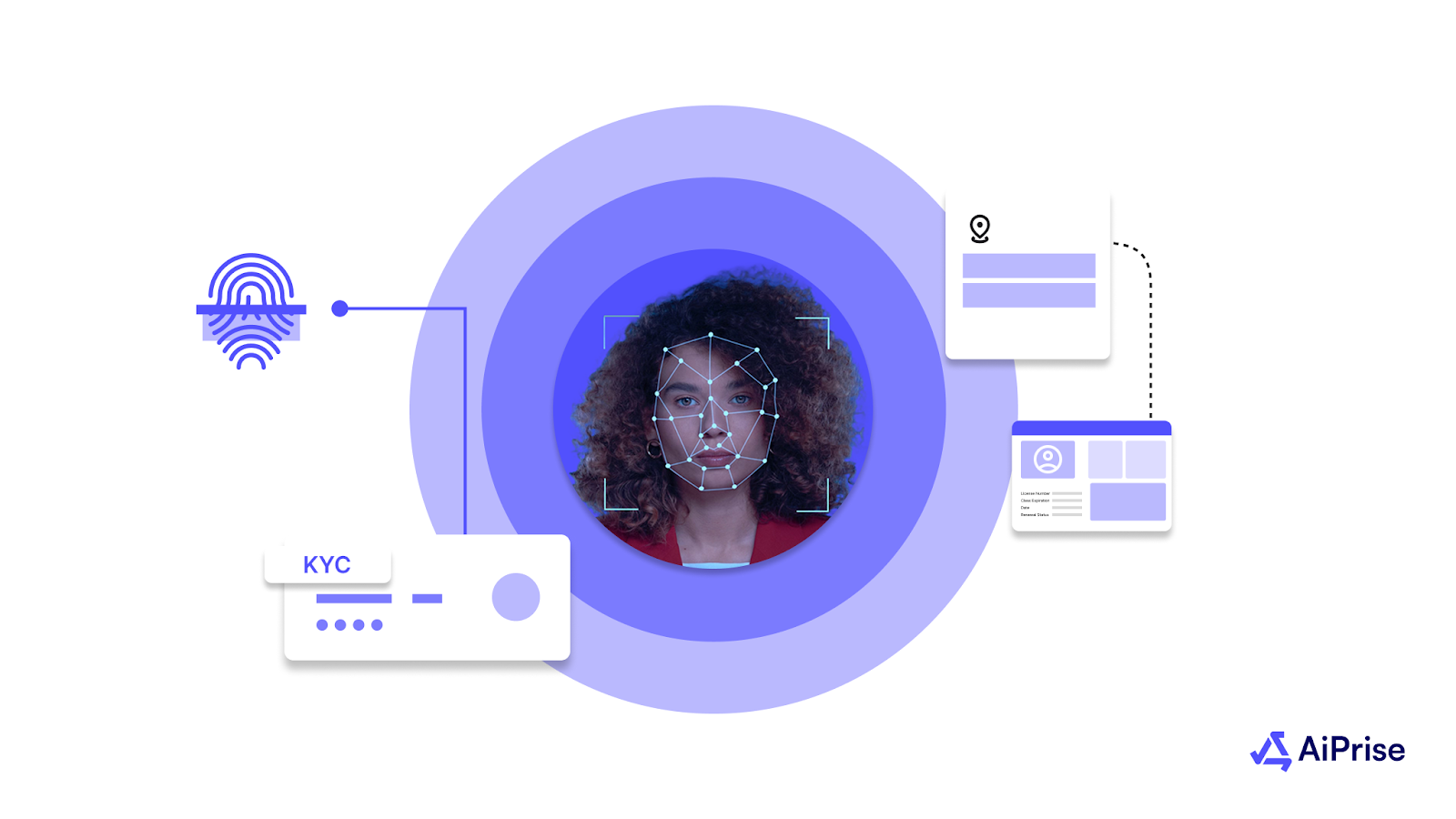
- Biometric checks, such as facial recognition or liveness detection, verify that the user matches the identity documents submitted.
- Data is screened against sanctions lists, watchlists, and politically exposed person databases to meet AML obligations.
- Risk scoring engines analyze geographic location, transaction intent, and behavioral signals to flag potential high-risk users.
- Approved users are continuously monitored to detect suspicious activity, account changes, or emerging compliance risks over time.
In the U.S., if you’re a platform that offers financial services, you have to register with FinCEN under the Bank Secrecy Act and implement Customer Identification Programs, which is what KYC and KYB are. If you’re in the EU, MiCA now establishes a common authorization framework for crypto-asset service providers, standardizing verification requirements across member states.
What to Look for in a Crypto KYC Provider
Choosing the wrong provider creates onboarding bottlenecks and blind spots in your compliance process, which will only get worse as you scale. That’s why you should assess crypto KYC platforms based on the following criteria:
- Automation with human oversight: The platform should automate document validation, biometric matching, sanctions screening, and risk scoring, so your compliance team handles only genuine edge cases. But make sure you can define escalation rules for edge cases with full audit trails.
- Regulatory coverage: Your provider must cover the jurisdictions in which you operate today and those where you’re expanding. That means you need to have the ability to adapt workflows as frameworks like MiCA or FinCEN guidance evolve.
- Global document support: Crypto is borderless. So, your KYC provider should handle identity documents across 190+ countries and support multiple verification methods. Some of them include document-based, database matching, and government eKYC.
- Fraud detection and risk scoring: Look beyond onboarding for ongoing risk assessment through device intelligence, behavioral signals, and email and phone scoring. Static identity verification alone doesn’t catch threats that show up after approval.
- Configurable verification workflows: You should be able to build multi-step verification flows and set risk thresholds based on your customer profiles.
- Integration and user experience: The platform should offer a single API or SDK that integrates with your stack without months of engineering. Evaluate sandbox environments, documentation quality, and webhook support before committing.
- Crypto-specific capabilities: Look for Travel Rule compliance support, crypto transaction monitoring, wallet screening, and demonstrated experience serving exchanges or DeFi platforms.
Top KYC Providers for Crypto Companies in 2026
Here are some of the KYC providers worth considering if you’re a fintech that facilitates crypto or stablecoin transactions:
1. AiPrise
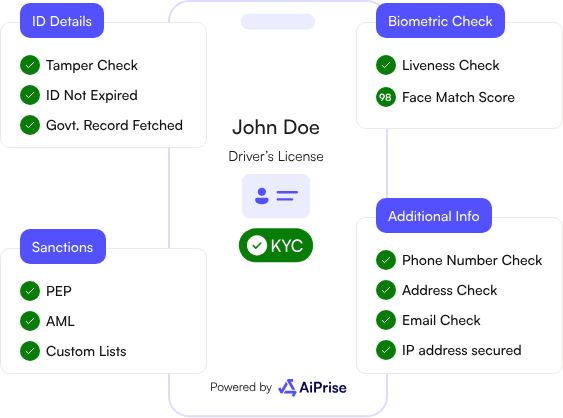
AiPrise brings KYC, KYB, AML screening, and fraud risk scoring together in one AI-powered platform. The entire verification lifecycle runs through a single system, purpose-built for crypto and fintech companies that have outgrown a patchwork of point solutions.
Key capabilities:
- One-click KYC: Returning users verify instantly without re-uploading documents, cutting friction for repeat interactions across platforms.
- AI-powered risk scoring: Combines 100+ data sources across identity, device, email, phone, and behavioral signals into a single risk score per user.
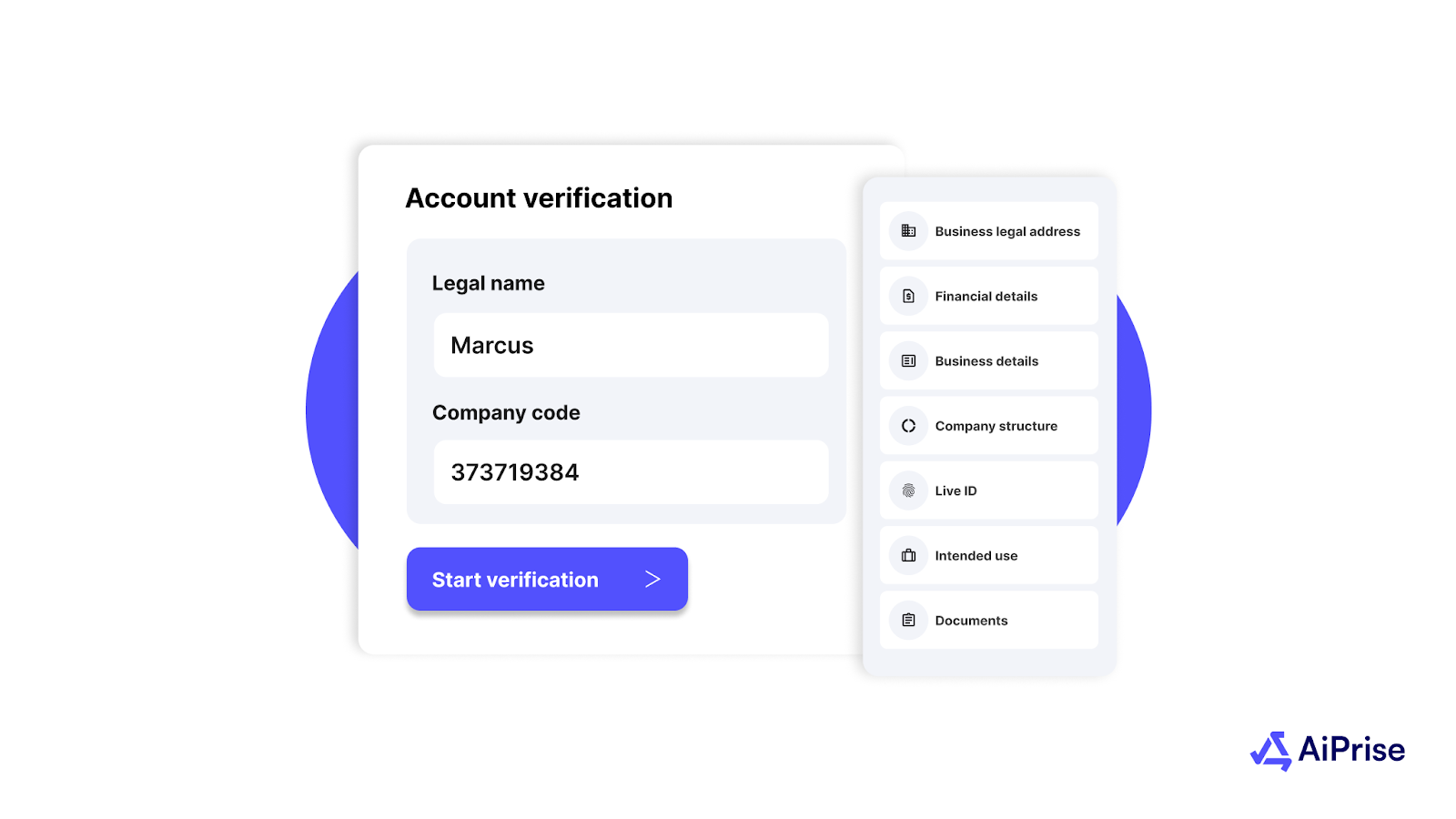
- Unified KYC/KYB workflows: Verify individuals and businesses through one platform. Streamline verification with identity checks, corporate registry pulls, UBO mapping, and sanctions screening all in one API.
- AI compliance agents: Purpose-built AML, document, and website agents that reduce false positives by up to 95% and process reviews up to 7x faster than manual analysis.
- Continuous monitoring: Risk-based ongoing screening with real-time alerts when a user’s sanctions, PEP, or adverse media status changes.
- Global coverage: 12,000+ document types across 200+ countries with biometric liveness detection and deepfake prevention.
- Regulatory compliance: Screens against 6,000+ watchlists, PEP databases, and adverse media, which helps crypto platforms meet BSA/FinCEN requirements and stay ahead of evolving frameworks like MiCA.
Case study: BlindPay
BlindPay processes cross-border payments across 40+ currencies in 120+ countries. Before AiPrise, it ran five separate compliance tools. But manual KYC stretched onboarding to days, and verification bottlenecks were costing the company 15% of monthly revenue.
After integrating AiPrise and automating its KYC workflow:
- 90% of checks run automatically. Individual verification dropped from 8 minutes to under 20 seconds.
- The entire KYB/KYC processing time dropped to 3 hours, which also increased onboarding completion by 2.3 times.
- It avoided approximately $180K in annual analyst costs.
“What stood out the most about AiPrise was the combination of flexible technology, full coverage, and responsive support. The platform adapted to our workflow and gave us the speed we needed to scale without compromising security. It’s rare to find a compliance solution that’s both robust and easy to integrate into daily operations.”
— Compliance Head, Blindpay
2. ComplyAdvantage
ComplyAdvantage is built to help companies mitigate financial crime risk, so its focus is on customer screening and ongoing monitoring rather than the initial identity verification process. It combines three layers of screening: sanctions lists, adverse media, and PEP.
If your KYC onboarding is already covered, ComplyAdvantage handles the post-onboarding compliance layer.

Key capabilities:
- Real-time AML screening: AI-powered sanctions, PEP, and adverse media screening that processes 8M+ articles daily across 34 adverse media categories.
- Transaction monitoring: A data-agnostic rules engine that monitors transaction patterns for suspicious activity across fiat and crypto flows.
- Customer and company screening: Screens individuals and entities against 75+ sanctions lists from 30+ jurisdictions and 1M+ PEP profiles.
- Ongoing monitoring: Continuous re-screening with real-time alerts when a customer’s risk profile changes.
- Strong AML data quality. Its proprietary AI models are trained on financial crime data rather than static watchlists, so it’s up to date and accurate.
3. Chainalysis
Chainalysis is a blockchain analytics platform. It handles on-chain transaction monitoring, wallet screening, crypto-specific risk intelligence, and investigation capabilities for fraudulent transactions.
Crypto companies can layer Chainalysis with a KYC provider for robust crypto risk intelligence and compliance capabilities.
Key capabilities:
- KYT (Know Your Transaction): Real-time monitoring across 400+ blockchain networks, flagging high-risk transfers, mixer usage, and sanctioned wallet interactions.
- Reactor: A visual investigation platform with 5B+ address clusters for tracing fund flows. It’s used by compliance teams and law enforcement.
- Address screening: Screens wallet addresses against sanctions lists and known illicit actors before your platform processes a transaction.
- Sanctions oracle: On-chain smart contract for real-time OFAC sanctions compliance; it’s built for DeFi protocols.
4. Sumsub
Sumsub is a crypto-native verification platform that bundles identity checks, Travel Rule compliance, crypto transaction monitoring, and reusable KYC into one product. If you need the widest set of crypto-specific compliance features in a single vendor, Sumsub tends to cover more ground than most.
Key capabilities:
- Identity verification: 14,000+ document types across 220+ countries with iBeta Level 2 certified liveness detection and AI deepfake prevention.
- Travel Rule compliance: Single integration connecting to GTR, TRP, CODE, Sygna, and other protocols across 1,700+ VASPs and 10,000+ supported assets.
- Crypto transaction monitoring: 300+ pre-built rules for detecting mixer usage, mule routes, hacked exchanges, and high-risk counterparties.
- Reusable KYC: Users verify once and share credentials across participating platforms, reducing the friction of repeated onboarding.
- Non-document verification: Government database matching in 50+ countries verifies users in under 5 seconds without document uploads.
5. Trulioo
Trulioo specializes in global identity verification through data matching and document checks, with particular strength in KYB and business entity verification. It’s a strong fit for enterprise crypto platforms expanding into multiple regions that need high match rates across diverse identity document types.

Key capabilities:
- Smart data routing: ML algorithms automatically select the best-performing data source for each verification by country because it optimizes for speed, cost, and accuracy.
- Global identity verification: PII matching against 500+ data sources across 195 countries with NLP-based fuzzy matching for name variations across scripts and languages.
- Document verification: 12,000+ document types with AI tamper detection, and it covers government IDs, utility bills, and bank statements.
- Business verification: Verifies against 700M+ business entities with UBO discovery processing in 3.3 seconds.
- AML watchlist screening: 6,000+ sanctions and enforcement lists with real-time PEP and adverse media monitoring across 20,000+ media sources.
How To Match The Right KYC Provider To Your Crypto Platform
Strong KYC in crypto is no longer just about meeting regulations; it directly affects how fast you scale, how well you manage risk, and how much trust users place in your platform. When verification is accurate, automated, and adaptable, onboarding becomes a growth driver instead of a bottleneck.
Each of these providers serves different compliance layers, so it really depends on what you’re looking for. While ComplyAdvantage and Chainalysis are strong at what they do, neither of them verifies individual user identity. On the other hand, Sumsub and Trulioo handle verification at scale. But you still might have to layer in other tools to get full coverage.
AiPrise is the solution that fills these gaps. You get everything from KYC verification to fraud scoring and continuous monitoring in one platform, along with AI agents to improve onboarding time and efficiency.
If your compliance stack still looks like it was assembled from spare parts, book a demo with AiPrise today.
Frequently Asked Questions
What is KYC in crypto?
KYC (Know Your Customer) is the process crypto platforms use to verify user identities before granting account access. It covers document checks, sanctions screening, biometric matching, and ongoing monitoring for suspicious activity.
What documents are required for crypto KYC?
Crypto KYC typically requires government-issued photo IDs, proof of address, and, sometimes, biometric verification such as facial recognition or liveness detection. Business accounts also require company registration documents and beneficial ownership details.
Is KYC mandatory for crypto companies in the United States?
KYC is mandatory for most U.S.-based crypto exchanges and platforms that fall under federal AML regulations. Platforms classified as money services businesses must register with FinCEN and implement Customer Identification Programs under the Bank Secrecy Act. Regulatory authorities expect crypto businesses to verify user identities and continuously monitor risk.
Can crypto platforms operate without KYC?
Some decentralized protocols operate without traditional KYC, but centralized exchanges and custodial services are generally required to verify users. Skipping it increases your legal, financial, and reputational exposure.
How long does crypto KYC verification take?
With automated systems, crypto KYC can be completed in seconds or minutes. Manual or fragmented processes can extend verification times to hours or even days.
Does KYC prevent all crypto fraud?
KYC significantly reduces fraud risk but does not eliminate it. Ongoing monitoring, risk scoring, and transaction analysis are essential for long-term protection.
Is KYC safe for cryptocurrency?
Many reputable KYC providers protect user data through encryption and compliance with data protection regulations like GDPR. You should look for SOC 2 certification and clear data retention policies as baseline security indicators to ensure your and your customers’ data are always protected.
Is no-KYC crypto legal?
In most regulated markets, centralized platforms must implement KYC. Decentralized protocols may not face the same requirements today, but the regulatory perimeter is expanding globally. FinCEN’s newer regulations are just one example of the same.
You might want to read these...






AiPrise
KYB Compliance: 2026 Regulations You Should Know About
As organizations expand globally and face tighter regulations, adherence to Know Your Business (KYB) standards has become one of the most critical compliance layers for fintech, online marketplaces, and other companies that need to verify business customers before letting them perform financial transactions.










.png)

.jpg)
















.png)








.png)
.png)
.png)













.png)
.png)


AiPrise’s data coverage and AI agents were the deciding factors for us. They’ve made our onboarding 80% faster. It is also a very intuitive platform.

Head of Operations



See your full compliance picture in one place
Use AI agents and global data to review businesses and users faster and more accurately
