

AiPrise
8 min read
February 5, 2026
Fastest Way to Automate KYB Verification for Global Businesses

Key Takeaways

Expanding globally sounds exciting, until KYB verification starts slowing every new onboarding to a crawl. Across regions, inconsistent business registries, manual document checks, and fragmented compliance workflows quietly drain your time, inflate operational costs, and delay revenue.
When onboarding stretches from hours into days, the pressure to automate KYB verification stops being a compliance goal and becomes a growth necessity. What makes this harder is that global KYB is about validating complex ownership structures, meeting country-specific regulations, and reducing fraud risk without adding friction.
Understanding how KYB automation actually works helps you spot where delays originate, why manual reviews fail at scale, and how real-time verification changes the equation. Once this subject becomes clear, faster onboarding, lower risk exposure, and scalable global expansion stop feeling aspirational and start feeling achievable.
Quick Overview
- Global KYB slows down when fragmented registries, manual reviews, and inconsistent ownership data block real-time business verification
- KYB automation replaces batch checks with live identity, ownership, and risk validation across countries
- Manual KYB fails first at scale due to complex UBO structures, cross-border entities, and a lack of ongoing monitoring
- Faster KYB comes from centralized data access, real-time decisioning, and continuous risk visibility across markets
What is KYB verification?
KYB verification is the process businesses use to validate company legitimacy, ownership structures, and regulatory compliance before onboarding partners. For fintechs, payment providers, and crypto platforms, KYB ensures counterparties are legitimate entities, not shells enabling fraud or laundering.
Without automated KYB verification, global expansion exposes teams to onboarding delays, regulatory penalties, and higher operational risk.
Why Global KYB Verification Takes Longer Than It Should?
Global KYB verification slows down because cross-border business validation depends on fragmented data systems, regulatory variation, and manual compliance dependencies.
Here are the core factors causing delays, based on how global fintech, payments, and crypto teams actually experience KYB friction:
- Country-specific business registries operate in silos, forcing compliance teams to manually search corporate records across jurisdictions
- Ownership and UBO structures vary widely across regions, increasing review time for entities with layered shareholders or nominee directors
- Manual document validation creates repeat back-and-forth cycles, especially when incorporation documents don’t meet local formatting or language standards
- Inconsistent data quality across markets leads to false positives, triggering unnecessary escalations and prolonged reviews for low-risk businesses
- Disconnected onboarding and compliance workflows slow decision-making, as approvals move across email threads, spreadsheets, and legacy systems
- Lack of real-time verification forces batch processing, meaning risk checks happen after onboarding begins instead of during it.
Also read: How Fintechs Automate KYB Checks To Cut Verification Time And Risk 2026
Knowing where time is lost sets the stage for a deeper look at what automation really changes, and what it doesn’t.
What Automating KYB Verification Actually Means in Practice?
Automating KYB verification goes beyond document uploads and focuses on embedding real-time business validation directly into onboarding workflows.
Here’s what KYB automation actually covers when built for fintechs, payment providers, and crypto platforms operating at scale:
- Business identity validation across global corporate registries to confirm legal existence and active status
- Ownership and UBO verification to uncover complex shareholding structures and control relationships
- Sanctions and watchlist screening to identify exposure to restricted entities and high-risk jurisdictions
- Risk scoring and decisioning to automatically classify businesses based on regulatory, geographic, and operational risk
Partial automation creates false confidence because manual reviews still sit between data checks and final approvals, slowing decisions and increasing risk exposure.
Where automation works best
- High-volume entity verification across multiple countries
- Real-time screening during onboarding instead of post-approval checks
- Consistent application of risk rules across regions
Where human oversight still matters
- Reviewing high-risk or complex ownership structures
- Handling regulatory exceptions and edge-case entities
- Making final decisions on escalated KYB cases
Even with automation in place, certain pressure points only become visible when onboarding volumes and geographies start expanding.
Where Manual KYB Breaks First at Global Scale?
Manual KYB processes start failing when verification volume, geographic reach, and regulatory exposure increase simultaneously.
Here’s where breakdowns happen first for global fintechs, payment providers, and crypto platforms operating across regions:
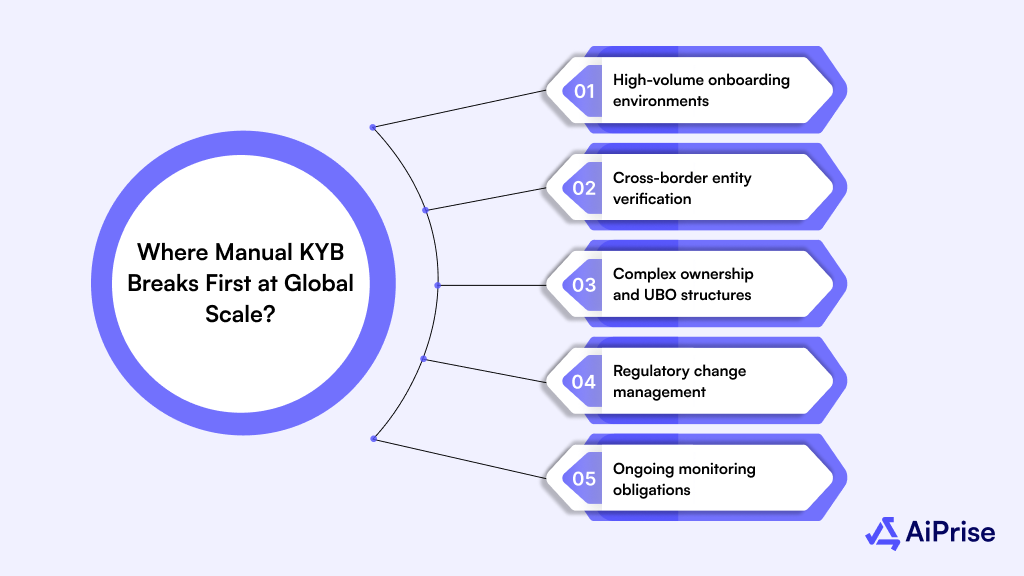
- High-volume onboarding environments
- Compliance teams rely on spreadsheets and inbox-based reviews, causing verification backlogs during peak onboarding cycles
- Example: A payments platform onboarding SMB merchants across the US, UK, and EU faces multi-day KYB queues during seasonal spikes
- Cross-border entity verification
- Manual checks struggle with country-specific registries, local languages, and inconsistent data formats
- Example: Verifying a Singapore-registered holding company with subsidiaries in LATAM requires separate registry lookups and manual translations
- Complex ownership and UBO structures
- Layered shareholding models increase human error and review time when handled manually
- Example: Crypto exchanges onboarding offshore entities with nominee directors face repeated escalations and delayed approvals
- Regulatory change management
- Manual workflows fail to adapt quickly to updated AML or KYB requirements across jurisdictions
- Example: Sudden sanctions updates force teams to recheck previously approved businesses without automated monitoring
- Ongoing monitoring obligations
- One-time manual verification misses ownership changes, expired documents, or newly sanctioned entities
- Example: A lending platform continues servicing a business after an ownership change because post-onboarding checks were not automated
Also read: AI-Powered KYB Solutions for Streamlined Business Verification
These breakdowns explain why speed-focused automation strategies are now becoming a necessity rather than a competitive advantage.
The Fastest Way to Automate KYB Verification for Global Businesses
Automating KYB at speed requires removing manual dependency points while maintaining regulatory accuracy across jurisdictions.
Here’s how global fintechs, payment providers, and crypto platforms achieve faster KYB verification without increasing compliance risk:
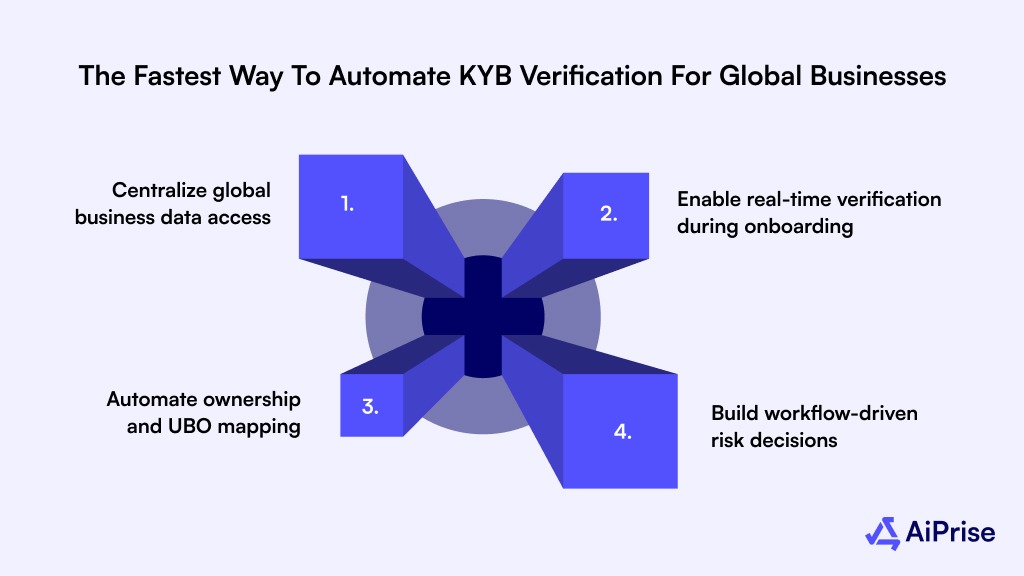
1. Centralize global business data access
Speed improves when KYB automation connects directly to global business registries instead of relying on country-by-country manual searches. This eliminates repetitive lookups across jurisdictions and gives compliance teams a single source of truth for entity validation. For global businesses, centralized access reduces onboarding delays caused by fragmented corporate data systems.
2. Enable real-time verification during onboarding
The fastest KYB automation happens when verification runs in real time, not after onboarding begins. Real-time checks allow business identity, ownership, and risk signals to be validated instantly as applications are submitted. This approach shortens approval cycles while preventing risky entities from entering your ecosystem unnoticed.
3. Automate ownership and UBO mapping
Global KYB slows down most when ownership structures are reviewed manually across multiple layers and jurisdictions. Automated ownership mapping surfaces control relationships and beneficial owners without forcing repeated human intervention. This reduces review fatigue while maintaining accuracy for complex, multi-entity business structures.
4. Build workflow-driven risk decisions
Speed comes from automating decisions, not just data collection. Rule-based workflows ensure low-risk businesses are approved quickly while high-risk entities are escalated for review. This balance allows faster onboarding without sacrificing regulatory confidence or increasing fraud exposure.
AiPrise accelerates KYB automation by combining AI-driven business verification, real-time global registry checks, and automated risk decisioning within a single scalable platform.
Speed alone isn’t enough if documentation and identity requirements aren’t clearly defined across regions.
Documents and IDs Required for Automated KYB Verification
Automated KYB verification still depends on collecting accurate business and individual documentation to validate legitimacy and ownership.
Here are the core documents and IDs global fintechs, payment providers, and crypto platforms typically require during KYB onboarding:
- Certificate of incorporation or business registration document to confirm legal existence and registration status
- Proof of business address, such as utility bills, lease agreements, or official correspondence
- Articles of association or equivalent documents outlining business structure and governance
- Shareholder registry or ownership declaration identifying shareholders and control percentages
- Ultimate Beneficial Owner identification documents, including government-issued IDs like passports or national ID cards
- Director and authorized signatory identification, typically requiring valid photo identification
- Tax identification numbers or business tax registration certificates, depending on jurisdiction
- Country-specific licenses or regulatory approvals for regulated industries
Also read: Understanding ID And Verification Of Residence Proof
Once documentation is handled efficiently, the difference between manual and automated KYB becomes far more visible in daily operations.
Manual vs Automated KYB: What Changes for Global Teams
The shift from manual to automated KYB fundamentally changes how global teams handle onboarding, risk, and scale.
Here’s a side-by-side view of what actually changes when KYB moves from human-led processes to automated workflows:
Beyond efficiency gains, automation also reshapes how risk is identified, measured, and managed during onboarding.
How Automation Reduces Risk While Increasing Speed?
Automating KYB verification reduces risk by removing manual blind spots while accelerating how quickly entities are assessed and approved.
Here’s how global fintechs, payment providers, and crypto platforms strengthen risk controls without slowing onboarding:
- Real-time business verification reduces exposure windows by identifying high-risk entities before onboarding is completed
- Automated sanctions and watchlist screening ensure consistent checks across jurisdictions without relying on manual updates
- Rule-based risk scoring applies uniform compliance logic, minimizing human error and subjective decision-making
- Continuous monitoring detects ownership changes, adverse media, or regulatory flags after onboarding
- Faster low-risk approvals allow compliance teams to focus attention on complex or high-risk entities
- Centralized audit trails improve regulatory defensibility by maintaining clear, time-stamped verification records.
Also read: Maximizing Global Business Verification
Even with the right systems in place, results can fall short if common implementation mistakes aren’t avoided early.
Common Mistakes Businesses Make When Automating KYB
Automating KYB verification delivers results only when implementation aligns with real-world compliance and operational needs.
Here are common mistakes global fintechs, payment providers, and crypto platforms make when scaling KYB automation:
- Automating existing manual workflows without redesigning processes, which preserves inefficiencies instead of eliminating them
- Relying on partial automation that still depends on manual reviews for basic checks, creating false confidence in risk coverage
- Ignoring global data coverage limitations leads to delays when expanding into new jurisdictions
- Treating KYB as a one-time onboarding task rather than an ongoing compliance obligation
- Failing to implement real-time decisioning, causing risk checks to occur after onboarding is already approved
- Choosing platforms without scalable automation capabilities, which limits growth and increases long-term compliance costs, is a gap that solutions like AiPrise are built to address through AI-driven KYB and continuous monitoring
Avoiding these missteps often comes down to choosing a platform designed specifically for global KYB complexity.
Build a Faster, More Reliable KYB Process with AiPrise
AiPrise supports fast, compliant KYB automation by combining global business verification, risk decisioning, and workflow automation in a single platform.
It enables global teams to onboard businesses across jurisdictions without manual complexity or fragmented vendor dependencies.
- Business Verification (KYB)
- Validates businesses against global registry information and publicly available legal entity data
- Verifies UBOs, directors, and stakeholders to uncover true ownership and control
- Global Data Coverage
- Uses 100+ data sources covering 500M+ businesses and 200+ countries
- Connects to local identity vendors worldwide through one API with fallback providers
- Risk-Based Decisioning
- Applies customizable rules to score business risk in real time
- Automatically approves low-risk entities and escalates high-risk cases
- Workflow & Case Management
- Centralizes KYB reviews, audit trails, and escalations in a single dashboard
- Reduces manual review time while maintaining regulatory traceability
- Continuous Monitoring
- Tracks changes in business status, ownership, and risk signals post-onboarding
- Ensures ongoing KYB compliance without repeated manual checks
This focused KYB capability allows global businesses to verify faster, reduce fraud exposure, and scale onboarding reliably across markets.
Wrapping Up
Automating KYB verification is no longer about convenience; it’s about removing onboarding friction while maintaining regulatory confidence at a global scale. When KYB processes are designed for real-time verification, risk-based decisions, and continuous monitoring, speed and compliance stop competing with each other.
AiPrise enables this balance by helping you automate KYB verification across countries without adding operational or compliance complexity.
If scaling globally while staying compliant is a priority, now is the right time to Book A Demo and see how faster KYB automation fits directly into your onboarding strategy.
FAQs
1. What is KYB verification?
KYB verification is the process of validating a business’s legal existence, ownership structure, and compliance risk before onboarding. It helps ensure businesses are legitimate and not involved in financial crime.
2. How long does KYB verification take?
Manual KYB verification can take days or weeks, especially for cross-border entities. Automated KYB verification significantly reduces this time by performing real-time checks during onboarding.
3. Can KYB verification be automated?
KYB verification can be automated using technology that validates business data, ownership, and risk signals in real time. Automation reduces manual reviews while maintaining regulatory accuracy.
4. What documents are required for KYB verification?
KYB verification typically requires business registration documents, proof of address, ownership information, and identification for UBOs and directors. Requirements may vary by country and industry.
5. Is automated KYB compliant with regulations?
Automated KYB verification is compliant when it applies consistent rules, real-time screening, and ongoing monitoring. It often improves compliance by reducing human error and ensuring continuous oversight.
You might want to read these...

AiPrise
KYB Compliance: 2026 Regulations You Should Know About
As organizations expand globally and face tighter regulations, adherence to Know Your Business (KYB) standards has become one of the most critical compliance layers for fintech, online marketplaces, and other companies that need to verify business customers before letting them perform financial transactions.



.jpg)








%20Can%20Improve%20Your%20Compliance%20Strategy.png)






%20Verification%20in%20the%20US.png)
AiPrise
5 min read
How KYB Verification Works in the US: The Ultimate Guide for Navigating Know Your Business
You can approve a new business customer in minutes. Or you can lose them while your team searches through registries, ownership records, and sanctions lists, trying to piece everything together.



AiPrise’s data coverage and AI agents were the deciding factors for us. They’ve made our onboarding 80% faster. It is also a very intuitive platform.

Head of Operations



See your full compliance picture in one place
Use AI agents and global data to review businesses and users faster and more accurately
