

AiPrise
9 min read
December 5, 2025
How to Do KYB in Lebanon?

Key Takeaways

A single verified company extract often prevents regulatory headaches and saves teams weeks of manual remediation. When onboarding Lebanese partners, you face inconsistent corporate records that obscure ownership and slow necessary compliance decisions. Lebanon’s official National News Agency reported Parliament approved banking secrecy amendments on April 24, 2025, with 87 votes. Hence, financial data access now requires clearer documentation and verified disclosures during KYB, making due diligence more detailed but far more reliable. Knowing this helps you request alternative bank proofs, escalate unclear ownership, and set realistic KYB timelines for partners.
Quick Overview
- KYB in Lebanon verifies a company’s identity, ownership, and registration through official government sources to ensure compliance and transparency.
- Collecting core documents like the Trade Register extract, shareholder list, bank confirmation, and proof of address forms the foundation of every check.
- Conducting risk screening, monitoring ownership changes, and staying aligned with AML Law No. 44 protects your business from fraud and penalties.
- Strong KYB processes improve onboarding speed, strengthen trust, and safeguard partnerships across Lebanon’s evolving financial and regulatory landscape.
What KYB Means in Lebanon?
Doing KYB in Lebanon means verifying whether the business you’re dealing with is real, registered, and trustworthy. It’s about checking official records to confirm ownership details, legal standing, and that the company isn’t tied to suspicious activity. Through this process, you stay compliant with Lebanon’s AML laws while protecting your organization from unnecessary financial or reputational risks. Knowing how KYB works locally helps you onboard partners confidently and keep every transaction above board.
Before conducting these checks, it helps to know exactly which documents and proofs are required to verify a business properly.
What Documents Are Needed for KYB in Lebanon?
Getting KYB in Lebanon right depends on collecting accurate documents that confirm a company’s identity and financial credibility. When these records are in place, your Lebanon business verification process runs faster and avoids compliance delays or rejected applications. Here are the essential documents and IDs to request during KYB checks in Lebanon:
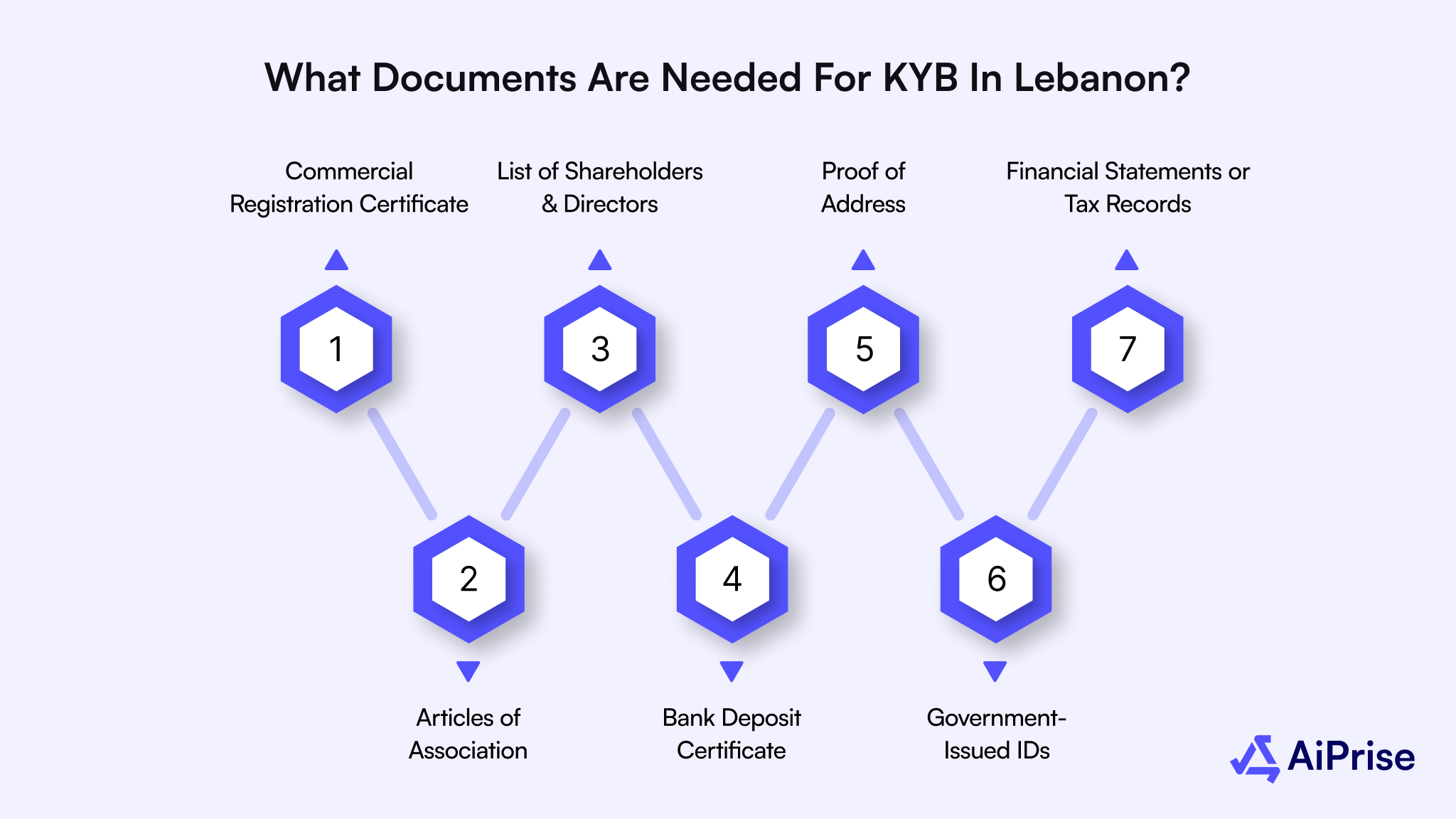
- Commercial Registration Certificate: Helps you confirm a company’s legal status and registration number directly from the Lebanese Commercial Register.
- Memorandum and Articles of Association: Give you insight into ownership details, internal structure, and the exact nature of business operations.
- List of Shareholders and Directors: Allows you to identify key decision-makers and verify beneficial owners for AML and compliance purposes.
- Bank Deposit Certificate: Assures you that the company has legitimate paid-up capital and stable banking relationships within Lebanon.
- Proof of Address: Lets you confirm the company operates from a verified, physical location instead of an unverifiable address.
- Government-Issued IDs: Provide you with official proof of identity for directors and shareholders through national IDs or passports.
- Financial Statements or Tax Records: Help you validate revenue claims, assess financial health, and detect inconsistencies before onboarding.
Once these documents are gathered, the next step is understanding how to verify them effectively using Lebanon’s official channels.
Also read: How to Verify Businesses from Lebanon

How Do You Do KYB in Lebanon?
Doing KYB in Lebanon involves verifying a company’s registration, ownership, and operations through official government-recognized channels.
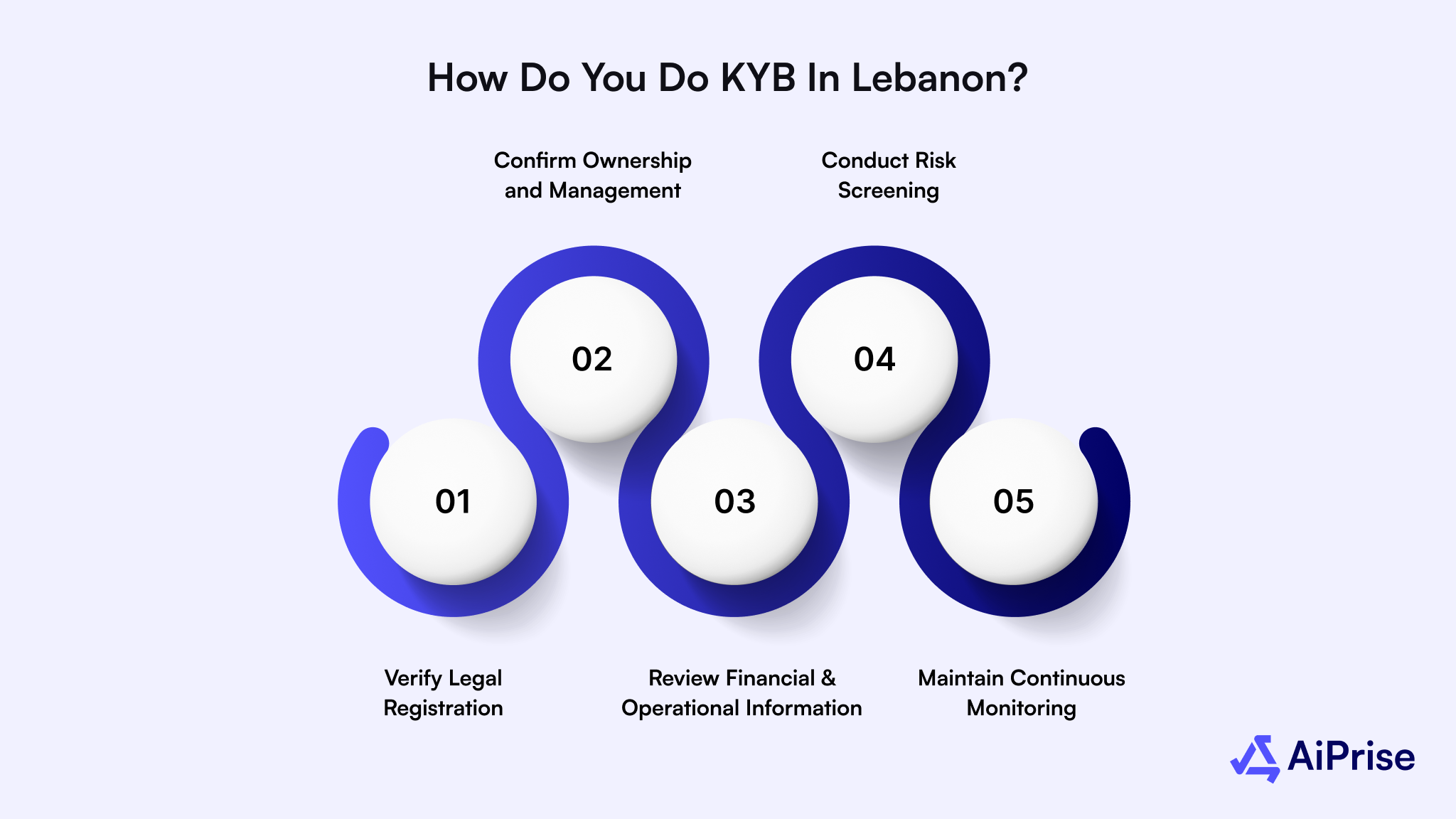
Here are the main steps you should follow to ensure your KYB checks are accurate and compliant:
1. Verify Legal Registration
Checking a company’s registration confirms its legal existence and prevents partnerships with unlicensed or inactive entities.
Here’s how you can verify this officially in Lebanon:
- Search the Lebanese Commercial Register (Registre du Commerce) through the Ministry of Justice website to confirm registration numbers and company status.
- Access the Ministry of Economy and Trade (MoET) portal to verify licenses and confirm the company’s branch filings or trade registration details.
- For foreign entities, review MoET’s “Foreign Companies” registry, which lists officially recognized international branches operating under Lebanese law.
2. Confirm Ownership and Management
Identifying real owners helps you prevent dealings with sanctioned individuals or undisclosed shareholders.
Here’s how to verify ownership using official records:
- Request the company’s Articles of Association filed with the Commercial Register to view shareholders, directors, and voting rights.
- Cross-check the List of Shareholders and Directors held by the Ministry of Economy’s Companies Department for updates or changes.
- Ask for notarized ID copies or passports of directors and beneficial owners to confirm their identities.
3. Review Financial and Operational Information
Understanding a company’s financial base ensures that it operates legitimately and meets capital requirements set by regulators.
Here’s how to check its financial credibility:
- Obtain a Bank Deposit Certificate to verify paid-up capital, as required during incorporation under Lebanese law.
- Review recent financial statements submitted for tax or audit purposes to confirm revenue and solvency.
- Confirm the business address using utility bills or lease contracts to ensure it matches registration details.
4. Conduct Risk Screening and Compliance Checks
Evaluating risk factors helps your compliance team detect suspicious activities before onboarding.
Here’s how to perform screening within Lebanese compliance frameworks:
- Check individuals and entities against the Special Investigation Commission (SIC) sanction and PEP databases for AML compliance.
- Use Banque du Liban Circular 83 guidelines to ensure customer due diligence aligns with national AML and CFT laws.
- Record red flags like rapid ownership changes, offshore structures, or unverifiable funding sources for escalation.
5. Maintain Continuous Monitoring
Keeping company records up to date ensures your KYB process remains compliant as businesses evolve.
Here’s how to maintain ongoing accuracy:
- Schedule periodic re-verification of documents through the Lebanese Commercial Register to detect structural or ownership changes.
- Re-screen partners against SIC and FATF-related watchlists as part of your ongoing AML program.
- Maintain digital audit trails of every verification and update for regulatory audits or internal reviews.
Also read: How a Reliable KYB Service Can Strengthen Your Business’s Compliance Framework
After following these steps, the next question becomes, what benefits can such a structured KYB process actually deliver in Lebanon’s market?
Benefits of a Strong KYB Process in Lebanon
Strengthening your KYB in Lebanon process builds trust and shields your business from regulatory and fraud risks in complex Lebanese markets.
Here are seven clear advantages you gain through robust Lebanon business verification:
- Enhanced regulatory clarity: Complying with Lebanon’s AML/CFT framework (Law No. 44) means your verification process sits firmly within official standards.
- Faster partner onboarding: Accessing verified registration and ownership data from Lebanese authorities reduces wait times and manual review backlogs.
- Better risk visibility: Mapping beneficial owners and directors uncovers hidden links, lowering your exposure to opaque entities in Lebanon.
- Stronger operational reliability: Verifying bank deposit certificates and address proofs ensures you only work with businesses genuinely operating in Lebanon.
- Improved investor and stakeholder confidence: Lebanon’s aggregate bank deposits hit roughly US $91.5 billion by August 2025, so you’re aligning with a large formal financial base.
- Enhanced audit readiness: Creating detailed verification trails and linking them to Lebanese official sources eases future compliance or regulator actions.
Even with these advantages, a strong KYB process means little if red flags go unnoticed, so understanding what to watch for is key.
Red Flags to Watch During KYB in Lebanon
Spotting early warning signs during KYB in Lebanon helps prevent onboarding risky entities that could harm your compliance standing. Recognizing these patterns early strengthens your Lebanon business verification process and protects your institution from reputational or regulatory damage.
Here are the most common red flags to stay alert for when running KYB checks in Lebanon:
- Frequent Changes in Ownership: Sudden or repeated changes in shareholders or directors often signal attempts to hide real control or funding sources.
- Incomplete or Altered Registration Data: Missing registry details, mismatched registration numbers, or altered incorporation documents indicate possible document tampering.
- Unverifiable Business Address: A company operating from a virtual office or PO box without physical presence can suggest non-operational or shell activity.
- Offshore or Opaque Ownership Structures: Businesses linked to jurisdictions with weak AML laws raise concerns about hidden beneficial ownership and money flow risks.
- Financial Statements That Don’t Match Activity: Reported revenue inconsistent with business size or sector often points to falsified or inflated figures.
- Resistance to Providing Identification Documents: Hesitation to share IDs, licenses, or bank confirmations typically signals a lack of transparency or concealed ownership.
- Involvement in Sanctioned or High-Risk Sectors: Entities connected to sectors like unregulated crypto or arms trade require enhanced due diligence under Lebanese AML laws.
Also read: Understanding KYB Risk Factors and Assessment
Next, let's examine how understanding how to handle them effectively ensures your KYB process remains credible and compliant.
KYB in Lebanon: Faster, Compliant Onboarding with AiPrise
AiPrise streamlines KYB in Lebanon by combining AI-driven verification, continuous monitoring, and automated onboarding workflows.
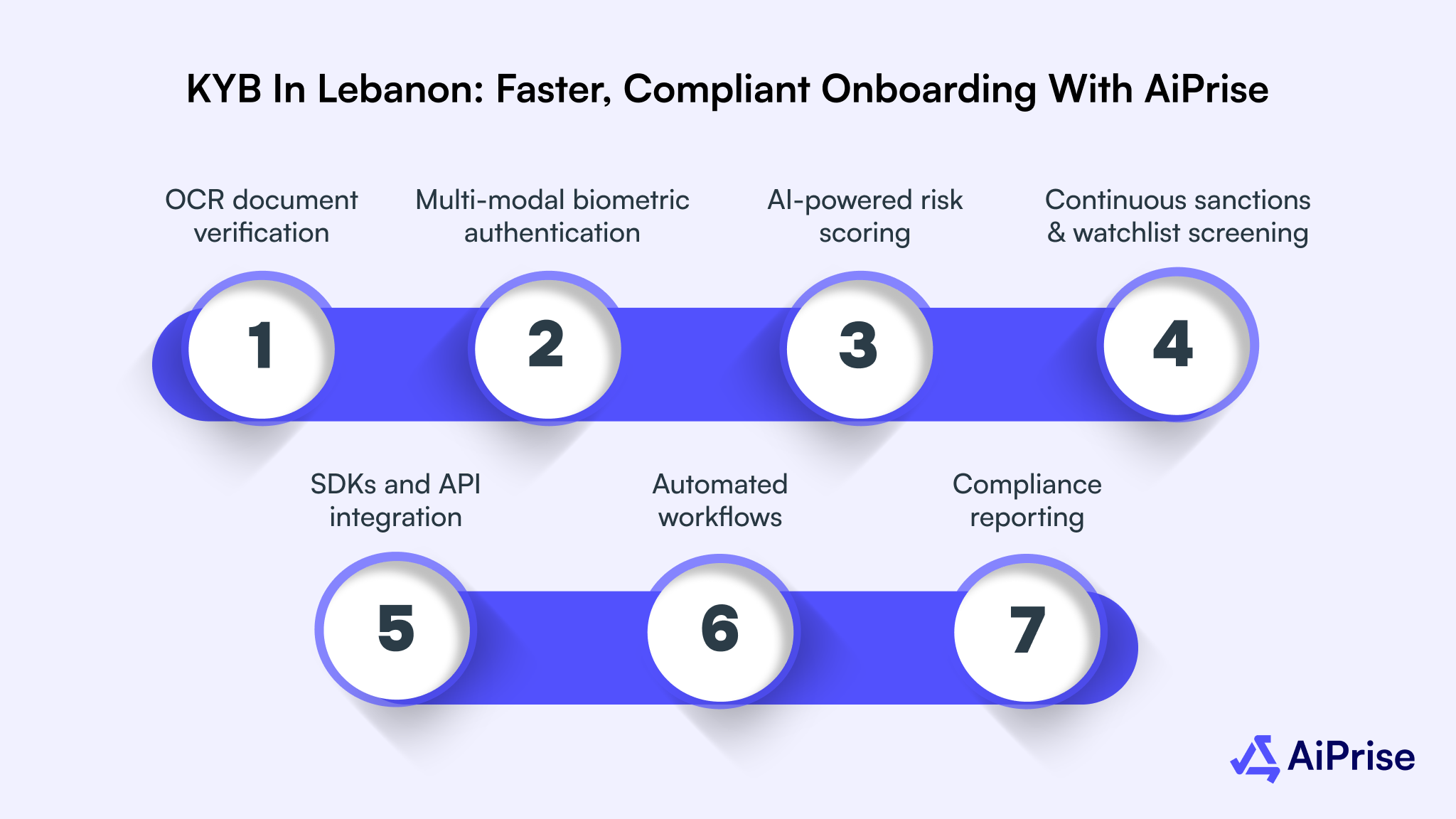
Here are the features that help you perform compliant KYB in Lebanon efficiently and with measurable confidence:
- OCR document verification: Advanced OCR extracts data from IDs and corporate documents, so you avoid manual entry errors and speed verification.
- Multi-modal biometric authentication: Multi-modal biometric checks match facial, fingerprint, and voice samples so you can confirm claimant identity in real time.
- AI-powered risk scoring: AI risk scoring correlates data from over one hundred sources, so your team prioritizes high-risk businesses immediately.
- Continuous sanctions & watchlist screening: Continuous sanctions and watchlist screening alerts you to ownership or sanction changes that affect KYB in Lebanon compliance.
- SDKs and API integration: Flexible SDKs and APIs integrate into your onboarding flow, enabling real-time KYB checks and seamless data exchange.
- Automated workflows & case management: Automated workflows route suspicious cases to analysts so your reviewers focus on complex investigations, reducing review times.
- Compliance reporting & audit trails: Comprehensive audit trails and compliance reports give you documented evidence for regulators and simplify KYB audits.
Wrapping Up
A strong KYB in the Lebanon framework protects your business from hidden risks and ensures compliance with evolving AML regulations. Accurate verification builds trust, prevents financial crime, and keeps your organization aligned with local and international legal standards. By maintaining updated records and continuous monitoring, your compliance operations stay resilient against fraud and regulatory scrutiny.
AiPrise simplifies this process through AI-driven automation, real-time verification, and continuous risk assessment tailored for Lebanese compliance needs. Its seamless integrations, advanced analytics, and biometric checks help your team verify faster without compromising accuracy or security.
Book A Demo today to experience how AiPrise strengthens KYB in Lebanon while reducing effort, cost, and compliance complexity.
FAQ
1. What documents do I need for KYB in Lebanon?
To complete KYB in Lebanon, you’ll need the company’s Trade Register extract, Memorandum and Articles of Association, shareholder and director lists, valid passports or Lebanese IDs, proof of address, and a bank deposit confirmation. These records confirm legal registration, ownership, and financial authenticity.
2. How long does KYB take for a Lebanese company?
Basic registry verification through the Commercial Register can take a few minutes to a few hours. However, enhanced due diligence, such as verifying ultimate beneficial ownership or financial records, can extend the process to several days.
3. Can foreign companies register a branch in Lebanon, and how does that affect KYB?
Foreign entities can register a branch with the Ministry of Economy and Trade and the Lebanese Commercial Register. During KYB, you should always request branch registration documents, authorization letters, and the local director’s ID for compliance validation.
4. Is KYB mandatory in Lebanon?
KYB in Lebanon is not a standalone regulation but is required under the country’s AML/CFT Law No. 44 and the Special Investigation Commission’s due diligence obligations. All regulated financial and payment sectors must perform business verification to remain compliant.
5. How to verify ultimate beneficial owners (UBOs) in Lebanon?
Verification of UBOs involves cross-checking shareholder data from the Trade Register and company filings. If ownership structures remain unclear, escalate verification by requesting shareholder declarations and certified ID copies of controlling individuals.
You might want to read these...

AiPrise
KYB Compliance: 2026 Regulations You Should Know About
As organizations expand globally and face tighter regulations, adherence to Know Your Business (KYB) standards has become one of the most critical compliance layers for fintech, online marketplaces, and other companies that need to verify business customers before letting them perform financial transactions.




.jpg)







%20Can%20Improve%20Your%20Compliance%20Strategy.png)




%20Verification%20in%20the%20US.png)
AiPrise
5 min read
How KYB Verification Works in the US: The Ultimate Guide for Navigating Know Your Business
You can approve a new business customer in minutes. Or you can lose them while your team searches through registries, ownership records, and sanctions lists, trying to piece everything together.


AiPrise’s data coverage and AI agents were the deciding factors for us. They’ve made our onboarding 80% faster. It is also a very intuitive platform.

Head of Operations



See your full compliance picture in one place
Use AI agents and global data to review businesses and users faster and more accurately
