Blogs

6 Best Practices for AML KYC Compliance at Scale in Fintech

AiPrise

10 min read

January 20, 2026

6 Best Practices for AML KYC Compliance at Scale in Fintech

6+ Best Practices for AML/KYC Compliance at Scale in Fintech

Highlights

Key Takeaways

Fintech teams are under pressure to onboard users faster while AML and KYC scrutiny keeps rising. Reviews pile up. Drop-offs increase. Compliance teams feel stretched. Growth slows. One question keeps coming up mid-process. How do you move fast without losing control?

As companies expand across borders, rules change, risk shifts, and static programs start to crack.

At scale means repeatable controls, audit-ready decisions, fewer false positives, and faster reviews. The best practices are clear. Use risk-based design. Layer KYC and KYB correctly. Monitor continuously. Reduce noise. Automate with oversight. Prove every decision.

The Best Practices That Actually Scale

  • Treat AML and KYC as continuous controls across the customer lifecycle, not as one-time onboarding checks.
  • Use risk-tiering to route review effort dynamically, allowing low-risk users to move fast and high-risk cases to deepen automatically.
  • Structure KYC and KYB workflows in clear layers so every decision is consistent, defensible, and audit-ready.
  • Reduce false positives through context-based alerting, using identity, behavior, and external signals before cases reach analysts.
  • Apply automation and AI to repetitive tasks only, keeping human judgment central and every outcome clearly documented.

Knowing the best practices is one thing. Seeing where most programs break under real scale is another. This is where theory meets operational friction, and gaps start to show.

Why AML/KYC Programs Break As Fintechs Scale

You likely built your AML and KYC program to support early growth. It worked when volumes were low and reviews were manageable. As customer counts rise, transactions move faster, and cross-border exposure increases, those same controls start to fail. Bottlenecks form. Risk slips through. Audits get harder to defend.

The breakdown usually follows a clear pattern.

Where programs fail under scale

  • Manual reviews don’t scale with volume: Review queues grow faster than headcount. Backlogs form. Decisions get rushed or delayed.
  • Static rules miss changing risk: Fixed thresholds fail to react when customer behavior, geography, or product usage shifts.
  • Fragmented tools create audit gaps: Identity checks, screening, and case notes live in different systems with no clean trail.

Traditional AML systems often generate false positive rates exceeding 95%, flooding your team with low-quality alerts and slowing real investigations.

Fragmented tools and noisy alerts make these failures harder to fix. AiPrise brings identity data, screening signals, and review logic into a single system, so risk decisions stay consistent as volume grows.
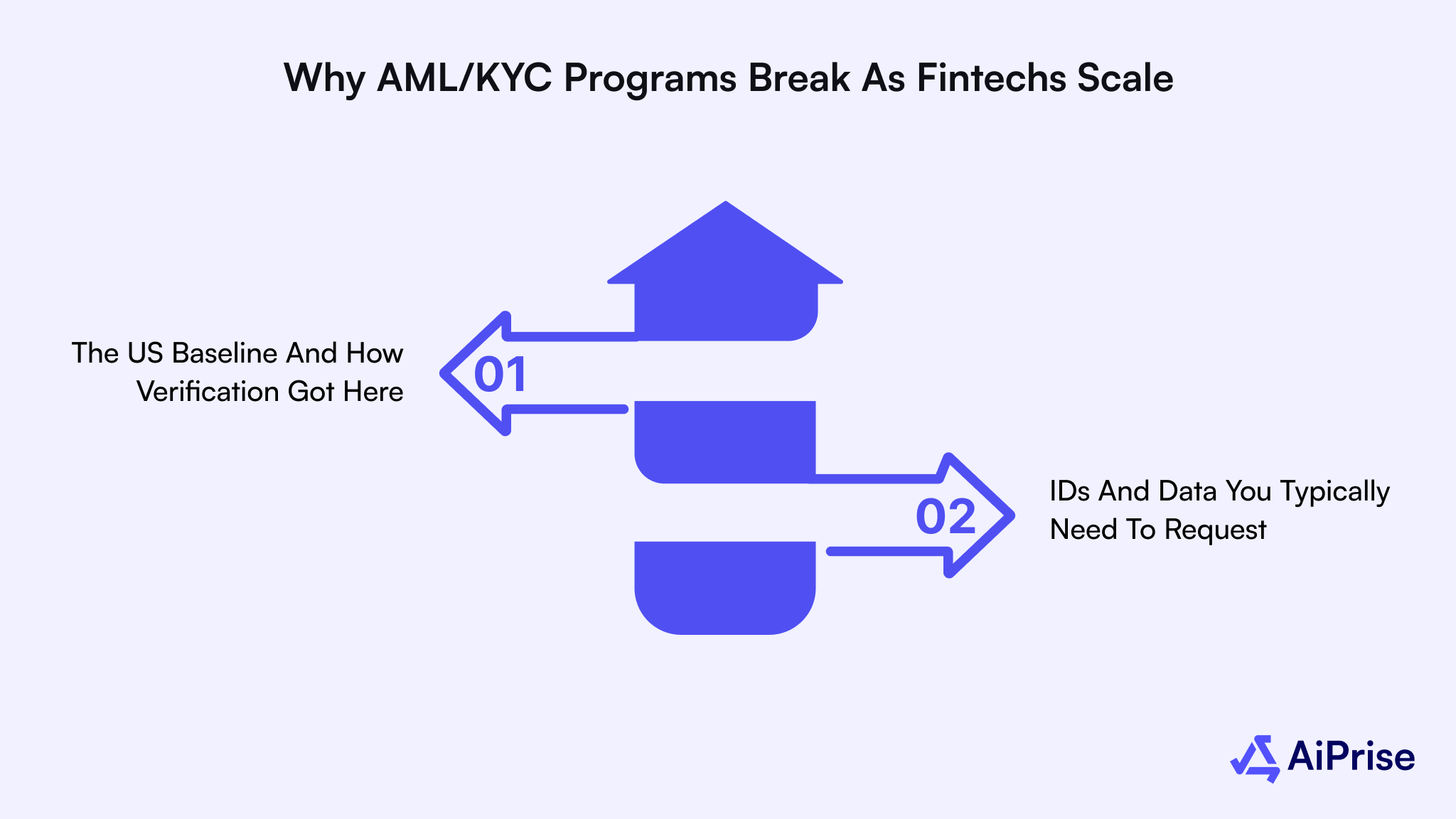
Why AML/KYC Programs Break As Fintechs Scale

The US Baseline And How Verification Got Here

You are operating under expectations shaped largely by the US regulatory model. Identity verification started with in-branch document checks. It moved to online KYC as digital banking grew. Today, US regulators expect risk-based AML programs with continuous monitoring, not one-time checks.

Because US banks, payment rails, and partners set onboarding standards, their expectations influence global fintech compliance even outside the US.

What the US baseline emphasizes:

  • Verifiable identity at onboarding.
  • Risk-based customer segmentation.
  • Ongoing monitoring and documented decisions.
  • Clear audit trails for regulators and partners.

IDs And Data You Typically Need To Request

Scalable compliance starts with collecting the minimum data needed to establish identity. You expand only when risk indicators appear. Over-collection slows onboarding. Under-collection weakens controls.

Below is a practical baseline most programs rely on.

Individual identity data:

  • Full legal name.
  • Date of birth.
  • Residential address.
  • Government-issued ID.
  • Selfie or liveness check, where applicable.

Business identity data:

  • Legal business name and registration number.
  • Jurisdiction of incorporation.
  • Beneficial owners and control percentages.
  • Directors and key officers.

The table below summarizes how these data sets are used across customer and business verification.

Entity Type Minimum Purpose
Individuals Confirm a real person exists and matches documents
Businesses Establish legitimacy and ownership transparency

Requirements vary by jurisdiction, product type, and risk exposure. Your controls must adapt without rebuilding workflows each time.

Also Read: Navigating KYC, AML, and Identity Verification in the USA

Once you see where programs fail and what regulators expect, the next step is clear. You need an operating model built for changing risk, not fixed checklists.
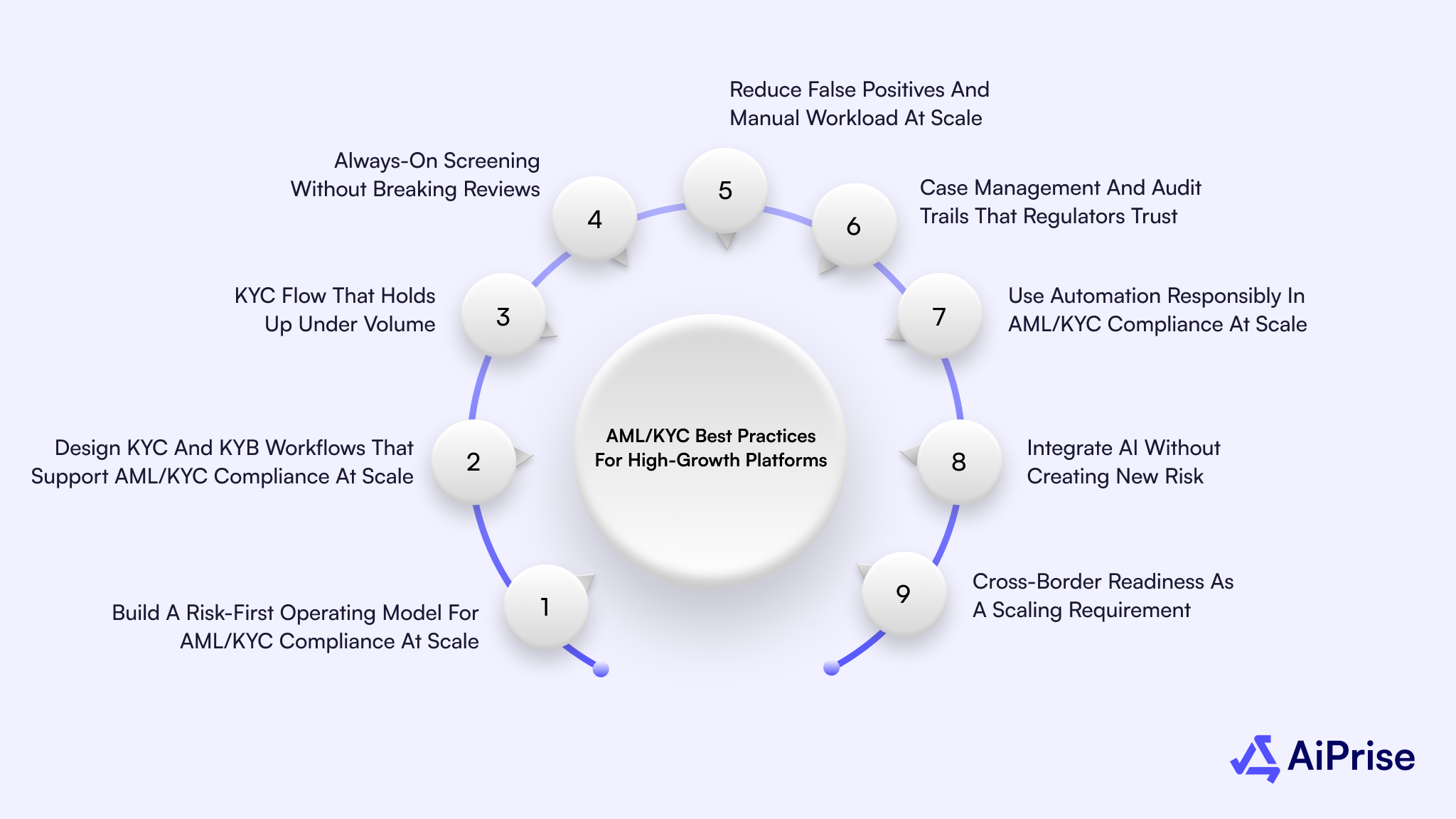
AML/KYC Best Practices for High-Growth Platforms

Best Practice 1: Build A Risk-First Operating Model For AML/KYC Compliance

AML and KYC must function as a continuous control layer across the customer lifecycle. You cannot rely on onboarding checks alone once transaction volume, product access, and geographic reach expand. Risk changes over time, and your operating model must respond without slowing legitimate users.

A risk-first model stays effective by reacting to live signals rather than static assumptions.

Key triggers that should update risk ratings:

  • Changes in product usage or transaction velocity.
  • New or expanded geographic exposure.
  • Ownership or control structure updates.
  • Behavioral shifts that break expected patterns.

Design rules that keep controls scalable:

  • Segment customers early based on risk exposure.
  • Escalate reviews immediately when new risk signals appear.
  • De-escalate when evidence supports a lower risk profile.

A Simple Risk Tiering Approach That Scales

Risk tiering helps you route effort where it matters most. You are not labeling customers permanently. You are deciding how much scrutiny is justified at a given point in time.

Below are the core inputs commonly used to assign and adjust tiers.

Common risk tiering inputs:

  • Geography and jurisdictional exposure.
  • Entity type, such as individual, merchant, or platform.
  • Funding source and payment methods.
  • Expected account activity and transaction behavior.
  • Network signals are tied to related entities or accounts.

Lower-risk tiers move with minimal friction. Higher-risk tiers trigger deeper checks and closer monitoring.

Platforms like AiPrise support this approach by using continuous fraud detection and risk scoring across identity, behavior, and external signals, so risk profiles update in real time without rebuilding workflows.

Best Practice 2: Design KYC And KYB Workflows That Support AML/KYC Compliance

Your workflows must prove identity, establish context, and adapt when risk increases. You are building controls that hold up under audits, not just flows that pass onboarding. Weak structure leads to inconsistent decisions and poor documentation.

KYB deserves special attention. Complex ownership structures and incomplete UBO data create exposure that often surfaces after onboarding.

Effective workflows share a few core traits.

What scalable workflows must support:

  • Identity verification that is consistent across regions.
  • Contextual risk assessment tied to products and usage.
  • Clear escalation paths when risk changes.
  • Ongoing monitoring tied back to the original profile.

Also Read: KYC onboarding and AML considerations

Best Practice 3: KYC Flow That Holds Up Under Volume (CIP → CDD → EDD) 

Customer Identification Program (CIP), Customer Due Diligence (CDD), and Enhanced Due Diligence (EDD) work best as layered controls. Each layer answers a specific compliance question and determines whether the next level of review is required. This structure keeps low-risk users moving while ensuring higher-risk cases receive the scrutiny regulators expect.

The table below shows what each layer establishes.

Layer What It Establishes
CIP The customer exists, and the identity is real
CDD The risk profile matches expected activity
EDD High-risk exposure is understood and documented

EDD typically activates when you see PEP exposure, sanctions proximity, high-risk jurisdictions, or unusual funding patterns.

If you need to verify users across risk tiers without slowing onboarding, AiPrise supports layered user verification from CIP through EDD.

Best Practice 4: Always-On Screening Without Breaking Reviews 

Screening must run continuously, not just at onboarding. The challenge is avoiding alert overload while still catching meaningful risk changes. Poor match logic creates noise that slows investigations and frustrates teams.

You reduce review strain by tightening how alerts are generated.

Core screening layers to maintain:

One control that matters most:

  • Strong match logic with entity resolution to avoid duplicate and low-confidence alerts.

Best Practice 5: Reduce False Positives And Manual Workload At Scale

Alert volume grows faster than analyst capacity once you scale. Reviews back up. Good customers get delayed. Risk teams spend time clearing noise instead of investigating real issues. The fix is not more analysts. It is better signal quality before alerts reach a queue.

Pre-enrichment and context-based triage reduce noise by adding meaning early.

Signals that should shape alert quality:

  • Identity attributes already verified during onboarding.
  • Behavioral patterns tied to expected account activity.
  • Device and session consistency across logins.
  • External context from sanctions, PEP, and adverse media sources.

The table below shows the operational metrics that reveal whether noise is under control.

Metric What It Shows
Alert-to-case ratio How much noise reaches analysts
Time-to-clear Operational drag per review
Escalation accuracy Whether alerts reflect real risk
QA findings Consistency and defensibility of decisions

Best Practice 6: Case Management And Audit Trails That Regulators Trust

Defensibility comes down to clarity. You must show who made the decision, what evidence was reviewed, and how the conclusion was reached. Gaps in documentation create regulatory risk even when outcomes are correct.

Strong case management enforces consistency.

Controls regulators expect to see:

  • Centralized case files with linked evidence.
  • Decision notes explaining reasoning.
  • Timestamps for reviews and escalations.
  • Reviewer identity and approval history.

Sampling and routine QA reviews confirm decisions remain consistent as volume grows.

Also Read: Comprehensive Guide to AML Compliance in FinTech

Best Practice 7: Use Automation Responsibly In AML/KYC Compliance At Scale

Automation should remove repetition, not judgment. You use it to handle volume while keeping humans accountable for risk decisions. Poor automation hides logic and weakens auditability.

Responsible automation follows clear boundaries.

What automation should handle:

Controls that keep automation defensible:

  • Explainable rules and model outputs.
  • Role-based access controls.
  • Defined retention policies.
  • Logged changes to workflows and rules.

Best Practice 8: Integrate AI Without Creating New Risk

AI works best where volume is high and decisions follow patterns. It should assist reviewers, not replace them. You use it to speed understanding, not override judgment.

Below are low-risk AI use cases most teams adopt first.

Practical AI applications:

  • Document classification and data extraction.
  • Entity resolution across records.
  • Alert summaries for faster review.
  • Drafting EDD reports from verified inputs.

High-risk approvals should always require human sign-off.

AiPrise applies automation where volume is highest, while keeping decision logic visible so compliance teams retain control and accountability.

Best Practice 9: Cross-Border Readiness As A Scaling Requirement

Global expansion breaks programs built for one country. Rules change. Data requirements shift. Local controls diverge. Rebuilding workflows for each region slows growth and increases error rates.

Scalable programs rely on modular design.

Controls that support cross-border growth:

  • Workflow templates adjusted by jurisdiction.
  • Centralized policies with local overlays.
  • Consistent KYB and UBO data models.

This structure lets you expand faster without reworking compliance for every new market.

Also Read: Implementing Global KYC Compliance In 7 Steps

You now have the blueprint for what works at scale. The next question is how to run all of this without stitching together tools, teams, and workflows by hand.

How AiPrise Supports AML/KYC Compliance At Scale

You face the same pressure points as most growing fintechs. Vendors vary by country. Reviews slow as volume rises. Fraud attempts concentrate on onboarding. AiPrise addresses these issues by acting as a compliance infrastructure rather than another point solution.
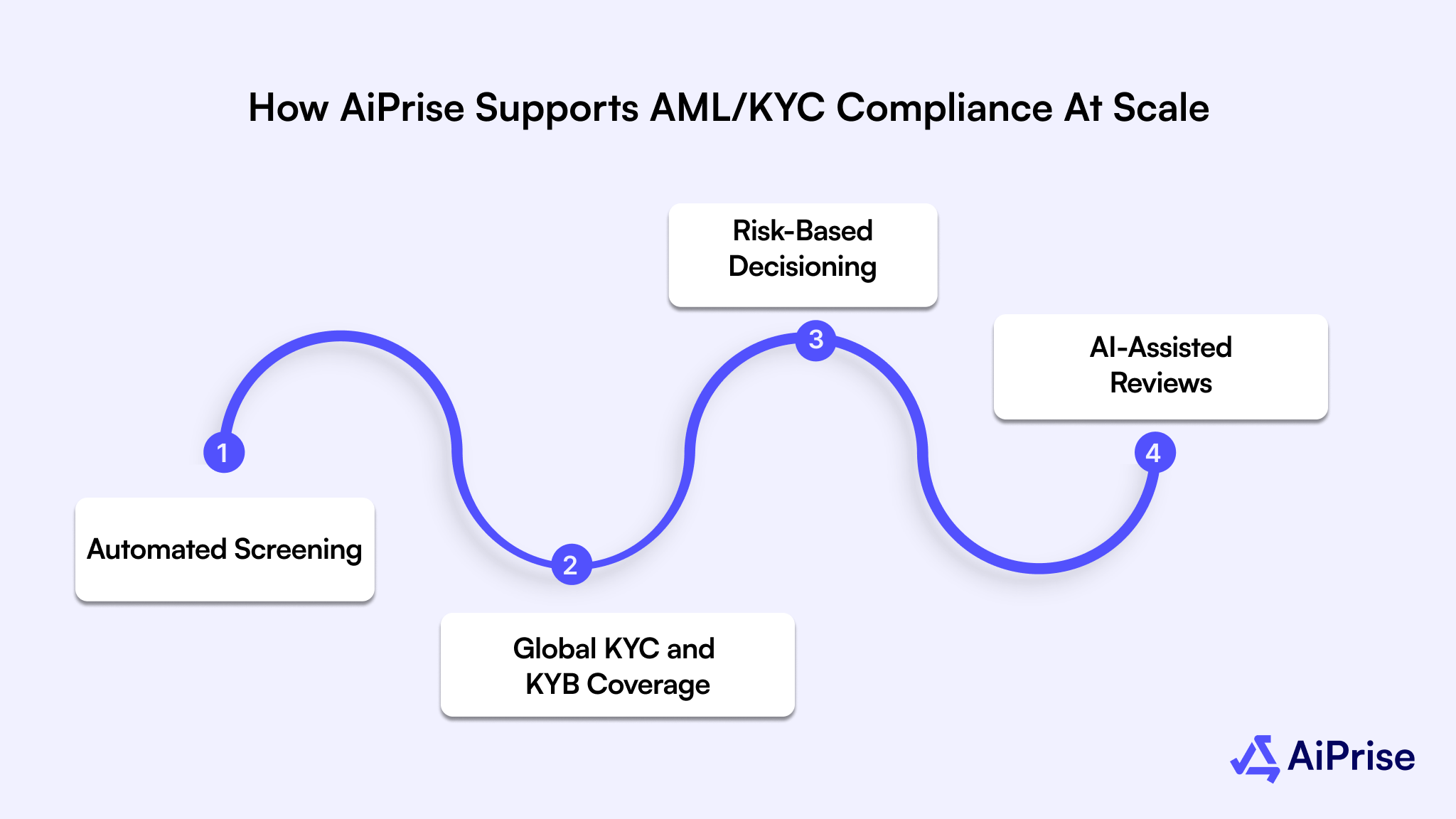
How AiPrise Supports AML/KYC Compliance At Scale

1. Automated Screening

Continuous checks across sanctions lists, PEP records, and adverse media keep risk visible as customers and businesses change over time. Watchlists, government data, and negative news sources are monitored in the background so you are not relying on point-in-time checks.

2. Global KYC And KYB Coverage

AiPrise verifies both people and businesses across jurisdictions using local and global sources. Proof of address, government records, and registry data help confirm that users and companies are real, active, and operating where they claim.

3. Risk-Based Decisioning

Custom workflows let you apply different review paths based on geography, product, and exposure. Low-risk users move through one-click KYC. Higher-risk entities trigger deeper KYB, UBO checks, and reverification without manual routing.

4. AI-Assisted Reviews

The Compliance Co-Pilot summarizes documents, highlights risk signals, and prepares case notes for analysts. Document insights and structured case views reduce time spent on clerical work while keeping human judgment in control.

5. Fraud And Risk Scoring

Identity, device, behavior, and external records feed into a live risk score. This helps you block bad actors early, before they turn into chargebacks, money movement, or regulatory exposure.
This combination gives you verified users, verified businesses, and audit-ready decisions as you scale across markets.

Final Thoughts

Scalable AML and KYC programs succeed when controls adapt as your business grows. Risk-tiering keeps reviews focused. Continuous monitoring catches change early. Lower noise protects analyst time. Defensible decisions hold up under scrutiny. Together, these practices turn compliance into a reliable operating function rather than a bottleneck.

If you are scaling into new markets or struggling with review volume, Book A Demo to see how AiPrise supports AML and KYC compliance at scale.

FAQs

1. How do you adjust AML and KYC controls during a sudden product launch or feature rollout?

You should run a pre-launch risk review tied to the new feature’s usage patterns and exposure points. Controls must activate at release, not after volume spikes.

2. What is the safest way to migrate AML and KYC programs when switching vendors or platforms?

You need parallel runs with preserved historical decisions and evidence. Migration plans should include validation checks before retiring legacy systems.

3. How can compliance teams prepare for regulator questions without knowing the audit scope in advance?

You maintain standardized decision records and clear ownership for every control. This allows rapid response regardless of audit focus.

4. What role should non-compliance teams play in AML and KYC execution at scale?

Product, operations, and support teams should follow defined escalation signals. This prevents risk blind spots outside compliance workflows.

5. How do you manage AML and KYC data retention without increasing security exposure?

Retention policies should align with jurisdictional timelines and restrict access by role. Archived data must remain searchable and tamper-resistant.

6. What signals indicate your AML and KYC program needs structural change, not tuning?

Rising exception handling, inconsistent reviewer outcomes, and delayed responses signal design limits. At that point, incremental fixes stop working.

Streamline compliance with AiPrise - Lets Talk!
Book a Demo

You might want to read these...

6+ Best Practices for AML/KYC Compliance at Scale in Fintech

AiPrise

10 min read

6 Best Practices for AML KYC Compliance at Scale in Fintech

Click now for best practices for AML/KYC compliance at scale. Cut risk, speed reviews, and avoid fines as fintech grows. Read now!

6 Types of Sanctions in KYC You Must Know to Avoid Penalties

AiPrise

11 min read

6 Types of Sanctions in KYC You Must Know to Avoid Penalties

Click now to understand types of sanctions in KYC, what triggers them, and how failures lead to fines and bans. Read now to stay compliant.

How to Automate KYC and Eliminate Manual Verification?

AiPrise

10 min read

How to Automate KYC and Eliminate Manual Verification?

Learn how to replace manual KYC checks with automated workflows that cut onboarding time, reduce errors, and improve compliance across verification processes.

Top KYC providers for Crypto Companies in 2026

AiPrise

11 min read

Top KYC providers for Crypto Companies in 2026

Compare the top KYC providers for crypto companies in 2026. Learn how KYC in crypto helps reduce fraud, meet regulations, and scale onboarding faster today.

AiPrise

16 min read

Top 5 KYC Providers in 2026 for Faster, Compliant Onboarding

Compare the top KYC providers in 2026 for faster, compliant onboarding. See features, pricing, and use cases to choose a KYC provider that fits your growth.

AiPrise

10 min read

10 KYC Onboarding Challenges and Best Practices to Fix Them

Explore common KYC onboarding challenges and strategies to fix slow onboarding, reduce drop-offs, and strengthen compliance controls.

Difference Between AML and Sanctions Screening: A Clear 2026 Guide

AiPrise

14 min read

Difference Between AML and Sanctions Screening: A Clear 2026 Guide

Learn the difference between AML and sanctions screening, how each works, and why both are required for compliance, risk control, and regulatory checks.

Effective AML Compliance for Small Businesses: A Practical Guide

AiPrise

14 min read

Effective AML Compliance for Small Businesses: A Practical Guide

Learn how AML compliance for small businesses works, key regulatory requirements, common risks, and practical steps to meet compliance expectations.

Automated KYC verification vs manual process explained with pros, costs, speed, accuracy, and which approach scales best for modern businesses today for teams.

AiPrise

11 min read

Automated KYC Verification vs Manual Process Explained

Automated KYC verification vs manual process explained with pros, costs, speed, accuracy, and which approach scales best for modern businesses today for teams.

AiPrise

21 min read

KYC Startups: Solutions and Challenges 2026

Secure your startup's future in 2025 with our in-depth guide on KYC solutions. Boost investor trust and ensure compliance. Get started now!

AiPrise

10 min read

AML Chile: Essential Steps for KYC and Secure Identity Verification

Master AML Chile with practical KYC steps, secure identity verification, and smart monitoring that reduce fraud risk and keep your business compliant every day.

AiPrise

13 min read

Top 10 KYC Failure Reasons and Their Solutions for 2025-26

Overcome KYC failure with key solutions to fake documents, manual processes, and poor data. Streamline with effective tools now! Click to enhance your KYC.

AiPrise

10 min read

How AML Compliance Works in Mexico: KYC and ID Checks

AML Mexico: Learn how KYC and ID checks stop fraud and meet regulatory rules in Mexico with steps, required documents, and practical tips for businesses today.

AiPrise

11 min read

KYC and AML in France: How Identity Verification Works

Know your customer français: Learn how KYC and AML work in France, the ID checks required, compliance steps, and practical tips to verify identities legally.

KYC and AML in Qatar: Strengthening Identity Verification Standards

AiPrise

10 min read

KYC and AML in Qatar: Strengthening Identity Verification Standards

AML Qatar: Strengthen KYC and AML standards in Qatar to secure identity verification, prevent financial crime, and help businesses meet regulatory compliance.

AiPrise

11 min read

How Thailand PIN Shapes Digital Trust for Businesses

Pin Thailand builds digital trust for businesses: verify IDs, cut fraud, secure transactions, and follow simple steps for safer onboarding and compliance.

How to Prevent KYC and AML Challenges

AiPrise

9 min read

How to Prevent KYC and AML Challenges

Weak identification systems without KYC safeguards enable criminal activity. Learn how to prevent KYC and AML challenges to protect your business and assets.

AiPrise

10 min read

Secure Digital KYC: How to Store and Share ID Documents Safely

Encrypt IDs, use tokenized links, immutable logs, and automated retention to protect customers, pass audits. kyzo kyc: securely store share identity documents.

AiPrise

10 min read

Blockchain and KYC Solutions in the Insurance Industry

Discover how blockchain KYC insurance solutions are revolutionizing the insurance industry by improving security, efficiency, and regulatory compliance.

What Is KYC Compliance in Banking? Essential Guide 2025

AiPrise

10 min read

What Is KYC Compliance in Banking? Essential Guide 2025

Learn what is KYC compliance in banking and how it protects your business. Stay ahead of risks with easy-to-follow compliance steps.

AiPrise

7 min read

Digital Transformation in Commercial Banking Client Onboarding

Boost commercial banking client onboarding with seamless omnichannel experiences, automation, API integration, real-time updates. Achieve better client satisfaction and conversion. Click now for insights!

Optimizing KYC Verification with Blockchain Technology

AiPrise

10 min read

Optimizing KYC Verification with Blockchain Technology

Explore how KYC blockchain whitepapers outline secure, reusable identity systems. Learn benefits, challenges, and real-world applications of blockchain KYC.

Understanding Identity Management in KYC Processes

AiPrise

10 min read

Understanding Identity Management in KYC Processes

Learn about identity management, KYC, and its role in streamlining secure, compliant Know Your Customer processes, improving efficiency for businesses globally.

Comprehensive Guide to Embedded Banking and  Finance

AiPrise

12 min read

Comprehensive Guide to Embedded Banking and Finance

Discover embedded banking examples that boost trust and conversions. Learn actionable strategies to improve your customer experience and grow your business.

Understanding Web3 KYC for Secure Online Identity

AiPrise

10 min read

Understanding Web3 KYC for Secure Online Identity

Explore the importance of Web3 KYC in securing online identities, ensuring compliance, and how decentralized technologies are transforming identity verification.

deepfake lega

AiPrise

10 min read

Understanding Deepfake Legal Implications and Actions

Understand deepfake legal implications, address defamation, and stay informed on federal and state laws. Seek legal advice now!

continuous KYC

AiPrise

10 min read

Continuous KYC: Transforming Customer Compliance Monitoring

Discover how continuous KYC enhances customer verification by enabling ongoing monitoring, preventing fraud, ensuring compliance, and building lasting trust.

Understanding KYC Verification Safety and Prevention Steps

AiPrise

10 min read

Understanding KYC Verification Safety and Prevention Steps

Is KYC verification safe? Explore data safety, regulatory compliance, phishing scams, and prevention steps. Protect your identity today!

Understanding KYC to Prevent Identity Theft

AiPrise

10 min read

Understanding KYC to Prevent Identity Theft

Prevent identity theft with KYC. Understand the process, its importance, and how to comply. Ensure safety and trust. Learn more now!

KYC remediation

AiPrise

8 min read

Understanding the KYC Remediation Process Steps

Learn the step-by-step KYC remediation process to stay compliant, reduce fraud risks, and improve customer trust in your business.

KYC process steps

AiPrise

6 min read

Steps to Complete the KYC Process

Discover the essential KYC process steps for financial institutions to ensure compliance, reduce risks, and prevent fraud. Protect your business today.

AiPrise

5 mins read

How Identity Verification Enhances KYC Compliance

Strengthen fraud prevention with identity verification KYC. Explore methods, key benefits, and best practices to ensure compliance and build customer trust.

AiPrise

6 mins read

Exploring The Key Benefits Of Regtech Solutions

Discover the benefits of RegTech, from cutting manual tasks to improving data accuracy and streamlining regulatory reporting. See how it simplifies compliance.

AiPrise

5

How to Avoid and Detect KYC Fraud

Discover practical steps to detect and prevent KYC fraud. Learn how to protect your business with effective strategies and tools for fraud detection.

AiPrise

6

How KYC Is Done In Banks: A Step by Step Guide

Understand how KYC is done in banks through identity checks, risk profiling, and monitoring. Learn how AI and ML improve efficiency in compliance.

AiPrise

8 mins read

Understanding eKYC: Meaning and Benefits

eKYC (electronic Know Your Customer) is a digital identity verification process that ensures secure onboarding. Learn its key benefits and how it works.

AiPrise

12 mins read

End to End KYC Process: A Complete Guide for Compliance and Fraud Prevention

Protect against fraud with an efficient end to end KYC process. Discover AI-driven solutions for better compliance and faster onboarding. Learn more now!

AiPrise

14 mins read

How Businesses Can Benefit from Free KYC Verification

Boost fraud prevention with free KYC verification. Cut compliance costs, enhance security, and streamline onboarding. Secure your business today!

AiPrise

12 mins read

Addressing KYC Challenges in Fragmented Identity Verification

Learn how fragmented identity signals affect KYC processes, the challenges they pose, and how advanced solutions can streamline and improve verification.

AiPrise

13 mins read

Understanding the Differences and Relationship Between KYC and CDD

Master KYC and CDD essentials! Enhance customer risk evaluations, prevent fraud, and ensure compliance. Click to streamline your verification process now.

AiPrise

16 mins read

3 Essential Components of KYC

Understand the key KYC components—CIP, CDD, and Ongoing Monitoring—that help prevent financial crime and enhance customer experience in compliance processes.

AiPrise

12 mins read

What is KYC? A Simple Guide for Beginners

Grasp what is KYC? Learn its definition, key roles in compliance, documentation, and prevent financial fraud. Dive in for insights!

AiPrise

10 mins read

Navigating KYC, AML, and Identity Verification in South Africa

Worried about KYC South Africa rules? This guide shows what's needed, what to watch for, and how to stay ready.

AiPrise

11 mind read

Understanding the Importance of Address Verification in KYC

Implement KYC address verification to enhance security, prevent fraud, and ensure compliance. Secure your business transactions now!

AiPrise

6 mins read

Navigating KYC, AML and Identity Verification in Rwanda

Navigate KYC Rwanda efficiently with insights on key documents, compliance, and cutting-edge identity verification. Click to enhance your security!

AiPrise

8 mins read

Navigating KYC, AML and Identity Verification in New Zealand

Navigate AML compliance in New Zealand with a risk-based approach. Understand KYC, identity verification, and reporting mandates. Ensure adherence now!

AiPrise

8 mins read

Navigating KYC, AML and Identity Verification in Russia

Understand AML Russia regulations, historical development, and identity verification. Learn about regulatory bodies, compliance tools, and sanctions impact. Stay compliant now!

AiPrise

14 mins read

Navigating KYC, AML and Identity Verification in South Korea

Master KYC in South Korea! Discover AML regulations, key CDD practices, and ensure compliance. Equip your business with the right tools today!

AiPrise

15 mins read

Navigating KYC, AML and Identity Verification in the United Kingdom

Ensure AML UK compliance with insights on KYC requirements, key legal frameworks, and identity verification. Protect your business today!

AiPrise

12 mins read

Navigating KYC, AML and Identity Verification in Yemen

Master AML in Yemen: Uncover KYC regulations and leverage digital tech solutions. Stay compliant with international standards. Click now!

AiPrise

12 mins read

Navigating KYC, AML and Identity Verification in Costa Rica

Master KYC in Costa Rica; understand AML laws, ID verification, and due diligence for compliance. Engage with third-party experts now!

AiPrise

15 mins read

Navigating KYC, AML and Identity Verification in India

Master AML India with insights on KYC, regulatory compliance, and identity verification improvements. Discover vital ways to safeguard financial security. Click now!

AiPrise

13 min read

Navigating KYC, AML and Identity Verification in Japan

Stay compliant with AML Japan. Explore key laws, digital asset regulations, and the role of AI. Enhance your KYC process today!

AiPrise

11 min read

Navigating KYC, AML and Identity Verification in Hungary

Master KYC and AML compliance in Hungary. Stay ahead with insights on regulations, identity verification, and technology. Click to learn more!

AiPrise

14 min read

Navigating KYC, AML and Identity Verification in Finland

Discover key AML Finland regulations. Master CDD and risk management. Improve compliance with tech. Click to enhance AML strategies now.

12 min read

Navigating KYC, AML and Identity Verification in Israel

Master KYC and AML in Israel with compliance tips, AML laws, and tech tools. Boost your due diligence today and stay compliant! Click now.

AiPrise

15 min read

Navigating KYC, AML and Identity Verification in Denmark

Understand AML Denmark: Explore key compliance obligations, KYC measures, and tech roles. Ensure compliance—click for insights!

AiPrise

13 min read

Navigating KYC, AML and Identity Verification in Ireland

Master KYC Ireland's regulations with advanced verification and tech, ensuring compliance and trust. Start optimizing your processes today!

AiPrise

6 min read

Navigating KYC, AML and Identity Verification in Vanuatu

Understand KYC Vanuatu rules. Ensure compliance for security, privacy balance, and protect consumer rights. Stay updated. Get expert advice!

AiPrise

11 min read

Navigating KYC, AML, and Identity Verification in Serbia

Master KYC, AML, and identity checks in Serbia and prevent financial crimes. Learn compliance protocols and face challenges with Serbia AML compliance tips.

AiPrise

5 mins

How to Verify Businesses from Benin?

Verify Benin companies effortlessly! Understand legal frameworks, access official registries, and choose third-party services to ensure compliance. Start verifying now!

AiPrise

8 min read

Legislation Addressing AI Deepfakes in the US

Understand US laws against AI deepfakes with insights on federal and state legislation, election integrity, and unique state protections. Click to stay informed.

AiPrise

8 min read

How Compliance Technology Drives Efficiency and Trends

Struggling with compliance? AI-driven automation in compliance technology with KYC, KYB, and AML tools helps prevent costly mistakes and ensures compliance.

AiPrise

5 min read

Decoding Individual Identity Verification in Australia

Ensure safe transactions with secure identity verification in Australia; trust OAIC's Digital ID to protect your privacy. Click for more.

AiPrise

5 min read

Navigating KYC, AML, and Identity Verification in the USA

Learn how to stay compliant with the Anti-Money Laundering Act and other regulations. Get simple steps to manage KYC and AML processes without the hassle.

AiPrise

5 min read

Changes and Overview of the FATF Grey List and Black List

Understand the FATF grey list: criteria, recent changes, and impacts. See countries now listed. Click to learn action plans and compliance needs.

AiPrise

5 min read

Navigating KYC and Compliance Risk in the Stablecoin Space

Understand KYC in stablecoin to safeguard transactions, mitigate compliance risks, and ensure financial integrity. Click to enhance your approach now!

AiPrise

8 min read

AML Compliance And Checks For Cross-Border Payments

Improve cross-border AML checks with tech solutions for customer verification. Ensure compliance and mitigate risks. Implement strategies today!

AiPrise’s data coverage and AI agents were the deciding factors for us. They’ve made our onboarding 80% faster. It is also a very intuitive platform.

Head of Operations

Speed Up Your Compliance by 10x

Automate your compliance processes with AiPrise and focus on growing your business.