

AiPrise
11 min read
March 4, 2026
Onboarding SDK Documentation for KYC & AML Workflows

Key Takeaways

Keeping compliant while launching new products is one of the biggest headaches for decision makers in financial services. Poor onboarding documentation increases risk, slows launches, and creates compliance gaps around KYC and AML workflows. Many teams struggle with fragmented guides that leave integration ambiguity and missed requirements, costing time and trust.
The SEC filed more than 40 enforcement actions through mid-January 2025, underscoring persistent compliance pressures on regulated firms. Understanding how to structure onboarding SDK documentation helps you close gaps, strengthen compliance, and speed secure onboarding. Clear, well-organized documentation reduces internal strain and builds confidence in your verification workflows.
QuicK Look
- Onboarding sdk documentation defines how KYC, AML, document verification, biometric checks, and sanctions screening integrate into your product architecture.
- Enterprise-grade documentation must map compliance logic, risk scoring, audit logs, API governance, and jurisdiction-specific identity requirements clearly.
- A structured API onboarding checklist prevents gaps across identity validation, OFAC screening, PEP checks, transaction monitoring, and error handling controls.
- Integration choice between SDK, embedded onboarding, and direct API determines compliance ownership, customization depth, scalability, and audit readiness.
What is Onboarding SDK?
An onboarding SDK is a prebuilt integration layer that enables secure identity verification, KYC, and AML workflows within your product environment. Unlike standalone APIs, an enterprise onboarding SDK combines user interface components, compliance logic, and backend orchestration into a unified deployment framework. Well-structured onboarding sdk documentation ensures your team aligns technical integration with regulatory requirements, audit readiness, and scalable compliance architecture.
Why Onboarding SDK Documentation Fails Teams?
This section explains why unclear onboarding SDK documentation can slow launches, expose compliance risk, and frustrate every team involved.
Below are the key reasons documentation gaps routinely lead to operational and regulatory challenges:
- Documentation that lacks clear workflow mapping often leaves technical and compliance teams guessing about KYC and AML integration standards.
- When onboarding sdk documentation templates omit risk controls and audit guidance, teams waste weeks fixing avoidable issues.
- The incomplete document onboarding API onboarding checklist sections leave developers creating workarounds instead of structured compliance workflows.
- Lack of enterprise onboarding sdk context leads to fragmented understanding across engineering and security leadership.
- Regulatory enforcement remains active in 2025, evidenced by an $18 million AML penalty against LPL Financial for failures in customer identity verification compliance.
- Teams struggle when onboarding sdk documentation does not align with regulatory expectations, risking fines and operational friction.
Also read: Identity Verification for Digital Onboarding Guide
Recognizing these gaps raises an important question: what should effective onboarding sdk documentation actually contain?
Core Components of Effective SDK Documentation
This section outlines the structural elements your onboarding sdk documentation must include to support scalable KYC and AML workflows.
Here are the foundational components that determine whether your documentation supports enterprise-grade verification architecture:
- Architecture Clarity: Clear system diagrams and workflow explanations align engineering, compliance, and product teams around one integration blueprint.
- Compliance Mapping: Explicit documentation of KYC requirements, AML screening logic, and sanctions workflows prevents regulatory misinterpretation and audit exposure.
- Data Governance Controls: Defined encryption standards, tokenization methods, and PII handling rules reduce security vulnerabilities and liability risks.
- Risk Engine Logic: Transparent risk scoring criteria and decision thresholds improve defensibility during regulatory reviews and internal audits.
- Audit Trail Framework: Detailed logging structures and case management documentation strengthen traceability and regulator readiness.
- Integration Layer Guidance: Clear SDK configuration steps, API onboarding checklist references, and versioning policies minimize deployment friction and rework.
Once the structure is clear, enterprise environments demand even deeper governance and scalability considerations.
Enterprise Onboarding SDK Requirements
This section defines the structural and governance standards your enterprise onboarding sdk must meet to support regulated KYC and AML environments.
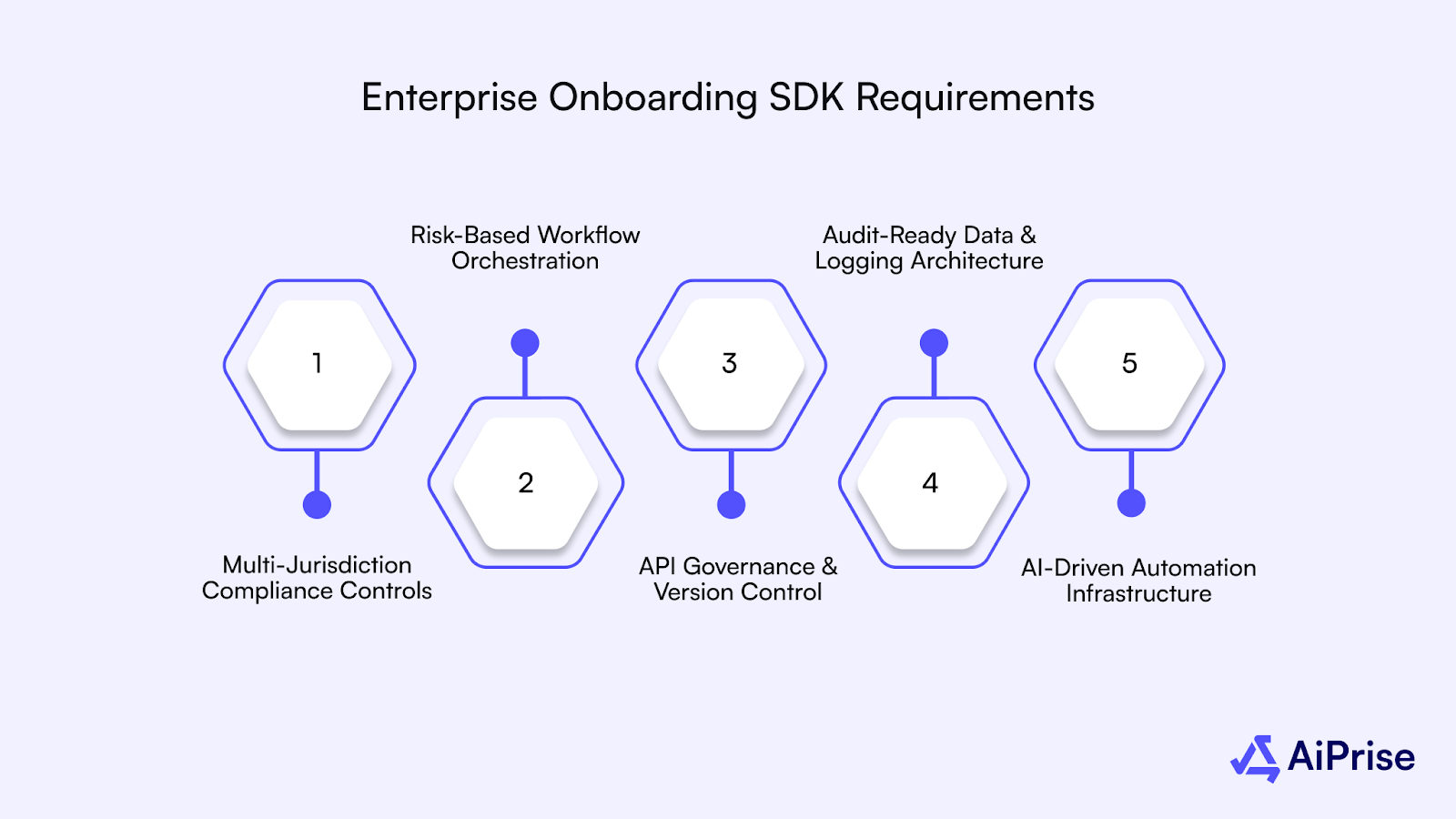
Here are the non-negotiable requirements that determine whether your onboarding infrastructure can scale without compliance friction:
1. Multi-Jurisdiction Compliance Controls
Your enterprise onboarding sdk must dynamically adjust identity verification flows based on jurisdictional AML, sanctions, and data residency requirements. Configurable rule engines should allow real-time updates when regulatory thresholds or document verification standards change. Embedded geo-specific logic reduces manual intervention and prevents fragmented onboarding experiences across regulated markets.
2. Risk-Based Workflow Orchestration
Risk scoring engines should trigger adaptive KYC depth, escalating verification layers based on behavioral and transactional signals. Structured onboarding sdk documentation must clearly define escalation triggers, decision trees, and automated case routing protocols. Granular workflow controls help you balance frictionless onboarding with defensible AML compliance enforcement.
3. API Governance and Version Control
Enterprise environments require documented API lifecycle policies, including deprecation schedules, backward compatibility standards, and change logs. Integration guides should define sandbox testing frameworks aligned with your internal API onboarding checklist controls. Version transparency ensures stable deployments and prevents compliance disruptions during SDK upgrades.
4. Audit-Ready Data and Logging Architecture
Comprehensive logging must capture document verification outcomes, biometric matches, sanctions screening results, and risk decision timestamps. Structured documentation should specify retention policies aligned with regulatory record-keeping requirements. Clear audit export protocols reduce preparation time during regulatory reviews or internal compliance investigations.
5. AI-Driven Automation Infrastructure
Modern enterprise onboarding sdk environments integrate automated document verification, biometric validation, and real-time sanctions screening. AiPrise’s onboarding SDK architecture supports configurable KYC and AML workflows with centralized compliance logic and automated monitoring capabilities. Centralized orchestration reduces operational overhead while maintaining scalable verification accuracy across high-volume onboarding channels.
Also read: AI Powered Strategies for Effective Business Onboarding
With enterprise standards defined, attention shifts to the operational layer, where compliance controls are executed during integration.
API Onboarding Checklist for Compliance
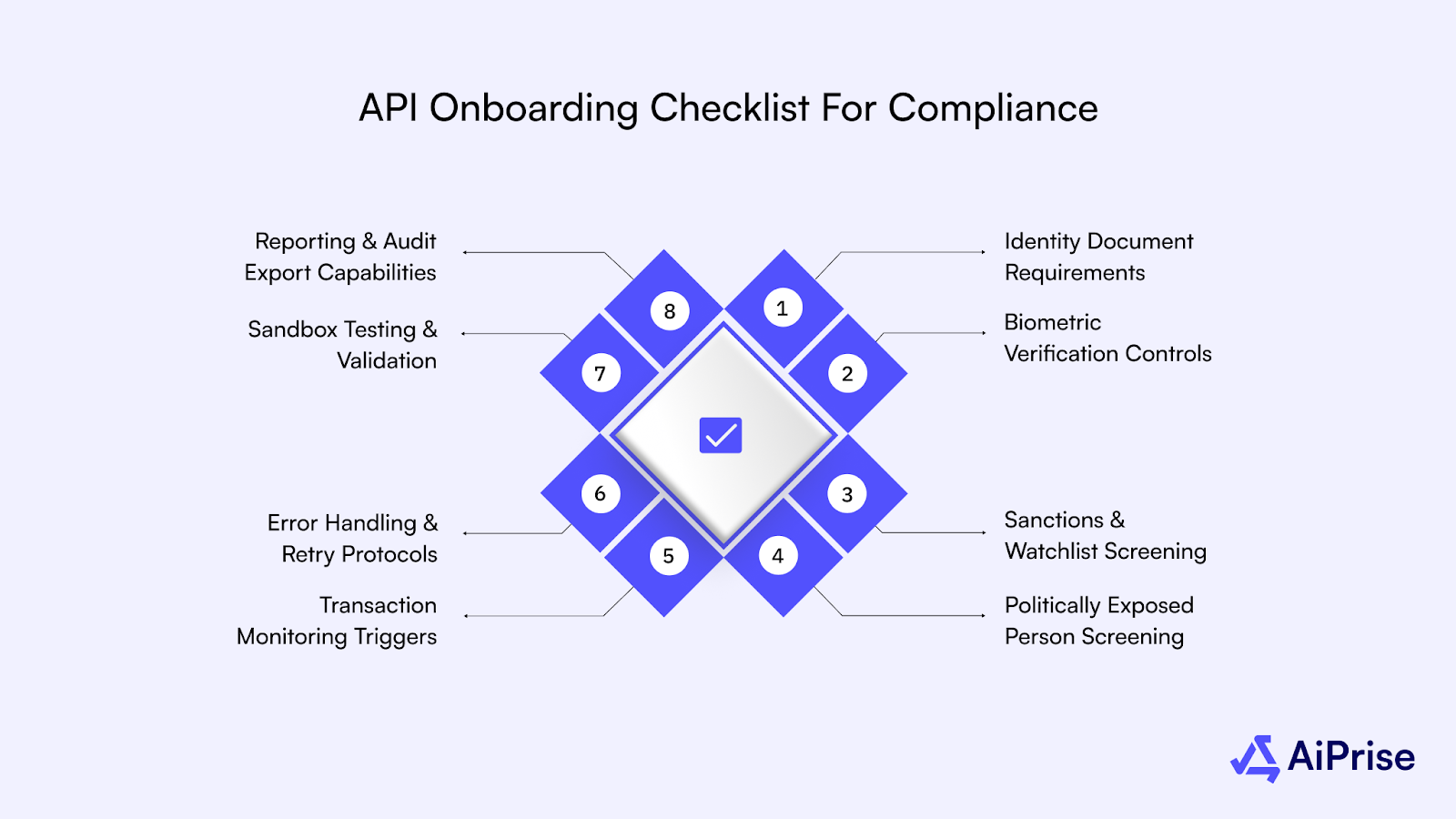
This section outlines a structured API onboarding checklist that strengthens compliance controls across KYC and AML integrations.
Here are the essential validation layers your onboarding sdk documentation must clearly define before deployment:
- Identity Document Requirements
- Specify accepted government-issued IDs such as passports, driver's licenses, or state identification cards
- Define document expiration validation rules and automated rejection thresholds for invalid submissions.
- Map document types to jurisdiction-specific KYC regulatory requirements within your enterprise onboarding sdk.
- Biometric Verification Controls
- Document facial recognition matching thresholds and liveness detection safeguards to prevent spoofing attempts.
- Define fallback mechanisms when biometric verification fails, or confidence scores fall below tolerance limits.
- Clarify how biometric data is encrypted, tokenized, and securely stored to meet compliance obligations.
- Sanctions and Watchlist Screening
- Integrate real-time screening against OFAC sanctions lists and other government-issued restricted party databases.
- Document escalation workflows when potential matches trigger false positive or high-risk alerts.
- Define refresh frequency for watchlist data updates to maintain regulatory alignment.
- Politically Exposed Person Screening
- Specify PEP classification logic and automated risk weighting within AML decision engines.
- Document enhanced due diligence triggers for high-risk customer profiles or beneficial owners.
- Ensure audit logs capture screening timestamps and risk outcomes for regulatory review.
- Transaction Monitoring Triggers
- Define behavioral monitoring rules that flag unusual onboarding-linked transactional patterns.
- Document thresholds for suspicious activity reporting and automated compliance notifications.
- Align monitoring logic with your broader AML governance framework.
- Error Handling and Retry Protocols
- Outline API response codes, retry intervals, and fallback authentication procedures during system failures.
- Document structured exception handling workflows to prevent onboarding abandonment.
- Clarify escalation paths for unresolved verification errors affecting compliance status.
- Sandbox Testing and Validation
- Provide documented test cases covering document uploads, biometric checks, and sanctions screening simulations.
- Align testing scenarios with your internal API onboarding checklist and compliance acceptance criteria.
- Validate audit trail completeness before production release to avoid regulatory gaps.
- Reporting and Audit Export Capabilities
- Define standardized compliance reports that capture KYC verification outcomes and AML screening results.
- Document data export formats suitable for internal audits and external regulatory examinations.
- Ensure retention schedules meet applicable record-keeping regulations in your operational jurisdictions.
A checklist prevents oversights, but documentation must also follow a structured template that keeps teams aligned long term.
Onboarding SDK Documentation Template Example
This section presents a structured onboarding sdk documentation template designed for enterprise KYC and AML workflow integration.
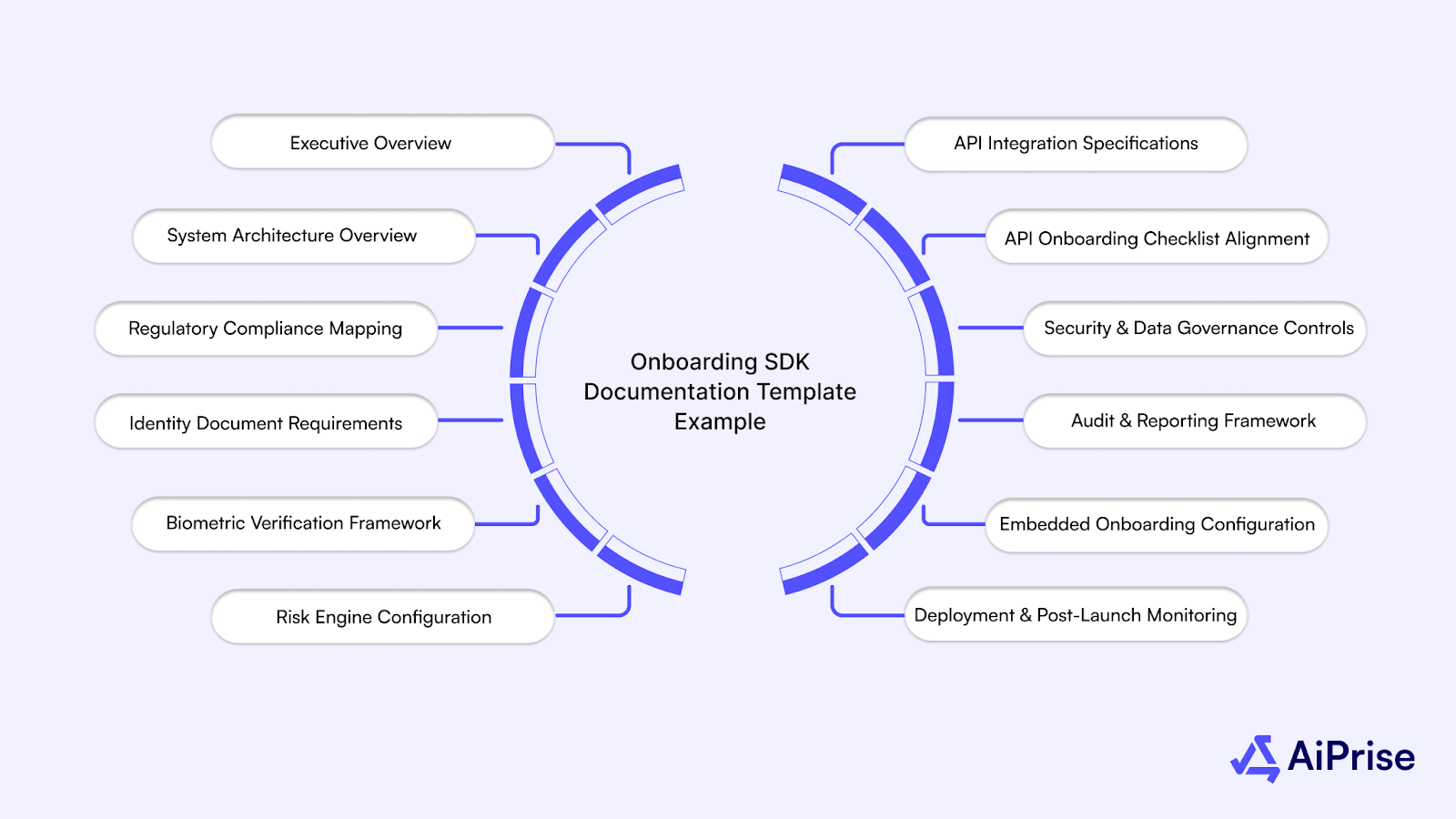
Here is a practical onboarding sdk documentation template you can adapt for compliance-driven deployment environments:
1. Executive Overview
- Purpose: Define how the enterprise onboarding SDK supports compliant identity verification and AML screening workflows.
- Scope: Outline supported jurisdictions, regulatory coverage, and operational risk controls.
- Audience: Product teams, compliance officers, security architects, and engineering stakeholders.
2. System Architecture Overview
- Deployment Model: Cloud-hosted, hybrid, or on-premise integration configuration.
- Integration Type: Embedded SDK, direct API integration, or orchestration layer deployment.
- Data Flow Summary: Identity input, document verification, biometric validation, sanctions screening, and decision engine output.
3. Regulatory Compliance Mapping
- KYC Coverage: Supported government-issued identity documents and verification logic by jurisdiction.
- AML Controls: OFAC screening, PEP identification, adverse media checks, and risk-based escalation workflows.
- Record Retention Policy: Defined retention timelines aligned with U.S. regulatory requirements.
4. Identity Document Requirements
- Accepted IDs: Passports, state-issued driver licenses, national identity cards, and corporate registration certificates.
- Validation Logic: OCR extraction rules, authenticity detection checks, and expiration date verification protocols.
- Fallback Controls: Manual review triggers for unreadable or inconsistent document submissions.
5. Biometric Verification Framework
- Supported Methods: Facial recognition with liveness detection and behavioral validation signals.
- Match Thresholds: Configurable confidence score requirements aligned with fraud risk appetite.
- Data Security Controls: End-to-end encryption and tokenized biometric storage standards.
6. Risk Engine Configuration
- Risk Scoring Model: Weighted scoring based on document validation, biometric match results, and sanctions screening outputs.
- Escalation Triggers: Automated enhanced due diligence workflows for high-risk onboarding profiles.
- Decision Logging: Timestamped audit entries capturing verification outcomes and risk classifications.
7. API Integration Specifications
- Authentication Method: OAuth tokens, API keys, and secure credential rotation policies.
- Endpoint Structure: Identity submission, document upload, sanctions screening, and status retrieval endpoints.
- Version Control Policy: API lifecycle governance, deprecation timelines, and backward compatibility standards.
8. API Onboarding Checklist Alignment
- Pre-Launch Validation: Sandbox testing for document uploads, biometric flows, and AML screening simulations.
- Error Handling Protocol: Standardized response codes, retry mechanisms, and fallback identity verification pathways.
- Compliance Verification: Confirmation that all KYC and AML decision logs are export-ready for audit review.
9. Security and Data Governance Controls
- Encryption Standards: AES-256 encryption for stored PII and TLS 1.3 for data in transit.
- Access Management: Role-based permissions for compliance reviewers and system administrators.
- Incident Response Plan: Documented escalation workflows for data breaches or verification anomalies.
10. Audit and Reporting Framework
- Audit Log Structure: Immutable logs capturing verification timestamps, screening results, and workflow decisions.
- Export Capabilities: CSV and regulator-ready reporting formats for external compliance reviews.
- Monitoring Controls: Continuous sanctions list updates and periodic verification refresh triggers.
11. Embedded Onboarding Configuration
- UI Components: Prebuilt identity capture modules and customizable verification prompts.
- Workflow Customization: Jurisdiction-based KYC depth and AML risk sensitivity adjustments.
- Enterprise Governance: Alignment with enterprise onboarding sdk compliance oversight structures.
12. Deployment and Post-Launch Monitoring
- Go-Live Checklist: Compliance sign-off, API performance validation, and risk engine testing confirmation.
- Ongoing Monitoring: Continuous AML screening updates and document expiration tracking workflows.
- Change Management: Structured SDK update procedures aligned with internal API governance policies.
Also read: Top 8 Compliance Automation Software for Faster Onboarding in 2025
When structured this way, your onboarding sdk documentation becomes searchable, regulator-aligned, and operationally scalable across enterprise verification environments.
SDK vs Embedded vs Direct API Integration
Choosing the right integration model directly impacts your compliance control, deployment speed, and long-term AML governance structure.
Here is a structured comparison of enterprise onboarding SDK, embedded onboarding, and direct API integration models:
Selecting an integration model matters, yet understanding how KYC and AML workflows operate inside that model matters even more.
KYC and AML Workflow Inside an SDK
Understanding how KYC and AML workflows operate inside an onboarding sdk helps you design verification flows that are defensible, automated, and regulator-ready.
Here are the core workflow stages typically executed inside an enterprise onboarding sdk:
- Identity data capture collects customer information, including full legal name, date of birth, address, and government identification numbers.
- Document verification validates passports, driver's licenses, or national identity cards using OCR extraction and authenticity detection controls.
- Biometric authentication performs facial recognition with liveness detection to confirm the individual matches submitted identity documents.
- Sanctions screening checks customer data against OFAC and other restricted party lists to prevent prohibited relationships.
- Politically exposed person screening evaluates enhanced risk exposure and triggers deeper due diligence workflows when required.
- Risk scoring engines calculate weighted compliance scores based on document validation, biometric confidence levels, and sanctions results.
- Decision orchestration applies predefined approval, rejection, or manual review rules aligned with your AML governance framework.
- Audit logging records timestamps, verification outcomes, and escalation triggers to support regulatory reviews and internal audits.
- Ongoing monitoring re-screens customers against updated sanctions lists and flags behavioral anomalies for continuous AML compliance.
Also read: Merchant Onboarding: Steps, Challenges, And Working
When structured correctly, platforms such as AiPrise enable these verification layers to operate within a unified, configurable onboarding sdk architecture.
How AiPrise Supports Compliant Onboarding?
AiPrise provides targeted features that help you build onboarding workflows that are secure, compliant, and efficient.
Here are the core AiPrise capabilities that directly support secure and regulator-ready KYC and AML workflows:
- AiPrise’s Onboarding SDK integrates identity capture, document verification, and AML screening into a single modular workflow, reducing implementation fragmentation.
- Real-time KYC and KYB checks cross-reference data from 100+ global sources, verifying identities and business legitimacy with high accuracy.
- Biometric authentication and OCR-powered document processing automate verification steps that would otherwise require manual review.
- Watchlist and sanctions screening embedded in workflows help you meet regulatory obligations while minimizing false positives.
- Risk scoring and customizable rule engines let you adjust verification depth based on risk thresholds and jurisdictional requirements.
- Centralized case management tools give your compliance team a live view of verification results, flags, and audit trails from one dashboard.
By aligning onboarding documentation with AiPrise’s integrated verification features, you reduce operational burden while strengthening AML and KYC controls.
Wrapping Up
Strong onboarding sdk documentation transforms compliance from a reactive burden into a scalable operational advantage for regulated teams. Structured KYC and AML workflows reduce audit exposure, accelerate integration timelines, and strengthen governance across enterprise verification environments. AiPrise supports this transition by delivering configurable onboarding SDK capabilities that align automation, compliance logic, and audit readiness within one architecture.
If your verification infrastructure needs greater clarity, control, and regulatory resilience, now is the time to Book A Demo and modernize your onboarding framework.
Frequently Asked Questions
1. What is onboarding SDK documentation?
Onboarding sdk documentation defines how KYC verification, AML screening, and identity validation workflows integrate into your application infrastructure. It outlines architecture, API specifications, compliance logic, audit logging requirements, and deployment governance standards.
2. How does an onboarding API work?
An onboarding API transmits identity data and verification requests to compliance engines for document validation and sanctions screening. It returns structured risk decisions while enforcing authentication, logging, and AML control mechanisms.
3.What documents are required for KYC onboarding?
KYC onboarding typically requires government-issued identification such as passports, driver's licenses, or national identity cards. Some workflows also require proof of address documentation depending on jurisdictional AML requirements.
4. What is embedded onboarding?
Embedded onboarding integrates hosted identity verification components directly into your product through SDK modules. It reduces development effort while maintaining structured compliance controls within predefined workflows.
5. How long does KYC onboarding take?
Automated onboarding sdk workflows can verify low-risk identities within minutes when validation checks pass successfully. Higher-risk profiles may require enhanced due diligence, extending review timelines to satisfy AML compliance standards.
You might want to read these...







.jpeg)


.jpg)

















.jpeg)






.png)



.png)










AiPrise’s data coverage and AI agents were the deciding factors for us. They’ve made our onboarding 80% faster. It is also a very intuitive platform.

Head of Operations



See your full compliance picture in one place
Use AI agents and global data to review businesses and users faster and more accurately
