

AiPrise
11 min read
December 2, 2025
How Thailand PIN Shapes Digital Trust for Businesses

Key Takeaways

Running a business in Thailand’s digital space means facing rising fraud, onboarding delays, and complex compliance checks that often drain both time and trust. Financial institutions, payment providers, and crypto platforms constantly battle identity risks that slow customer growth and invite regulatory scrutiny. According to Thailand’s Ministry of Digital Economy and Society, over THB 98 billion was lost to online scams in 2025, underscoring how fragile digital trust remains across industries. Understanding how the Thailand PIN strengthens identity verification gives a clear edge, helping reduce fraud exposure, simplify KYC/KYB compliance, and build lasting confidence in every digital transaction.
Key Takeaways
- The Thai Personal Identification Number (PIN) is a 13-digit national ID that forms the backbone of Thailand’s digital identity and verification ecosystem.
- Businesses use the Thai PIN to verify individuals quickly, reduce fraud, and comply with KYC, KYB, and AML regulations.
- Proper verification involves checking PINs against official databases, using biometrics, and ensuring data protection under the PDPA.
- Adopting Thai PIN verification builds stronger customer trust, minimizes onboarding delays, and ensures smooth compliance across Thailand’s digital economy.
What Is the Thai PIN?
The Thai Personal Identification Number (PIN) is a 13-digit unique identifier issued to Thai nationals and resident individuals, used across government and commercial systems.
Here are the details you’ll want to understand:
- Serves as a national identity number and, in many cases, functions as the Tax Identification Number (TIN) under the civilian registration law.
- Printed on the national ID card (issued by the Department of Provincial Administration/DOPA) and used for banking, public services, and legal transactions.
- Every Thai citizen (and many long-term legal residents) receives it at birth or upon legal registration, making it a foundational piece of identity data.
- Enables businesses and institutions to reference a stable, government-issued identifier when verifying an individual’s identity or tax status.
- If you’re trying to streamline KYC, KYB, or AML checks in Thailand, this PIN is often the first piece of information you’ll request and validate.
Once you understand its foundation, it becomes clear why this number holds so much value for businesses building safer onboarding systems.
Why the Thai PIN Is Important for Business?
Adopting the Thai PIN for verification helps you strengthen trust, reduce risk, and ensure smoother compliance when operating or onboarding in Thailand.
Here are the core business benefits you should consider:
- Helps reduce onboarding friction by linking the individual’s identity across government databases, meaning less manual follow-up and faster approval times.
- Supports fraud prevention by providing a stable digital anchor: when you verify a valid Thai PIN associated with correct personal information, impersonation or fake identity risks drop significantly.
- Enhances compliance posture: you can demonstrate to regulators and internal auditors that you’ve used a unique, government-issued identifier during your identity verification process.
- Improves customer experience: By reducing false negatives or delays in verification, you build confidence with clients or partners that your processes are trustworthy and efficient.
- Enables data-driven risk scoring and continuous monitoring (since once you’ve validated a PIN, you can monitor changes tied to it, such as address updates or new associations).
Also read: A Complete Guide to Starting a Business in Thailand
While the Thai PIN brings practical benefits in compliance and onboarding, its real value lies in how it builds confidence across Thailand’s digital economy, connecting verified identities with authentic business relationships.
How Thailand PIN Shapes Digital Trust for Businesses?
Establishing digital trust in Thailand goes beyond compliance; it’s about giving customers and partners the confidence that your business deals with verified identities. The Thai PIN helps you build that foundation by creating a transparent link between individuals and legitimate data sources.
Here’s how the Thai PIN contributes to stronger trust and safer business ecosystems:
- Creates verified identity links between citizens and government databases, helping you validate authenticity in seconds.
- Reduces fraud exposure by ensuring that every verified identity traces back to an official record.
- Improves customer confidence as verified onboarding feels secure and transparent, building loyalty from the first interaction.
- Supports cross-industry compliance, helping banks, payment providers, and fintech startups maintain the same trust standards as large financial institutions.
- Strengthens Thailand’s digital infrastructure, making regulatory and private sector collaboration more reliable for long-term business growth.
To make those benefits tangible, it’s important to see how Thai PIN verification actually works in a business setting, step by step.

Key Verification Steps in Thailand’s Digital Identity Process
Implementing the Thai PIN effectively in your business processes ensures faster onboarding, stronger compliance, and reduced exposure to fraud or identity risks.
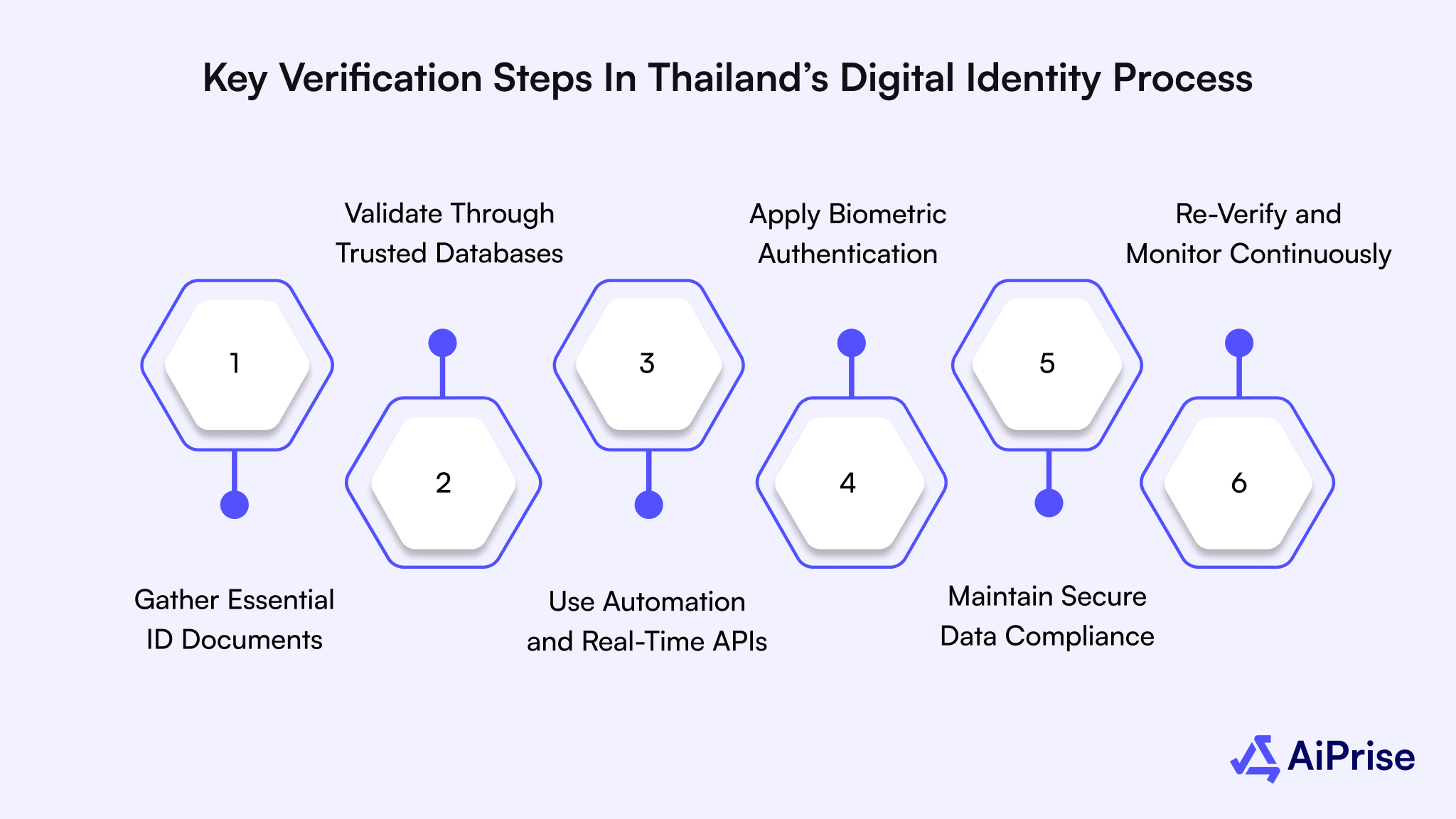
Here are the essential steps you can follow to make verification smoother and more reliable:
1. Gather Essential ID Documents
Every verification process starts with collecting clear, valid documents that display the Thai PIN. This usually includes the national ID card, which holds the 13-digit number, and sometimes a passport or work permit for foreign residents. Ensuring that scanned copies are legible and unaltered helps prevent rejection during automated or manual review.
2. Validate Through Trusted Databases
To confirm authenticity, the Thai PIN must be cross-checked against official sources like the Department of Provincial Administration (DOPA) registry or verified third-party data providers. Matching the name, address, and date of birth with registry records quickly flags any inconsistencies. This step not only strengthens KYC accuracy but also helps identify high-risk or potentially fraudulent applicants early.
3. Use Automation and Real-Time APIs
Integrating verification APIs into your onboarding platform allows you to confirm Thai PINs instantly, reducing delays that frustrate customers. Automated systems can flag errors or suspicious patterns before human review, ensuring speed without compromising accuracy. Over time, these APIs enable continuous monitoring, so any future changes or sanctions tied to a verified PIN can be detected immediately.
4. Apply Biometric Authentication
Combining the Thai PIN with biometric verification, such as facial recognition or fingerprint matching, adds a powerful layer of trust. Biometric checks validate that the person submitting the ID truly owns it, preventing impersonation. This approach builds stronger assurance for businesses handling high-value transactions or sensitive financial services.
5. Maintain Secure Data Compliance
Handling Thai PIN data requires strict adherence to the Personal Data Protection Act (PDPA) to safeguard user information. Encryption, secure transmission, and limited access permissions are essential to avoid compliance breaches. Maintaining transparent consent and audit logs also reinforces your credibility and ensures smooth regulatory audits.
6. Re-Verify and Monitor Continuously
Verification isn’t a one-time task; it’s an ongoing responsibility for any regulated business. Continuous monitoring of active PINs allows you to track updates such as address changes or sanction list alerts. Keeping this process automated helps you maintain compliance, strengthen fraud prevention, and protect your company’s reputation long-term.
Also read: How to Conduct Due Diligence on Thai Companies
Once verification is embedded into your processes, its ripple effect extends far beyond compliance, transforming how Thai businesses interact, verify, and build reliable partnerships in the digital space.
Impact of Thai PIN on Digital Business Relationships
Every transaction in the modern Thai economy relies on a layer of verification that balances convenience with compliance. The PIN Thailand framework provides that balance, ensuring business relationships start with authenticity rather than assumption.
Here are the key ways it transforms business relationships and operational trust:
- Simplifies onboarding by replacing lengthy manual checks with fast, verified PIN authentication, cutting delays without losing accuracy.
- Builds traceability so businesses can track customer and partner history through a consistent, government-backed identity key.
- Improves interoperability between systems, from banking to e-commerce, as the same PIN can be validated across platforms without friction.
- Encourages safe digital transformation, giving small and mid-sized businesses the tools to verify, onboard, and monitor users confidently.
- Reinforces accountability across Thailand’s digital economy by making verified identity data a shared foundation between regulators and enterprises.
As Thai PIN verification reshapes how businesses operate and collaborate, understanding the legal framework behind it becomes essential to maintain both compliance and credibility in every transaction.
Regulatory & Compliance Landscape in Thailand
Thailand’s regulatory framework demands precision and transparency when verifying identities or processing digital transactions. Understanding these laws is the foundation for building sustainable digital trust in Thailand’s financial and fintech sectors.

1. KYC, KYB, and AML Standards
Businesses operating in Thailand must comply with the Know Your Customer (KYC) and Know Your Business (KYB) standards to detect financial crime and fraud. The Thai PIN offers a verified digital anchor that makes it easier to match customers and companies against official records. Integrating PIN verification within your onboarding flow keeps you aligned with Anti-Money Laundering (AML) regulations and ensures faster, safer approvals.
2. Compliance with PDPA Regulations
Thailand’s Personal Data Protection Act (PDPA) governs how you collect, store, and share sensitive data such as Thai PINs. Maintaining compliance means encrypting identity records, obtaining clear consent, and securing data transfers both domestically and abroad. Treating the PIN as regulated personal data not only avoids penalties but also reinforces your company’s credibility with Thai regulators.
3. PIN-Based Verification
Embedding Thai PIN verification into your compliance process creates reliable audit trails and strengthens accountability. Regulators can easily see that you’re validating identities against government-issued identifiers instead of unverified data. This transparent approach reduces liability, supports AML audits, and proves your commitment to secure and compliant business operations in Thailand.
Also read: Thailand Company Registration: Your Guide to Compliance
Even with these benefits, practical hurdles still exist; understanding them helps you avoid verification pitfalls and stay one step ahead.
Common Challenges When Using the Thai PIN for Business Verification
Even though the Thai PIN offers many advantages, you’ll face practical obstacles when using it for business verification, knowing these helps you build a more resilient process.
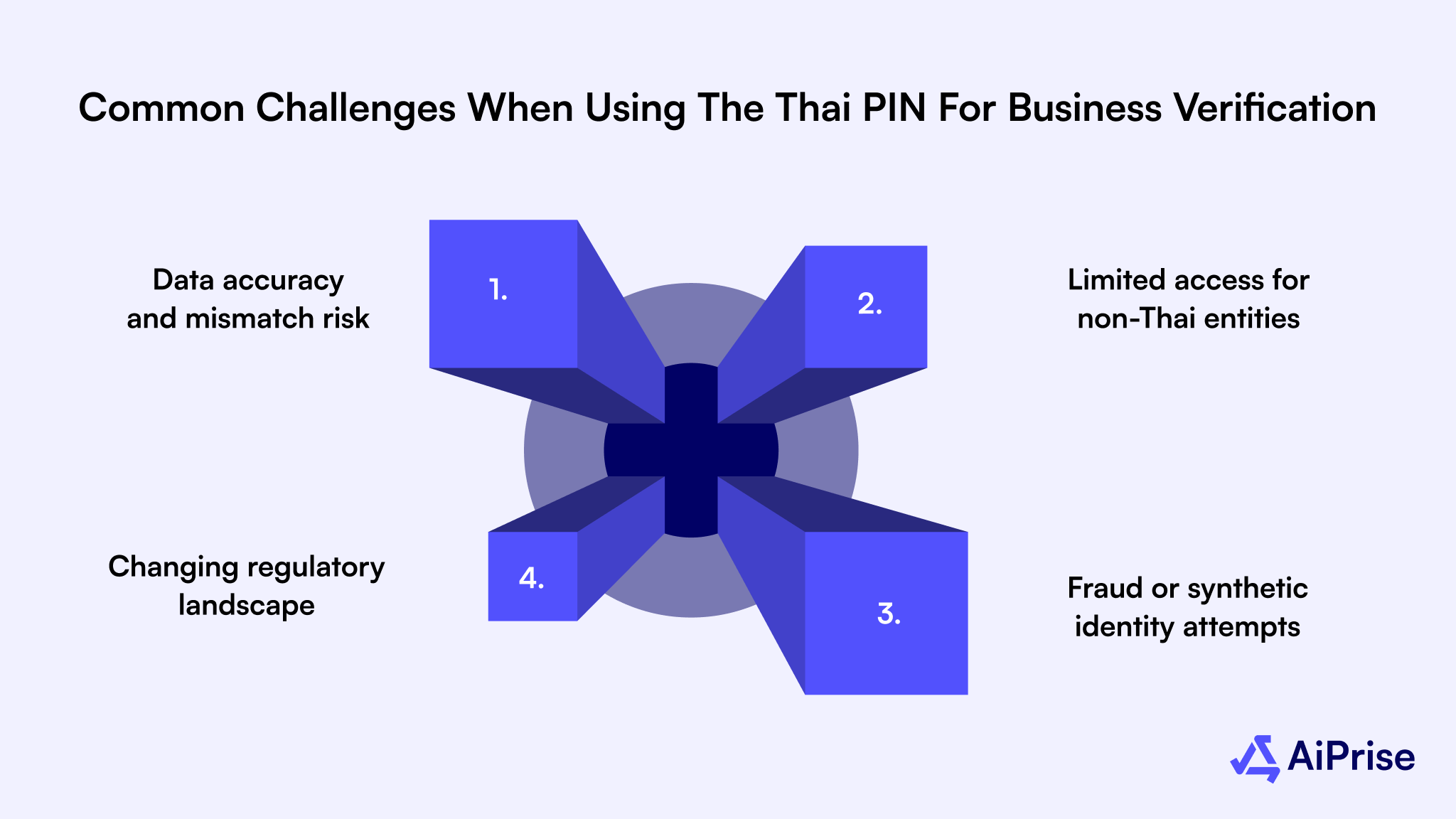
Here are the main challenges and how you can prepare for them:
- Data accuracy and mismatch risk: Records tied to the PIN may have spelling errors, outdated addresses, or registration discrepancies. Mitigation: Use multi-factor verification (document + biometric check + PIN cross-match) rather than relying solely on the PIN.
- Limited access for non-Thai entities: Businesses based outside Thailand, or onboarding foreign nationals, may struggle to access government databases tied to the PIN. Mitigation: Work with local compliant verification providers who have official access and translation capabilities.
- Fraud or synthetic identity attempts: Even with a valid PIN, a malicious actor may submit real-looking IDs or match minimal details. Mitigation: Incorporate fraud-detection algorithms, transaction behaviour analytics, and real-time screen checks in your workflow.
- Changing regulatory landscape: Thailand’s regulations around digital identity, sanctions lists, and AML continue to evolve (especially as the country deepens its fintech appetite). Mitigation: Build flexible verification systems that can incorporate new data sources or compliance rules without a full platform rebuild.
To tackle those challenges effectively, many organizations turn to advanced compliance technology designed to simplify complex verification workflows, and that’s where AiPrise steps in.
AiPrise: Platform Features for PIN Verification
A single platform designed to help verify Thai PINs, stop fraud, and keep compliance airtight across global operations.
Here are the core capabilities and features that make onboarding faster, safer, and more scalable:
- One API, multiple partners: Connect to local identity vendors worldwide through a single integration, enabling redundant verification paths and higher reliability for Thai PIN checks.
- Customizable onboarding flow: Design and tweak the onboarding journey with drag-and-drop modules and branded forms to match local expectations and reduce drop-offs.
- One-Click KYC: Perform rapid KYC using just an ID number and a selfie, where supported, cutting manual steps and improving approval rates for Thai nationals.
- Global document verification: Verify thousands of local ID types, including Thai national ID cards, in under 30 seconds using OCR and MRZ/barcode crosschecks.
- Biometric + liveness checks: Combine facial recognition, 1:N face match, and real-time liveness verification to block impersonation and deepfake attacks during PIN validation.
- 100+ data sources & registry checks: Cross-reference the Thai PIN against government registries and multiple data providers to reduce false positives and increase match confidence.
- Extensive coverage metrics: Access large-scale reference pools (500M+ verifiable businesses, 5B+ verifiable users, coverage across 200+ countries) to support cross-border risk decisions.
- Risk-based decisioning & dynamic scoring: Apply custom rules and real-time risk scores so higher-risk PINs trigger step-up KYC or enhanced due diligence automatically.
- Compliance Co-Pilot (AI): Utilize AI to slash manual review time, generate EDD reports, and extract insights from incorporation documents and shareholding structures.
- Watchlist & sanctions screening: Automate PEP, sanctions, and adverse-media checks against global lists to ensure PINs and related parties aren’t flagged.
- Continuous monitoring & re-verification: Keep verified PINs under ongoing surveillance for address changes, sanctions hits, or suspicious activity, triggering reverification where needed.
- Comprehensive KYB & UBO checks: Validate business registrations, uncover ultimate beneficial owners, and layer social/website signals to build a full risk profile.
- Smart document analysis & case management: Extract key fields from documents automatically and route exceptions to a unified dashboard for quick human review and audit trails.
- Vendor consolidation & cost efficiency: Replace multiple point solutions with one platform to cut vendor overhead, reduce latency, and simplify compliance contracts.
- Branded, user-friendly UX features: Offer save-and-resume onboarding, custom theming, and localized language support to improve completion rates for Thai customers.
These capabilities are built to help firms verify Thai PINs reliably, reduce fraud losses, and demonstrate KYC/KYB/AML compliance with clear audit trails, all while keeping the onboarding experience fast and customer-friendly.
Wrapping Up
By adopting Thai PIN verification, your team can dramatically reduce fraud, speed onboarding, and strengthen compliance. That practical step helps your operations build trusted customer relationships while avoiding costly regulatory penalties and delays. AiPrise gives your team a unified platform that combines Thai PIN verification, biometrics, and global data sources.
Book A Demo to see how it accelerates onboarding, reduces manual reviews, and keeps AML and PDPA obligations in check.
Frequently Asked Questions (FAQs)
1. What is the Thai Personal Identification Number (PIN)?
The Thai PIN is a 13-digit number issued by the Department of Provincial Administration (DOPA) to every Thai citizen and some legal residents. It serves as a national identifier used for tax filing, banking, and government transactions.
2. How can a business verify a Thai PIN online?
Verification can be done through government-authorized portals or licensed third-party verification providers that access DOPA’s citizen registry. These systems cross-check the PIN with personal details like name and birthdate to confirm authenticity.
3. Is it legal for foreign businesses to verify Thai PINs?
Yes, as long as the verification process complies with Thailand’s Personal Data Protection Act (PDPA). Foreign entities must use approved providers or local partners with proper data-handling permissions.
4. Why is the Thai PIN important for business verification?
The PIN acts as an official, government-backed identifier that reduces fraud risk and ensures KYC/KYB accuracy. It helps confirm the legitimacy of customers, partners, or suppliers during onboarding.
5. What documents are needed to verify a Thai PIN?
Usually, a valid Thai national ID card is required, showing the 13-digit PIN, along with supporting details such as name, address, and date of birth. For foreigners, a passport or work permit may be needed.
6. Can the Thai PIN be used for company verification (KYB)?
Not directly. The Thai PIN applies to individuals, while businesses are verified using a Tax Identification Number (TIN) or company registration number issued by the Department of Business Development (DBD). However, verifying owners and directors via their PINs enhances KYB reliability.
You might want to read these...








.jpeg)


.jpg)
















.jpeg)







.png)




.png)










AiPrise’s data coverage and AI agents were the deciding factors for us. They’ve made our onboarding 80% faster. It is also a very intuitive platform.

Head of Operations



See your full compliance picture in one place
Use AI agents and global data to review businesses and users faster and more accurately
