

AiPrise
10 min read
January 12, 2026
How to Automate KYC and Eliminate Manual Verification?

Key Takeaways

Do manual KYC processes slow onboarding, frustrate customers, and quietly expose your compliance teams to growing regulatory and operational risk?
As customer volumes rise, manual checks create bottlenecks, increase human error, and weaken fraud detection capabilities. This growing pressure explains why many regulated businesses now aim to replace manual KYC checks with automated verification workflows. In 2025, FinCEN assessed a $3,500,000 civil penalty against Paxful for KYC and AML compliance failures.
Understanding KYC automation helps you avoid similar enforcement risks while improving onboarding speed and regulatory consistency. It also equips you to build verification processes that scale efficiently without compromising accuracy, trust, or compliance expectations.
Quick Overview
- Manual KYC slows onboarding, increases errors, and raises compliance risk as customer volumes and regulatory scrutiny continue to grow.
- KYC automation replaces manual reviews with digital identity checks, biometric verification, and real-time risk assessment workflows.
- Automated KYC improves onboarding speed, consistency, fraud detection, audit readiness, and long-term regulatory adaptability.
- Financial institutions, fintech platforms, payments, crypto, insurance, and lending providers use automated KYC to scale securely and efficiently.
What Is KYC Automation?
KYC automation is the use of technology to digitally verify customer identities without relying on time-consuming manual reviews. It replaces repetitive human checks with automated workflows that validate documents, identities, and risk indicators in real time. This approach helps you onboard customers faster while maintaining accuracy, consistency, and regulatory compliance across verification processes.
Key Components of KYC Automation
KYC automation relies on interconnected technologies that replace manual identity checks with faster, more consistent verification workflows.
Here are the essential components that enable businesses to automate KYC checks effectively and reduce operational dependency on human review.
- Digital identity data capture systems automatically collect customer information securely during onboarding without manual data entry delays.
- Document verification technology validates government-issued IDs like passports and driver’s licenses using OCR and authenticity checks.
- Biometric verification tools confirm identity ownership through facial recognition and liveness detection during remote onboarding processes.
- Risk assessment engines analyze customer data against fraud indicators, sanctions lists, and regulatory watchlists in real time.
- Workflow automation orchestrates verification steps seamlessly, ensuring consistent compliance outcomes across high-volume onboarding operations.
Also read: Understanding Identity Verification (IDV) and its Significance

Once you see how automated KYC functions, the limitations of manual verification become much harder to ignore.
Why Replace Manual KYC Checks?
Manual KYC processes struggle to meet modern compliance demands while supporting scale, speed, and consistent risk management.
Here are the primary reasons regulated businesses aim to replace manual KYC checks with automated verification systems.
- Manual reviews significantly increase onboarding time, causing customer drop-offs and lost revenue opportunities during critical acquisition stages.
- Human-led verification introduces inconsistencies and errors that weaken audit trails and regulatory defensibility over time.
- Scaling manual KYC teams increases operational costs while failing to match onboarding spikes or seasonal demand surges.
- Regulatory expectations now require real-time monitoring, which manual processes cannot reliably deliver without automation support.
These challenges become even clearer when manual and automated KYC approaches are viewed side by side.
Manual vs Automated KYC
Manual and automated KYC approaches differ significantly in efficiency, accuracy, scalability, and long-term compliance sustainability.
The comparison below highlights how automation fundamentally improves verification outcomes across operational and regulatory dimensions.
Beyond surface-level differences, automation delivers tangible business outcomes that extend far past faster onboarding.
Core Benefits of Replacing Manual KYC Checks
Replacing manual KYC checks delivers measurable improvements across compliance, operational efficiency, and customer onboarding experiences.
.png)
Here is how automated KYC directly impacts business performance and regulatory confidence.
1. Faster Customer Onboarding
Automated KYC significantly reduces onboarding time by eliminating manual document reviews and repetitive data validation steps. This improvement helps you convert more users during initial sign-up without sacrificing verification accuracy or regulatory compliance. Faster onboarding also strengthens customer satisfaction by removing friction from identity verification journeys.
2. Reduced Compliance Risk
Automation enforces consistent verification rules, minimizing gaps that often trigger regulatory scrutiny or enforcement actions. Continuous monitoring ensures customer profiles remain compliant as regulations and risk profiles evolve over time. This consistency strengthens audit readiness and reduces dependency on reactive compliance remediation efforts.
3. Lower Operational Costs
Automated workflows reduce reliance on large compliance teams while handling higher onboarding volumes efficiently. Cost savings increase as manual rework, exception handling, and verification backlogs decline. This allows compliance budgets to shift toward strategic risk management initiatives instead of repetitive verification tasks.
4. Improved Audit Readiness
Automated KYC creates standardized digital audit trails that simplify regulatory examinations and internal compliance reporting processes. This significantly reduces audit preparation time while improving confidence in verification accuracy and documentation completeness. Stronger audit readiness helps you avoid penalties caused by missing records or inconsistent manual compliance practices.
5. Enhanced Fraud Detection Accuracy
Automation applies consistent risk rules across customers, with AiPrise fraud and risk scoring reducing loopholes in manual workflows. AiPrise fraud and risk scoring identifies suspicious behavioral patterns earlier without relying solely on subjective human judgment. This proactive detection approach strengthens fraud prevention while preserving onboarding speed and meeting regulatory compliance standards.
6. Better Regulatory Adaptability
Automated KYC systems adjust faster to regulatory updates without requiring frequent operational or workflow redesigns. This adaptability helps you remain compliant as AML and KYC requirements evolve across jurisdictions. Improved flexibility reduces long-term compliance pressure and prevents rushed, last-minute operational changes.
Also read: Online Identity Verification Methods: 7 Different Types
The next concern most teams face is how to adopt automation without interrupting existing compliance operations.
How to Automate KYC Without Disruption
Automating KYC without disruption requires a structured, phased approach that preserves compliance continuity while improving operational efficiency.
Here is how you can replace manual KYC checks smoothly using automation, without breaking existing onboarding or compliance workflows.
- Start by assessing existing KYC workflows
- Review current manual verification steps to identify repetitive, time-consuming tasks suitable for immediate automation.
- Map compliance checkpoints carefully to ensure automation aligns with existing regulatory obligations and internal audit expectations.
- Implement automation in phases, not all at once
- Begin with low-risk customer segments to validate automated KYC accuracy before scaling across higher-risk onboarding flows.
- Gradual rollout reduces operational shock and allows teams to adapt confidently to new verification processes.
- Maintain human oversight for high-risk cases
- Use automation to handle routine identity checks while reserving manual reviews for flagged or complex cases.
- This hybrid approach ensures compliance teams retain control during the transition from manual KYC checks.
- Integrate automation with existing systems
- Connect KYC automation tools with CRM, onboarding, and compliance platforms to avoid fragmented workflows.
- Seamless integration prevents duplicate data entry and reduces friction across customer verification journeys.
- Train compliance and operations teams early
- Educate teams on how automated KYC decisions are generated to build trust and operational confidence.
- Clear training minimizes resistance and ensures consistent handling of automated verification outcomes.
- Monitor performance and refine continuously
- Track onboarding speed, error rates, and compliance exceptions to measure automation effectiveness.
- Continuous optimization helps you fully replace manual KYC checks without compromising regulatory or customer experience standards.
AiPrise enables you to automate KYC without disruption by embedding AI-driven verification, fraud detection, and risk scoring directly into existing workflows.
Once implemented correctly, automated KYC starts delivering value across multiple industries and onboarding scenarios.
Automated KYC Use Cases
Automated KYC supports diverse industries by adapting verification workflows to different risk profiles and regulatory requirements.
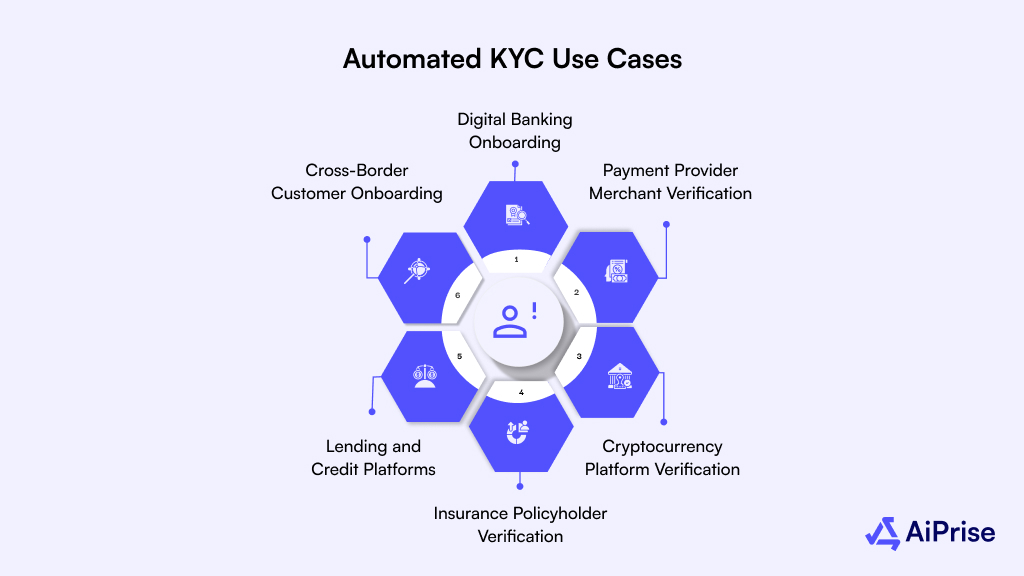
Below are practical use cases demonstrating how automation replaces manual KYC checks across regulated sectors.
1. Digital Banking Onboarding
Banks use automated KYC to verify customer identities instantly during account creation without branch visits.
This approach reduces abandonment rates while maintaining strict adherence to banking compliance regulations.
Automated checks also enable faster expansion into digital-first customer segments.
2. Payment Provider Merchant Verification
Payment platforms automate merchant KYC to validate business legitimacy before transaction processing begins. This reduces fraud exposure while accelerating merchant onboarding timelines. Automation supports scalable growth without increasing manual compliance overhead.
3. Cryptocurrency Platform Verification
Crypto platforms rely on automated KYC to meet AML requirements while supporting global user onboarding. Real-time risk screening helps detect suspicious activity early without delaying legitimate users. This balance improves regulatory trust while preserving platform growth velocity.
4. Insurance Policyholder Verification
Insurance providers use automated KYC to verify policyholders quickly during digital policy issuance and claims processing. This approach reduces identity fraud while improving customer experience during high-stress, time-sensitive insurance interactions. Automation also ensures compliance with industry-specific identity verification and anti-fraud regulatory requirements.
5. Lending and Credit Platforms
Lending platforms automate KYC to validate borrower identities before approving loans or issuing credit products. This ensures regulatory compliance while accelerating approval timelines and reducing manual underwriting review delays. Faster identity verification improves borrower satisfaction and increases overall loan conversion rates.
6. Cross-Border Customer Onboarding
Automated KYC enables global platforms to verify international customers without relying on region-specific manual workflows. This supports consistent compliance across jurisdictions while significantly reducing operational and staffing complexity. Automation makes international expansion scalable without increasing compliance headcount or verification costs.
Also read: Understanding Your Customers - 3 Simple Steps to KYC
Supporting these use cases effectively depends on choosing the right category of tools for your verification needs.
KYC Automation Tools
KYC automation tools provide the infrastructure required to replace manual verification with scalable, compliant digital processes.
Here are the primary categories businesses evaluate when selecting KYC automation solutions.
- Identity verification platforms like Aiprise validate individuals using document checks, biometrics, and liveness detection technologies.
- Business verification tools support KYB workflows by validating company registration, ownership, and beneficial ownership structures.
- Sanctions and watchlist screening systems automate checks against global regulatory and enforcement databases continuously.
- Workflow orchestration tools manage verification steps, exception handling, and audit trails across onboarding lifecycles.
Understanding tool categories sets the stage for seeing how an integrated platform brings everything together in practice.
How to Automate KYC at Scale Using AI-Driven Verification and Compliance Tools
This section explains how a unified AI-driven platform helps you replace manual KYC checks with scalable, compliant automation.
Here is how AiPrise supports KYC automation through purpose-built products and compliance-focused features.
- AiPrise Identity Verification automates document checks using OCR, liveness detection, and biometric matching for real-time onboarding accuracy.
- AiPrise Fraud and Risk Scoring analyzes behavioral signals and risk indicators to detect suspicious activity early during verification workflows.
- AiPrise AML Screening continuously monitors customers against sanctions, PEP lists, and watchlists to maintain regulatory compliance.
- AiPrise KYB Verification validates business entities, ownership structures, and beneficial owners to reduce commercial and financial crime risks.
- AiPrise Workflow Automation orchestrates KYC processes end-to-end, reducing manual intervention while ensuring consistent compliance outcomes.
- AiPrise API and SDK integrations embed automated KYC seamlessly into existing onboarding systems without disrupting operational workflows.
Wrapping Up
Replacing manual KYC checks with automation helps you accelerate onboarding, reduce compliance risk, and operate efficiently in regulated environments. Understanding KYC automation empowers you to build scalable verification processes that balance speed, accuracy, and evolving regulatory expectations. AiPrise helps you achieve this through AI-driven KYC automation, fraud risk scoring, and continuous compliance monitoring.
If improving onboarding efficiency and reducing verification risk matters to your business, Book A Demo to see KYC automation in action.
FAQs
1. What is KYC automation, and how does it work?
KYC automation uses technology to verify customer identities digitally, replacing manual reviews with faster, rule-based verification workflows. It works by combining document verification, biometric checks, and automated risk assessment within integrated onboarding systems.
2. Is automated KYC compliant with US regulations?
Automated KYC is compliant when systems follow US regulatory requirements like AML laws and maintain auditable verification records. Automation helps you apply consistent compliance rules while adapting quickly to regulatory updates and enforcement expectations.
3. What documents are required for KYC automation?
KYC automation typically requires government-issued identification such as passports, driver’s licenses, or national identity cards. Business verification may also require registration certificates, ownership documents, and beneficial ownership information for compliance purposes.
4. Can automated KYC completely replace manual verification?
Automated KYC replaces most manual checks but usually retains human review for high-risk or exception-based cases. This hybrid approach ensures efficiency while maintaining control over complex compliance and fraud scenarios.
5. How does KYC automation reduce onboarding time?
Automation eliminates repetitive manual reviews by validating identities and risk signals in real time during onboarding. This significantly shortens approval cycles, helping you onboard customers faster without compromising compliance accuracy.
You might want to read these...








.jpeg)


.jpg)
















.jpeg)








.png)



.png)










AiPrise’s data coverage and AI agents were the deciding factors for us. They’ve made our onboarding 80% faster. It is also a very intuitive platform.

Head of Operations



See your full compliance picture in one place
Use AI agents and global data to review businesses and users faster and more accurately
