

AiPrise
11 min read
January 19, 2026
6 Types of Sanctions in KYC You Must Know to Avoid Penalties
.jpg)
Key Takeaways

Sanctions failures rarely happen after an account is live. They happen at onboarding. A missed signal or weak rule can quietly allow risk in or block the wrong customer. Compliance teams face rising false positives. Growth teams see good users drop off. In H1 2025, regulators issued US$228.8 million in sanctions-related penalties worldwide, showing how costly early mistakes can be.
Types of sanctions in KYC are legally enforced restrictions that apply to countries, individuals, businesses, and beneficial owners. They decide who can be onboarded, paid, or retained. Are sanctions only about countries, or do they extend to people behind an account?
In the US, sanctions screening evolved from manual checks to automated, risk-based monitoring. Yet friction persists. 67% of banks worldwide have lost clients due to slow, inefficient onboarding, underscoring onboarding as a critical control point in KYC and fraud prevention.
Key Takeaways
- Sanctions failures start with onboarding logic, not bad actors. Most penalties trace back to weak screening design, incomplete ownership checks, or static rules applied too early in the customer journey.
- Types of sanctions in KYC demand different controls, not one rulebook. Economic, financial, sectoral, and jurisdiction-based sanctions trigger distinct actions, ranging from hard stops to enhanced review.
- Ownership and control exposure is where most programs break. Clean-looking entities often mask sanctioned risk through UBOs, layered holdings, or governance roles that surface only with deeper checks.
- Screening once is not screening at all. Real exposure appears after onboarding through list updates, ownership changes, new corridors, or transaction counterparties.
- Scalable compliance depends on orchestration, not manual effort. Programs that unify data sources, apply risk-based decisions, and support reviewers consistently outperform checklist-driven setups.
What Sanctions Mean in KYC and Why They Matter
Sanctions in a KYC context are legally binding restrictions that prevent you from onboarding, paying, or maintaining relationships with prohibited parties. These controls are enforced by regulators with strict liability. If a sanctioned party enters your system, enforcement action follows regardless of intent or transaction size.
Sanctions translate into concrete system actions across onboarding and account activity.
This is how sanctions operate inside KYC programs:
- Onboarding blocks occur when an applicant, business name, or beneficial owner matches a sanctions list. Your system must stop account creation until the match is resolved or rejected.
- Transaction restrictions apply when payments involve sanctioned entities, countries, or sectors. Even indirect exposure through intermediaries can trigger automatic declines.
- Account freezes are required when sanctions apply after onboarding, forcing you to lock funds, halt activity, and notify regulators.
Sanctions controls work at two levels:
- The sanction lists screen specific individuals and entities using names, aliases, and identifiers.
- Sanctions regimes restrict entire jurisdictions, industries, or activities.
Screening must cover individuals, businesses, beneficial owners, and jurisdictions consistently.
Also Read: 3 Essential Components of KYC
Why Understanding Types of Sanctions in KYC Is Operationally Critical
Sanctions management is an operational risk issue, not a compliance checkbox. When your systems misinterpret sanctions, the impact shows up immediately as delayed onboarding, blocked payments, and escalations that overwhelm review teams. Each sanctions category carries different legal triggers, response requirements, and escalation paths. Treating them as a single rule set creates friction for legitimate users and blind spots for real exposure.
Different sanction types activate different controls inside your stack:
- Economic and financial sanctions require hard stops at onboarding and payment execution, including account blocks and asset freezes.
- Jurisdiction-based sanctions trigger country-level restrictions that affect entire customer segments and transaction corridors.
- Sector and activity-based sanctions require enhanced due diligence rather than outright rejection, especially for trade and platform clients.
Uniform handling increases risk and cost:
- Overblocking low-risk cases inflates false positives and user drop-off.
- Under-screening high-risk categories leads to reportable violations.
A 2024 AML technology survey found that false positives account for over 90% of sanctions and transaction-monitoring alerts, driving up investigation workload and compliance costs.
Frequent mismatches, slow reviews and inflate alert volumes. AiPrise helps reduce false positives by combining clearer identity signals, adaptive risk scoring, and continuously updated sanctions data.
The 6 Types of Sanctions in KYC You Must Know
Sanctions in KYC are not uniform controls. Each type restricts access to financial systems in a different way. When you understand how each category functions, you can apply the right control at the right stage without over-blocking legitimate users or missing real exposure.
The table below helps you map each sanction type to its practical impact so you can apply the correct control without adding friction. Use this comparison to align screening, onboarding decisions, and monitoring rules:
This operational view helps you apply proportionate controls instead of relying on blanket restrictions.
Also Read: Comprehensive Guide To Sanctions Checks For Compliance
1. Economic Sanctions in KYC
Economic sanctions are the most impactful category for KYC because they directly restrict financial access across countries, entities, and individuals. You encounter them most often during onboarding and payment screening, especially in cross-border activity. These sanctions are legally binding and require immediate enforcement once exposure is confirmed.
How economic sanctions are issued and applied:
- Governments impose them through national authorities or international bodies to restrict trade, finance, or investment.
- In the US, enforcement and list publication are handled by the Office of Foreign Assets Control.
- Sanctions may apply to entire jurisdictions, specific sectors, named entities, or individuals and their ownership networks.
What you need to screen for in KYC:
- Customer country of residence, incorporation, or operation.
- Beneficial owners with direct or indirect ownership in sanctioned regions.
- Counterparties involved in trade, payments, or settlement flows.
- Transaction corridors linked to restricted countries or banks.
How economic sanctions affect your systems:
- Onboarding must stop when a confirmed match exists at the customer or UBO level.
- Transactions must be blocked when payments touch sanctioned countries, banks, or entities.
- Assets must be frozen if funds are linked to sanctioned ownership or control.
Public resources you should rely on:
- OFAC Sanctions Lists for SDN and sectoral sanctions.
- United Nations Security Council sanctions lists for global exposure.
- Government advisories tied to specific sanction programs and countries.
Economic sanctions require precise matching and ownership analysis. Treating them as simple country blocks increases false positives and leaves indirect exposure undetected.
Managing economic sanctions at scale requires more than country blocking. AiPrise supports ownership-aware screening and jurisdiction logic through a unified sanctions and identity decision layer.

2. Financial Sanctions in KYC
Financial sanctions are a money and asset–focused application of economic sanctions. You encounter them when regulators restrict access to accounts, payments, securities, or financial infrastructure. These sanctions trigger immediate, non-negotiable controls once exposure is confirmed.
How financial sanctions are issued and applied:
- Authorities impose them to cut off sanctioned parties from banks, payment rails, and capital markets.
- In the US, enforcement and updates are managed by the Office of Foreign Assets Control.
- Financial sanctions often target individuals, companies, vessels, banks, or specific financial instruments rather than entire countries.
What you need to screen for in KYC and payments:
- Customer and UBO names, aliases, and identifiers linked to blocked parties.
- Bank identifiers, correspondent banks, and payment intermediaries.
- Ownership or control relationships that reach sanctioned persons.
- Source of funds and destination of funds connected to restricted entities.
How financial sanctions affect your systems:
- Accounts must be frozen the moment a confirmed match exists.
- Payments must be blocked or rejected before settlement.
- Reporting obligations are triggered, including regulator notifications and audit logs.
Public resources you should rely on:
- OFAC Specially Designated Nationals List for individuals and entities.
- OFAC Consolidated Sanctions List for program-wide coverage.
- Regulatory guidance from national financial authorities on blocking and reporting thresholds.
Financial sanctions demand real-time screening and ownership transparency. Delays or partial checks expose you to immediate enforcement risk.
3. Diplomatic Sanctions in KYC
Diplomatic sanctions act as an early risk signal rather than an immediate financial prohibition. You encounter them when governments formally restrict political or diplomatic engagement with another state or its officials. While they may not always mandate account blocking, they raise jurisdiction and counterparty risk across your onboarding stack.
How diplomatic sanctions are issued and applied:
- Governments impose them through foreign policy actions such as suspending diplomatic relations or limiting official engagement.
- In the US, announcements and policy direction often originate from the U.S. Department of State.
- Multilateral diplomatic sanctions may also be issued through the United Nations Security Council.
What you need to watch for in KYC screening:
- Customers or businesses linked to sanctioned governments or state-owned entities.
- Politically exposed persons connected to restricted regimes.
- Transactions involving government agencies or state-controlled organizations.
- Sudden changes in country risk ratings tied to diplomatic actions.
How diplomatic sanctions affect your controls:
- Country risk scores must be elevated during onboarding.
- Enhanced due diligence becomes mandatory instead of standard checks.
- Transaction monitoring thresholds often tighten for affected regions.
Public resources you should rely on:
- Official sanctions and advisory releases from the U.S. Department of State.
- United Nations sanctions resolutions and country notices.
- Government risk advisories published by national regulators.
Diplomatic sanctions rarely act alone. They often precede economic or financial sanctions, making early risk escalation critical in KYC programs.
4. Military Sanctions in KYC
Military sanctions apply to activities connected to defense, weapons, and sensitive technologies. You encounter them when onboarding or servicing customers involved in manufacturing, trading, financing, or transporting restricted goods. These sanctions are narrow in scope but carry a high enforcement risk when missed.
How military sanctions are issued and applied:
- Governments impose them to restrict access to weapons, defense equipment, and military-grade technology.
- International arms embargoes are commonly authorized by the United Nations Security Council.
- In the US, export and military-use restrictions are enforced through agencies like the Bureau of Industry and Security.
What you need to watch for during KYC and KYB:
- Customers operating in defense manufacturing, aerospace, or weapons supply chains.
- Businesses dealing in dual-use goods that have both civilian and military applications.
- Trade finance, shipping, or logistics providers moving restricted materials.
- Payment flows tied to sanctioned defense contractors or embargoed regions.
How military sanctions affect your controls:
- Onboarding may require sector-level restrictions instead of name-based blocking.
- Enhanced due diligence becomes mandatory for trade-related clients.
- Transaction monitoring must flag goods descriptions, routes, and counterparties.
Public resources you should rely on:
- UN arms embargo listings and country-specific resolutions.
- Export control lists and licensing guidance from the Bureau of Industry and Security.
- National customs and trade compliance advisories
Military sanctions require industry awareness, not just name screening. Missing sector exposure creates regulatory risk even when customers appear clean at first glance.
Also Read: Steps To Perform KYC Compliance Checks
5. Environmental Sanctions in KYC
Environmental sanctions target activities that harm ecosystems, wildlife, or climate stability. You encounter them when onboarding or monitoring customers connected to natural resources, commodities, or cross-border supply chains. These sanctions are enforced through trade restrictions and activity bans rather than simple name matches.
How environmental sanctions are issued and applied:
- Governments and international bodies impose them to restrict commerce linked to environmental harm.
- Multilateral actions are often coordinated through the United Nations Environment Programme.
- In the US, enforcement actions and trade controls are supported by agencies like the U.S. Environmental Protection Agency and customs authorities.
What you need to watch for during KYC and KYB:
- Businesses trading timber, wildlife products, minerals, oil, or agricultural commodities.
- Supply chains connected to deforestation, illegal mining, or wildlife trafficking.
- Importers or exporters operating in regions under environmental trade restrictions.
- Inconsistencies between declared business activity and shipment or trade data.
How environmental sanctions affect your controls:
- Onboarding requires deeper validation of business purpose and supply chain exposure.
- Ongoing monitoring must track changes in trade routes and commodity sources.
- Transaction reviews often focus on goods descriptions rather than counterparties alone.
Public resources you should rely on:
- UN environmental sanctions notices and trade advisories.
- US customs and environmental enforcement bulletins.
- Public databases tracking restricted species, materials, and commodities.
Environmental sanctions demand supply-chain awareness inside KYC. Screening names alone leaves trade-linked exposure undetected.
6. Sporting and Cultural Sanctions in KYC
Sporting and cultural sanctions restrict participation, funding, or representation in international sports, arts, and cultural platforms. You encounter them when onboarding organizations, sponsors, foundations, or individuals tied to sanctioned teams, federations, or cultural bodies. These sanctions rarely block entire accounts but create financial and reputational exposure if ignored.
How sporting and cultural sanctions are issued and applied:
- Governments or international bodies impose them to isolate states or organizations symbolically and economically.
- Enforcement often aligns with decisions by bodies such as the International Olympic Committee or international cultural councils.
- Sanctions may restrict participation, funding, endorsements, or prize-related payments.
What you need to watch for during KYC and payments:
- Sports federations, clubs, or cultural organizations under participation bans.
- Sponsorship entities making payments to sanctioned teams or individuals.
- Foundations or NGOs acting as intermediaries for restricted cultural funding.
- Cross-border payments linked to events, awards, or appearances.
How these sanctions affect your controls:
- Payments may require blocking or additional review even when entities are not criminally sanctioned.
- Onboarding decisions often hinge on reputational and regulatory guidance rather than lists alone.
- Ongoing monitoring is needed as sanctions can change around major events.
Public resources you should rely on:
- Official notices from international sports and cultural bodies.
- Government advisories on restricted participation or funding.
- Public sanction announcements tied to global events.
Sporting and cultural sanctions sit at the intersection of compliance and reputation. Missing them exposes you to regulatory scrutiny and public backlash, even when financial crime risk appears low.
Also Read: End to End KYC Process: A Complete Guide for Compliance and Fraud Prevention
How Sanctions Screening Works Inside a KYC Program
Sanctions screening is a step-by-step workflow, not a single check. You run it at onboarding, at transaction time, and again when profiles or lists change. If you only screen once, exposure builds quietly through ownership changes, new jurisdictions, and updated sanctions designations.
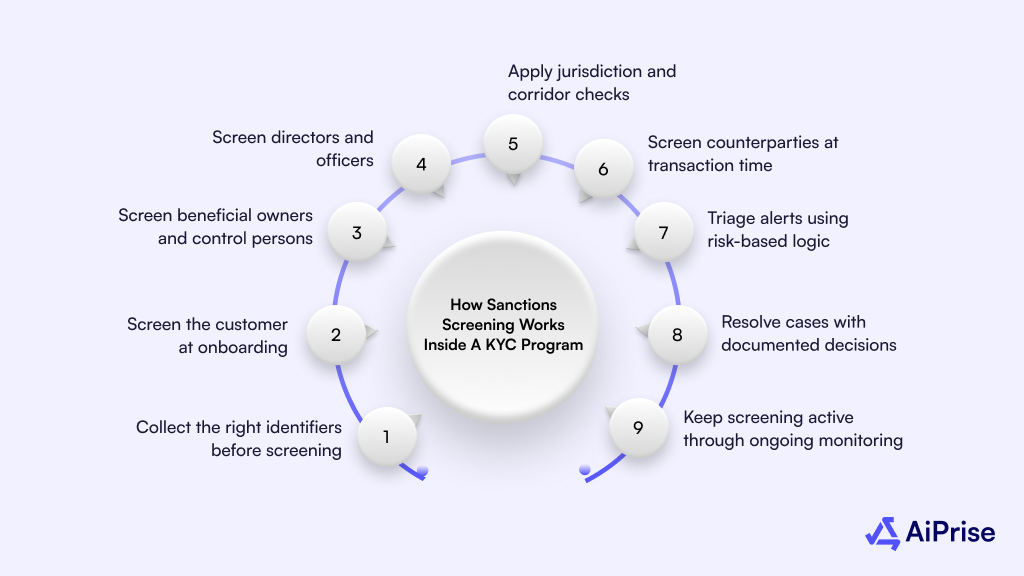
Step-by-step sanctions screening process inside KYC:
- Step 1: Collect the right identifiers before screening
- Capture full legal name, aliases, date of birth or incorporation date, nationality, address, and jurisdiction.
- Look out for missing middle names, initials-only records, and inconsistent spellings across documents.
- Step 2: Screen the customer at onboarding
- Run screening against sanctions lists using name and identifier matching, not name-only.
- Look out for common-name false positives and partial matches that still require review.
- Step 3: Screen beneficial owners and control persons
- Screen UBOs, controllers, and anyone with meaningful control rights, even if they are not the applicant.
- Look out for layered holding companies, nominee directors, and ownership changes right before onboarding.
- Step 4: Screen directors and officers
- Screen directors, officers, and signatories because governance roles can trigger restrictions even when the entity looks clean.
- Look out for shared officers across multiple entities and frequent director churn.
- Step 5: Apply jurisdiction and corridor checks
- Evaluate exposure to sanctioned countries and restricted corridors based on residence, incorporation, operating locations, and expected payment routes.
- Look out for IP geolocation mismatches, high-risk routes, and “registered in one country, operating in another” patterns.
- Step 6: Screen counterparties at transaction time
- Screen payees, senders, intermediary banks, and settlement parties because exposure often appears only when money moves.
- Look out for new counterparties, unusual payment chains, and sudden changes in recipient banks.
- Step 7: Triage alerts using risk-based logic
- Separate likely false positives from higher-risk matches using identifiers, context, and risk scoring.
- Look out for “close match” patterns that repeat across related entities or linked UBOs.
To reduce reviewer fatigue, platforms like AiPrise summarize alerts with contextual signals and document insights, allowing teams to focus on true exposure instead of repetitive checks.
- Step 8: Resolve cases with documented decisions
- Use case management to record evidence, decisions, and approvals so your program can withstand audits.
- Look out for undocumented overrides, inconsistent reviewer notes, and missing escalation trails.
- Step 9: Keep screening active through ongoing monitoring
- Re-screen when the sanctions lists update and when customer profiles change.
- Look out for ownership updates, new jurisdictions, product expansion, and profile edits that should trigger re-screening.
Controls that ensure the program holds up under scrutiny:
- Ongoing monitoring for list updates and profile changes.
- Case management to document alert resolution and reviewer decisions.
- Audit trails aligned with guidance from the Office of Foreign Assets Control.
Also Read: Steps to Know Your Customer (KYC) Compliance and Reducing Fraud
Where Sanctions Failures Commonly Happen and How to Avoid Them
Sanctions failures usually come from system design gaps rather than poor intent. When onboarding volume grows faster than controls, risk slips through unnoticed or legitimate users get blocked.
Common failure points you should watch for include, along with practical fixes:
- Fragmented vendors across regions apply different sanctions lists, update cycles, and match logic, which leads to uneven enforcement and missed exposure when customers operate across borders.
- Fix: Centralize sanctions screening through a single orchestration layer that standardizes lists, match thresholds, and escalation logic across all regions.
- Fix: Centralize sanctions screening through a single orchestration layer that standardizes lists, match thresholds, and escalation logic across all regions.
- Static rules treat low-risk and high-risk profiles the same, inflating false positives while allowing indirect ownership or sector exposure to slip through.
- Fix: Use risk-tiered rules that adjust screening depth based on geography, ownership structure, and transaction behavior.
- Fix: Use risk-tiered rules that adjust screening depth based on geography, ownership structure, and transaction behavior.
- Manual reviews fail to scale with onboarding volume, creating alert backlogs and forcing rushed decisions that increase error rates.
- Fix: Combine automated pre-filtering with structured case workflows so reviewers focus only on high-risk, context-rich alerts.
- Fix: Combine automated pre-filtering with structured case workflows so reviewers focus only on high-risk, context-rich alerts.
- Missing re-verification triggers allow risk to accumulate when ownership changes, new jurisdictions are added, or sanctions lists are updated.
- Fix: Implement event-based re-screening tied to ownership updates, regulatory changes, and periodic review cycles.
These failures often stem from fragmented tooling. AiPrise addresses this by centralizing sanctions screening, risk logic, and case workflows into a single operational control plane.
How AiPrise Supports Sanctions Compliance at Scale
AiPrise functions as a compliance infrastructure, not a checklist tool. You use it to unify sanctions screening, identity verification, and risk controls into a single operational layer that stays active as you scale across regions. This reduces fragmentation while keeping enforcement consistent as regulations change.
AiPrise supports sanctions compliance through:
- Orchestration across data sources, connecting global sanctions lists, identity records, and business registries through one decision layer.
- Risk-based decisioning at onboarding, allowing low-risk users to move fast while applying deeper checks where exposure exists.
- AI-assisted case review, which summarizes documents and alerts so reviewers focus on judgment, not clerical work.
- Continuous monitoring, keeping profiles current as lists, ownership, or risk signals change.
This shift from fragmented checks to unified sanctions orchestration is not theoretical. It is already changing how fast-growing fintechs operate.
A fast-growing neobank serving the African diaspora in Europe used AiPrise to replace fully manual KYC and sanctions screening managed by a lean compliance team. As onboarding volumes increased, manual document review and sanctions checks caused delays, higher risk exposure, and inconsistent decisions.
By integrating AiPrise, the neobank shifted sanctions compliance into a scalable, risk-based workflow without adding headcount.
Key outcomes achieved with AiPrise:
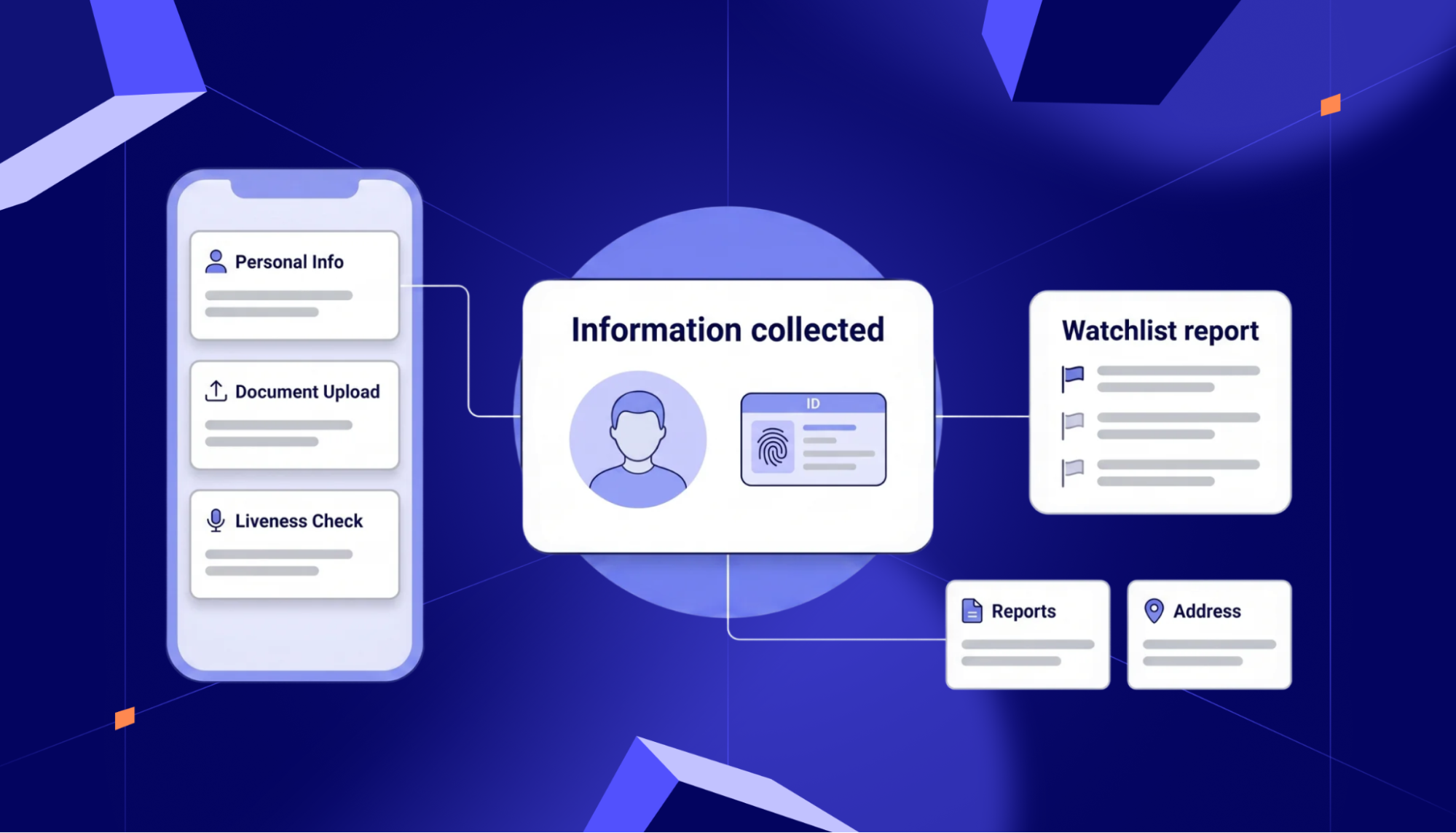
- Automated identity data extraction, biometric checks, and sanctions screening at onboarding.
- Risk-based decisioning that routed only edge cases to human reviewers.
- Faster account approvals and doubled onboarding conversion rates.
- Improved fraud detection through multi-signal screening.
- Consistent sanctions enforcement across jurisdictions without manual overhead.
See how unified sanctions screening fits into a global onboarding flow with AiPrise.
Final Thoughts
Sanctions are dynamic, layered, and rarely confined to a single list or rule. When your KYC program treats them as static checks, you either slow growth or expose the business to enforcement risk. Risk-adaptive onboarding allows you to apply deeper controls only where exposure exists, while legitimate users move through without delay.
This balance requires infrastructure that can unify data, adjust decisions in real time, and support human oversight at scale. AiPrise enables sanctions compliance without friction by aligning screening, risk decisioning, and review into one system. Book A Demo to see how this approach supports growth with control.
FAQs
1. How do sanctions classifications affect alert prioritization in KYC systems?
Different sanctions trigger different urgency levels. You should prioritize asset freezes and payment blocks over jurisdiction risk signals to avoid delayed enforcement.
2. When should sanctions screening move from name matching to ownership analysis?
You shift focus when entities pass initial checks but show layered ownership. Indirect control often surfaces only through UBO and control structure analysis.
3. How do targeted or smart sanctions change onboarding decisions?
Targeted sanctions require precision, not blanket rejection. You allow onboarding while restricting specific activities, sectors, or transaction types linked to the designation.
4. What makes sanctions lists harder to manage than they appear?
Lists change frequently and include aliases, transliterations, and ownership rules. You must track updates and interpret control thresholds, not just names.
5. How do OFAC sanctions impact non-US companies processing dollar transactions?
Any transaction touching the US financial system can trigger exposure. You must screen even offshore customers when USD clearing or US intermediaries are involved through the Office of Foreign Assets Control.
6. Why do sanctions issues surface during payments rather than onboarding?
Counterparties and intermediaries often appear only at transaction time. You need transaction-level screening to catch exposure missed during initial KYC.
You might want to read these...





AiPrise
6 min read
KYB Compliance: 2026 Regulations You Should Know About
As organizations expand globally and face tighter regulations, adherence to Know Your Business (KYB) standards has become one of the most critical compliance layers for fintech, online marketplaces, and other companies that need to verify business customers before letting them perform financial transactions.










.png)

















.png)








.png)
.png)
.png)











.png)

AiPrise’s data coverage and AI agents were the deciding factors for us. They’ve made our onboarding 80% faster. It is also a very intuitive platform.

Head of Operations



See your full compliance picture in one place
Use AI agents and global data to review businesses and users faster and more accurately
