

AiPrise
March 3, 2026
How Biometric One-Click KYC Transforms Onboarding

Key Takeaways

Customer onboarding today demands speed, precision, and strict regulatory compliance from your compliance and product teams. Manual verification delays approvals, increases abandonment, and exposes your platform to costly fraud risks. In the first half of 2025, the U.S. government reported 748,555 identity theft cases, reflecting sharp year-over-year growth.
Growing digital identity abuse intensifies scrutiny from regulators and raises operational pressure across fintech and payments firms. Biometric one-click KYC strengthens onboarding by combining automated identity verification with real-time fraud detection controls. Understanding this transformation helps you accelerate approvals, reduce fraud losses, and maintain regulatory confidence at scale.
Quick Overview
- Biometric one-click KYC verifies identity instantly using facial recognition, liveness detection, and government-issued ID validation in a single flow.
- Traditional KYC relies on manual reviews, increases onboarding delays, and leaves gaps in fraud detection and audit readiness.
- Automated biometric verification reduces synthetic identity fraud, lowers operational costs, and improves approval rates with risk-based controls.
- US regulations require identity verification, recordkeeping, and ongoing AML monitoring, all supported through digital audit trails and real-time screening.
What Is Biometric One-Click KYC?
Biometric one-click KYC is an automated identity verification framework that combines facial recognition, liveness detection, and document authentication into a single, frictionless onboarding action. Unlike traditional verification flows that rely on manual review queues, the biometric KYC process extracts data from government-issued IDs, validates authenticity, and matches live biometrics in real time to produce an instant risk-based decision.
For platforms deploying biometric one-click KYC online, this model reduces onboarding latency, strengthens fraud controls, and supports compliant identity verification without adding operational overhead or approval delays.
Traditional KYC vs Biometric One-Click KYC
Traditional verification models rely on manual reviews and fragmented checks, while biometric one-click KYC delivers automated, risk-based decisions instantly.
Here is how both approaches compare across operational efficiency, fraud prevention strength, and compliance control.
Also read: Understanding Identity Management in KYC Processes
The operational difference is clear, but the fraud landscape explains why this shift is becoming unavoidable.
Why Fintech Onboarding Faces Rising Fraud?
Digital onboarding environments now attract more sophisticated identity attacks, increasing financial and regulatory exposure for growing platforms.
Here are the structural reasons fraud risk continues escalating across fintech onboarding ecosystems.
- Synthetic identity fraud combines real and fabricated data, bypassing static document checks in legacy verification systems.
- Deepfake technology enables attackers to manipulate facial verification systems lacking advanced liveness detection controls.
- Stolen credentials circulate rapidly across dark web marketplaces, accelerating automated account creation attempts.
- Manual KYC queues delay detection, allowing fraudulent accounts to transact before a comprehensive review occurs.
- Fragmented onboarding systems lack real-time biometric cross-validation, weakening early-stage fraud interception mechanisms.
- The IDENT repository holds over 325 million biometric identities, underscoring how biometric intelligence now operates at national infrastructure levels, not at experimental deployment stages.
- Without a fortified biometric KYC process, onboarding environments remain vulnerable to evolving identity manipulation tactics.
- Biometric one-click KYC online reduces these risks by validating identity authenticity before transactional access begins.
Knowing the threats is one thing, but understanding how the verification process works shows how those risks are addressed.
The Biometric KYC Process Explained
The biometric KYC process combines identity authentication, biometric validation, and automated risk scoring into a single secure onboarding framework.
Here is how biometric one-click KYC online executes identity verification with measurable fraud resistance and compliance strength.
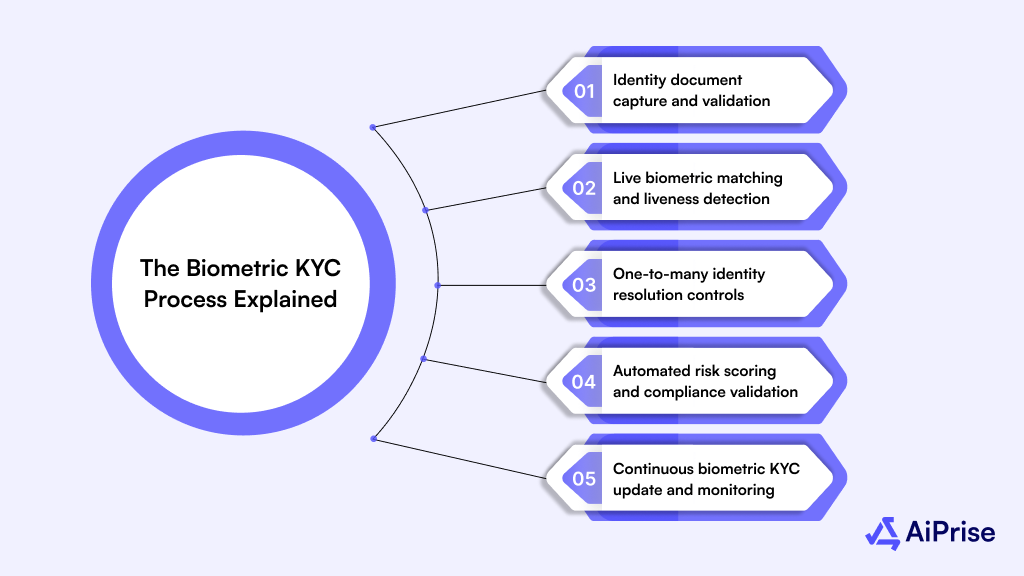
- Identity document capture and validation
- Government-issued IDs such as passports or driver’s licenses are securely captured during onboarding.
- Optical Character Recognition extracts structured data while detecting tampering, forgery patterns, and inconsistencies.
- Live biometric matching and liveness detection
- A live facial scan compares biometric features against the submitted identification document in real time.
- Advanced liveness detection prevents spoofing attempts using static photos, replay attacks, or synthetic media.
- The FBI’s Next Generation Identification system demonstrates biometric algorithm reliability with 99.6% identification accuracy across 189 million master fingerprints.
- One-to-many identity resolution controls
- When one-to-many searches are conducted, federal benchmarks require a minimum false-positive threshold of 1:1,000 or better.
- These standards strengthen risk confidence when biometric one-click KYC for fintech environments scales across large applicant volumes. National Institute of Standards and Technology
- Automated risk scoring and compliance validation
- Identity attributes are screened against sanctions lists, watchlists, and fraud intelligence databases.
- Machine learning models assign dynamic risk scores that trigger approvals or structured compliance escalations.
- Continuous biometric KYC update and monitoring
- Ongoing monitoring revalidates identities against evolving regulatory lists and emerging fraud indicators.
- This ensures sustained AML alignment without introducing friction into approved user journeys.
Also read: End to End KYC Process: A Complete Guide for Compliance and Fraud Prevention
When the mechanics are clear, the next logical question becomes how this translates into measurable business value.
Benefits of One-Click KYC for Fintech
Biometric one-click KYC restructures digital onboarding by accelerating approvals while strengthening fraud controls and regulatory defensibility.
Here are the measurable business advantages that biometric one-click KYC for fintech platforms delivers at scale.
1. Faster Customer Onboarding and Reduced Drop-Off
Biometric one-click KYC online compresses identity verification into seconds, eliminating manual review backlogs and repeated document uploads. Shorter verification cycles reduce abandonment during digital account opening and improve funded account conversion rates. Faster approvals also enhance your customer onboarding strategy by aligning identity checks with real-time transaction intent.
2. Stronger Fraud Detection and Identity Assurance
The biometric KYC process combines document validation, facial recognition, and liveness detection to prevent synthetic identity fraud. Layered identity intelligence reduces exposure to account takeover, mule accounts, and onboarding-stage financial abuse. Stronger fraud detection directly supports your fraud risk management framework and reduces downstream remediation costs.
3. Lower Operational and Compliance Costs
Automated decisioning reduces dependency on large manual compliance teams and repetitive document review workflows. Reduced false positives decreases investigation overhead and protects approval rates during traffic surges. Operational efficiency improvements support scalable AML compliance automation without proportional staffing expansion.
4. Higher Approval Rates With Risk-Based Controls
Risk-based identity scoring ensures legitimate applicants receive instant approvals without unnecessary friction. Improved signal accuracy minimizes conservative rejections that negatively impact revenue growth. Higher precision supports a sustainable digital identity verification model across regulated financial services.
5. Audit Readiness and Regulatory Confidence
Automated verification logs create structured audit trails aligned with Customer Identification Program requirements. Continuous biometric KYC update capabilities strengthen ongoing compliance monitoring and sanction screening controls. Stronger documentation simplifies internal audits and regulatory examinations tied to your KYC and AML compliance program.
Business value alone is not enough; regulatory alignment determines whether onboarding frameworks hold up under scrutiny.
US KYC and AML Compliance Requirements
Federal identity verification rules require financial institutions to validate customer identities and maintain verifiable audit records.
Here are the core regulatory obligations that biometric one-click KYC must support in the United States.
- Customer Identification Program under the Bank Secrecy Act requires collecting name, date of birth, address, and identification number before account activation.
- Financial institutions must verify identity using documentary methods such as passports or driver’s licenses, or approved non-documentary methods.
- The USA PATRIOT Act mandates a reasonable belief that the customer is the individual they claim to be.
- AML obligations require ongoing monitoring of transactions and risk-based identity reassessment beyond initial onboarding approval.
- FinCEN regulations require maintaining records of identity verification procedures for regulatory examination and enforcement review.
- Regulators expect risk-based controls that adapt verification intensity depending on product exposure and customer risk classification.
- Digital audit trails generated through the biometric KYC process provide time-stamped verification evidence for supervisory inspections.
- Biometric one-click KYC online strengthens compliance defensibility by linking identity validation directly to automated AML screening systems.
- Structured identity logs and biometric verification records reduce regulatory exposure during enforcement actions or consent orders.
Also read: KYC Startups: Solutions and Challenges 2026
Compliance obligations vary by sector, which makes real-world applications worth examining across different financial models.
Use Cases for Biometric One-Click KYC Across Financial Services
Biometric one-click KYC supports secure onboarding across regulated financial sectors where speed and compliance must operate together.
Here are the primary environments where biometric one-click KYC online delivers measurable operational and fraud control advantages.
- Banks use the biometric KYC process to accelerate digital account opening while maintaining Customer Identification Program compliance standards.
- Payment providers deploy biometric one-click KYC for fintech ecosystems to prevent merchant onboarding fraud and synthetic identity abuse.
- Cryptocurrency exchanges rely on biometric verification to reduce account takeover risks and strengthen AML monitoring controls.
- Digital lenders implement biometric one-click KYC to validate borrower identity before loan disbursement and credit exposure approval.
- Cross-border fintech platforms integrate biometric identity verification to meet varying regulatory requirements without duplicating onboarding workflows.
- Embedded finance providers apply automated biometric screening to reduce fraud losses while maintaining scalable partner onboarding models.
Use cases demonstrate applicability, but implementation ultimately depends on the technology partner enabling the framework.
How AiPrise Enables Biometric One-Click KYC?
AiPrise delivers an integrated identity verification infrastructure designed to operationalize biometric one-click KYC at scale.
Here are the platform capabilities that directly support secure, compliant, and automated biometric onboarding.
- One Click KYC enables identity verification using an ID number and a live selfie without repeated document uploads.
- Global document verification supports local ID cards, passports, and driver’s licenses across 220+ countries.
- 1:N face match technology detects duplicate identities and blocks repeated fraudulent onboarding attempts.
- Real-time liveness detection prevents spoofing through deepfakes, static images, and replay attacks.
- Government database verification cross-checks identity attributes against official data sources for higher confidence matching.
- Dynamic risk scoring applies customizable rule engines to automate approval, escalation, or enhanced due diligence decisions.
- Automated sanctions screening integrates AML checks directly into the biometric KYC process.
- Onboarding SDKs allow customizable, branded verification flows without disrupting user experience or compliance structure.
These focused capabilities enable biometric one-click KYC for fintech environments to reduce fraud exposure while maintaining regulatory readiness.
Wrapping Up
Biometric one-click KYC is no longer an upgrade but a structural requirement for secure, scalable digital onboarding.
Stronger identity assurance, automated compliance controls, and faster approvals now determine whether your platform grows or absorbs preventable risk. AiPrise enables biometric one-click KYC with integrated identity verification, dynamic risk scoring, and automated AML screening built for regulated growth.
Book A Demo to see how biometric one-click KYC can accelerate onboarding while strengthening fraud and compliance controls.
Frequently Asked Questions
1. What is biometric one-click KYC?
Biometric one-click KYC is an identity verification method that combines facial recognition, liveness detection, and database validation into a single automated onboarding action. It enables instant, risk-based identity decisions without manual review delays.
2. What documents are required for biometric KYC?
Most biometric KYC processes require a government-issued ID such as a passport, driver’s license, or national identity card. Some implementations also support ID-number-based verification combined with a live selfie.
3. Is biometric KYC safe and secure?
Biometric KYC uses encrypted biometric matching, liveness detection, and fraud intelligence checks to prevent spoofing and identity manipulation. When implemented correctly, it reduces exposure to synthetic identity and account takeover risks.
4. How long does biometric KYC take?
Biometric one-click KYC online typically completes within seconds to a few minutes, depending on risk scoring thresholds. Automated validation significantly reduces the waiting time compared to manual KYC reviews.
5. Is biometric verification required for AML compliance in the US?
US regulations require identity verification under the Customer Identification Program and AML rules, but they do not mandate specific technologies. Biometric verification strengthens compliance defensibility by providing stronger identity assurance and digital audit trails.
You might want to read these...







.jpeg)


.jpg)

















.jpeg)







.png)






.png)










AiPrise’s data coverage and AI agents were the deciding factors for us. They’ve made our onboarding 80% faster. It is also a very intuitive platform.

Head of Operations



See your full compliance picture in one place
Use AI agents and global data to review businesses and users faster and more accurately
