Blogs

Recognizing Common Banking and AML Red Flags

November 25, 2025

Recognizing Common Banking and AML Red Flags

Recognizing Common Banking and AML Red Flags

Key Takeaways

Have you ever approved an account that felt legitimate but later triggered serious compliance concerns?

You face onboarding friction, rising fraud, overwhelming false positives, and costly regulatory fines that strain compliance teams' resources. In 2025, FinCEN reported that U.S. institutions filed 4.7 million SARs in FY24, averaging 12,870 per day. Knowing common red flags and strengthening KYC reduces false positives, prevents fraud, and limits regulatory exposure. Read on to learn practical, bank-focused steps you can apply immediately to protect your institution.

Quick Overview

  • Detecting banking red flags early helps prevent fraud, reduce compliance breaches, and protect your institution from costly penalties.
  • Understanding key U.S. AML regulations, from the Bank Secrecy Act to FinCEN’s recent advisories, strengthens your compliance foundation.
  • Building effective KYC and AML programs requires proper ID collection, ongoing monitoring, and dynamic risk assessment to catch anomalies faster.
  • Modern, data-driven monitoring systems outperform traditional models by identifying hidden transaction patterns, reducing false positives, and improving audit readiness.

What are Banking Red Flags?

Banking red flags are operational indicators that suggest increased risk requiring immediate review and verification.
They surface during onboarding, account lifecycles, or transaction monitoring when patterns deviate from expected customer behavior. You should treat these signals as prompts to gather evidence, reassess risk, and escalate appropriately to investigators.

Recognizing them is only the first step; understanding why they matter helps determine how deeply they affect your compliance framework.

Why banking red flags matter?

Banking red flags signal operational anomalies that require immediate investigation to prevent fraud and regulatory breaches. Below are critical reasons why detecting banking red flags protects operations, compliance, and customer trust:

  • Unchecked banking red flags can trigger large regulatory fines, disrupting operations and draining your capital reserves.
  • Missed indicators enable fraudsters to exploit weak KYC controls, resulting in direct losses and reputational damage to your firm.
  • High false positives from poor detection models overwhelm analysts and slow remediation, reducing your team's investigation capacity.
  • Sophisticated schemes like funnel accounts hide through many small transfers, evading static thresholds in your transaction monitoring.
  • Opaque ownership structures frustrate investigations and delay action, especially when UBO verification is incomplete within your process.
  • Persistent compliance failures erode customer trust and make it harder for your institution to maintain partnerships.

To stay ahead of these risks, it’s essential to understand how U.S. AML regulations have evolved and shaped modern banking oversight.

U.S. AML Regulatory Timeline

This timeline shows major U.S. AML milestones that shape how you detect and respond to banking red flags.
Below are key regulatory milestones and obligations your compliance program must reflect to remain effective and audit-ready.

  • The Bank Secrecy Act created reporting obligations and recordkeeping that force banks to watch for suspicious transactions. Over time, regulators expanded expectations, so your AML program must incorporate reporting and monitoring duties.
  • The USA PATRIOT Act strengthened customer identification checks and significantly broadened suspicious-activity reporting across banking channels. Given these legal changes, your onboarding and SAR processes must remain documented, tested, and auditable by examiners.
  • FinCEN’s Customer Due Diligence rule required banks to identify beneficial owners and keep clear ownership records. Failure to gather accurate UBO data creates investigative gaps you will struggle to close during suspicious-activity probes.
  • The Corporate Transparency Act introduced beneficial-ownership reporting to FinCEN, increasing transparency into shell companies and nominee ownership.
    As a result, your compliance workflows must align with BOI reporting rules and verify data before filing.
  • Recent FinCEN advisories and enforcement actions emphasize continuous monitoring, transaction testing, and robust KYC controls for banks. In practice, your teams must perform testing and update detection models to capture evolving banking red flags reliably.

Regulations set the framework, but your frontline control begins with verifying identities and documents correctly.

Also read: Anti Money Laundering (AML) Law: A Complete Guide

Essential IDs And Documents To Collect

Collecting the right IDs and documents prevents banking red flags and speeds accurate risk assessments during onboarding.
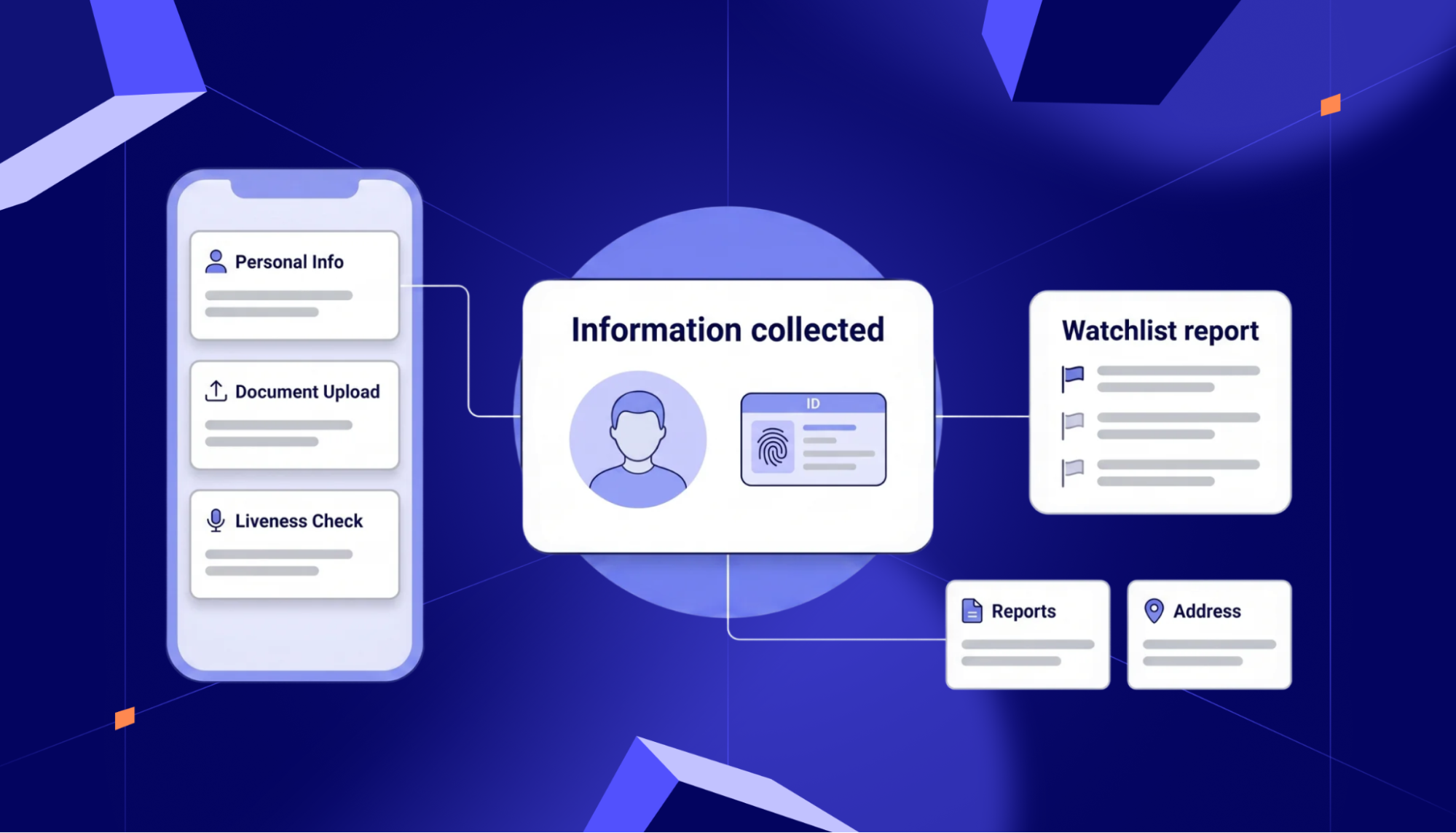
Below are the required individual and business documents that strengthen KYC, KYB, and ongoing AML controls.

  • Government-issued photo ID, such as a passport or driver’s licence, is essential and must be verified robustly.
    Proof of address and liveness checks help confirm identity and reduce synthetic or stolen identity risks.
  • Incorporation documents and articles of association provide legal existence and registration details that banks must verify. Recent bank statements or audited financials demonstrate transactional behavior and validate stated business activity and scale.
  • Collecting UBO names, ownership percentages, and government IDs closes gaps that criminals use to hide control.
    Verify relationships through corporate registries and third-party data to reduce opacity and investigative delays for your team.
  • Source-of-funds documentation, like payment traces, contracts, or bank statements, helps establish legitimacy for high-value accounts. Requesting these documents upfront prevents suspicious gaps and speeds investigations if red flags later emerge.
  • Device fingerprinting, IP history, and biometric hashes add contextual signals that complement document verification in real time. These signals help detect account takeover attempts and link suspicious activity across multiple accounts or channels.
  • Maintain document retention and schedule periodic revalidation to ensure records support investigations and regulatory examinations. Refreshing customer data every 12–24 months reduces stale information and helps catch identity drift or ownership changes.

Once these identification layers are in place, it becomes easier to spot early warning signs that indicate higher financial crime risk.

schedule-your-demo

Major Banking Red Flags

Spotting major banking red flags early protects your institution from financial losses, regulatory penalties, and reputational harm. Here are ten critical patterns that reveal hidden risks across customer onboarding, transactions, and ongoing monitoring:

Major Banking Red Flags

1. Inconsistent Customer Data

When a customer gives vague answers or contradictory data during onboarding, the risk of hidden intent multiplies; such behavior may indicate identity fraud, synthetic identities, or shell entities designed to bypass controls. You should escalate any account where documentation, ownership, or business purpose doesn’t align with expected patterns.

2. Unusual Transaction Volumes

Rapid, large amounts of inbound funds and immediate outbound transfers outside the business model hint at layering or funneling. Transactions significantly deviate from a customer’s known profile, strip out logic, and may signal illicit funds. Your monitoring must spot these anomalies and trigger case reviews; awaiting manual detection only increases exposure.

3. Complex Ownership Structure

Multi-layered companies, frequent beneficial-owner changes, or opaque trusts can mask true control and hide risks. When you struggle to identify a UBO or entity’s business purpose, your bank is exposed to undisclosed liabilities. Strong KYB and entity graph analysis help cut through the complexity and reduce “unknown control” blind spots.

4. High-Risk Jurisdictions

Accounts linked to sanctioned, high-corruption, or weak-supervision jurisdictions amplify your risk and compliance burden. A customer transferring funds through or from such jurisdictions demands enhanced due diligence and monitoring. You must map geography-based risk into your detection rules and escalate suspicious links quickly.

5. Documentation Anomalies

If submitted documents are forged, expired, inconsistent, or lack credible verification, the identity check fails. Missing proof of address or suspicious photo/ID mismatches allow fraudsters to slip through under your nose. Automating document verification and capturing liveness/biometric signals significantly hardens your front-door defences.

6. Sudden Account Activity

Accounts that were quiet then suddenly show high-value flows could indicate takeover, mule use, or funnel transactions. Such bursts of activity deviate from the account history and raise legitimate concerns that warrant immediate review. Your system should flag dormant-to-live transitions and trigger deeper evaluation of source, conduct, and destination.

7. Linked or Shared Accounts

When one individual or entity controls several accounts across your bank or network, risk multiplies. You may encounter parallel deposit streams, then aggregated outflows, indicative of funneling or layering schemes. Establish account linkage analytics to track relationships and patterns across multiple accounts and channels.

8. Cash-Heavy Transactions

Heavy use of cash deposits, travel-related funds, prepaid cards, or untraceable e-wallets increases laundering risk.
Criminals prefer these channels to avoid traditional banking traceability; your controls must account for them.
Integration of payment-rail intelligence and channel-specific thresholds is essential to keep your risk manageable.

9. Abrupt Behavioral Shifts

A customer shifting to a new business line, an unexplained product change, or a transaction type warrants immediate investigation. You may find the account was legitimate until illicit flows started; your detection remains a step behind. Regular refresh of risk profiles and behavioral baselines helps you spot divergence early and reduce blind spots.

10. Weak Ongoing Monitoring

Onboarding checks do not suffice; failure to refresh documentation, screen sanctions, or monitor transactions leaves gaps. When you’re relying on static thresholds or manual review only, you’re potentially missing evolving laundering techniques. Continuous monitoring, automation, and updating your controls are critical to stop red flags from turning into losses.

While these signals expose operational weaknesses, AML red flags uncover deliberate efforts to disguise illicit money flows within your system.

Also read: Understanding User Identity Verification Process

Key AML Red Flags to Watch For

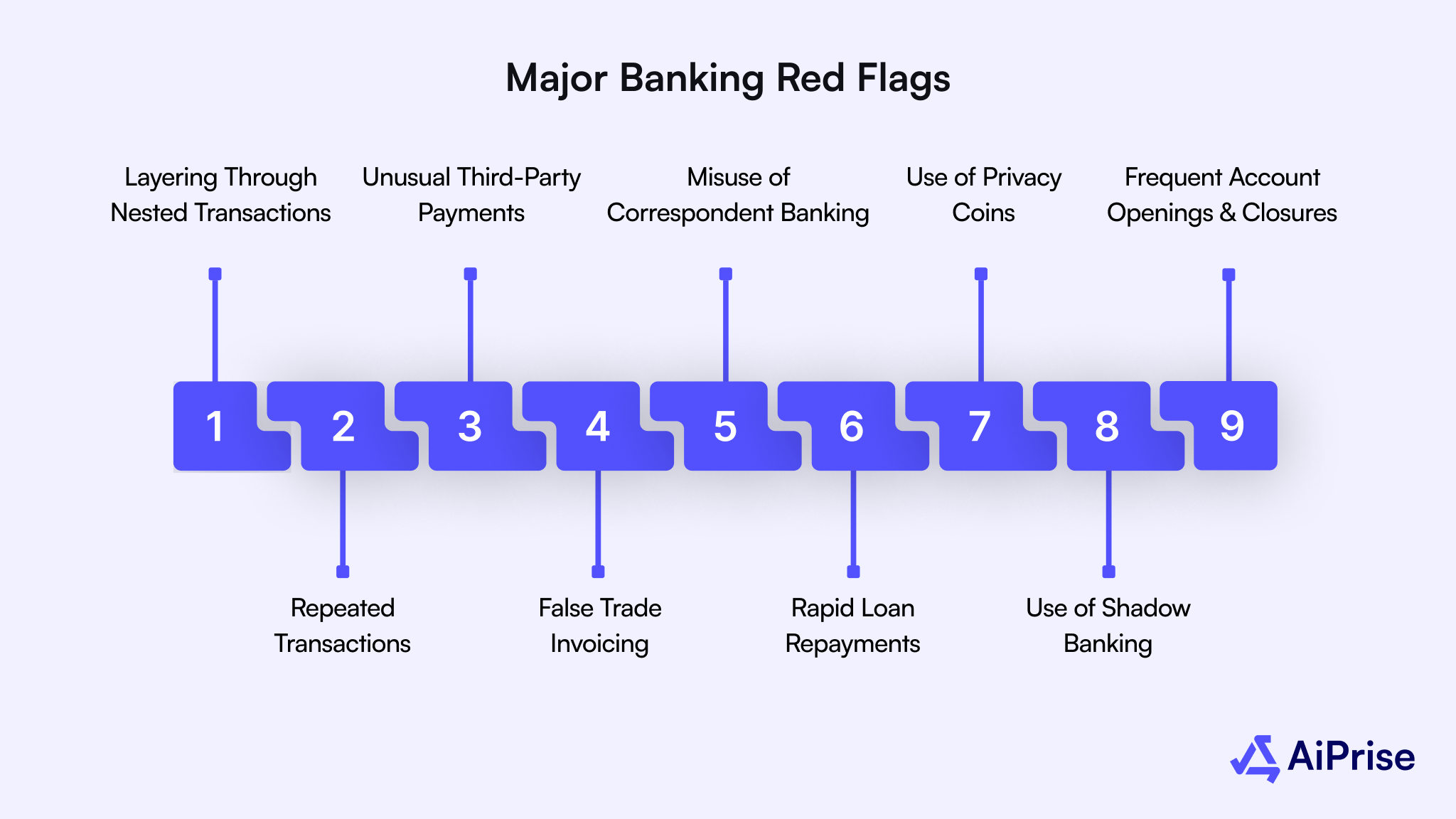
AML red flags go beyond routine banking irregularities; they reveal deliberate attempts to disguise the movement and origin of illicit funds. Here are the distinct behaviors and transaction patterns that commonly signal active money laundering across your network.
Key AML Red Flags to Watch For

1. Layering Through Nested Transactions

Funds passing through multiple intermediary accounts or correspondent banks create confusion around their true origin. This pattern often involves deliberate “nesting” within larger institutions to conceal suspicious flows. Maintaining visibility across intermediaries and enforcing transaction look-through rules helps detect layering before funds exit your system.

2. Repeated Transactions Just Below Reporting Thresholds

Customers who consistently structure deposits or withdrawals to remain below reporting limits may be avoiding detection. This deliberate “smurfing” behavior fragments large sums into smaller transactions to bypass AML thresholds. Automated pattern recognition can identify repeated near-threshold movements that human reviewers might overlook.

3. Unusual Third-Party Payments

Funds transferred to or received from unrelated third parties without clear economic reasoning often indicate laundering channels. Such transfers exploit legitimate accounts as temporary pass-throughs for hidden beneficiaries. Reviewing payment relationships and validating counterparties strengthens your ability to uncover these covert transactions.

4. False Trade Invoicing

Trade-based money laundering disguises funds through falsified invoices or manipulated import/export values.
Criminal networks use this method to move money internationally under the pretense of commerce.
Analyzing pricing patterns, trade routes, and shipment data helps identify mispriced or circular trade transactions.

5. Misuse of Correspondent Banking Relationships

Nested relationships within correspondent accounts enable indirect access to your financial network through weak foreign controls. Illicit actors exploit these arrangements to obscure ownership and fund origins. Regular due diligence and transaction-level monitoring of correspondent partners mitigate exposure from external laundering activity.

6. Rapid Loan Repayments

Loans repaid unusually fast with unclear funds can legitimize illicit proceeds under the guise of early repayment. Such activity often lacks commercial logic and should prompt a closer review of repayment sources. Cross-referencing repayment data with customer income patterns ensures consistency and transparency.

7. Use of Privacy Coins

Privacy-focused cryptocurrencies and coin-mixing services conceal transaction origins and disrupt blockchain traceability. These tools fragment and reassemble funds to eliminate identifiable trails. Integrating blockchain analytics and crypto-risk scoring helps isolate high-risk wallets and detect laundering through digital assets.

8. Use of Shadow Banking

Unregulated money transfer systems, such as hawala or similar informal networks, enable anonymous cross-border movement of funds. These channels operate outside conventional oversight, complicating AML tracking and reporting. Enhanced scrutiny of cross-border remittance patterns helps identify and flag transactions routed through informal systems.

9. Frequent Account Openings and Closures

Opening multiple accounts across short timeframes and closing them soon after transactions indicates layering and concealment. This tactic removes traceability and limits the effectiveness of account-based monitoring. Centralizing customer data and enforcing cooling-off periods between account actions helps deter this behavior.

Identifying these laundering patterns is only effective when paired with structured actions that turn detection into a consistent compliance practice.

Practical Bank Playbook You Can Use This Quarter

A structured playbook helps you translate banking red flag detection into consistent, daily compliance practices across your institution. Here are key actions you can apply immediately to strengthen KYC accuracy, AML monitoring, and investigative outcomes.

  • Establish a risk-based onboarding process that adjusts verification intensity according to customer type, geography, and transaction volume.
  • Integrate document verification tools that authenticate government-issued IDs and cross-reference data against trusted registries automatically.
  • Ensure beneficial ownership data is collected, verified, and linked to corporate structures before activating business accounts.
  • Use transaction monitoring rules that align with specific customer risk profiles rather than relying on static thresholds.
  • Configure alert prioritization to focus analyst time on complex, high-risk transactions instead of low-value false positives.
  • Set up daily reconciliation between onboarding data and transaction activity to identify mismatches or missing due diligence fields.
  • Train frontline and compliance teams to recognize behavioral indicators, such as evasive communication or inconsistent documentation.
  • Conduct quarterly scenario testing to validate that systems detect patterns like funneling, layering, or rapid wire movements.
  • Schedule periodic reviews of customer documentation, ensuring expired IDs, addresses, or business registrations are promptly updated.
  • Document all red flag responses, escalation steps, and conclusions to create defensible audit trails for regulators and internal reviews.

With your short-term plays in place, maintaining long-term AML control requires consistency and collaboration, exactly what the next section explains

Also read: Online Identity Verification Methods: 7 Different Types

Common Compliance Gaps in Banking

Even with strong AML programs, small operational oversights can weaken your ability to detect critical banking red flags. Below are the most common compliance pitfalls that quietly increase exposure to fraud, regulatory penalties, and reputational risk.

  • Outdated monitoring rules often fail to detect new laundering techniques or evolving transaction behaviors across digital channels.
  • Fragmented data systems prevent analysts from connecting alerts across departments, leading to incomplete investigations and missed risks.
  • Incomplete UBO verification leaves gaps that bad actors exploit through layered ownership and shell entities.
  • Excessive false positives overwhelm analysts and delay the review of genuine red flags that demand immediate attention.
  • Weak escalation protocols slow down responses when suspicious activity is detected, increasing regulatory and financial exposure.
  • Infrequent document refreshes cause outdated customer information to remain in your system, masking new risks or ownership changes.
  • Limited staff training reduces awareness of behavioral red flags and emerging fraud trends within your teams.
  • Overreliance on manual reviews creates delays and inconsistencies that weaken compliance quality under heavy transaction volumes.
  • Neglecting cross-channel activity causes blind spots when customers move funds between products or subsidiaries.
  • Poor audit documentation limits your ability to demonstrate control effectiveness during examinations or enforcement reviews.

Closing these gaps is only part of the solution; reinforcing your AML framework ensures they don’t reopen over time.

schedule-your-demo

AML Best Practices to Reduce Red Flags

Strong AML frameworks directly reduce the frequency and severity of banking red flags across your operations.
Below are key AML best practices to help you detect suspicious activity faster and maintain consistent compliance.

  • Adopt continuous transaction monitoring to identify abnormal activity patterns as they occur, not after exposure has already occurred. Real-time detection minimizes financial loss and strengthens your ability to meet regulatory expectations during examinations.
  • Align AML programs with FinCEN advisories and FFIEC guidelines to ensure every control meets current U.S. standards. Regular alignment keeps your institution ahead of enforcement actions and evolving regulatory interpretations.
  • Automate sanctions and PEP screening to prevent onboarding of high-risk customers linked to illicit activity or restricted entities. Automated checks lower manual errors and shorten onboarding without compromising compliance accuracy.
  • Review alerts collaboratively with fraud and risk teams to create a unified understanding of suspicious activity. Shared insights across teams help uncover patterns that siloed systems and departments may miss.
  • Refresh AML policies and typologies annually to reflect emerging risks and new laundering methods observed by regulators. Updating policies keeps your framework adaptive and ensures analysts respond effectively to changing financial crime trends.

Applying these practices builds a sustainable foundation, and AiPrise’s capabilities make maintaining them far more manageable.

How AiPrise Supports Your AML and KYC Strategy?

How AiPrise Supports Your AML and KYC Strategy?

AiPrise offers a full-stack platform that helps you proactively reduce exposure to banking red flags by combining KYC, KYB, AML, and fraud detection capabilities. Here are key features and services that align directly with the red-flag detection and compliance workflow we’ve discussed.

  • Global Document & Identity Verification: AiPrise verifies over 12,000 ID document types and covers 220+ countries and territories, reducing onboarding risk worldwide.
  • Biometric Authentication & Liveness Checks: The platform uses 1:N face-matching and real-time liveness tests to prevent identity fraud, impersonation, and synthetic identities.
  • Comprehensive KYB & UBO Verification: AiPrise provides business-verification workflows, including global business lookups, ownership chains, and organizational structure to expose hidden controls.
  • Risk-Scoring & Rule Engine: You can customize risk models and implement rule-based alerts aligned with your banking red-flags strategy, enabling faster escalation and fewer false positives.
  • Continuous Monitoring & Sanctions Screening: The platform integrates watch-lists and adverse-media databases to continuously screen customers and flag elevated risk behavior beyond onboarding.
  • Single API / Integration Layer: With one integration, you access multiple identity vendors and global data sources, simplifying your vendor stack and reducing complexity.
  • Automated Workflow & Case Management: AiPrise automates document validation, identity checks, and case escalation so your team focuses on high-risk alerts, not manual reviews.
  • Scalable Global Coverage: The platform supports complex compliance needs across jurisdictions and channels, ensuring that your monitoring of banking red flags adapts as your business grows.

Wrapping Up

Recognizing banking red flags early protects your institution from regulatory scrutiny, financial losses, and long-term reputational harm. Building proactive AML and KYC frameworks ensures that suspicious activity is identified, investigated, and reported before it escalates further. Embedding continuous monitoring, risk-based onboarding, and robust data validation helps you stay compliant while maintaining customer trust.

AiPrise empowers your compliance teams to detect, verify, and monitor risk seamlessly across every stage of the customer lifecycle. Its AI-driven verification, continuous screening, and automated case workflows reduce manual effort and improve detection accuracy in real time.

Book A Demo with AiPrise today to strengthen your AML defenses, simplify verification, and build a secure, compliant banking ecosystem.

FAQ

1. What are common banking red flags that indicate potential AML issues?

Common banking red flags include sudden large transactions, frequent small deposits, opaque ownership structures, and transfers to high-risk jurisdictions. Identifying these patterns early allows your compliance team to investigate and report suspicious activity before losses occur.

2. How often should banks update their KYC and AML records?

KYC and AML records should be refreshed every 12–24 months for standard-risk customers and more frequently for high-risk ones. Regular updates ensure that customer profiles, ownership data, and transaction patterns remain accurate and regulator-ready.

3. What documents are essential for verifying individual and business customers?

Essential documents include a government-issued photo ID, proof of address, and, for businesses, incorporation certificates and beneficial ownership details. Collecting and verifying these documents strengthens your compliance posture and prevents fraudulent or high-risk account openings.

4. How does continuous monitoring help in detecting banking red flags?

Continuous monitoring tracks real-time activity to identify unusual behaviors that static reviews might miss. This approach ensures faster detection of suspicious transactions, better risk control, and improved overall compliance outcomes.

5. How does AiPrise improve AML and KYC compliance for banks?

AiPrise automates ID verification, sanctions screening, and ongoing monitoring through AI and machine learning. These capabilities help your institution detect red flags faster, reduce false positives, and maintain full regulatory compliance effortlessly.

Streamline compliance with AiPrise - Lets Talk!
Book a Demo

You might want to read these...
1 min read

Supply Pay Chooses AiPrise for KYB and KYC Across Its Cross-Border Supply Chain

Supply Pay, the platform for cross-border supply chain financing and payments, has chosen AiPrise to power its global KYB and KYC.

2 min read

AiPrise Partners With Range to Bring Business Verification and Transaction Controls Into One Line of Sight

Compliance teams running stablecoins and fiat can now verify who they are dealing with and screen what moves, through two platforms built to work together.

1 min read

VelaFi Chooses AiPrise for Global KYB Across Latin America, the US and Asia

VelaFi, the stablecoin-powered financial infrastructure platform for Latin America, the US and Asia, has chosen AiPrise to power its global KYB.

6 min read

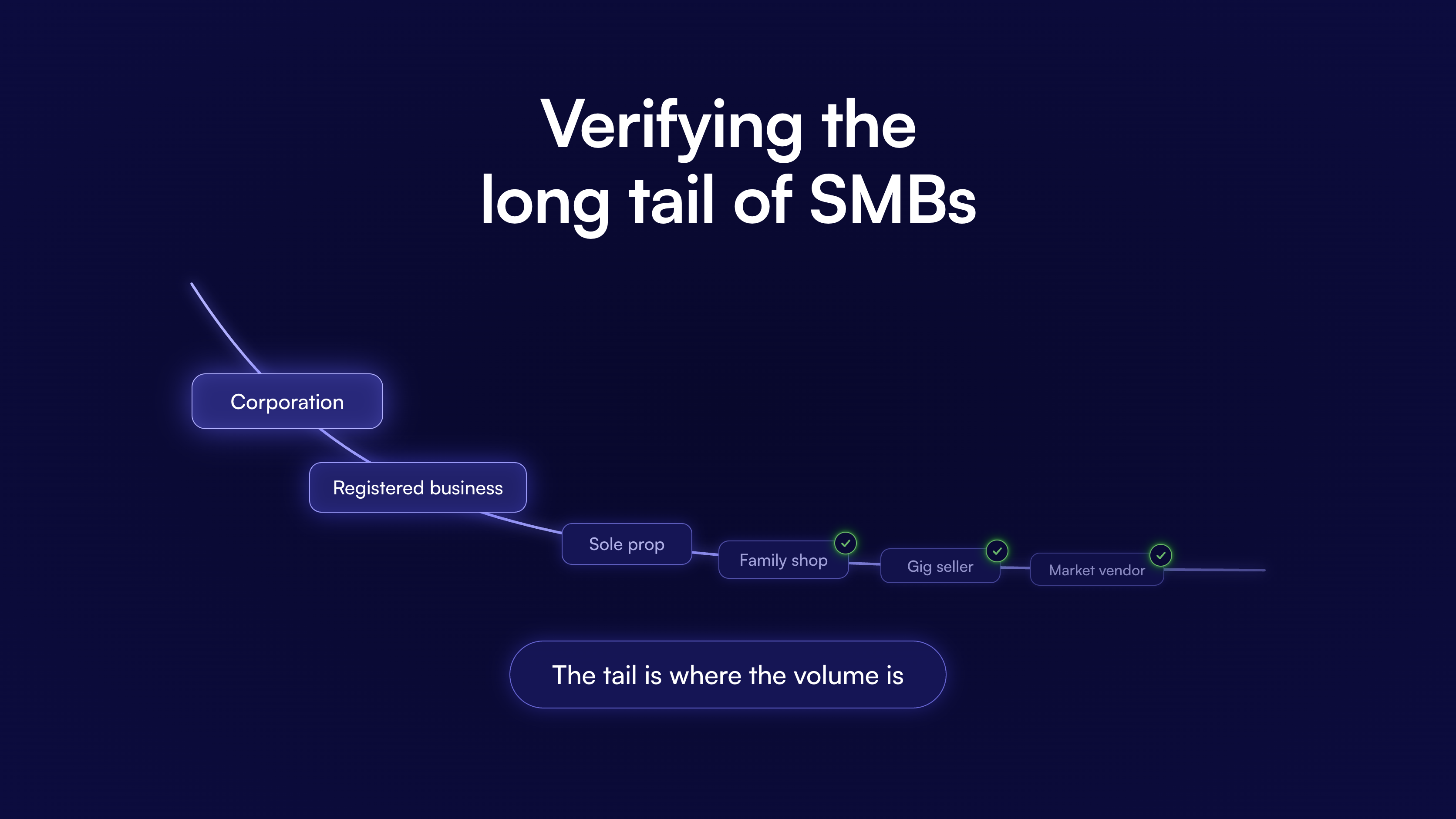
Verifying the Long Tail of SMBs

Most of your applicants are small. Most of your fraud hides among them. How platforms verify the long tail of SMBs without drowning in reviews or rejecting good sellers.

7 min read

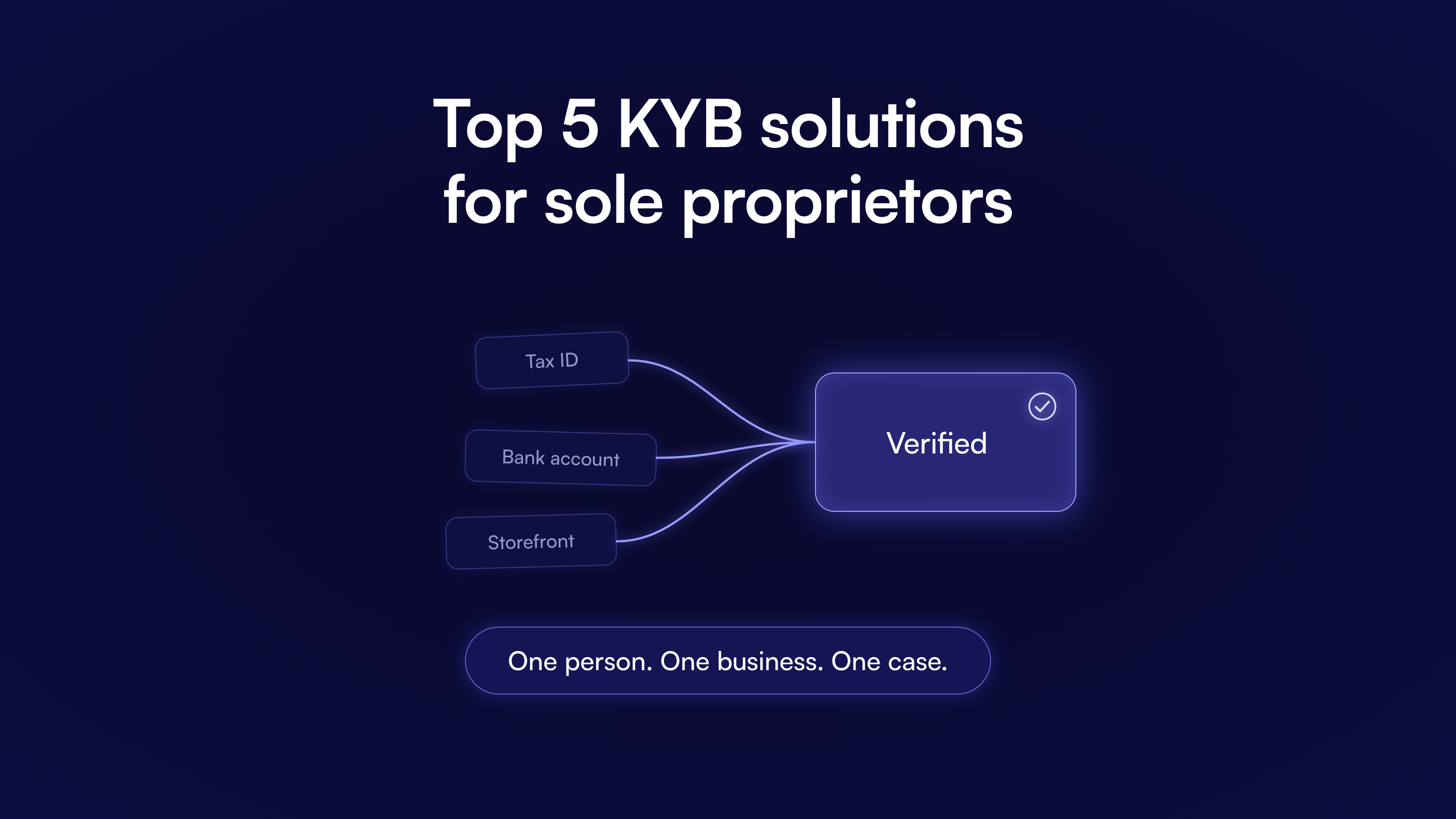
Top 5 KYB Solutions for Verifying Sole Proprietors (2026)

The best KYB solutions for verifying sole proprietors in 2026: why the smallest businesses are the hardest to verify, what actually works for thin-file entities, and how the leading providers compare.

7 min read

Best KYB Solutions for Verifying Large Enterprise Businesses (2026)

The best KYB solutions for verifying large enterprise businesses in 2026: why ownership depth changes everything, what to demand from a platform, and how the leading providers compare.

6 min read

Top 5 Full-Cycle KYB Solutions (2026)

The top full-cycle KYB solutions in 2026, ranked on what end-to-end actually requires: collection, verification, risk scoring, review, and monitoring in one platform.

7 min read

What Full-Lifecycle KYB Actually Means (And Why One Platform Beats Five Vendors)

Every vendor claims end-to-end KYB. Here is what the full lifecycle actually covers, what the market really sells, and what changes when all five stages run on one platform.

10 min read

Best KYB Solutions for the US Market (2026)

The best KYB solutions for the US market in 2026: what the CDD Rule requires after the end of BOI reporting, why 50-state registry fragmentation matters, and how the leading providers compare.

10 min read

Best KYB Solutions for the Canadian Market (2026)

The best KYB solutions for the Canadian market in 2026: what FINTRAC actually requires, why the October 2025 rules changed the game, and how the leading providers compare.

9 min read

KYB 101: What Know Your Business Is and How It Works in 2026

What Know Your Business means, what a KYB check verifies, the five stages of the KYB lifecycle, and how verification works in 2026.

Chaitanya Sarda

4 min read

Introducing Business Pre-fill: Onboard Businesses in 65+ Countries With Just Two Fields

AiPrise launches Business Pre-fill: applicants enter a business name and country, and AiPrise fills the rest of the application from official registry records across 65+ countries.

Chaitanya Sarda

6 min read

I Did KYB 27 Times Before My KYB Company Turned One

Business verification is hiding in plain sight. A founder's count of every time a young startup gets asked to prove it's a real business.

Image depicting smurfing process

AiPrise

What Is Smurfing in Money Laundering? A Complete Guide

Learn what smurfing is, how it works in money laundering schemes, common red flags, and why detecting suspicious transaction patterns matters.

Illustration depicting structuring

AiPrise

What Is Structuring in AML? A Complete Guide

Learn what structuring is, how it works, why it matters for AML compliance, and the steps organizations can take to detect and prevent it.

Title image for KYC Vs KYC

AiPrise

KYB vs. KYC: Key Differences & How to Stay Compliant

Learn the main differences between Know Your Business (KYB) and Know Your Customer (KYC) regulations, compliance, requirements, and processes.

feature image for KYB compliance

AiPrise

KYB Compliance: 2026 Regulations You Should Know About

As organizations expand globally and face tighter regulations, adherence to Know Your Business (KYB) standards has become one of the most critical compliance layers for fintech, online marketplaces, and other companies that need to verify business customers before letting them perform financial transactions.

laptop running a KYB software for crypto

AiPrise

KYB for Crypto: How to Verify Businesses and Reduce Risk

Crypto removes traditional intermediaries from financial transactions, but it doesn’t remove risk. If anything, it attracts it.

Visual representation or automated Know Your Customer (KYC)

AiPrise

The Complete Guide to KYC Automation for Faster, Compliant Onboarding

Every customer your compliance team verifies manually is time and money lost to document chasing and follow-up emails. And it adds up faster than most teams expect.

AiPrise

5 min read

What FinCEN’s Proposed Rule Really Means for AI in KYB and AML

AiPrise

10 min read

Top 10 AML and Identity Verification APIs for Compliance in 2026

Explore the top 10 aml and identity verification APIs in 2026 for compliance. Compare features, pricing, and use cases to choose the API for your business.

AiPrise

12 min read

Theft & Identity Fraud Trends in 2026: What You Must Watch

Identity fraud trends in 2026 reveal credit card fraud dominance and AI-driven deepfakes. Learn key preventive measures and protect yourself today!

AiPrise

8 min read

Address Fraud Detection: Best Practices for Fintech & Banks

Strengthen onboarding with address fraud detection best practices for fintech and banks. Prevent identity fraud, reduce risk, and meet compliance standards.

Top 5 KYB Providers with AI for Faster Business Verification

AiPrise

Top 5 KYB Providers with AI for Faster Business Verification

Discover the top 5 KYB Providers with AI enabling faster business verification, smarter risk checks, seamless onboarding, and compliance-ready decisions today.

Anti-Money Laundering Compliance: Proven Strategies for 2026

AiPrise

9 min read

Anti-Money Laundering Compliance: Proven Strategies for 2026

Anti-money laundering compliance in 2026 made practical. Learn proven strategies to detect risk, meet regulations, and protect business from financial crime.

AiPrise

11 min read

Deepfake Detection vs. Liveness Checks in Modern Security

See how Financial institutions and crypto platforms safeguard the onboarding process by implementing deepfake detection vs liveness checks to ensure compliance.

AiPrise

9 min read

Identity Verification Match Rates and Metrics Explained

Understand identity verification match rates, key metrics, and benchmarks that impact approval accuracy, fraud risk, and onboarding decisions that matter.

Requirements for AML AI in Banking: The Ultimate Guide You Can't Miss

AiPrise

14 min read

Requirements for AML AI in Banking: The Ultimate Guide You Cannot Miss

Explore the requirements for AML AI in banking. Discover how banks apply AI across KYC, monitoring, and SARs to strengthen compliance and reduce alert overload.

AiPrise

9 min read

Visa Cross Border Payments: What Fintechs Must Get Right

Visa cross-border payments explained for fintechs. Learn what must work across compliance, FX, speed, and security to scale card payments without friction today

Top Cross-Border Payments Companies for Compliant Global Transfers

AiPrise

10 min read

Top Cross Border Payments Companies for Compliant Global Transfers

Explore top cross-border payments companies enabling compliant global transfers. Compare features, coverage, pricing, and compliance fit to choose the provider

6 Types of Sanctions in KYC You Must Know to Avoid Penalties

AiPrise

11 min read

6 Types of Sanctions in KYC You Must Know to Avoid Penalties

Click now to understand types of sanctions in KYC, what triggers them, and how failures lead to fines and bans. Read now to stay compliant.

Visual representation of crypto KYC compliance steps

AiPrise

11 min read

Top KYC Providers for Crypto Companies in 2026 (Compared)

Compare the top 5 crypto KYC companies. Review their capabilities to find the crypto KYC provider that fits your compliance needs in 2026.

Top 7 KYC solutions

AiPrise

16 min read

Top 7 KYC Solutions in 2026 for Faster, Compliant Onboarding

Identity verification and compliance checks can be a bottleneck for companies that want to onboard customers at scale.

6 Key AML Use Cases Powered by AI in 2026

AiPrise

13 min read

6 Key AML Use Cases Powered by AI in 2026

Explore how AI is transforming AML compliance in 2026. Learn about key use cases in transaction monitoring, fraud detection, and KYC with AiPrise AI solutions.

Top 8 Liveness Detection Tools for Customer Onboarding in 2026

AiPrise

12 min read

Top 8 Liveness Detection Tools for Customer Onboarding in 2026

Understand how liveness detection works, why it matters, and which tools offer the strongest protection against spoofing and deepfake attacks.

AiPrise

9 min read

What Is a PEP Review? Screening Process, Challenges and Best Practices

Learn what a PEP review is, how PEP screening works, common challenges compliance teams face, and best practices for managing political exposure risk.

AiPrise

11 min read

Top 8 Stablecoin Fraud Detection Tools and How They Compare

Discover the top tools for stablecoin fraud detection, with insights on monitoring suspicious transactions, wallet risk scoring, and cross-chain analysis.

AI-Powered Fraud Detection in Payments: 2026 Trends

AiPrise

18 min read

AI Powered Fraud Detection in Payments: 2026 Trends

Explore 2025 trends in AI-powered fraud detection for enterprise payment software. Optimize defenses against threats like synthetic identities. Discover solutions today!

Liveness Detection Framework Guide for Secure Identity Verification

AiPrise

12 min read

Liveness Detection Framework Guide for Secure Identity Verification

Understand the liveness detection framework, key liveness detection types, and benefits for fraud prevention, secure onboarding, and compliance in 2026.

Automated KYC verification vs manual process explained with pros, costs, speed, accuracy, and which approach scales best for modern businesses today for teams.

AiPrise

11 min read

Automated KYC Verification vs Manual Process Explained

Automated KYC verification vs manual process explained with pros, costs, speed, accuracy, and which approach scales best for modern businesses today for teams.

Comprehensive Guide To Sanctions Checks For Compliance

Antoine

11 min read

Comprehensive Guide To Sanctions Checks For Compliance

Understand sanction check 5, a process of screening individuals against global watchlists, and its benefits for safer onboarding.

AiPrise

13 min read

10 AML Typologies Every Bank Needs to Know in 2026

Discover the top 10 AML typologies for 2026. Learn how banks, fintechs, and payment processors can detect, prevent, and respond to money laundering effectively.

Top 10 Financial Compliance Challenges Businesses Face in 2026

AiPrise

14 min read

Top 10 Financial Compliance Challenges Businesses Face in 2026

Learn the top financial compliance challenges businesses face in 2025–26, including regulation changes and security risks.

Guide to Understanding Fraud Detection Rules

AiPrise

17 min read

Guide to Understanding Fraud Detection Rules

See how fraud detection rules protect and automate real-time fraud prevention. Customize your approach with adaptable and effective solutions now.

How KYC AML Blockchain Protocols Can Transform Compliance in 2026

AiPrise

10 min read

How KYC AML Blockchain Protocols Can Transform Compliance in 2026

Discover how KYC AML blockchain protocols help banks and fintechs streamline identity verification, detect fraud, and stay compliant in 2026.

A Complete Guide to AML Regulations in Real Estate for 2026

AiPrise

13 min read

A Complete Guide to AML Regulations in Real Estate for 2026

Learn key AML real estate rules, risks, and best practices for 2026 to prevent money laundering, stay compliant, and protect your business.

AiPrise

13 min read

Top 10 KYC Failure Reasons and Their Solutions for 2025-26

Overcome KYC failure with key solutions to fake documents, manual processes, and poor data. Streamline with effective tools now! Click to enhance your KYC.

AiPrise

15 min read

The 15 Most Crypto-Friendly Countries in 2026

Explore the 15 most crypto-friendly countries in 2026, with insights on regulation, taxation, banking access, and growth opportunities.

AiPrise

7mins

CurrencyFair places its trust in AiPrise for onboarding and fraud controls

A Complete Guide to Money Laundering Scams in 2026

AiPrise

12 min read

A Complete Guide to Money Laundering Scams in 2026

Learn how money laundering scams work in 2026, from money mules and crypto fraud to real estate and online payment abuse, plus prevention strategies.

AiPrise

10 mins

AiPrise Monthly Review November 2025

AiPrise November Newsletter

Deepfake Selfie Verification in Identity Checks

AiPrise

10 min read

Deepfake Selfie Verification in Identity Checks

Deepfake selfie verification detects manipulated facial images, prevents identity fraud in onboarding, improves KYC accuracy, and speeds identity checks now.

AiPrise

9 min read

Compliance in Business in Singapore: What’s Changing

Business in Singapore: Learn key compliance changes, regulatory updates, and practical steps to keep your company compliant and ready, and reduce legal risk.

How to Check a UAE Company’s Trade License Online

AiPrise

9 min read

How to Check a UAE Company’s Trade License Online

Learn how to check trade license online in the UAE: step-by-step guide to verify company status, expiry, and license details quickly and securely from anywhere

10 min read

Online Banking Frauds Exposed With Proven Prevention Tips

Stay safe from online banking fraud. Avoid phishing, fake apps, and unauthorized access. Implement MFA, verify transfers. Protect your funds now!

AI-Powered Enhanced Due Diligence for Risk Management

AiPrise

9 min read

AI Powered Enhanced Due Diligence for Risk Management

Discover how AI-powered enhanced due diligence helps businesses reduce risk, ensure compliance, detect suspicious activity, and improve operational efficiency.

Fintech Fraud Prevention: Effective Strategies and Solutions

AiPrise

10 min read

Fintech Fraud Prevention: Effective Strategies and Solutions

Explore effective fintech fraud prevention strategies and solutions to safeguard your financial transactions and protect your business from cyber threats.

What Is Remediation in Banking and Its Process

AiPrise

12 min read

What Is Remediation in Banking and Its Process

What is remediation in banking? Understand the process, roles, and best practices to fix compliance gaps, restore controls, and protect customer trust now.

AiPrise

10 mins

AiPrise Monthly Review October 2025

AiPrise October Newsletter

AiPrise

10 mins

AiPrise Monthly Review September 2025

AiPrise September Newsletter

AiPrise

10 mins

AiPrise Monthly Review August 2025

AiPrise August Newsletter

AiPrise

8 min read

How Consent Orders Guide Stronger Banking Compliance Systems

Consent order banking strengthens compliance by enforcing stricter controls, improving oversight, and driving transparency across financial institutions.

Optimizing KYC Verification with Blockchain Technology

AiPrise

10 min read

Optimizing KYC Verification with Blockchain Technology

Explore how KYC blockchain whitepapers outline secure, reusable identity systems. Learn benefits, challenges, and real-world applications of blockchain KYC.

Comprehensive Guide to AML Transaction Monitoring Scenarios

AiPrise

7 min read

Comprehensive Guide to AML Transaction Monitoring Scenarios

Identify key AML transaction monitoring scenarios and enhance your compliance with tailored strategies. Reduce false positives, adapt to risks. Click now!

KYC workflow flowchart to help businesses stay compliant

AiPrise

11 min read

How to Build a KYB and KYC Workflow for Compliance

Need to standardize your KYC and KYB processes and make onboarding simpler? Check out our guide on how to build effective KYB and KYC workflows.

A Guide to Crypto Cleansing and Money Laundering

AiPrise

12 min read

A Guide to Crypto Cleansing and Money Laundering

Learn how crypto cleansing helps you secure your crypto portfolio. Take action now for safer, more compliant digital transactions.

Comprehensive Guide to Embedded Banking and  Finance

AiPrise

12 min read

Comprehensive Guide to Embedded Banking and Finance

Discover embedded banking examples that boost trust and conversions. Learn actionable strategies to improve your customer experience and grow your business.

risk based financing

AiPrise

10 min read

Understanding Risk Based Lending and Pricing

Uncover risk based financing: impact on loan terms, credit score role, and borrower strategies. Learn how to secure better terms now!

business in thailand

AiPrise

13 min read

A Complete Guide to Starting a Business in Thailand

Register your business in Thailand efficiently! Explore the new DBD Biz Regist system, digital identity verification, and online signature benefits. Act now!

Key Components of BSA/AML Risk Assessment

AiPrise

12 min read

Key Components of BSA AML Risk Assessment

Uncover the 3 fundamental components of risk assessment BSA. Enhance compliance by identifying inherent risks and developing mitigation strategies. Dive in!

Anti-Money Laundering and Procurement Risk in Insurance Sector

AiPrise

13 min read

Anti Money Laundering and Procurement Risk in Insurance Sector

Discover how the insurance industry can mitigate money laundering risks through AML strategies, effective procurement practices, and advanced fraud detection.

Understanding Web3 KYC for Secure Online Identity

AiPrise

10 min read

Understanding Web3 KYC for Secure Online Identity

Explore the importance of Web3 KYC in securing online identities, ensuring compliance, and how decentralized technologies are transforming identity verification.

AiPrise

5 mins

Announcing our 12.5M Series A for AI powered Global Compliance

Rethinking global compliance and building next generation compliance platform

AiPrise

5 mins

AiPrise and Unit21 Partner to Close the Gap Between Onboarding and Continuous Risk Monitoring

AiPrise and Unit21 today announce a strategic partnership designed to close a key gap in financial risk management: the disconnect between customer onboarding and ongoing monitoring.

top 10 employee frauds

AiPrise

10 min read

Top 10 Employee Frauds and Prevention Strategies

Discover the top 10 employee frauds and effective prevention strategies. Protect your business with regular audits, segregation duties, and monitoring systems. Click to safeguard your assets now!

deepfake lega

AiPrise

10 min read

Understanding Deepfake Legal Implications and Actions

Understand deepfake legal implications, address defamation, and stay informed on federal and state laws. Seek legal advice now!

phone number identity verification

AiPrise

10 min read

Phone Number Identity Verification: Is Your Business Protected?

Use phone number identity verification to prevent fraud, secure transactions, and increase trust. Verify customer identities quickly and confidently today.

The importance of KYC and AML for crypto exchanges

AiPrise

10 min read

Importance of KYC and AML for Crypto Exchanges

Learn the importance of KYC and AML for crypto exchanges to prevent fraud, ensure regulatory compliance, and build trust with users and investors worldwide.

globe covered by business and owner connections to represent the verification process

AiPrise

11 min read

8 of the Best KYB Software Providers in 2026

Compliance doesn’t just fail when someone skips an ID check. The cracks start to form when a business looks legitimate on the surface but isn’t.

Online Marketplace Risks and Prevention Strategies

AiPrise

9 min read

Online Marketplace Risks and Prevention Strategies

Learn how to protect your online marketplace from risks like fraud, counterfeit goods, and data breaches with effective prevention strategies.

biggest money laundering cases

AiPrise

9 min read

The Biggest Money Laundering Cases in History

Explore the biggest money laundering cases in history and the lessons they offer. Read more now!

Understanding Digital Identity and How It Works

AiPrise

11 min read

Understanding Digital Identity and How It Works

Understand what a digital identity is, how it works, its risks, and ways to protect it with smart verification and security practices.

Anti-Money Laundering Directive: Key Changes and Compliance

AiPrise

7 min read

6th Anti Money Laundering Directive: Key Changes and Compliance

Explore the key changes in the 6AMLD: expanded money laundering definitions, corporate liability, and enhanced penalties. Ensure compliance now!

AiPrise

12 min read

Fraud and Money Laundering: Key Differences and Connections

Unveil how fraud and money laundering differ and connect. Explore impacts, tech roles, and strategies. Prevent financial crime today!

Best Practices for Merchant Verification

AiPrise

10 min read

Best Practices for Merchant Verification

Boost trust and prevent fraud with effective merchant verification. Comply with regulations, streamline processes with AI, and enhance security. Click to secure your business today!

Understanding KYC Verification Safety and Prevention Steps

AiPrise

10 min read

Understanding KYC Verification Safety and Prevention Steps

Is KYC verification safe? Explore data safety, regulatory compliance, phishing scams, and prevention steps. Protect your identity today!

singapore crypto license requirements

AiPrise

6 min read

Singapore Crypto License Requirements: A Complete Guide

Learn about the latest Singapore crypto license requirements. Find out what the capital requirements and application processes are for crypto businesses.

digital asset anti-money laundering act

AiPrise

7 min read

Understanding the Digital Asset Anti-Money Laundering Act 2023

Learn about the Digital Asset Anti-Money Laundering Act 2023. Understand its key provisions and how they impact compliance for digital asset businesses.

AiPrise

9 min read

How to Detect Fraudulent Documents in KYB Verification

Boost your business compliance by detecting fraudulent documents in KYB. Use AI tools, cross-check registrations, and implement risk assessment. Upgrade your KYB processes today!

online identity verification methods

AiPrise

10 min read

Online Identity Verification Methods: 7 Different Types

Find out the most effective online identity verification methods. Explore how different methods work and choose the best verification option for your business.

income verification documents

AiPrise

9 min read

Income Verification Documents: What You Need to Know

Learn about different income verification documents for compliance. Get a complete guide on income requirements, processes, and common mistakes to avoid.

UK mica

AiPrise

8 min read

Understanding UK Crypto Regulations After MiCA

Stay compliant with UK crypto regulations and avoid costly penalties. Learn about key updates and how MiCA influences UK laws for crypto firms.

money laundering detection

AiPrise

9 min read

Methods for Effective Money Laundering Detection

Stay compliant and reduce fraud risk by learning money laundering detection techniques, identifying red flags, and applying AML best practices.

AiPrise

8 mins read

What is Ongoing Monitoring? Types and Tips to Implement

Find out what ongoing monitoring is and why it's essential for compliance. Get a complete guide to implement effective continuous screening processes.

AiPrise

7 mins read

Fraud Detection and Prevention Strategies in Banking

Explore key AI innovations and real-time monitoring in fraud prevention for banks. Enhance security with behavior analytics. Stay compliant!

AiPrise

8 mins read

What is a Verification Check? Types, Process, and Benefits

Find out what verification checks involve, and how they work. Get a complete guide to verification processes, their types, benefits, and common challenges.

AiPrise

6 mins read

Understanding Fraud: Patterns and Prevention Strategies

Understand fraud behavior patterns and explore strategies to prevent fraud effectively. Ensure your business stays secure with actionable tips and insights.

AML fines examples

AiPrise

9 mins read

AML Fines Explained: Key Facts and Examples

Explore AML fines, which industries may face enforcement actions, notable case examples, and ways organizations can strengthen compliance and reduce regulatory risk.

AiPrise

4 mins read

Benefits and Challenges of Facial Recognition Technology

Discover the top benefits of facial recognition for banking and payments: stronger security, fraud prevention, compliance, and better customer trust.

AiPrise

12 mins read

How to Identify Fake IDs?

Identify bad fake IDs with tips on checking holograms, spelling errors, and card quality. Stay vigilant with ID scanners. Enhance security now!

AiPrise’s data coverage and AI agents were the deciding factors for us. They’ve made our onboarding 80% faster. It is also a very intuitive platform.

Testimonial Company logo Bridge

Head of Operations