

AiPrise
10 min read
December 5, 2025
How AML Compliance Works in Mexico: KYC and ID Checks

Key Takeaways

Small verification gaps often become the invisible fault line where fraud and regulatory risk quietly widen over time. When onboarding slows, you lose customers and face operational bottlenecks that erode revenue and trust. If checks are too weak, you incur regulatory fines and reputational damage that disrupt strategic growth plans. Understanding that Mexico’s UIF received 8,497,880 reports in January–June 2025 helps you prioritize automated monitoring and sharper risk rules.
Quick Overview
- Mexico’s AML framework under LFPIORPI requires businesses to identify, verify, and monitor all customers and transactions.
- KYC and ID verification steps use documents like INE, CURP, and RFC to confirm identity and prevent fraud.
- KYB checks ensure companies are legitimate by validating registration, ownership, and risk exposure across sectors.
- Continuous monitoring and UIF reporting keep financial activities transparent and safeguard organizations from compliance violations.
What Defines AML Compliance in Mexico?
Mexico’s AML framework outlines how businesses must detect, report, and prevent suspicious financial activity under national regulations. Understanding these legal expectations helps reduce compliance errors that can trigger fines, audits, or reputational harm. Here are the main components that shape AML Mexico requirements and how they affect your daily operations:
- The LFPIORPI law serves as Mexico’s core anti-money laundering regulation, requiring businesses to identify, verify, and monitor all clients and transactions.
- The Unidad de Inteligencia Financiera (UIF) investigates suspicious activities, so complete and timely reporting protects your business from penalties and operational scrutiny.
- The Comisión Nacional Bancaria y de Valores (CNBV) supervises financial entities, ensuring KYC and AML procedures follow established standards across banks, fintechs, and payment providers.
- Reporting entities include financial institutions, payment processors, real estate agencies, and high-value goods dealers responsible for monitoring and submitting alerts to the UIF.
- Maintaining accurate KYC records and client profiles ensures stronger audit readiness and demonstrates a proactive stance toward AML compliance with Mexico obligations.
- Integrating digital verification tools simplifies compliance management, reduces manual errors, and gives faster visibility into potential high-risk transactions under the KYC Mexico regulations.
Building on that foundation, it’s time to see how practical KYC steps bring those regulatory expectations to life.
Also read: How To Do KYB In Mexico?
What Are the KYC Steps Required in Mexico?
KYC steps required in Mexico form the foundation of every AML compliance process, ensuring each customer or partner is verified accurately. Here are the essential KYC steps required in Mexico that strengthen compliance and protect your business from financial and regulatory risks:
- Gather essential identity documents such as INE, CURP, RFC, or valid passports to verify customer identities effectively. These documents establish the authenticity of each individual and ensure your customer base complies with national KYC Mexico standards.
- Collect proof of address through recent utility bills or official bank statements to confirm customer residency and traceability. Accurate address verification ensures compliance with UIF expectations and provides stronger records for internal audits.
- Verify document authenticity using OCR technology and government databases to detect falsified, expired, or altered information instantly. This practice strengthens AML compliance in Mexico operations and prevents exposure to fraudulent applications.
- Match data with regulatory watchlists including PEP and sanction databases to identify high-risk or restricted entities before onboarding. Early screening helps reduce exposure to financial crime and ensures your institution remains within regulatory limits.
- Evaluate customer risk profiles based on transaction behavior, business nature, and regional exposure to assign accurate monitoring levels. A balanced, risk-based KYC approach supports faster onboarding without compromising AML compliance obligations.
- Maintain continuous record updates so customer data stays current, audit-ready, and compliant with CNBV and UIF verification standards. Ongoing updates reflect a proactive compliance culture and reduce the likelihood of regulatory breaches.
- Adopt biometric authentication solutions like facial or fingerprint recognition to confirm identity securely during digital onboarding. Utilizing advanced verification tools streamlines KYC procedures while maintaining strict data accuracy across compliance workflows.
To make those steps effective, ID verification becomes the next essential layer in confirming authenticity and preventing fraud.

How Does ID Verification Work in Mexico?
ID verification in Mexico ensures that customer identities are genuine, accurate, and compliant with AML Mexico and KYC Mexico standards. Here are the essential elements of ID verification in Mexico that help you maintain trust, accuracy, and compliance across every customer interaction:
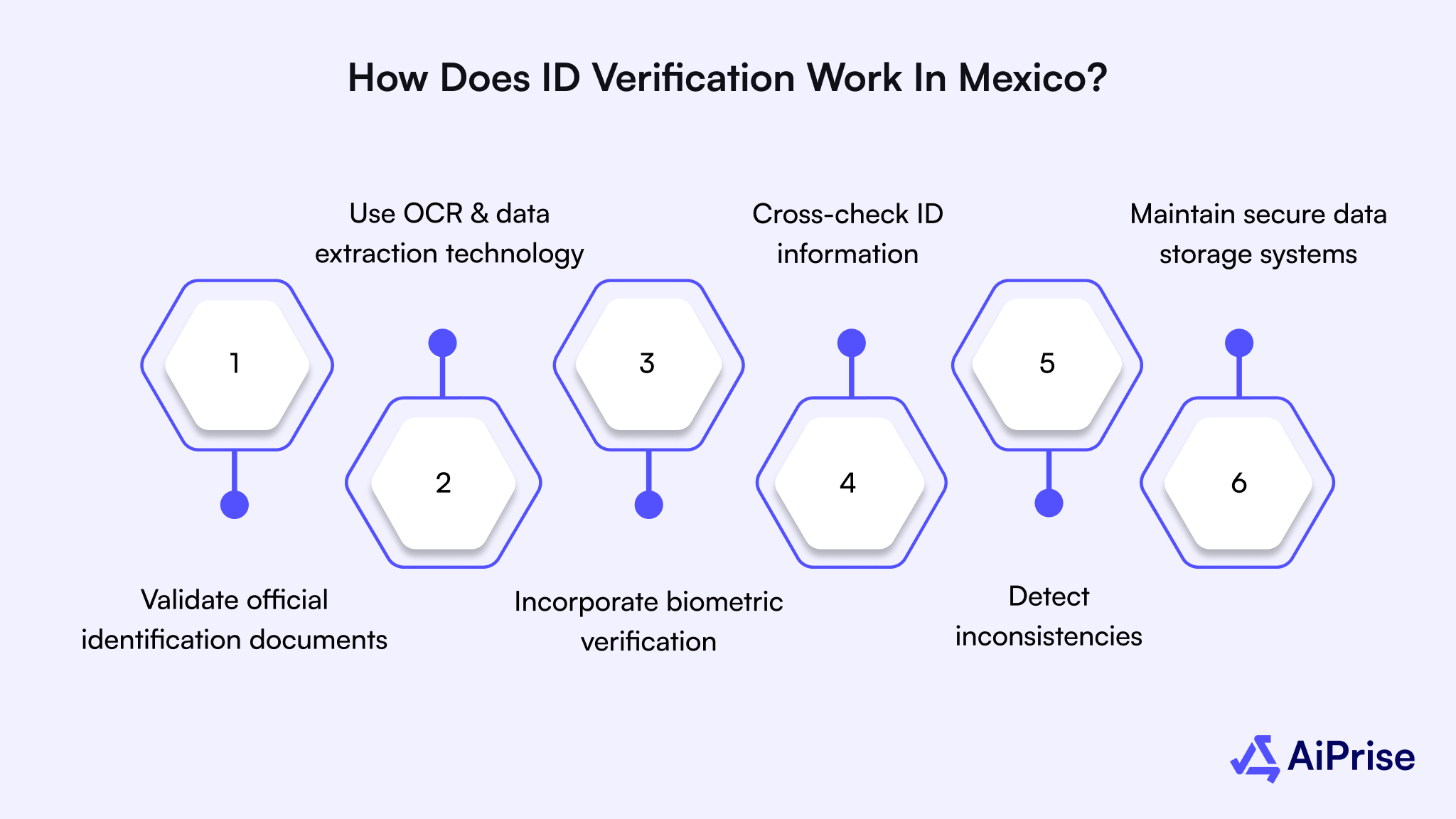
- Validate official identification documents such as INE, passport, CURP, or residency cards to confirm the person’s legal identity. Authentic document validation safeguards your business from onboarding unverified individuals and ensures adherence to AML compliance with Mexican laws.
- Use OCR and data extraction technology to read and verify ID details quickly without manual data entry errors. Automated scanning increases accuracy, speeds up verification, and minimizes human oversight in compliance workflows.
- Incorporate biometric verification through facial or fingerprint recognition to ensure the individual presenting the ID matches the record. Biometrics strengthen KYC accuracy by preventing impersonation and improving confidence in customer verification results.
- Cross-check ID information against government and global databases to detect stolen or forged documents in real time. Database verification ensures that your organization only engages with legitimate customers and stays compliant with CNBV standards.
- Detect inconsistencies or red flags by comparing ID data with transaction patterns, customer declarations, and previous account information. Early identification of anomalies prevents financial misconduct and reinforces AML Mexico due diligence procedures.
- Maintain secure data storage systems that protect verified IDs and personal details in compliance with data protection laws. Secure storage builds regulatory trust and demonstrates your commitment to safeguarding sensitive identity information.
Once individuals are verified, confirming the legitimacy of the businesses they represent completes the compliance picture.
Also read: Understanding Your Customers - 3 Simple Steps to KYC
What Are the KYB Requirements in Mexico?
KYB, or Know Your Business, focuses on verifying the legitimacy and ownership of companies operating under AML Mexico regulations. Thorough business verification protects your organization from partnering with shell companies, fraudulent entities, or businesses engaged in money laundering. Here are the key KYB Mexico requirements your compliance team should follow to maintain transparency and meet national regulatory expectations:
- Verify business registration details using official documents such as the company’s constitutive act, RFC number, and proof of incorporation. Confirming these credentials ensures each business entity operates legally and meets AML compliance Mexico standards.
- Identify beneficial owners who control or significantly influence the company to ensure transparency in ownership structures. Understanding true ownership prevents hidden connections to illicit networks and strengthens your organization’s due diligence process.
- Cross-check company information with government and financial registries to validate authenticity and detect inconsistencies early. This verification step ensures you only engage with credible partners that align with CNBV and UIF requirements.
- Assess the company’s risk level based on industry type, transaction volume, and cross-border exposure to determine enhanced review needs. A structured risk assessment helps manage potential compliance liabilities linked to high-risk sectors.
- Maintain accurate business records and update them regularly to reflect ownership or structural changes over time. Keeping KYB data current demonstrates consistent regulatory compliance and reduces the likelihood of oversight penalties.
- Incorporate automated KYB verification tools that consolidate data from multiple sources to identify anomalies instantly. Automation supports faster onboarding and improved decision-making without compromising AML or KYC compliance standards.
With both individuals and businesses verified, the focus shifts to how ongoing monitoring and UIF reporting sustain compliance daily.
Read more on: How To Do KYB In Mexico?
Continuous Monitoring and Reporting to UIF
Continuous monitoring under AML compliance in Mexico ensures financial activity stays transparent and suspicious transactions are flagged without delay. Strong oversight processes help maintain compliance, protect business reputation, and reduce exposure to legal and regulatory risks. Here are the essential elements of continuous monitoring and reporting to UIF that every reporting entity should follow:
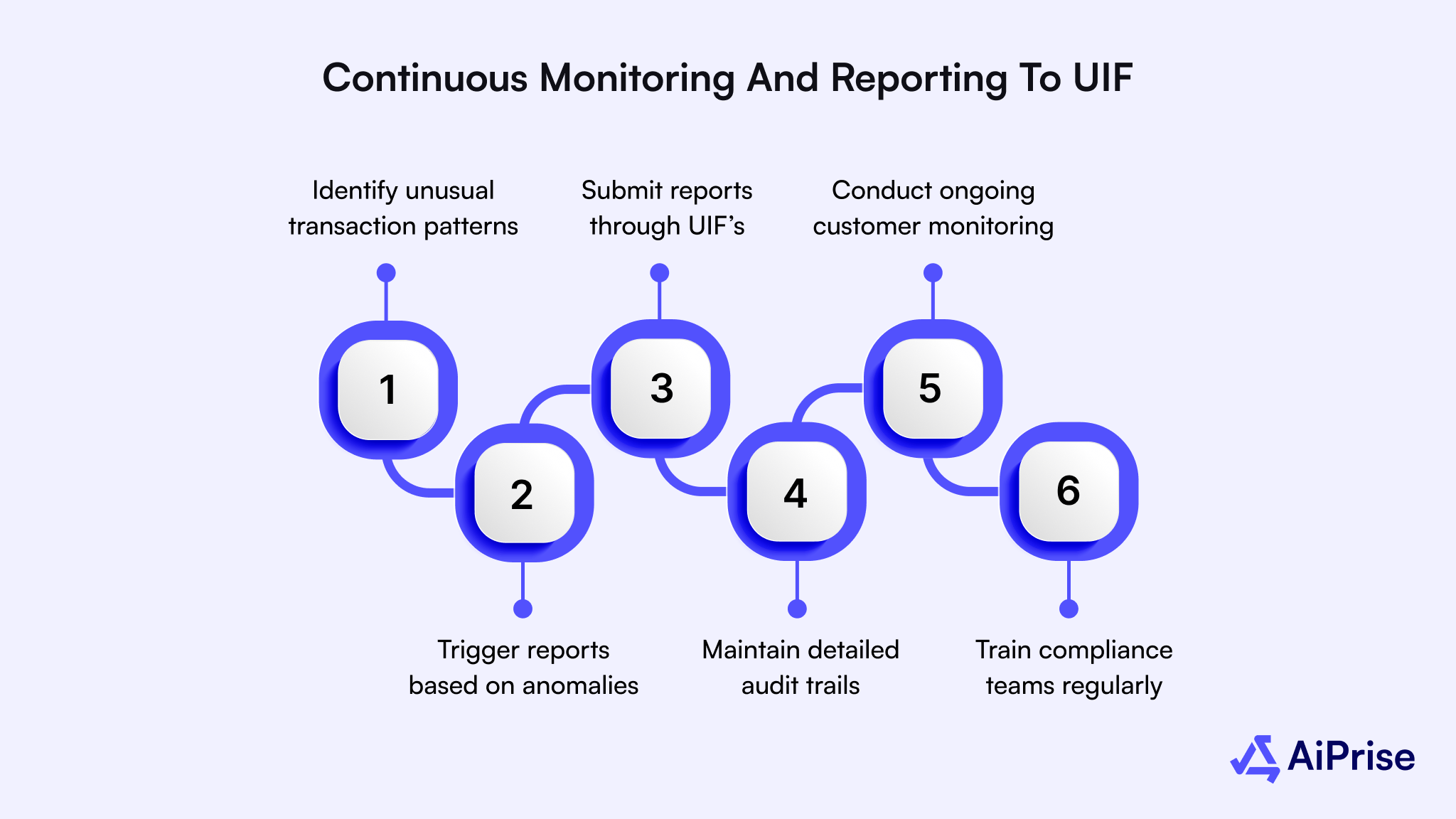
- Identify unusual transaction patterns through ongoing reviews that highlight inconsistencies in customer behavior or account activity. Detecting irregularities early reduces financial exposure and ensures compliance with UIF’s strict reporting obligations.
- Trigger reports based on anomalies such as high-value transfers, complex transaction structures, or activity inconsistent with declared income. Reporting these promptly protects your organization from regulatory penalties and potential reputational harm.
- Submit reports through UIF’s online platform using secure data transmission and standardized reporting formats required for all regulated entities. Timely submissions demonstrate compliance readiness and build trust with regulatory authorities overseeing AML Mexico operations.
- Maintain detailed audit trails to document transaction monitoring, risk assessments, and decision-making processes supporting each report submission. Proper documentation strengthens internal governance and ensures accurate responses during UIF inspections or audits.
- Conduct ongoing customer monitoring to capture changes in risk profiles, ownership, or financial patterns that may signal new threats. Regular reviews enable early intervention and help sustain continuous compliance with AML and KYC Mexico guidelines.
- Train compliance teams regularly to interpret UIF guidance, manage alerts efficiently, and maintain high standards of data integrity. Consistent staff awareness ensures each report meets legal expectations and aligns with Mexico’s evolving AML framework.
Staying compliant shouldn’t slow operations, which is why practical methods to reduce friction are key to lasting efficiency.
Practical Strategies to Reduce Compliance Friction and Risk
Efficient AML operations depend on balancing regulatory rigor with smooth customer experiences across every stage of verification. Strong internal frameworks help financial institutions, fintechs, and payment providers minimize delays, prevent errors, and maintain full compliance with AML Mexico standards. Here are practical strategies to reduce friction and strengthen your organization’s compliance performance:
- Adopt automated KYC and KYB solutions to accelerate verification processes while maintaining high accuracy and audit readiness. Automation reduces manual workload, cuts onboarding time, and ensures each step aligns with AML compliance Mexico requirements.
- Segment customers by risk level so enhanced due diligence applies only to high-risk entities or industries. Risk-based segmentation allows faster onboarding for low-risk customers without compromising regulatory standards.
- Use real-time data analytics tools to detect anomalies before they escalate into reportable incidents or fraudulent activity. Instant insights improve monitoring efficiency and keep compliance teams focused on genuine risks rather than false alerts.
- Integrate secure digital platforms that connect seamlessly with internal systems to streamline customer identification and documentation checks. A unified infrastructure prevents duplication, improves data accuracy, and supports continuous KYC Mexico compliance.
- Establish clear internal reporting workflows that define roles, timelines, and escalation procedures for suspicious transactions. Structured processes eliminate confusion, speed up decision-making, and ensure timely submissions to the UIF.
- Regularly review compliance policies to align them with updated CNBV and UIF regulations and international AML frameworks. Frequent evaluations ensure ongoing adherence and protect your organization from penalties or regulatory setbacks.
- Utilize AI-driven verification tools like AiPrise to automate identity checks, risk scoring, and continuous monitoring with precision. Advanced AI capabilities reduce friction, enhance decision accuracy, and enable scalable AML and KYC compliance for growing businesses.
Also read: Understanding Identity Verification (IDV) and its Significance
All these measures come together through solutions built to simplify compliance and strengthen trust, something AiPrise delivers seamlessly.
AiPrise: AML & KYC Solutions for Mexico
AiPrise accelerates compliance while lowering AML risk across Mexico; request a live demo to evaluate real impact.
Below are practical ways the platform helps meet UIF obligations, reduce onboarding friction, and strengthen KYC controls:
- Fast OCR tailored for INE, CURP, and RFC documents captures accurate data so you avoid manual transcription errors.
- Biometric liveness and facial matching verify ID holders against document photos, helping you prevent impersonation risks.
- Integration with more than a hundred local and global data sources enriches profiles so you detect hidden risks early.
- Real-time sanctions and PEP screening cross-check names against UIF and international watchlists so you avoid prohibited relationships.
- Continuous monitoring that triggers alerts on suspicious patterns and anomalies allows your team to file UIF reports promptly.
- Prebuilt onboarding SDK and workflow automation integrate with your systems, reducing integration time and compliance operational costs.
Wrapping Up
Effective AML compliance in Mexico requires clear processes, strong monitoring, and technology that supports your oversight. Balancing speedy onboarding with robust KYC checks helps maintain customer trust and reduces regulatory exposure. Following Mexico-specific steps and automating key controls positions your compliance team to act decisively when alerts arise.
AiPrise combines localized document recognition for INE, CURP, and RFC with biometric checks to confirm identities rapidly. Integrated risk scoring and continuous screening help your team detect suspicious patterns and prioritize UIF reporting efficiently. Deploying AiPrise reduces manual verification time, lowers false positives, and strengthens audit trails for regulatory reviews.
Book A Demo to see how AiPrise simplifies AML compliance, accelerates KYC checks, and strengthens ID verification in Mexico.
FAQ
1. What documents are required for KYC in Mexico?
Acceptable KYC documents include an INE or passport, CURP, and RFC when available, along with a recent proof of address. Financial institutions may also request additional documents depending on customer risk profiles and account type.
2. Who must comply with Mexico’s AML rules?
All regulated financial institutions, payment providers, and designated vulnerable businesses, such as real estate agencies, casinos, and precious metals dealers, must adhere to AML Mexico regulations under the LFPIORPI law.
3. How do Mexican firms report suspicious transactions?
Reporting entities submit suspicious transaction reports directly to the UIF through its secure online portal, following official formats and confidentiality protocols mandated by the authority.
4. Can KYC be done fully online in Mexico?
Yes, most regulated entities use digital KYC solutions powered by OCR, biometric authentication, and registry checks. However, enhanced due diligence is still required manually for higher-risk cases or complex ownership structures.
5. What penalties exist for AML non-compliance?
Non-compliance can lead to significant administrative fines, temporary suspension of operations, and even criminal prosecution for serious money-laundering offenses under LFPIORPI enforcement provisions.
You might want to read these...








.jpeg)


.jpg)















.jpeg)





.png)



.png)










AiPrise’s data coverage and AI agents were the deciding factors for us. They’ve made our onboarding 80% faster. It is also a very intuitive platform.

Head of Operations



See your full compliance picture in one place
Use AI agents and global data to review businesses and users faster and more accurately
