

AiPrise
9 min read
December 2, 2025
How to Prevent KYC and AML Challenges

Key Takeaways

How secure is your verification framework when fraudulent accounts slip through?
In FY24, U.S. financial institutions filed an average of 12,870 Suspicious Activity Reports (SARs) every day, totalling 4.7 million filings for the year, according to FinCEN. More than half were tied to fraud, underscoring how weak identification systems without proper KYC safeguards actively enable criminal activity. For banks, payment processors, and crypto platforms, the stakes go beyond compliance fines; unchecked risks erode customer trust, invite regulatory action, and undermine long-term growth, leaving businesses exposed in a landscape where financial crime shows no signs of slowing.
Key Takeaways
- Weak identification systems without proper KYC safeguards enable fraud, money laundering, and regulatory issues, exposing businesses to significant risks.
- KYC/AML compliance challenges include high friction during onboarding, fragmented data, and the constant evolution of global regulations.
- Strong verification systems rely on multi-layered approaches like document checks, biometrics, and continuous monitoring to effectively prevent fraud.
- Best practices involve adopting a risk-based approach, automating KYC/AML processes, and maintaining ongoing monitoring to ensure compliance and operational efficiency.
Why Weak Identification Systems Are Dangerous?
It’s important to understand how gaps in identification are exploited and the damage they leave behind. Weak verification frameworks expose your business to financial crime, regulatory heat, and operational strain. Here are the critical risks you face when ID checks fall short.
- Identity fraud & impersonation: If onboarding accepts fake or manipulated IDs (or lacks checks on document integrity and liveness), bad actors can create synthetic identities or take over real ones.
- Money laundering & layering: Criminals channel illicit proceeds through weakly verified accounts, then obfuscate origin via many small transactions or shell companies.
- Regulatory non-compliance & fines: Regulators expect advanced KYC/AML controls. Underinvesting in identity verification leads to violations and penalties.
- Reputational damage and loss of trust: News of fraud or money laundering tied to your platform can scare users and partners away.
- Operational inefficiency and false positives: Weak systems often generate many false alerts or manual reviews, burdening compliance teams.
Next, we’ll look at how businesses are often caught off guard by recurring challenges that make these vulnerabilities even harder to overcome.

Core KYC / AML Challenges to Watch Out For
Building an effective compliance framework isn’t only about adding checks; it’s about addressing recurring issues that undermine protection. Weak identification systems without KYC safeguards enable criminal activity, and these challenges highlight why robust defenses are essential. Here are the most common hurdles businesses face:
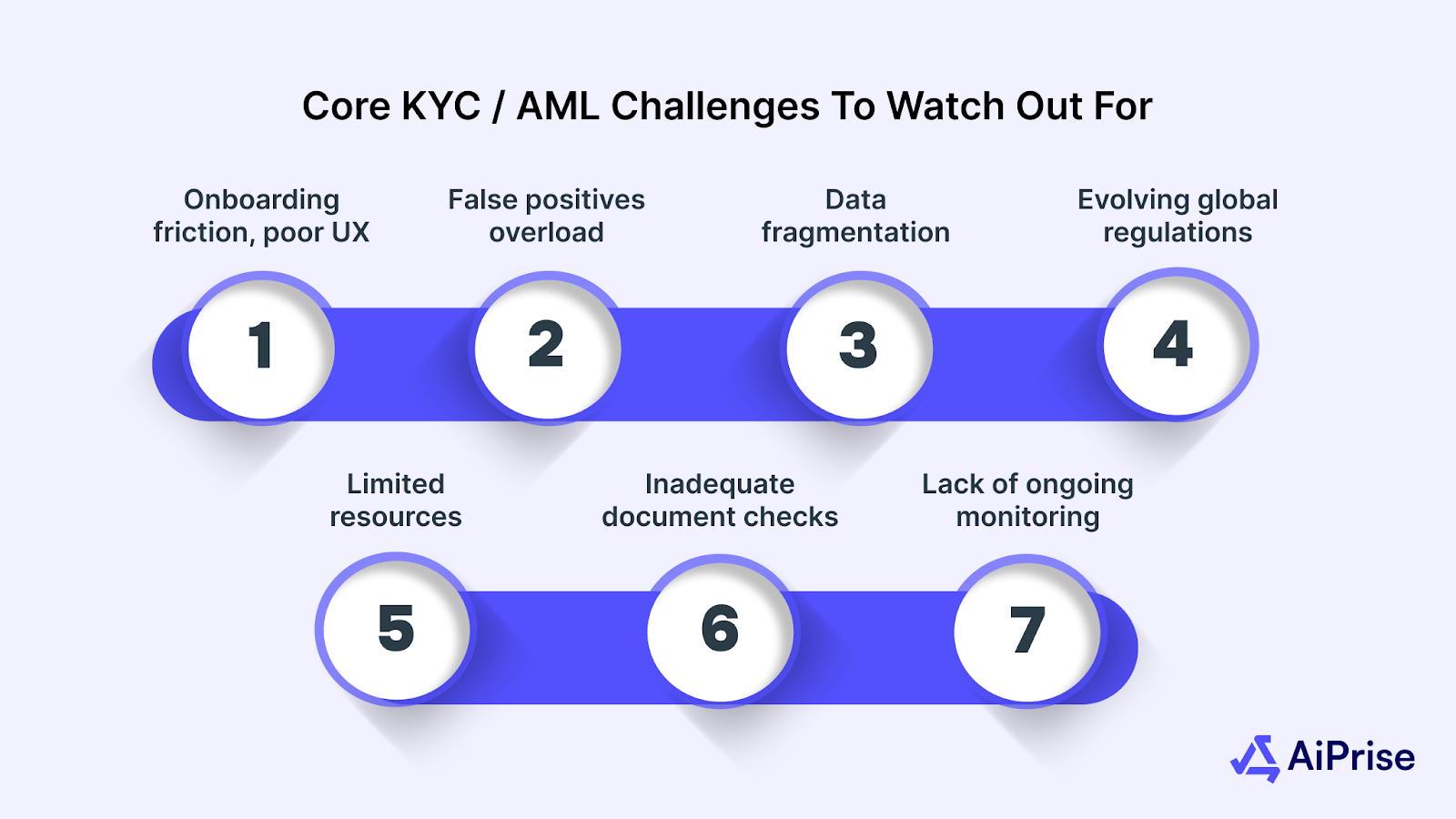
1. High onboarding friction and poor user experience
Overly complex verification steps frustrate customers and increase abandonment during account creation. Manual reviews add unnecessary delays that frustrate users further. Striking the right balance between security and speed is critical to retention and compliance.
2. False positives overload
When systems flag legitimate users as suspicious, analysts waste valuable resources on avoidable reviews. This slows down compliance teams while leaving gaps for real threats. Improving accuracy is vital to protecting users without unnecessary disruption.
3. Data fragmentation and siloed systems
KYC, AML, and fraud functions often operate in disconnected silos without proper integration. This lack of correlation allows risks to slip past unnoticed. Unified platforms ensure data visibility, smarter detection, and stronger compliance alignment.
4. Evolving global regulations
Regulations constantly shift across jurisdictions, making consistent compliance complex and costly. Firms that fail to keep pace face financial penalties and reputational loss. Adaptable compliance frameworks help address regulatory complexity while maintaining operational efficiency.
5. Limited technical or human resources
Many organizations lack the skilled staff or infrastructure required to manage compliance effectively. This resource gap increases vulnerability to exploitation by sophisticated bad actors. Scalable solutions help bridge capacity limits without sacrificing compliance strength.
6. Inadequate document and biometric checks
Weak document inspection or missing biometric liveness detection allows fraudsters to bypass onboarding security. This opens doors to identity fraud, account takeover, and regulatory violations. Strong authentication safeguards ensure identities are validated accurately and reliably.
7. Lack of ongoing monitoring
Verification cannot stop once onboarding is complete; account behavior must be monitored continuously. Without ongoing checks, evolving risks remain undetected until significant damage occurs. Proactive surveillance strengthens defenses and ensures long-term compliance readiness.
The next step is understanding the techniques and technologies that are reshaping how businesses approach security and compliance.
Also read: How to Detect Money Laundering? All You Need to Know
Identification and Verification Techniques
Effective defenses against fraud and compliance failures start with strong verification methods that adapt to evolving risks. Weak identification systems without KYC safeguards enable criminal activity, so businesses must adopt layered techniques for accuracy and resilience. Below are key approaches that strengthen trust and reduce vulnerabilities.
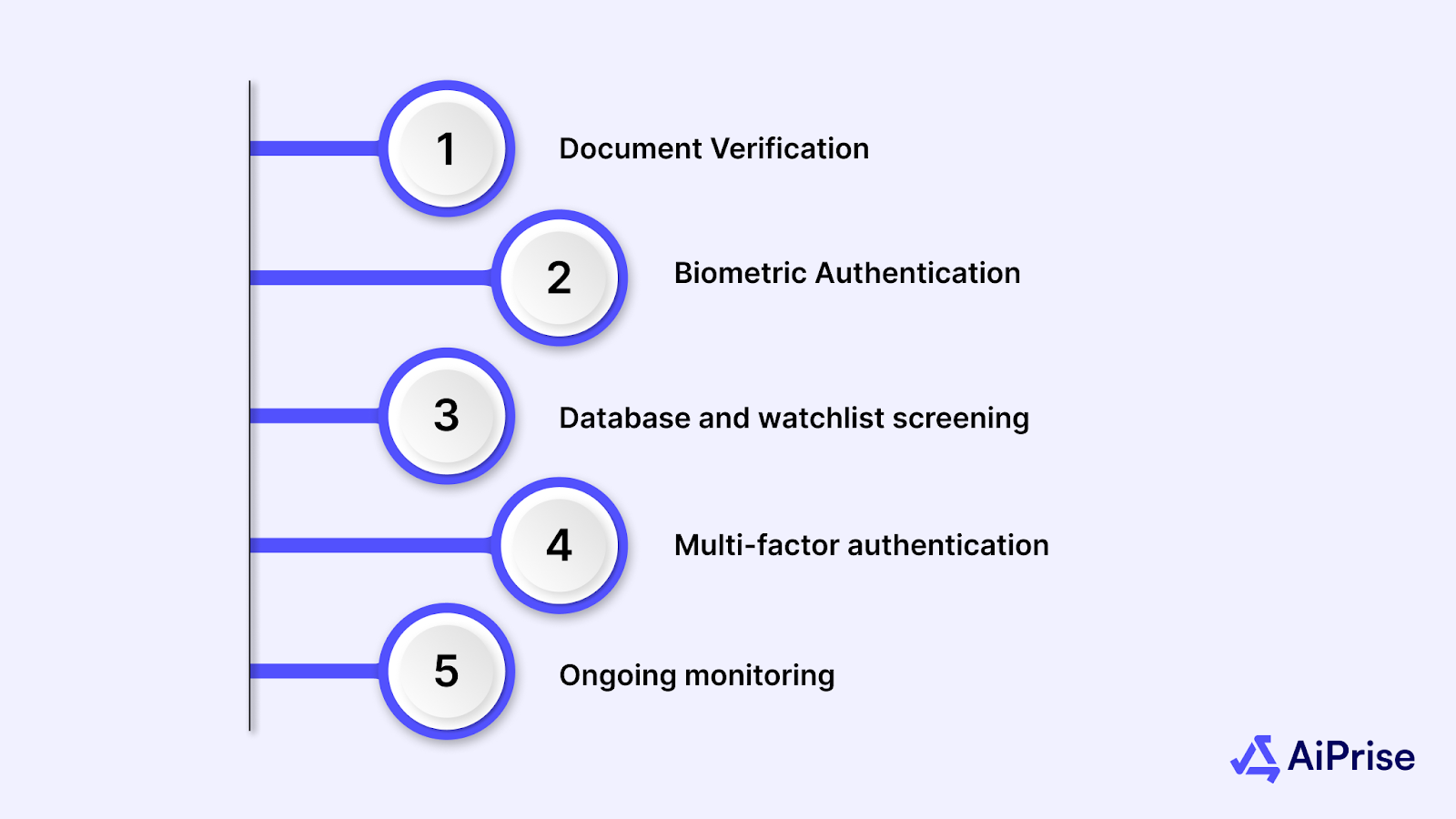
1. Document verification
Advanced document checks validate government-issued IDs for authenticity, spotting tampering or forgery attempts with high precision. Automated scanning reduces human error while improving efficiency in high-volume environments. Strong document controls form the first line of defense against identity fraud.
2. Biometric authentication
Biometric methods like facial recognition and liveness detection confirm users are real, not spoofed identities. These techniques minimize impersonation risks by analyzing unique biological features. Incorporating biometrics adds resilience where documents alone may be insufficient.
3. Database and watchlist screening
Cross-referencing applicant data against global watchlists and government databases helps flag high-risk individuals quickly. Automated screening ensures compliance with evolving KYC and AML regulations. These checks reduce exposure to sanctioned entities or politically exposed persons.
4. Multi-factor authentication (MFA)
MFA strengthens security by requiring multiple forms of verification beyond a single credential. It prevents unauthorized access even if one factor, like a password, is compromised. Implementing MFA safeguards sensitive financial platforms and user data effectively.
5. Ongoing monitoring
Verification must extend beyond onboarding through continuous monitoring of user activities. Real-time alerts identify anomalies or suspicious transactions before they escalate. This proactive approach ensures compliance while maintaining customer trust over time.
Effective KYC and AML practices hinge on using the right tools. Let’s look into the specific methods you can implement to not only close the gaps but also future-proof your compliance systems.
Also read: Understanding Fraud: Patterns and Prevention Strategies
Best Practices to Prevent KYC / AML Challenges
Preventing fraud and compliance failures needs a scalable strategy. Weak ID systems without KYC safeguards enable criminal activity, so defenses must be advanced, evolving, and regulator-ready. Below are best practices that serve as actionable pillars for strengthening compliance while also improving user experience and operational efficiency.
1. Adopt a risk-based approach
Segment customers into low, medium, and high-risk categories to apply tailored KYC and AML checks. High-risk profiles should undergo Enhanced Due Diligence (EDD), including beneficial ownership checks, background reviews, and source-of-funds validation. Risk tiers must be updated continuously as user behavior, geography, and regulatory alerts evolve.
2. Use multi-layered identity verification
Combine document verification, such as OCR and forgery detection, with biometric liveness checks like face or voice matching. Accept only trusted government-issued IDs (passport, driver’s license, or national ID), with additional proof where required by law. Screen against sanctions lists, PEP databases, and adverse media for deeper assurance.
3. Automate and integrate systems
Integrate KYC and AML processes into your onboarding workflows through APIs and SDKs to reduce friction. Merge fraud detection with AML monitoring (a FRAML approach) to capture complex, multi-channel risks. Leverage machine learning and graph analytics to uncover hidden anomalies across networks and transactions.
4. Maintain ongoing monitoring and refresh data
Ensure monitoring doesn’t stop after onboarding, and track customer activity continuously to spot suspicious behaviors. Refresh customer documentation every 12–24 months to keep records valid and compliant. Automate alerts for changes in sanctions lists, PEP status, and adverse news to stay ahead of threats.
5. Optimize for false positives and efficiency
Excessive false positives waste analyst time and weaken investigations. Refine rule thresholds and shift from binary checks to scoring systems for smarter triaging. Introduce analyst feedback loops so the system learns from real-world false alerts and improves detection accuracy over time.
6. Stay aligned with regulations
Map your compliance program to global frameworks such as BSA/FinCEN in the US and AMLD in the EU. Maintain full documentation, audit trails, and transaction records for at least five years to satisfy audit requirements. Conduct regular independent audits to ensure compliance practices remain rigorous.
7. Train and empower your team
Technology works best when backed by a knowledgeable workforce. Provide ongoing training on fraud trends, regulatory updates, and identity threats. Equip analysts with unified dashboards that consolidate risk, identity, and transaction data, enabling faster decisions with fewer blind spots.
If you’re looking for a partner who can help implement these best practices, AiPrise offers a comprehensive solution. Let’s take a closer look at how their tools make it easier to stay ahead of fraud and regulatory risks.
Also read: How Identity Verification Enhances KYC Compliance
Strengthen Your Compliance with AiPrise
When protecting your business against fraud and regulatory risks, having a reliable verification partner is critical. Here’s how AiPrise helps organizations build stronger defenses and maintain trust:
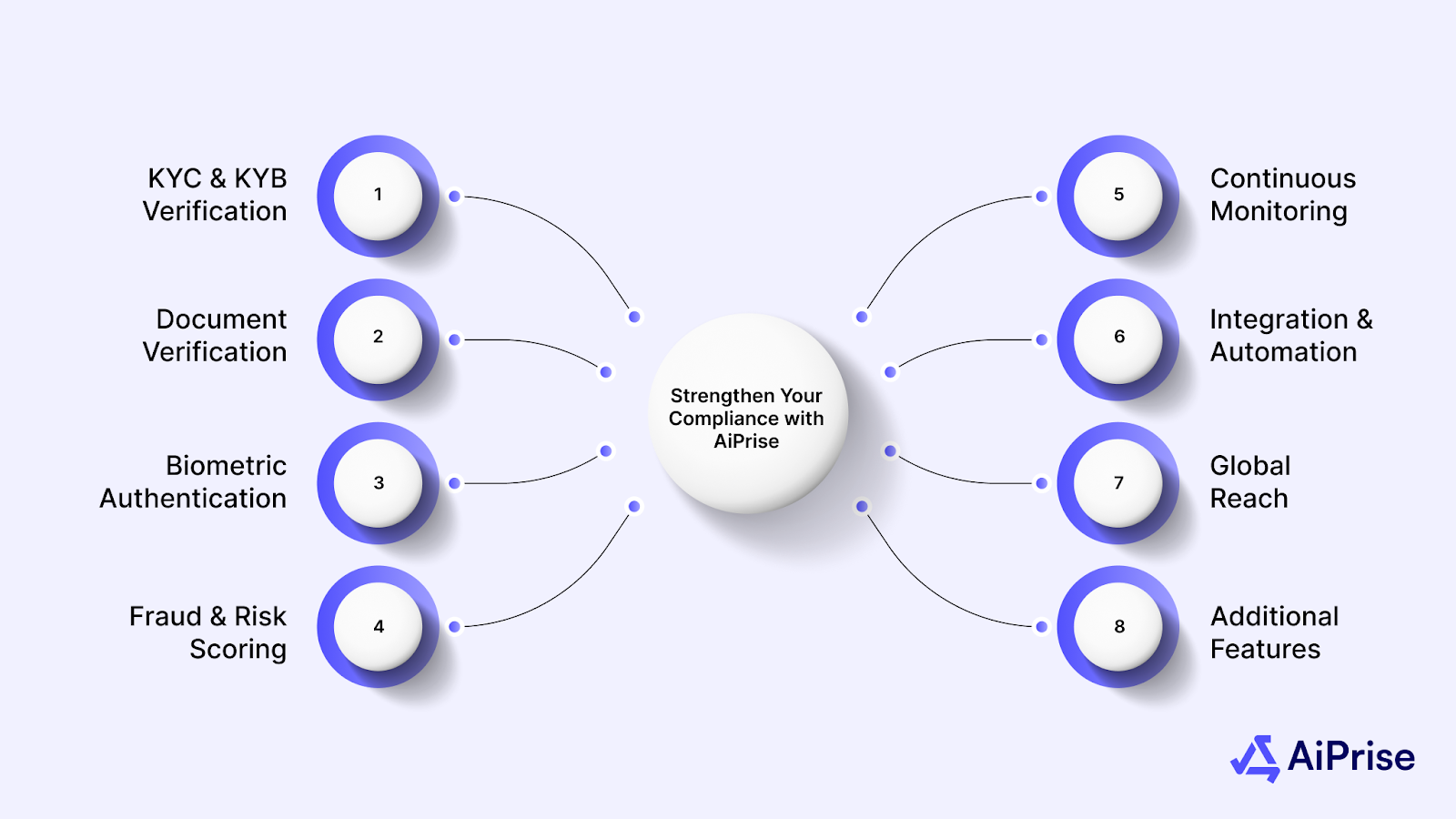
- KYC & KYB Verification: Accurately validate individuals and businesses using AI-powered checks, ensuring all customers and partners are legitimate.
- Document Verification: Extract and verify data from IDs, passports, and other government-issued documents using advanced OCR technology.
- Biometric Authentication: Confirm identities through facial recognition, fingerprints, and voice analysis to prevent impersonation or synthetic accounts.
- Fraud & Risk Scoring: Assess risk across more than 100 data sources, flagging potential fraudulent activity before it impacts your business.
- Continuous Monitoring & Compliance: Track document expiry, screen against sanction lists, and monitor accounts for evolving risks in real time.
- Integration & Automation: Seamlessly embed onboarding SDKs into your systems, automating KYC/AML checks and reducing manual errors.
- Global Reach: Support compliance for financial institutions, payment providers, crypto platforms, and other regulated sectors worldwide.
- Additional Features: Proof of Address, watchlist screening, case management, workflows, one-click KYC, re-verification, and document insights to streamline operations.
Final Thoughts
Weak identification systems without KYC safeguards enable criminal activity, creating risks that go beyond regulatory fines and financial loss. Businesses that fail to implement robust identity verification and AML controls are vulnerable to fraud, money laundering, and reputational damage. Organizations can enhance compliance, onboarding, and security by understanding challenges and adopting best practices.
AiPrise provides AI-driven solutions that simplify and secure identity verification for individuals and businesses. From KYC/KYB checks to biometric authentication, continuous monitoring, and fraud scoring, AiPrise ensures compliance while reducing operational burden.
Book a Demo with AiPrise today to ensure your platform prevents fraud, stays compliant, and builds trust with verified users and businesses.
FAQ
1. Which pillar of KYC helps in the detection and prevention of illegal activities?
The Customer Due Diligence (CDD) pillar helps detect and prevent crimes like money laundering and terrorist financing by verifying customer identities and monitoring suspicious transactions.
2. What is a critical step to ensure no KYC tampering has been done?
By conducting regular audits and using multi-layered verification, biometrics, document checks, and government database cross-references, to ensure data integrity.
3. Does KYC prevent identity theft?
Yes. KYC verifies customer identities before account creation or transactions, helping financial institutions block the use of fake or stolen identities.
4. What are the primary objectives of AML and KYC regulations, and why are they crucial for the integrity of financial systems?
They aim to prevent financial crimes and protect system integrity by ensuring transparency and accountability in banking, insurance, and crypto platforms.
5. What are the consequences of non-compliance with AML and KYC regulations?
Non-compliance can lead to heavy fines, legal actions, loss of licenses, and damage to reputation or customer trust.
You might want to read these...








.jpeg)


.jpg)
















.jpeg)





.png)



.png)










AiPrise’s data coverage and AI agents were the deciding factors for us. They’ve made our onboarding 80% faster. It is also a very intuitive platform.

Head of Operations



See your full compliance picture in one place
Use AI agents and global data to review businesses and users faster and more accurately
