

AiPrise
15 min read
December 15, 2025
The 15 Most Crypto-Friendly Countries in 2026

Key Takeaways

The cryptocurrency industry is becoming a global financial force, with total market capitalization surging to $3.96 trillion despite past crises like the crypto winter, Terra-Luna, and FTX. Today, governments, institutions, and regulators are reshaping the sector through clearer laws, tax frameworks, and compliance standards.
For investors, traders, startups, and digital nomads, choosing the right country to operate in has become a critical strategic decision, impacting taxation, banking access, licensing, and long-term security. As pro-crypto regulations expand across the U.S., Europe, Asia, and the Middle East, certain jurisdictions now stand out as global crypto hubs.
This guide breaks down the 15 most crypto-friendly countries in 2026 to help you identify where digital assets can truly thrive.
Key Takeaways
- Countries are shifting from restrictive approaches to strategic regulation, integrating cryptocurrencies into formal financial systems for taxation, oversight, and economic growth.
- Selecting the right country affects licensing, tax efficiency, banking access, institutional support, and long-term operational security for crypto ventures.
- Leading jurisdictions like the UAE, Switzerland, Singapore, and the U.S. provide regulatory certainty, tax advantages, strong banking systems, and access to global capital markets.
- Even crypto-friendly countries require adherence to AML/KYC, Travel Rule, and local licensing rules to operate safely and scale internationally.
- Platforms like AiPrise help crypto businesses monitor transactions, verify identities, and manage risks, enabling compliance while fostering growth in multiple jurisdictions.
Why Are More Countries Normalizing Cryptocurrencies?
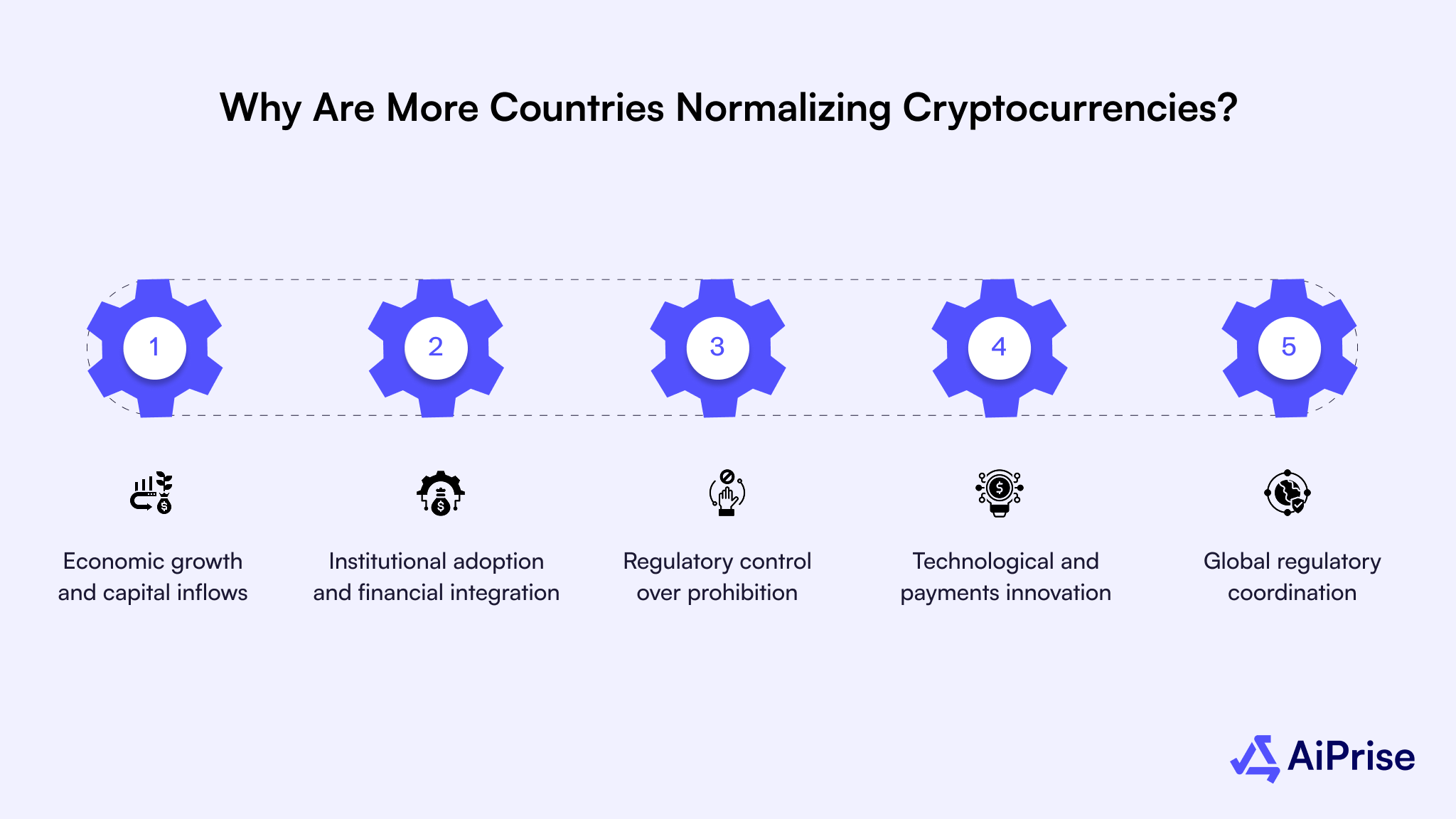
Cryptocurrency adoption is no longer driven solely by retail speculation or niche technology communities. It has become a strategic economic and regulatory priority for governments worldwide.
As digital assets mature into a multi-trillion-dollar global market, countries are increasingly choosing to normalize crypto through formal regulation, taxation frameworks, and institutional integration rather than attempting outright bans. This shift reflects both economic opportunity and regulatory necessity.
Several key factors are driving this global normalization:
- Economic growth and capital inflows: Crypto-friendly policies attract foreign investment, blockchain startups, and high-net-worth individuals, which fuels job creation and strengthens local fintech and Web3 ecosystems. For many emerging economies, digital assets now serve as a fast-track tool for accelerating financial sector growth and global visibility.
- Institutional adoption and financial integration: Cryptocurrencies are no longer operating outside traditional finance. Banks, investment funds, payment processors, and public companies now actively offer crypto-related services, pushing governments to introduce formal regulations that protect investors while supporting market stability.
- Regulatory control over prohibition: Years of bans and heavy restrictions have proven ineffective. Instead of stopping crypto activity, prohibitions tend to push it underground. By adopting licensing, taxation, and compliance frameworks, governments gain visibility, enforcement power, and new streams of public revenue.
- Technological and payments innovation: Blockchain is transforming cross-border payments, tokenization, and decentralized finance by enabling faster settlements and lower transaction costs. Countries that embrace these technologies gain a competitive advantage and reduce reliance on slow, legacy financial infrastructure.
- Global regulatory coordination: Frameworks such as the EU’s MiCA, the Travel Rule, and standardized compliance requirements are aligning how digital assets are regulated worldwide. This growing coordination is accelerating crypto normalization across both developed and emerging markets.
Crypto normalization is no longer speculative; it is now a deliberate economic and regulatory strategy. As adoption expands and institutional participation deepens, countries that provide clarity, safety, and infrastructure are emerging as the dominant crypto hubs of 2026.
Also Read: How AI is Transforming AML Compliance
Now, let’s look at the crypto countries that you need to know.
Top 15 Crypto-Friendly Countries in 2026
Today’s leading jurisdictions combine clear licensing frameworks, institutional participation, strong compliance systems, and real-world adoption across payments, banking, and investment markets.
Countries that once took a cautious stance are now actively competing to attract Web3 startups, exchanges, tokenization projects, and digital asset investors.
The following 15 countries represent the most influential crypto hubs in 2026, offering a mix of regulatory stability, growth opportunities, tax efficiency, and global market access:
United Arab Emirates (UAE)
The UAE, led by Dubai and Abu Dhabi, has built one of the world’s most advanced crypto ecosystems. With dedicated regulators like Dubai’s VARA and Abu Dhabi Global Market (ADGM), the country provides structured licensing, compliance clarity, and institutional-grade oversight.
Combined with zero personal income tax, strong banking access, and crypto-focused free zones, the UAE continues to attract global exchanges, funds, and Web3 startups in 2026.
Why crypto is gaining relevance:
- Zero tax on personal crypto income and capital gains attracts high-volume traders and investors.
- Purpose-built regulators like VARA and ADGM provide legal certainty and predictable licensing.
- Government-backed funding and blockchain programs are accelerating real-world adoption.
The UAE stands out as a top-tier crypto jurisdiction by combining tax efficiency, regulatory clarity, and direct access to global capital markets.
Switzerland
Switzerland, anchored by Zug’s “Crypto Valley”, remains one of the most trusted and institution-friendly crypto jurisdictions in the world. The country is known for its regulatory precision, political stability, and deep financial infrastructure.
With clear oversight from the Swiss Financial Market Supervisory Authority (FINMA), Switzerland continues to attract blockchain startups, crypto banks, custodians, and large institutional players in 2026.
Why crypto is gaining relevance:
- FINMA provides clear guidance for cryptocurrencies, tokenized assets, and crypto service providers.
- Strong legal protections give investors and firms long-term confidence and reduced regulatory risk.
- Several cantons offer favorable tax treatment for long-term crypto holdings and blockchain businesses.
For those prioritizing legal certainty, institutional credibility, and long-term regulatory stability, Switzerland remains a premier global crypto destination in 2026.
Singapore
Singapore continues to lead Asia’s regulated crypto landscape under the oversight of the Monetary Authority of Singapore (MAS). The country has built a tightly controlled yet innovation-friendly environment for digital assets, making it a preferred base for regulated crypto exchanges, custodians, and fintech platforms.
With a strong legal system, stable banking access, and a thriving technology ecosystem, Singapore remains a key institutional crypto hub in 2026.
Why crypto is gaining relevance:
- The Payment Services Act provides a clear and strict licensing regime for crypto businesses.
- Most long-term crypto investors benefit from the absence of capital gains tax.
- Deep integration between crypto firms, banks, and fintech companies supports mainstream adoption.
Singapore stands out as one of the world’s safest and most institution-ready environments for regulated crypto activity.
Hong Kong
Hong Kong has reestablished itself as a leading crypto gateway to Asia, combining strong financial infrastructure with progressive regulation. The Securities and Futures Commission (SFC) has implemented licensing rules for virtual asset service providers, while government initiatives promote tokenization and Web3 innovation.
With robust banking networks and access to international capital markets, Hong Kong continues to attract exchanges, blockchain startups, and institutional investors in 2026.
Why crypto is gaining relevance:
- Clear legal frameworks allow retail and institutional crypto trading with regulatory oversight.
- Government-backed tokenization and Web3 funds encourage adoption of digital assets.
- Direct access to global capital markets supports liquidity and institutional participation.
Hong Kong is quickly becoming Asia’s leading regulated crypto finance hub, offering clarity, access, and growth opportunities for investors and businesses alike.
Canada
Canada continues to be a stable and forward-looking hub for regulated crypto activity. As one of the first countries to approve Bitcoin and Ethereum ETFs, it has integrated digital assets into mainstream financial services while maintaining strong oversight through the Canadian Securities Administrators (CSA).
The combination of institutional support, regulatory clarity, and mature banking infrastructure makes Canada a reliable destination for investors and blockchain enterprises in 2026.
Why crypto is gaining relevance:
- Early approval of Bitcoin and Ethereum ETFs encourages institutional participation.
- National banks and major financial institutions actively support crypto services.
- Balanced tax policies provide certainty for long-term holders and blockchain entrepreneurs.
Canada remains a trusted jurisdiction that balances innovation, legal clarity, and financial stability for serious crypto investors and businesses.
Also Read: Principles, Assessment, And Strategies In Fraud Risk Management
United States
The United States remains the largest and most influential institutional crypto market globally. Expanding ETF approvals, growing political support, and clearer federal guidance have strengthened its position as a hub for blockchain startups, exchanges, and institutional investors.
States like Wyoming and Texas have introduced pro-crypto legislation, while national regulators such as the SEC and CFTC continue to provide oversight. Combined with a deep financial ecosystem and venture capital access, the U.S. continues to drive innovation and adoption in 2026.
Why crypto is gaining relevance:
- Rapid institutional adoption and active participation from Wall Street firms boost market liquidity and credibility.
- Pro-crypto state legislation provides localized advantages for startups and investors.
- Expansion of regulated stablecoins and tokenized assets supports broader financial integration.
The U.S. remains the world’s largest crypto capital market, though fragmented state regulations require careful navigation by investors and businesses.
Cayman Islands
The Cayman Islands remain a premier offshore hub for crypto hedge funds, decentralized autonomous organizations (DAOs), and exchanges. Its tax-neutral environment, combined with clear virtual asset licensing laws under the Virtual Asset Service Provider (VASP) framework, provides a highly attractive ecosystem for digital asset businesses.
The jurisdiction’s strong legal infrastructure, developed banking sector, and global financial connectivity continue to make it a preferred choice for crypto investment and fund management in 2026.
Why crypto is gaining relevance:
- Zero capital gains and corporate tax encourage fund formation and high-net-worth crypto investments.
- The dedicated VASP regulatory framework ensures compliance and operational transparency.
- Robust legal structures protect investor rights and support international fund operations.
The Cayman Islands remain a top destination for crypto funds and offshore digital asset structures, balancing legal clarity with tax efficiency.
Bermuda
Bermuda has positioned itself as a leading offshore crypto hub through a compliance-first approach. The Digital Asset Business Act (DABA) provides clear licensing, regulatory oversight, and guidelines for blockchain and digital asset firms.
Combined with strong government support, robust banking infrastructure, and international connectivity, Bermuda continues to attract crypto exchanges, fintech startups, and tokenization projects in 2026, making it a stable and attractive jurisdiction for digital asset businesses.
Why crypto is gaining relevance:
- Purpose-built digital asset legislation ensures regulatory clarity and operational transparency.
- Government initiatives actively support compliant crypto firms and innovation.
- No direct tax on crypto capital gains encourages investors and long-term holders.
Bermuda offers one of the most reliable and tax-efficient crypto environments, combining regulatory confidence with investor-friendly policies.
Australia
Australia has steadily developed a comprehensive regulatory framework for cryptocurrencies, combining innovation with investor protection. The Australian Securities and Investments Commission (ASIC) oversees licensing for exchanges, custody providers, and digital asset businesses.
Government collaboration on tokenization, central bank digital currencies (CBDCs), and blockchain infrastructure continues to strengthen the ecosystem. With high retail adoption, strong banking integration, and supportive fintech policies, Australia remains a key destination for crypto startups and investors in 2026.
Why crypto is gaining relevance:
- Clear exchange and custody licensing rules provide operational certainty for businesses.
- Strong retail adoption fuels market activity and liquidity.
- Regulatory sandboxes encourage blockchain startups and innovative crypto solutions.
Australia balances innovation, consumer protection, and regulatory clarity, making it a stable and attractive crypto market.
Panama
Panama is rapidly establishing itself as a tax-efficient crypto hub in Latin America. With no capital gains tax on cryptocurrency transactions and a growing focus on AML compliance, the country is attracting both investors and blockchain businesses.
Its strategic location, robust banking system, and business-friendly policies provide easy access to global markets, making Panama an increasingly attractive jurisdiction for crypto activities in 2026.
Why crypto is gaining relevance:
- No capital gains tax encourages investment and long-term holding of crypto assets.
- Expanding regulatory transparency provides legal clarity for investors and companies.
- Strategic banking and global business connectivity support international crypto operations.
Panama is emerging as a quiet but highly attractive tax haven for crypto investors and blockchain businesses in 2026.
Portugal
Portugal continues to be one of Europe’s most attractive destinations for crypto investors and professionals. Its tax-friendly approach, particularly zero tax on long-term cryptocurrency gains, combined with a stable legal framework, makes it ideal for individual investors and entrepreneurs.
Strong access to EU financial markets and a growing ecosystem of crypto-friendly services further strengthen Portugal’s appeal in 2026, drawing both digital nomads and blockchain startups.
Why crypto is gaining relevance:
- Zero tax on long-term crypto gains encourages investment and holding.
- The country serves as a popular relocation hub for crypto professionals seeking tax efficiency and quality of life.
- EU regulatory stability through frameworks like MiCA ensures legal clarity and compliance.
Portugal remains a top European crypto-friendly jurisdiction, combining tax benefits, regulatory stability, and a supportive environment for investors and professionals alike.
Malta
Malta, often referred to as “Blockchain Island,” continues to be a leading European hub for cryptocurrency and blockchain innovation. The country offers one of the world’s most detailed legal frameworks for digital assets, providing clear recognition of virtual currencies and tokenized projects.
Its robust regulatory system, combined with strong EU market access, has attracted exchanges, fintech startups, and blockchain enterprises seeking legal certainty and operational stability in 2026.
Why crypto is gaining relevance:
- Malta’s first-mover advantage in blockchain legislation gives firms early regulatory clarity.
- Comprehensive licensing rules for crypto exchanges and service providers ensure operational compliance.
- Strategic access to the EU market allows businesses to scale across member states efficiently.
Malta remains a top European jurisdiction for crypto firms seeking regulatory certainty and a gateway to the EU market.
Estonia
Estonia has built a reputation as one of Europe’s most startup-friendly crypto jurisdictions, thanks to its digital-first governance model and advanced blockchain infrastructure. The country offers streamlined licensing for virtual asset service providers and supports a fully digital business environment, making it easy for crypto startups to establish and scale operations.
Combined with strong compliance systems and access to EU markets, Estonia remains an attractive destination for blockchain innovation in 2026.
Why crypto is gaining relevance:
- Efficient digital business registration allows quick and cost-effective company setup.
- Robust blockchain compliance systems ensure regulatory transparency and investor confidence.
- The e-residency program enables crypto founders to operate remotely while accessing EU markets.
Estonia is ideal for lean, digitally native crypto startups seeking fast EU market access and regulatory clarity.
Germany
Germany has emerged as one of Europe’s most favorable jurisdictions for cryptocurrency, particularly for long-term investors. With clear legal frameworks and growing institutional participation, the country provides stability and predictability for both retail and professional investors.
Strong banking infrastructure and widespread adoption of crypto payment solutions further enhance Germany’s position as a reliable and mature crypto market in 2026.
Why crypto is gaining relevance:
- Crypto gains are tax-free after a one-year holding period, encouraging long-term investment.
- Institutional crypto custody is fully legalized, supporting banks, funds, and regulated exchanges.
- High retail adoption strengthens market liquidity and mainstream acceptance.
Germany remains a top choice for patient, regulation-focused investors seeking a secure and mature European crypto environment.
Netherlands
The Netherlands has become one of Europe’s most attractive destinations for crypto businesses and investors. With strong fintech infrastructure, clear regulatory oversight, and widespread digital adoption, the country is rapidly establishing itself as a compliant hub for EU-regulated crypto operations.
Its strategic location, skilled workforce, and supportive business environment make it ideal for blockchain startups, exchanges, and institutional investors in 2026.
Why crypto is gaining relevance:
- Comprehensive regulation of crypto exchanges ensures legal clarity and investor protection.
- High consumer adoption drives market liquidity and mainstream acceptance.
- A favorable environment for Web3 startups encourages innovation and business growth.
The Netherlands effectively balances innovation with regulatory compliance, making it a leading European crypto hub for businesses and investors alike.
Together, these 15 countries highlight a clear global shift, from restricting cryptocurrencies to strategically integrating them into national financial systems.
Now, let’s look at some strategies to follow when choosing the right crypto-friendly country for your business.
Suggested Read: How to Spot a Fake Identity: A Guide to Combating Synthetic Fraud
AiPrise supports crypto businesses with advanced AML and risk management solutions. Its Fraud and Risk Scoring solution monitors blockchain transactions, flags high-risk wallets, and identifies potential money-laundering patterns, helping exchanges, custodians, and DeFi platforms.
Strategies to Choose a Crypto-Friendly Country for Your Business
Selecting the right jurisdiction for your crypto operations is a critical decision that impacts taxation, regulatory compliance, access to capital, and long-term business growth. Not all “crypto-friendly” countries are equally suited for every type of business.
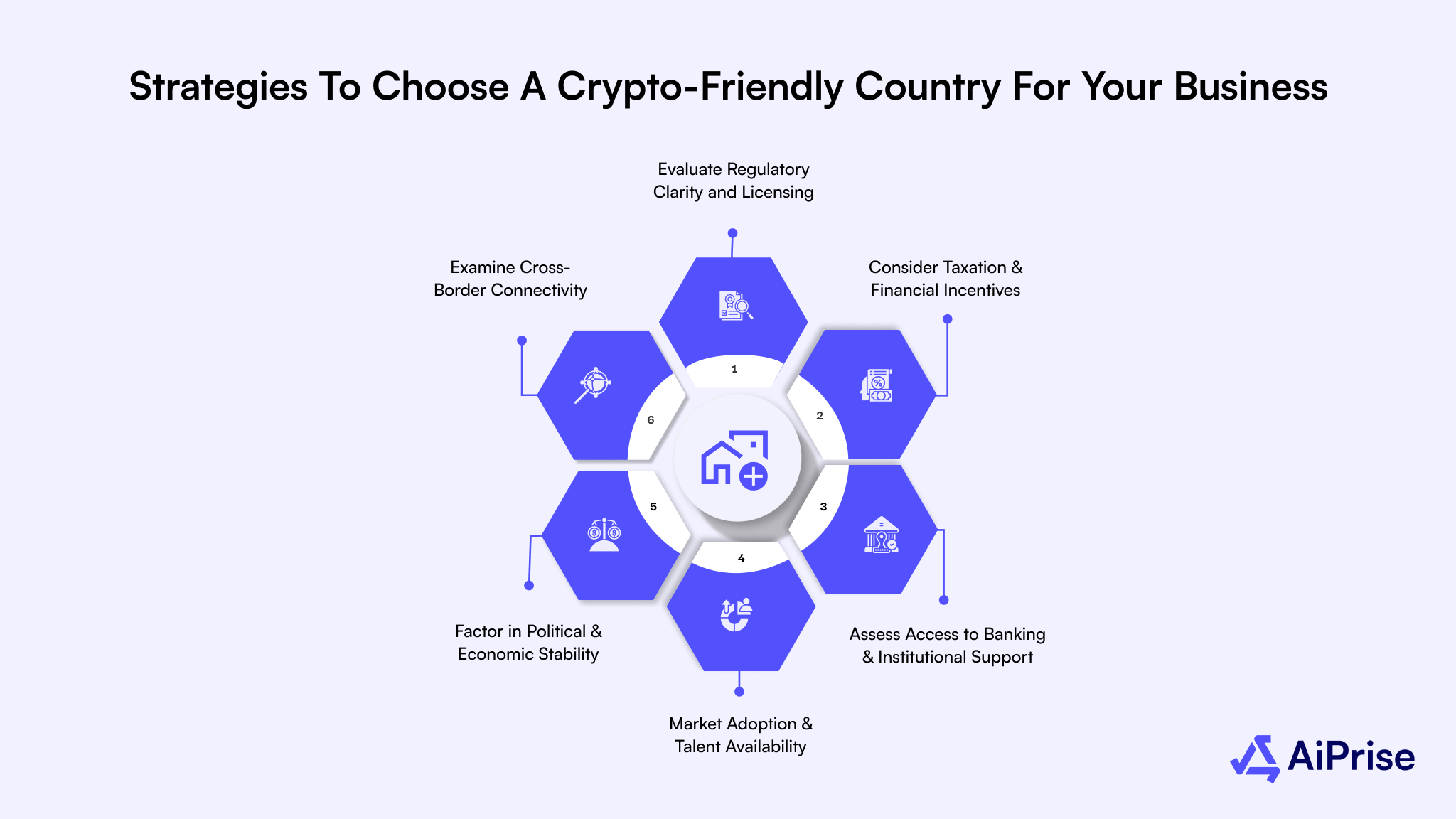
Here are key strategies to consider when choosing the ideal location for your crypto venture:
- Evaluate Regulatory Clarity and Licensing Requirements: Ensure the country has clearly defined crypto regulations, licensing frameworks, and oversight bodies. Transparent rules reduce operational risk, provide legal certainty, and make it easier to attract investors and partners.
- Consider Taxation and Financial Incentives: Look at corporate taxes, capital gains policies, and available tax incentives for crypto businesses. Tax-friendly jurisdictions can significantly improve profitability and long-term sustainability.
- Assess Access to Banking and Institutional Support: Check whether banks and financial institutions in the country support crypto operations, including custody, payment processing, and investment services. A robust financial infrastructure is crucial for scaling operations.
- Understand Market Adoption and Talent Availability: A thriving local crypto ecosystem, high consumer adoption, and access to skilled blockchain professionals can accelerate growth and adoption for your business.
- Factor in Political and Economic Stability: Stable political and economic environments reduce regulatory unpredictability and provide long-term security for your operations.
- Examine Cross-Border Connectivity: If your business deals with international clients or investors, consider countries with strong global banking links, trade agreements, and digital infrastructure.
Choosing the right jurisdiction is about balancing regulatory clarity, tax efficiency, market access, and operational support. A strategic location can provide a competitive advantage, safeguard compliance, and enable your crypto business to scale confidently in the global market.
Also Read: How Banks Utilize Machine Learning For Fraud Detection
Crypto businesses also need technology that can monitor blockchain activity, verify wallet and entity identities accurately, and flag high-risk transactions before they escalate.
How AiPrise Helps Crypto Businesses Stay Compliant
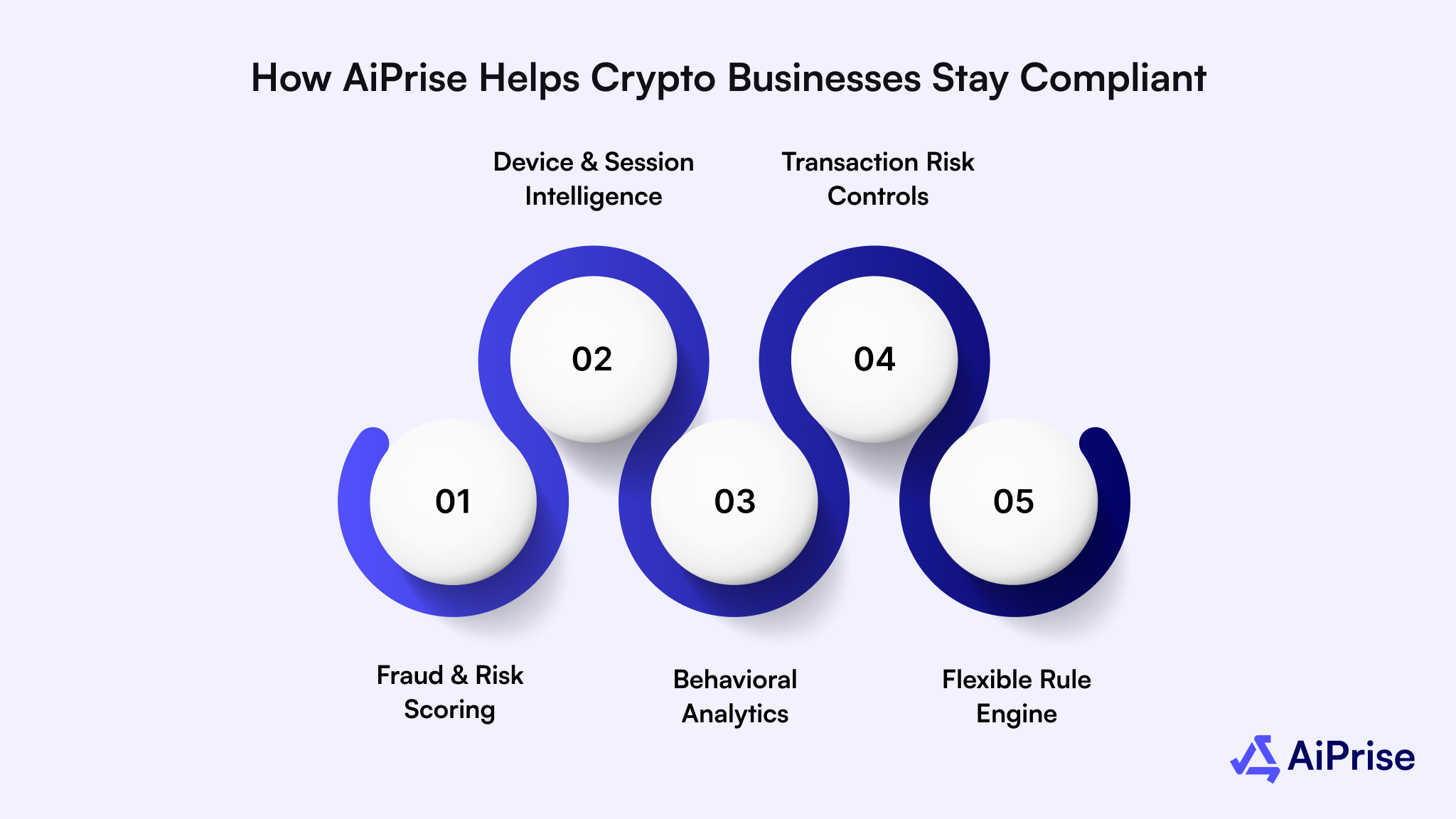
AiPrise unifies blockchain transaction monitoring, identity verification, behavioral intelligence, and risk scoring into a single orchestration layer, giving exchanges, custodians, DeFi platforms, and crypto enterprises a faster, clearer way to identify potential money-laundering and compliance risks tied to wallets, counterparties, and high-value transactions.
By detecting anomalies before they become violations, the platform helps firms prevent regulatory breaches, reduce compliance exposure, and maintain smooth trading and transaction workflows.
With AiPrise, crypto businesses can:
- Fraud & Risk Scoring: Analyze risk at onboarding and throughout the transaction lifecycle using 100+ signals, including wallet behavior, transaction patterns, IP, device, corporate registries, and legal databases to flag suspicious entities.
- Device & Session Intelligence: Identify compromised devices, browser spoofing, emulator activity, and remote access tools (RATs) to stop high-risk transaction attempts before they are processed.
- Behavioral Analytics: Track navigation patterns, keystrokes, and wallet interactions to detect anomalous behavior indicative of synthetic identities or fraudulent intent.
Transaction Risk Controls: Apply checks such as source-of-funds validation, counterparty reputation scoring, velocity thresholds, cooling-off periods, and automated holds for high-value or suspicious crypto transfers.
Flexible Rule Engine: Configure risk rules and automated workflows aligned with your firm’s internal policies, regulatory obligations, and tolerance for false positives.
AiPrise gives crypto businesses end-to-end visibility and adaptive control, helping them prevent AML violations before they occur while maintaining a seamless experience for legitimate traders and investors.
Book A Demo to see how AiPrise strengthens identity verification and reduces compliance risks in crypto transactions.
Wrapping Up
Choosing the right crypto-friendly country is increasingly critical as blockchain adoption grows faster, cross-border activity expands, and regulatory frameworks evolve. Businesses face challenges in understanding local laws, accessing institutional support, and navigating tax and compliance requirements, which can impact growth and operational efficiency.
AiPrise offers unified insights for crypto businesses by combining jurisdiction analysis, regulatory guidance, and risk monitoring into a single platform. By highlighting opportunities and potential regulatory considerations early, it helps firms make informed decisions, reduce operational uncertainty, and plan expansion strategies effectively.
Talk to Us Today to see how AiPrise helps crypto businesses select optimal jurisdictions, stay informed, and position themselves for growth in 2026 and beyond.
FAQs
1. How do crypto regulations differ between countries, and why does it matter for my business?
Regulations vary in licensing, reporting obligations, and DeFi operations. Countries with clear legal frameworks reduce uncertainty, protect investors, and allow startups to scale safely, while unclear jurisdictions risk fines, frozen assets, or operational restrictions. Understanding these differences ensures your business aligns with both product offerings and compliance strategy.
2. Are there countries where I can legally operate a crypto exchange without a traditional bank account?
Some jurisdictions, like the Cayman Islands and Malta, allow regulated exchanges to operate via alternative financial arrangements or local banking partnerships. However, most high-volume platforms still require compliant banking integration for liquidity, fiat conversions, and regulatory reporting.
3. How do global AML and KYC standards impact crypto businesses across borders?
Even in crypto-friendly countries, businesses must comply with international AML/KYC guidance, including FATF rules and the Travel Rule. This affects onboarding, cross-border transfers, and reporting, making robust compliance systems essential to avoid penalties and maintain access to global financial networks.
4. Which countries are emerging as hubs for blockchain innovation beyond crypto trading?
Singapore, UAE, and Estonia actively support tokenization, DeFi, NFTs, and CBDC projects. These jurisdictions provide regulatory sandboxes, funding opportunities, and developer ecosystems, making them attractive for startups focusing on broader blockchain applications, not just trading.
5. Can political stability affect crypto business operations even in crypto-friendly countries?
Yes. Even favorable jurisdictions can experience policy shifts, regulatory tightening, or taxation changes due to political instability. Assessing governance, legal enforcement, and historical consistency of crypto policy is critical to minimize risk and protect long-term investments.
You might want to read these...






AiPrise
KYB Compliance: 2026 Regulations You Should Know About
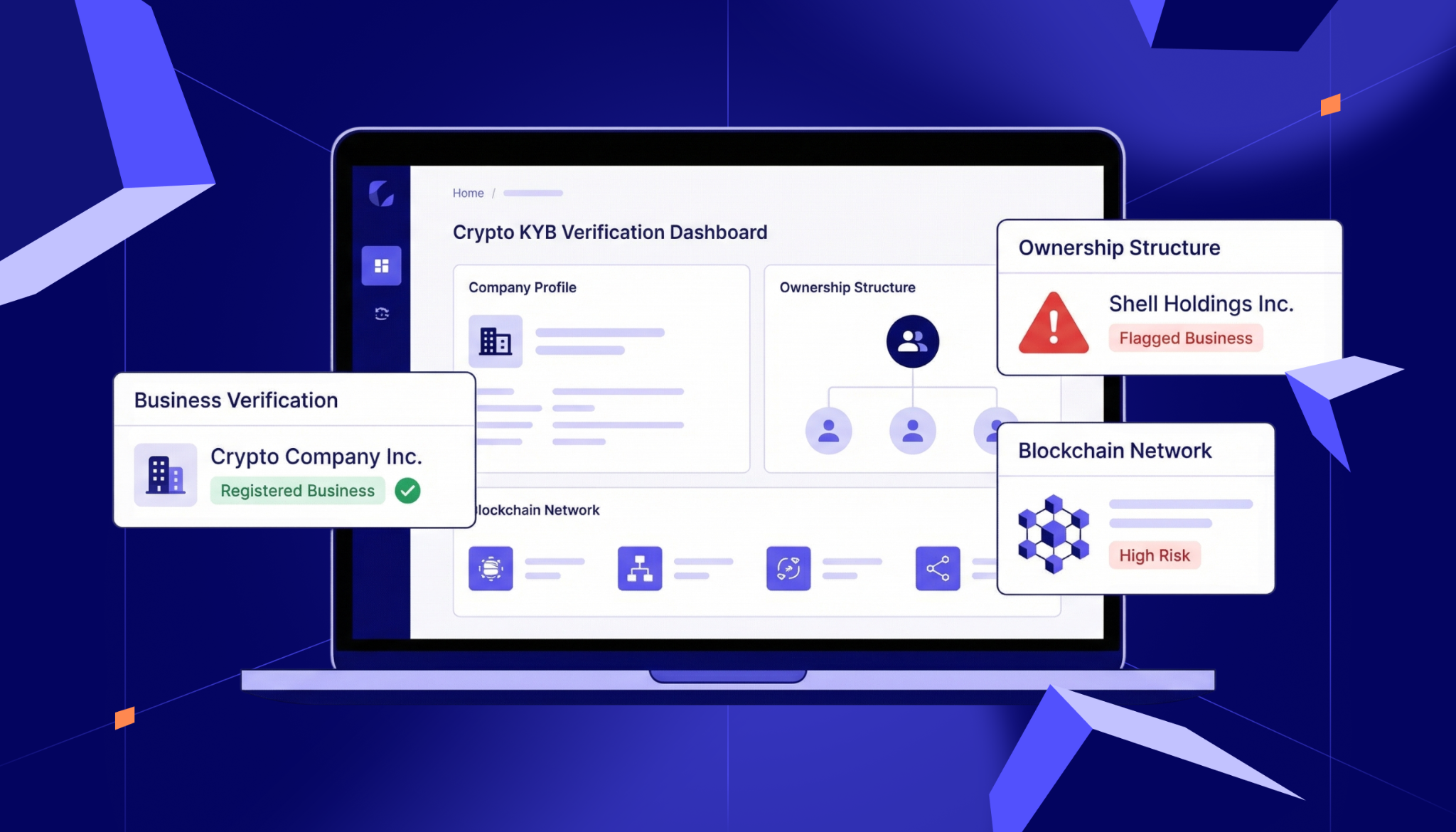
As organizations expand globally and face tighter regulations, adherence to Know Your Business (KYB) standards has become one of the most critical compliance layers for fintech, online marketplaces, and other companies that need to verify business customers before letting them perform financial transactions.










.png)

.jpg)
















.png)








.png)
.png)
.png)


















.png)

.png)






AiPrise’s data coverage and AI agents were the deciding factors for us. They’ve made our onboarding 80% faster. It is also a very intuitive platform.

Head of Operations



See your full compliance picture in one place
Use AI agents and global data to review businesses and users faster and more accurately
