

AiPrise
13 min read
December 17, 2025
A Complete Guide to AML Regulations in Real Estate for 2026

Key Takeaways

Money laundering in the real estate sector is a massive, often overlooked risk, with global transactions estimated at $1.6 trillion annually. Criminals exploit high-value property deals, opaque ownership structures, and inconsistent reporting rules to launder illicit funds, making real estate a prime target.
For investors, developers, and compliance teams, understanding the evolving AML real estate regulations is critical. It is not just to avoid penalties, but to safeguard the integrity of the property market.
This guide breaks down the latest AML real estate rules, reporting requirements, and best practices to help stakeholders stay compliant and mitigate money-laundering risks.
Key Takeaways
- Global real estate launders $1.6 trillion annually, making AML compliance critical for firms to prevent illicit funds and regulatory fines.
- Complex ownership, cross-border deals, and opaque structures make real estate a high-risk sector for money laundering and fraud.
- Key 2026 AML regulations include FATF guidance, beneficial ownership registries, CDD/EDD, STRs, cross-border monitoring, and CTF laws.
- Firms can stay compliant via robust due diligence, transaction monitoring, staff training, technology adoption, and continuous audits.
- AiPrise unifies identity verification, behavioral analytics, and risk scoring, helping real estate firms detect suspicious activity early and reduce compliance exposure.
Why AML is Gaining Relevance in Real Estate
Anti-money laundering (AML) compliance has become a top priority in real estate due to the sector’s unique vulnerability to illicit financial activity. Real estate transactions are high-value by nature, often involving millions of dollars in a single deal, which makes them an attractive channel for money laundering.
Several factors contribute to this growing relevance:
- Complex Ownership Structures: Many properties are purchased through shell companies, trusts, or layered corporate entities, which can conceal the true beneficial owner. This opacity creates opportunities for criminals to launder funds without detection, and regulators are increasingly targeting these structures for transparency.
- Cross-Border Investments: Real estate markets are global, attracting foreign buyers who may originate from high-risk jurisdictions. These cross-border investments increase the complexity of due diligence, as banks, brokers, and real estate agents must verify the source of funds and ensure compliance with multiple legal frameworks.
- Regulatory Evolution: Governments worldwide are tightening AML regulations specific to real estate. Policies now require rigorous customer due diligence (CDD), identification and verification of beneficial owners, and reporting of suspicious property transactions. Non-compliance can lead to substantial fines, legal penalties, and reputational damage.
- Integration with Financial Systems: Real estate is increasingly intertwined with banking and finance, from mortgage lending to investment vehicles. This integration amplifies the risk of money laundering and heightens regulatory expectations for financial institutions to implement AML controls in conjunction with real estate partners.
- Market Integrity and Reputation: Beyond legal obligations, AML compliance protects the credibility of real estate markets. High-profile money laundering scandals can erode investor confidence, depress property values, and damage the reputation of developers, brokers, and financial institutions involved in transactions.
AML real estate compliance is no longer optional. The combination of high-value deals, opaque ownership structures, and cross-border activity has made the sector a key focus for regulators.
Proactive AML measures not only mitigate legal and financial risk but also reinforce market integrity and trust, safeguarding both businesses and the wider real estate ecosystem.
Also Read: How AI is Transforming AML Compliance
Now, let’s look at some of the main AML real estate regulations governing the sector.
Key AML Regulations in Real Estate to Look Out for in 2026
The real estate sector remains a prime target for money laundering due to high-value transactions, opaque ownership structures, and complex funding sources. In 2025, several AML regulations are critical for real estate professionals to understand and implement.
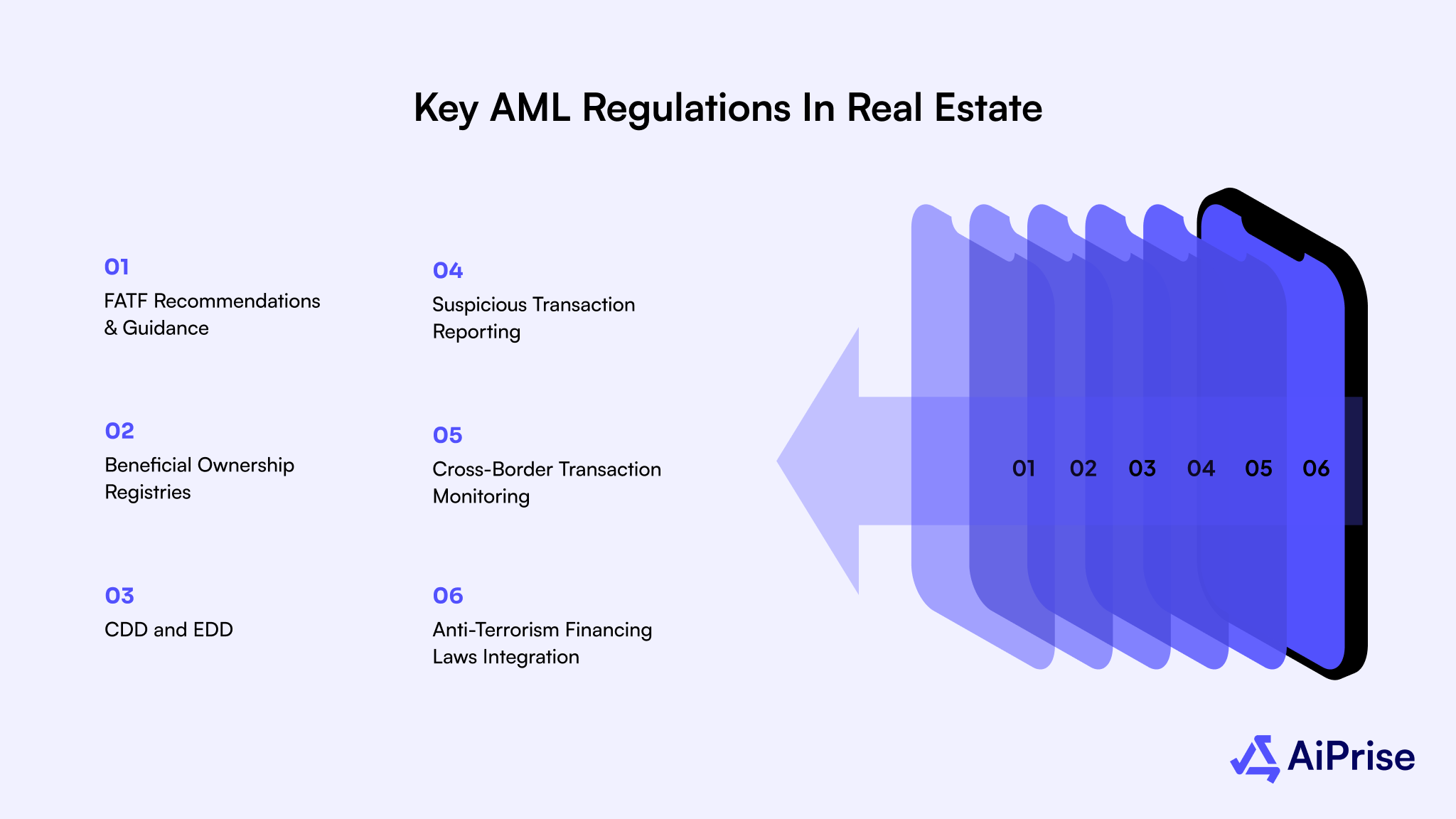
Each regulation not only defines compliance requirements but also addresses specific risks and has a measurable impact on operational practices:
FATF Recommendations and Guidance
The Financial Action Task Force (FATF) sets international standards for AML and counter-terrorism financing (CTF). Its recommendations provide guidance for real estate transactions, emphasizing risk-based approaches and customer due diligence.
What It Counters: FATF targets anonymous property purchases, shell companies, and transactions that conceal the true source of funds. It also addresses the use of real estate to launder illicit proceeds from organized crime or corruption.
Compliance with FATF guidelines requires real estate firms to verify client identities, track high-value transactions, and report suspicious activity. Adopting FATF-aligned processes enhances transparency, reduces regulatory exposure, and strengthens international trust.
Beneficial Ownership Registries
Many jurisdictions are introducing registries that require disclosure of the ultimate owners of properties and legal entities involved in transactions.
What It Counters: This regulation mitigates the risk of anonymous ownership structures often used to launder funds or evade taxes. It targets shell companies, trusts, and other entities that obscure the true beneficiaries of real estate investments.
Real estate firms must verify and document beneficial ownership accurately. Failure to comply can result in fines, legal action, or blocked transactions. Full disclosure ensures that transactions are transparent, traceable, and less vulnerable to illicit activity.

Customer Due Diligence (CDD) and Enhanced Due Diligence (EDD)
CDD and EDD are foundational AML requirements. While CDD verifies the identity of clients and transaction parties, EDD applies to higher-risk situations, such as politically exposed persons (PEPs) or high-value purchases.
What It Counters: These measures combat fraud, money laundering, and the misuse of illicit funds in property purchases. EDD specifically addresses complex or high-risk deals that may otherwise bypass standard scrutiny.
Firms must collect detailed documentation on identity, source of funds, and transaction purpose. Implementing robust CDD/EDD procedures reduces false positives, prevents inadvertent facilitation of illicit activity, and strengthens audit readiness.
Suspicious Transaction Reporting (STR)
Real estate entities are required to file STRs when transactions exhibit unusual patterns or suspicious characteristics, such as rapid resale, abnormal payment structures, or mismatched ownership documentation.
What It Counters: STRs help detect and prevent illicit activity, including money laundering, tax evasion, and fraud. They provide authorities with early warnings of potentially illegal property transactions.
Timely and accurate STR filings protect firms from regulatory penalties, enhance investigative capabilities, and demonstrate proactive compliance. It also signals to regulators that a firm maintains an effective risk-monitoring framework.
Cross-Border Transaction Monitoring
With globalization, real estate deals increasingly involve foreign buyers or offshore entities. Regulations require enhanced monitoring of cross-border transactions to flag high-risk jurisdictions and unusual funding sources.
What It Counters: This regulation targets international money laundering schemes, foreign criminal proceeds, and funds linked to sanctioned or high-risk countries. It prevents illicit funds from entering local property markets.
Firms must implement automated risk-scoring and monitoring tools to identify suspicious international deals in real time. Effective monitoring reduces exposure to international AML violations and enhances reputational integrity.
Anti-Terrorism Financing Laws Integration
AML compliance now intersects with counter-terrorism financing (CTF) requirements, mandating checks against sanctions lists, politically exposed persons (PEPs), and high-risk accounts.
What It Counters: This framework prevents real estate from being used as a vehicle for financing terrorism, including through shell companies or foreign investments that may funnel illicit capital.
Integrating CTF measures into transaction screening ensures that firms comply with national security regulations, protects clients from unintended exposure to sanctioned entities, and enhances trust with regulators and stakeholders.
Firms must track beneficial ownership, perform rigorous due diligence, monitor suspicious and cross-border transactions, and integrate anti-terrorism measures. Doing so not only reduces legal and financial risk but also strengthens market integrity and customer confidence.
Suggested Read: How to Spot a Fake Identity: A Guide to Combating Synthetic Fraud
AiPrise strengthens AML compliance and risk management in real estate transactions with its Fraud and Risk Scoring solution. By identifying suspicious buyers, shell companies, and hidden risks early, it helps firms reduce regulatory exposure and stay ahead of evolving AML requirements.
To help real estate professionals navigate regulatory demands, the following six areas outline how to stay compliant with AML regulations.
How to Stay Compliant with AML Regulations in Real Estate
Regulatory scrutiny is intensifying globally, with authorities demanding that real estate professionals not only identify suspicious activity but also actively mitigate it through structured controls and transparent reporting.
Achieving compliance is critical to protecting your business from financial penalties, reputational damage, and legal exposure, while demonstrating a commitment to ethical operations and responsible real estate practices.
To help real estate professionals navigate these demands, the following six areas outline how to stay compliant with AML regulations:
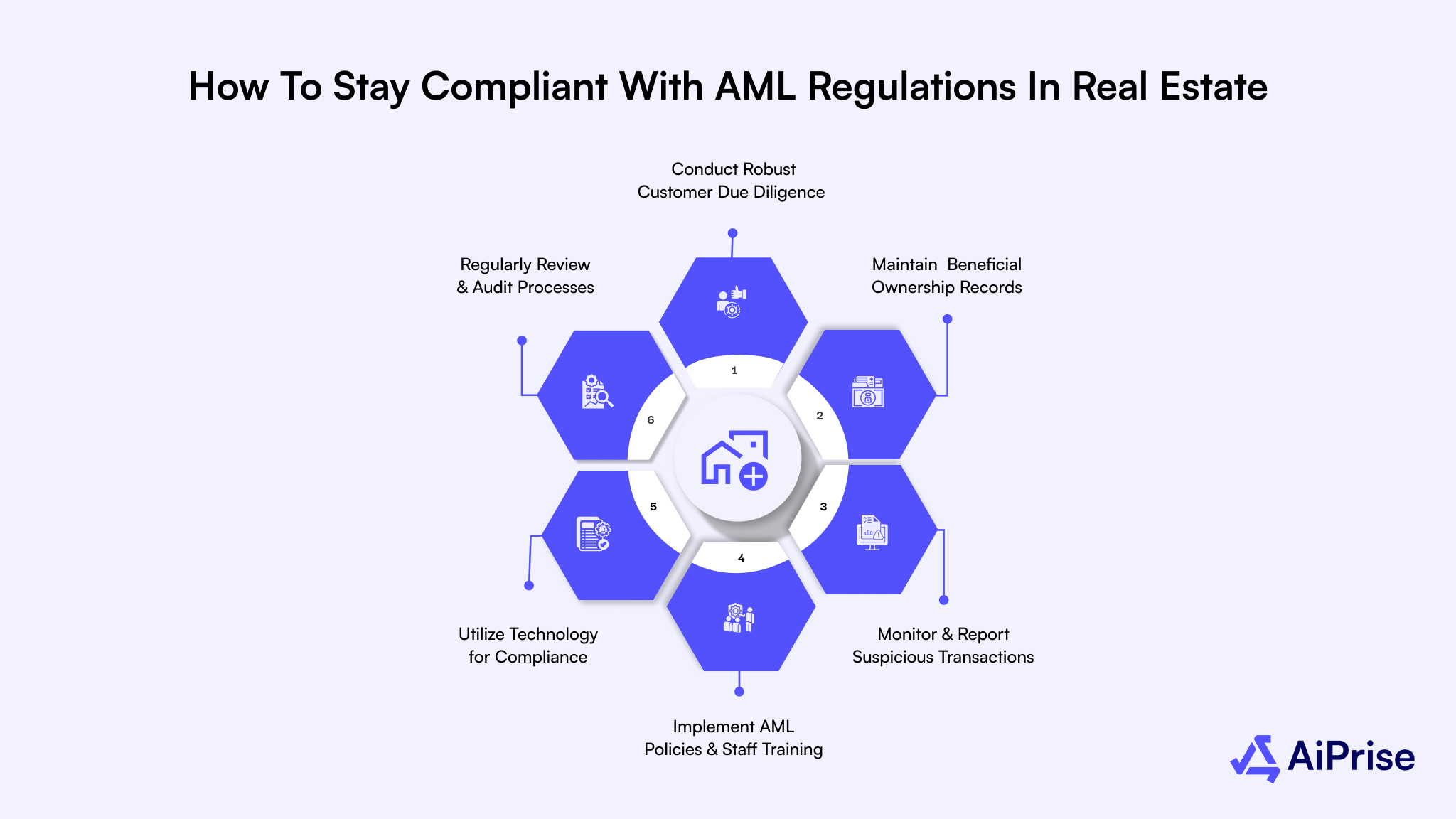
Conduct Robust Customer Due Diligence
Verify the identity of all buyers, sellers, and investors. For high-value transactions or high-risk clients, conduct enhanced due diligence to understand the source of funds, occupation, geographic risk, and financial history.
How to Enforce:
- Establish standardized CDD procedures for every client, ensuring full identity verification before initiating transactions.
- Implement risk scoring to classify clients based on transaction size, jurisdiction, and prior history.
- Maintain documented records of all verification and due diligence steps for audit purposes.
Outcome: By rigorously verifying identities, your firm prevents the use of real estate as a channel for illicit funds, reduces exposure to regulatory sanctions, and demonstrates a culture of compliance to authorities.
Maintain Up-to-Date Beneficial Ownership Records
Identify and document ultimate beneficial owners (UBOs) for all property purchases involving corporations, trusts, or complex structures. Understanding who truly owns a property is critical to prevent anonymity in illicit transfers.
How to Enforce:
- Require all entities to disclose UBO information during onboarding.
- Cross-check ownership data against public records, corporate registries, and sanctions lists.
- Update ownership records regularly to reflect changes in control or structure.
Outcome: Maintaining accurate beneficial ownership records ensures transparency, deters criminals from hiding behind shell companies, and allows regulatory authorities to track suspicious activity efficiently.
Monitor and Report Suspicious Transactions
Implement monitoring systems to flag unusual behavior, such as over- or under-valued transactions, frequent high-cash dealings, rapid resales, or cross-border transfers from high-risk jurisdictions.
How to Enforce:
- Use transaction monitoring software that automatically detects anomalies based on defined risk rules.
- Train staff to recognize red flags and escalate suspicious cases immediately.
- Report flagged transactions promptly to the relevant financial intelligence units (FIUs) as required by law.
Outcome: Proactive monitoring and timely reporting prevent illicit funds from entering the real estate market, mitigate legal liability, and build confidence among regulators and stakeholders.
Implement AML Policies and Staff Training
Clear AML policies guide employees on client onboarding, due diligence, transaction monitoring, and reporting obligations. Continuous training ensures staff can identify and respond to red flags effectively.
How to Enforce:
- Develop formal AML manuals and SOPs tailored to real estate operations.
- Conduct mandatory annual training sessions for all employees, including scenario-based exercises.
- Establish internal reporting channels for staff to escalate concerns safely.
Outcome: A trained, policy-aware workforce reduces the risk of human error, ensures regulatory adherence, and reinforces a culture of compliance that protects both the organization and its clients.
Utilize Technology for Compliance
Automated AML solutions streamline identity verification, transaction monitoring, and sanctions screening. Technology reduces manual errors and accelerates detection of high-risk behavior.
How to Enforce:
- Deploy platforms that integrate KYC checks, PEP/sanctions screening, and transaction monitoring into a single workflow.
- Regularly update systems with the latest risk indicators, watchlists, and regulatory changes.
- Use AI-powered analytics to detect patterns that may indicate fraud or money laundering attempts.
Outcome: Technology enhances operational efficiency, ensures continuous monitoring, and provides audit-ready data for regulators, reducing reliance on manual checks and increasing compliance reliability.
Regularly Review and Audit Processes
Periodic reviews and audits ensure your AML framework remains effective against evolving risks and complies with new regulations. Continuous improvement is essential in a dynamic market like real estate.
How to Enforce:
- Conduct internal audits at least annually to identify gaps and inefficiencies in AML controls.
- Test algorithms and monitoring systems for accuracy, bias, and effectiveness in real-world conditions.
- Adjust policies and procedures in response to audit findings, emerging risks, and regulatory updates.
Outcome: Ongoing auditing and review keep your compliance program current, reduce vulnerability to sophisticated laundering schemes, and demonstrate to regulators that your firm maintains proactive risk management.
Implementing these practices mitigates risk, strengthens regulatory credibility, and safeguards your firm against costly violations.
Also Read: Understanding KYC to Prevent Identity Theft
Even with a clear understanding of regulations and best practices, real estate firms face persistent hurdles in implementing AML compliance effectively. Let’s explore the key challenges and practical ways to overcome them.
Challenges of AML Compliance in Real Estate and How to Overcome Them
AML real estate compliance is complex due to the sector’s high-value transactions, cross-border activity, and often opaque ownership structures.
Agents, brokers, and developers face multiple hurdles in identifying suspicious activity, conducting thorough due diligence, and keeping up with evolving regulations. Without effective controls, firms risk hefty fines, reputational damage, and even criminal liability.
However, by understanding the key challenges and implementing practical solutions, real estate professionals can strengthen compliance, streamline processes, and safeguard their business:
By using technology, maintaining up-to-date knowledge, and embedding strong governance, real estate professionals can minimize exposure to illicit activity while ensuring regulatory adherence.
Also Read: How Banks Utilize Machine Learning For Fraud Detection
To turn AML real estate policy and governance into actionable protection, real estate firms need technology that can detect suspicious activity early, verify client identities accurately, and flag high-risk transactions before they escalate.
How AiPrise Helps Real Estate Firms Strengthen AML Compliance
AiPrise unifies identity verification, behavioral intelligence, and risk scoring into a single orchestration layer, giving real estate professionals a faster, clearer way to identify potential money laundering and compliance risks tied to buyers, shell companies, and high-value transactions.
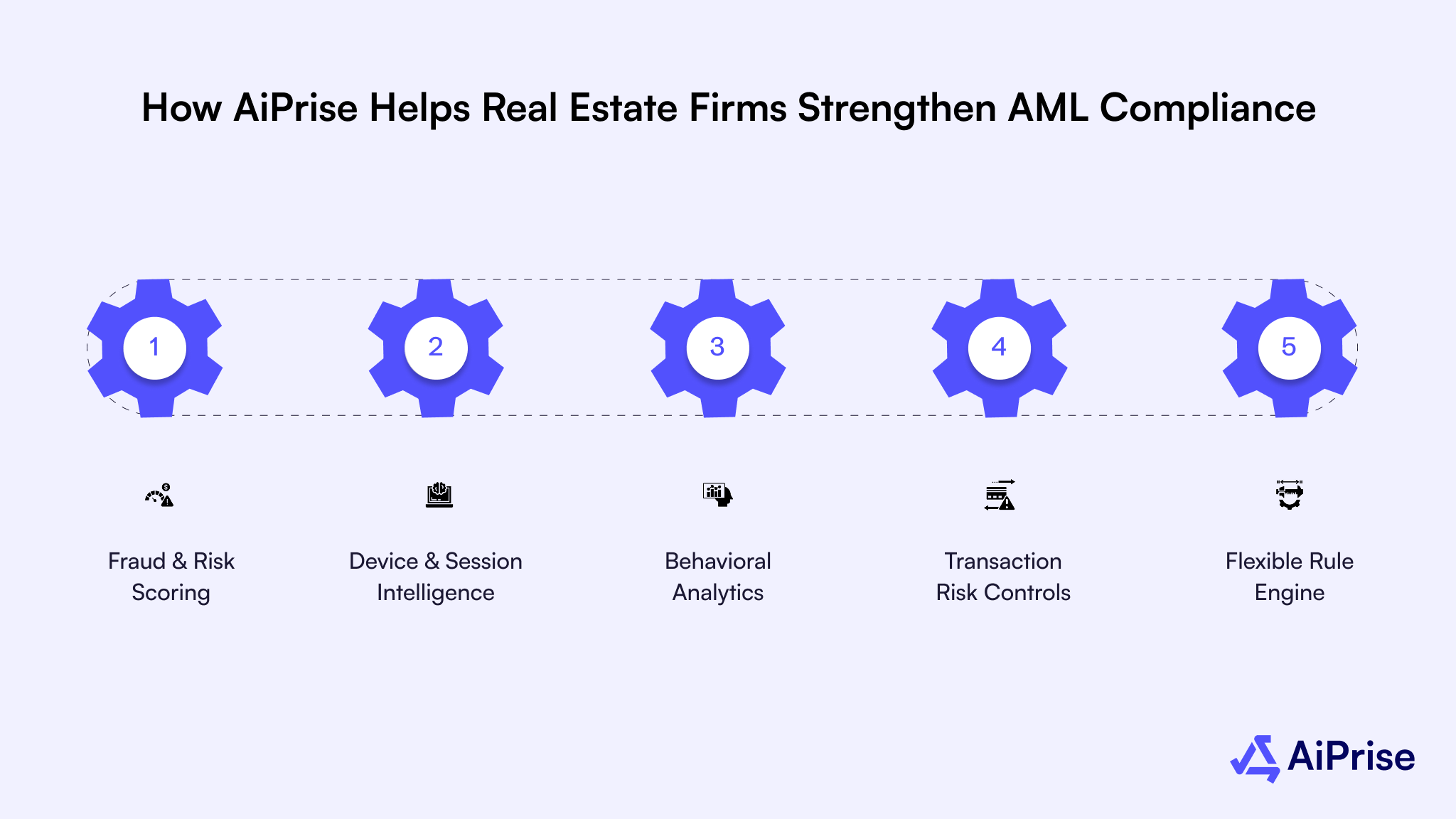
By detecting anomalies before they become violations, the platform helps firms prevent regulatory breaches, reduce compliance exposure, and maintain smooth transaction workflows.
With AiPrise, firms can:
- Fraud & Risk Scoring: Analyze risk at onboarding and throughout the transaction lifecycle using 100+ signals, including email, phone, device, documents, non-bureau data, corporate registries, and legal databases to flag suspicious entities.
- Device & Session Intelligence: Identify compromised devices, browser spoofing, emulator activity, and remote access tools (RATs) to stop high-risk transaction attempts before they are processed.
- Behavioral Analytics: Track navigation patterns, keystrokes, hesitation, and document interactions to detect anomalous behavior indicative of synthetic identities or fraudulent intent.
- Transaction Risk Controls: Apply checks such as source-of-funds validation, beneficiary reputation scoring, velocity thresholds, cooling-off periods, and automated holds for high-value or suspicious property transfers.
- Flexible Rule Engine: Configure risk rules and automated workflows aligned with your firm’s internal policies, regulatory obligations, and tolerance for false positives.
AiPrise gives real estate firms end-to-end visibility and adaptive control, helping them prevent AML violations before they occur while maintaining a seamless experience for legitimate buyers and investors.
Book a Demo to see how AiPrise strengthens identity verification and reduces compliance risks in real estate transactions.
Wrapping Up
AML compliance in real estate is increasingly critical as transactions grow faster, cross-border, and more complex. Firms face challenges in identifying high-risk clients, monitoring unusual patterns, and staying ahead of evolving regulations, which can lead to severe fines and reputational damage.
AiPrise offers unified risk intelligence by combining identity verification, transaction monitoring, and behavioral analytics into a single platform. By detecting suspicious activity early, it helps real estate firms prevent money laundering, reduce regulatory exposure, and maintain smooth, compliant operations.
Talk to Us Today to see how AiPrise strengthens AML compliance, safeguards transactions, and keeps your firm protected end-to-end.
FAQs
1. How does the complexity of property ownership structures complicate AML compliance in real estate?
Criminals often use complex ownership arrangements to obscure the true beneficial owners, making it difficult for real estate professionals to identify and verify clients accurately, thus requiring enhanced due diligence and advanced ownership tracing tools.
2. What challenges do manual AML compliance approaches present for busy real estate agencies?
Manual processes are time-consuming and prone to human error, such as missing red flags or failing to update sanctions lists promptly. This can lead to regulatory penalties, client dissatisfaction, and increased operational costs.
3. How is AML automation improving risk management for real estate transactions?
Automated platforms streamline identity verification, sanctions screening, risk assessment, and suspicious transaction reporting, reducing human error and accelerating compliance workflows, which is essential for handling high-value and cross-border deals.
4. Why is a risk-based approach necessary in real estate AML compliance?
Not all real estate transactions carry equal risk: cross-border purchases, high-value properties, or transactions involving politically exposed persons (PEPs) warrant more stringent checks. Regulators expect firms to tailor controls accordingly and justify risk classifications during audits.
5. What are the consequences of AML non-compliance specific to real estate firms and individuals?
Penalties can include heavy fines, license suspensions, exclusion from contracts, and reputational damage. Moreover, individuals such as compliance officers and executives can face personal liability if negligence is found in AML practices, emphasizing the need for robust compliance culture.
You might want to read these...






AiPrise
KYB Compliance: 2026 Regulations You Should Know About
As organizations expand globally and face tighter regulations, adherence to Know Your Business (KYB) standards has become one of the most critical compliance layers for fintech, online marketplaces, and other companies that need to verify business customers before letting them perform financial transactions.











.png)

.jpg)


















.png)








.png)
.png)
.png)

















.png)

.png)






AiPrise’s data coverage and AI agents were the deciding factors for us. They’ve made our onboarding 80% faster. It is also a very intuitive platform.

Head of Operations



See your full compliance picture in one place
Use AI agents and global data to review businesses and users faster and more accurately
