

AiPrise
22 min read
December 17, 2025
STO Compliance Guide: Key Features and Regulations

Key Takeaways

Security Token Offerings (STOs) combine the efficiency of blockchain with the obligations of regulated securities. While this model opens new paths for capital formation, it also places issuers under strict legal and operational scrutiny. In 2026, STO compliance extends far beyond basic disclosures or investor onboarding. Issuers are expected to maintain clear controls around investor eligibility, anti-money-laundering checks, token governance, custody, and ongoing reporting. These requirements apply across the full lifecycle of an STO and vary significantly by jurisdiction. This guide explains the regulations, compliance features, and practical considerations you need to plan, launch, and manage an STO with confidence.
Key Takeaways
- STOs require structured compliance across jurisdictions, covering identity checks, smart contract governance, asset custody, and reporting.
- Investor eligibility, AML controls, and transaction monitoring shape the integrity and scalability of every STO.
- Global regulations differ sharply, making adaptable workflows essential for cross-border participation.
- Fraud prevention relies on blockchain analytics, risk scoring, and continuous oversight throughout the investor lifecycle.
- AiPrise strengthens STO compliance with unified KYC, KYB, AML, and monitoring tools that support secure, scalable digital securities operations.
What Are Security Token Offerings (STOs)?
You can think of an STO as a regulated way to raise capital using blockchain while giving investors a token that represents a real financial interest. Instead of dealing with unregulated digital assets or slow traditional instruments, you get a compliant structure that lets you reach global investors with more transparency and programmable controls.
Here are the core elements that define an STO for you:
- Tokenized Financial Rights: Your security token can represent equity, debt, revenue share, or fund participation. For example, a digital infrastructure startup might issue tokens that pay a quarterly yield tied to project performance.
- Programmable Compliance Controls: You can embed investor limits, sale restrictions, and eligibility rules inside the token itself. This reduces manual errors and keeps your issuance aligned with your internal policies.
- Investor Trust Through Auditability: Every transaction sits on a tamper-resistant ledger, which gives investors and partners a clear view of activity when they evaluate your offering.
- Faster and More Flexible Capital Formation: You can reach qualified individuals or institutions without heavy intermediaries, which helps you move faster while maintaining regulatory integrity.
- Liquidity Opportunities Through Secondary Markets: Once approved, your tokens can be traded on compliant platforms, giving investors controlled liquidity while you stay within regulatory boundaries.
Why Compliance Matters for STO Issuers in 2026
If you plan to issue or scale an STO in 2026, compliance becomes one of your biggest strategic levers. Regulatory scrutiny is rising, investor expectations are sharper, and digital asset markets are maturing into a space where only well-governed offerings gain traction.
You are no longer judged only on your technology but also on your ability to prove that investor protections, financial controls, and risk safeguards are in place from day one.
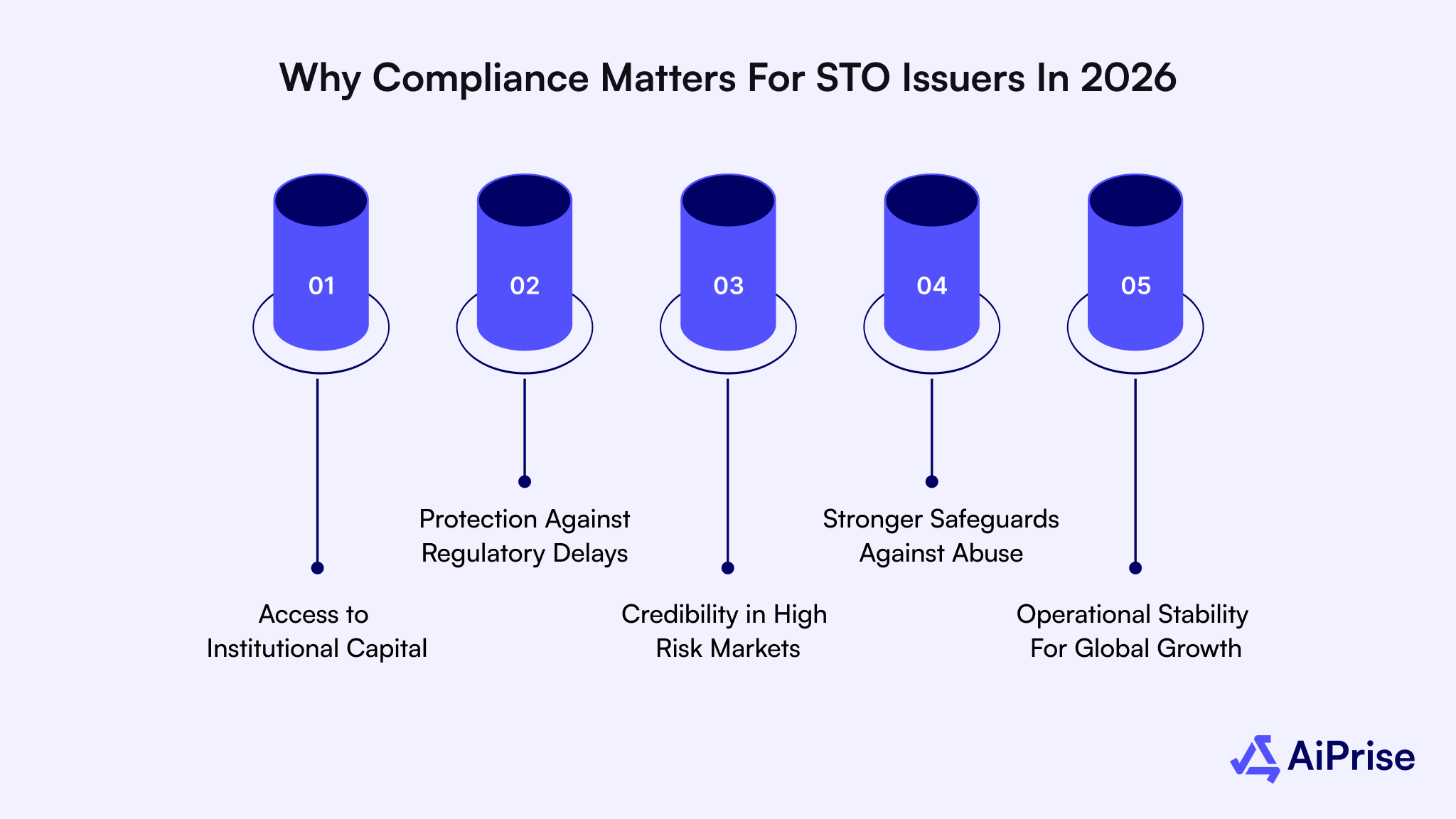
Here are 5 key reasons compliance carries more weight than ever:
- Access to Institutional Capital: You open the door to banks, funds, and payment providers only when your controls mirror the standards they already use. For example, a US-based fintech launching an STO can win institutional interest if it demonstrates clear internal controls and transparent oversight.
- Protection Against Regulatory Delays: You reduce the risk of stalled launches by aligning early with jurisdiction-specific rules. This helps you avoid costly rework and lets your team focus on investor acquisition instead of remediation.
- Credibility in High Risk Markets: If you operate in industries like crypto trading or cross-border payments, strong compliance helps you reassure sophisticated investors who need evidence that your token aligns with safe market practices.
- Stronger Safeguards Against Abuse: You limit the chance of suspicious participants entering your ecosystem when your onboarding and monitoring tools match the expectations of auditors or partner institutions.
- Operational Stability For Global Growth: You create a repeatable framework that supports expansion into new regions without major redesign, helping your issuance scale smoothly as regulations change.
Also read: Deepfake Selfie Verification in Identity Checks.
To understand how Security Token Offerings (STOs) work in practice, it's essential to look at the key regulations that shape them.
Top STO Regulations You Must Understand
As STOs gain traction in regulated finance, you face a growing web of rules that shape how you structure offerings, screen investors, and manage token activity. Many jurisdictions are updating digital asset frameworks to close gaps in earlier guidance, and these revisions directly affect how you design your issuance workflow.
Below are the key regulatory areas you need to understand before exploring the specific requirements in each region.
SEC Regulations Reg D, Reg S, Reg A+
If you are planning an STO for a U.S. audience, these SEC exemptions shape how you design your fundraising strategy, who you can onboard, and how you communicate your offer. Each path gives you a different balance of speed, disclosure, and investor reach.
Your decision affects everything from marketing boundaries to accreditation verification, so choosing the wrong route can slow your timeline or limit your investor pool.
Below are the core points you need to factor in:
- Reg D For Accredited Investors: You can raise capital quickly from accredited individuals or institutions in the US with limited disclosure. For example, if you run a payments startup and want a fast private round, Reg D helps you keep compliance lean while still protecting your cap table from unqualified investors.
- Reg S For Global Investors Outside The US: You can target non-US participants without triggering domestic offering rules. This is useful when you want to expand access to regions where your product already has traction, such as APAC or the Middle East, while keeping US regulatory exposure low.
- Reg A+ for Wider US Retail Reach: You can open your STO to everyday US investors if you meet higher disclosure and auditing requirements. This is effective when you want broader distribution or community participation, such as a digital asset platform letting its early users invest with smaller checks.
- Marketing Boundaries Under Each Path: Your outreach strategy changes based on the exemption you select. For instance, Reg D allows limited solicitation, while Reg A Plus supports public communication. This helps you shape your promotional approach without risking penalties.
- Ongoing Filing Expectations: You need to prepare periodic updates and documentation that match the requirements of the exemption. Clear internal reporting processes help you maintain compliance throughout your issuance lifecycle.
FINRA Oversight and Broker-Dealer Requirements
Launching an STO in the US often involves activities that fall under the supervision of FINRA, especially when token distribution, solicitation, or secondary trading touches broker-dealer functions.
Many STO teams underestimate how closely these rules map to digital asset workflows, which can create friction when raising capital or offering trading access. Strong alignment with FINRA expectations helps prevent service disruptions and builds trust with regulated partners who expect airtight conduct standards.
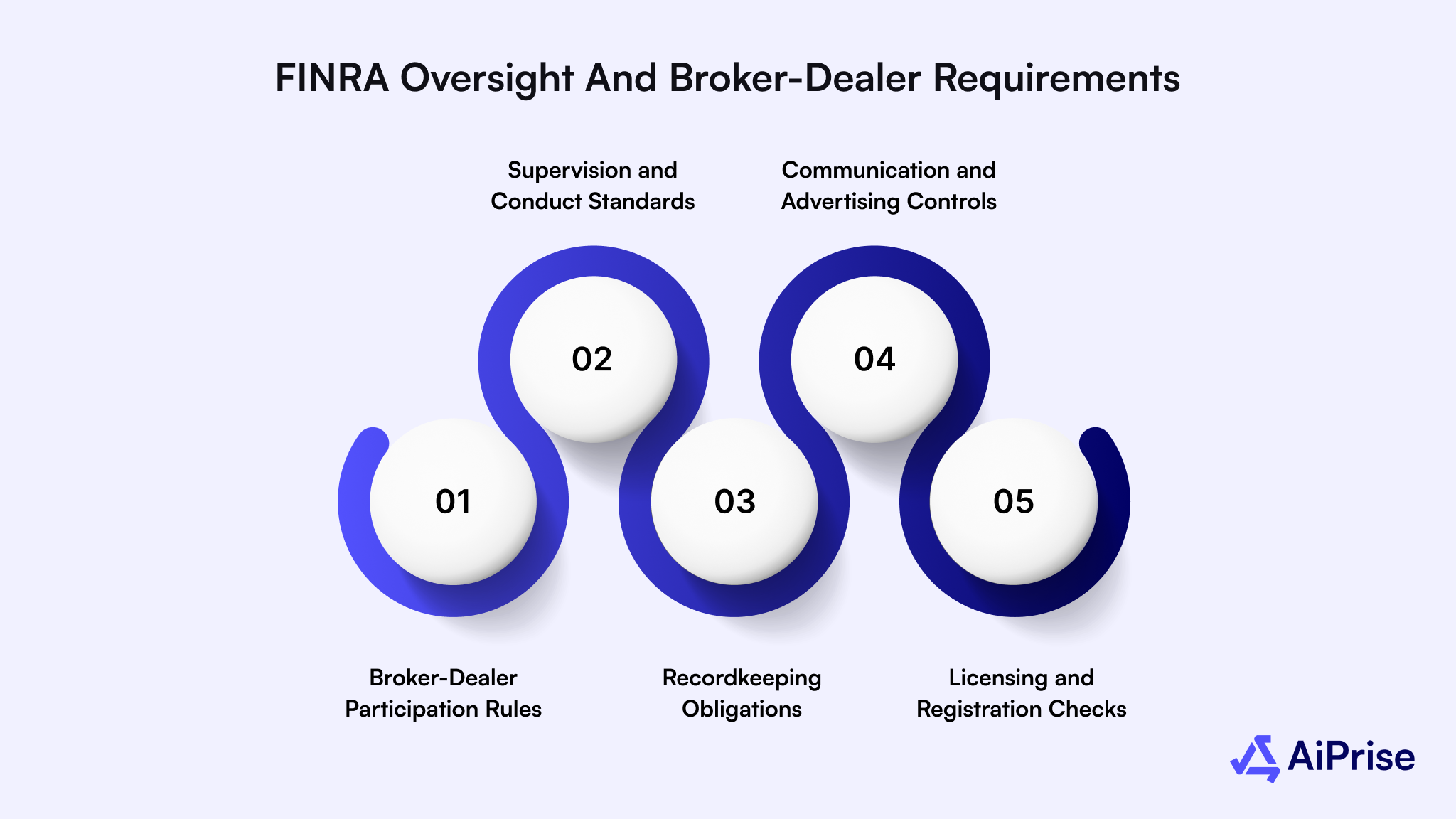
Below are the areas that matter most for STO issuers:
- Broker-Dealer Participation Rules: Broker-dealers must handle activities that qualify as securities solicitation or transaction execution. For instance, an STO platform offering curated investor matchmaking would likely need a licensed partner to avoid violations.
- Supervision and Conduct Standards: FINRA requires documented supervision of communications, sales practices, and investor interactions. This includes recording promotional materials and training staff involved in investor conversations.
- Recordkeeping Obligations: All communication, trade data, and investor-related documents must be stored in compliant formats. A token platform offering secondary trading may need systems that capture wallet activity logs alongside traditional records.
- Communication and Advertising Controls: Marketing messages must avoid exaggerated claims and must match actual offering terms. STO teams often set up pre-approval workflows to ensure every public statement meets FINRA guidelines.
- Licensing and Registration Checks: Any entity performing regulated functions must verify that it holds the correct registrations. Partnerships with already registered broker-dealers can streamline this rather than building a full compliance operation internally.
Regulatory Frameworks Governing STOs Worldwide
STO expansion across borders brings new opportunities, but it also exposes issuers to regional rules that shape everything from disclosure standards to investor eligibility. Every major market is refining its digital asset framework, and these updates influence how your tokens can be issued, traded, and held.
A clear view of global expectations helps avoid conflicts between jurisdictions and reduces the risk of regulatory surprises during your rollout.
Below are the regional insights that matter when planning global access:
- EU Under MiCA and Pilot Regime: STOs must follow structured disclosure rules, technology governance expectations, and trading venue requirements. A European fintech offering tokenized debt might need to operate through a regulated DLT market operator for secondary trading.
- UK Under FCA Digital Asset Guidance: Tokens classified as security tokens fall under financial promotion rules and authorization thresholds. UK-based investors often expect granular risk disclosures and transparent onboarding steps before they participate.
- APAC Markets With Varied Regulatory Maturity: Singapore and Hong Kong provide well-defined securities token frameworks, while emerging markets may require case-by-case approvals. Platforms raising capital across APAC often create segmented onboarding journeys to satisfy local regulators.
- Middle East With Rapid Institutional Adoption: Regulators in the UAE and Bahrain are building digital asset sandboxes that encourage compliant STO activity. Issuers targeting these regions often prepare enhanced governance documentation to meet the expectations of local financial centers.
- Cross-Border Coordination Needs: Regional variations in custody rules and offering classifications may require different issuance structures. Planning upfront avoids situations where a token structure approved in one region conflicts with another jurisdiction.
AML, CFT, and Sanctions Screening Obligations
STO issuers face rising scrutiny from authorities focused on preventing illicit finance through digital assets. Regulators now expect comprehensive systems that identify suspicious activity early, especially when investor flows span multiple regions or when tokens offer liquidity pathways.
Weak Screening controls can block banking access, delay exchange listings, or trigger enforcement reviews.
Below are the screening obligations that shape STO readiness:
- AML Controls for Risk-Based Reviews: Screening must evaluate transactional behavior, funding patterns, and investor background. A token platform attracting participants from emerging markets might require more frequent checks to spot anomalies.
- CFT Measures For Monitoring Funding Sources: Issuers need tools that review the origin of funds and detect patterns tied to extremist financing. This often means correlating wallet history with off-chain identity data.
- Sanctions Screening For Global Participants: Every wallet and identity must be checked against sanctions lists like OFAC, UN, and regional authorities. STOs targeting cross-border investors benefit from automated list updates.
- Escalation and Enhanced Due Diligence Steps: Higher risk participants require deeper investigation. For example, a corporate investor with complex ownership layers may need additional verification processes before receiving tokens.
- Documentation and Audit Readiness: Regulators expect clear evidence of every screening action. STOs that prepare audit-friendly logs can respond quickly during regulatory reviews.
Data Privacy Requirements GDPR, CCPA, etc.
Handling investor data during an STO exposes teams to strict privacy laws that regulate how information is collected, stored, and transferred. Global frameworks like GDPR and CCPA are expanding enforcement actions, and digital asset platforms are increasingly required to prove that sensitive data is secured at every stage of onboarding.
A single gap in consent, retention, or cross-border transfers can lead to penalties or investor distrust, especially when working with regulated institutions.
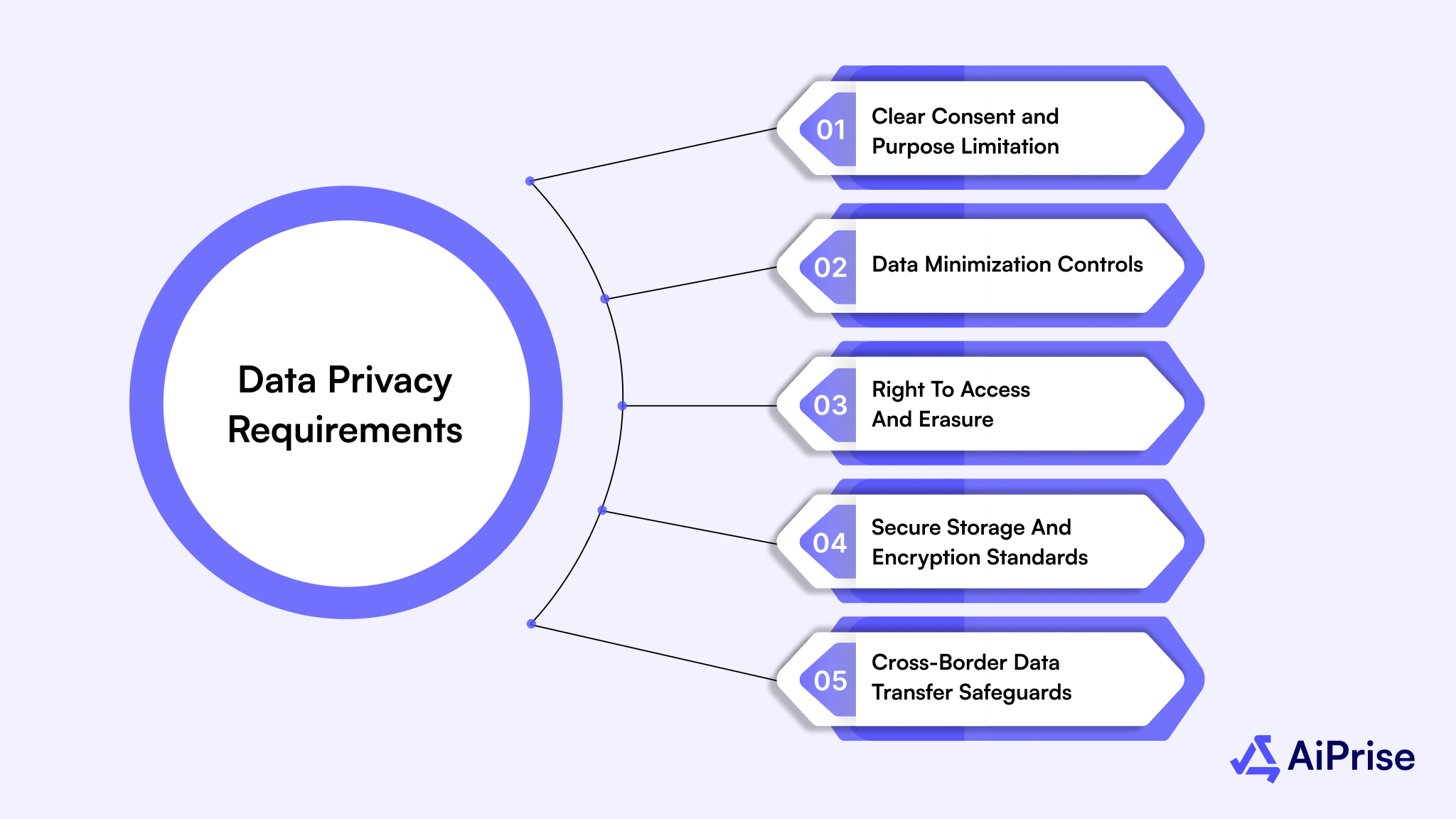
Below are the privacy rules that influence STO operations:
- Clear Consent and Purpose Limitation: Every data point must have a defined use. If an STO collects passport details for eligibility checks, it cannot repurpose that information for marketing without explicit permission.
- Data Minimization Controls: Only information directly required for compliance can be stored. This helps reduce exposure if a breach occurs and supports faster internal audits.
- Right To Access And Erasure: Investors may request copies of stored data or ask for deletion once retention periods end. STO platforms must prepare workflows to honor these rights without disrupting operational records.
- Secure Storage And Encryption Standards: Investor files and transaction metadata must be encrypted at rest and in transit. Cloud infrastructures that support token activity must prove compliance through certifications or internal policies.
- Cross-Border Data Transfer Safeguards: Moving data from the EU to other regions requires contractual protections or approved mechanisms. STO teams expanding into new markets often set up localized storage to stay compliant.
Cross-Border Token Issuance Restrictions
Issuing tokens across jurisdictions introduces a layer of regulatory friction that shapes who you can onboard and how you structure distribution. Many regions classify token offerings differently, which affects solicitation rules, disclosure depth, and resale limitations.
Cross-border investors form a large part of your strategy; careful planning becomes essential to avoid conflicts between national securities laws or restrictions on the movement of digital assets.
Below are the factors that shape compliant cross-border issuance:
- Jurisdiction-Based Offering Limits: Some regulators cap investor participation based on residency or financial status. A token sale reaching both Asia and Europe may require separate tiers to avoid breaching local thresholds.
- Resale and Transfer Controls: Certain countries restrict secondary trading for specified periods. A platform enabling early liquidity must embed controls that prevent unauthorized resale in restricted regions.
- Marketing and Communication Boundaries: Promotional content must respect regional solicitation rules. Tailored landing pages or geo-specific disclosures often help maintain compliance across diverse markets.
- Restrictions on Digital Asset Custody: Some jurisdictions allow only locally licensed custodians to hold tokenized instruments. STOs expanding into these areas may need new custody partners to meet regulatory expectations.
- Cross-Border Data Handling Constraints: Identity data collected during onboarding may fall under local privacy rules, which can impact verification workflows. Separate infrastructure environments often support smoother compliance when serving multiple regions.
Once you understand the core STO regulations, the next step is recognizing the compliance features every STO platform must have.
The Seven Core Compliance Capabilities for STO Platforms
Regulators and investors now expect STO platforms to operate with the same rigor as regulated financial systems, which means compliance features must be embedded directly into your technology stack.
Many platforms still focus on token issuance mechanics but overlook the controls that validate investor eligibility, secure digital assets, and support ongoing supervision.
Below are 7 core feature categories you need before exploring each capability in detail.
1. KYC and KYB Verification for Investor Eligibility
Investor eligibility checks shape the security and credibility of your STO. Strong KYC and KYB processes help confirm that individuals and businesses entering your ecosystem meet regulatory expectations and match the risk appetite of your offering.
These controls also support smoother interactions with banking partners that expect verified investor profiles. When verification becomes seamless, your onboarding flow feels more professional and reduces friction for qualified participants.
Below are the verification capabilities that support compliant eligibility:
- Identity Validation With Multi Layer Checks: Verification should capture government IDs, biometrics, and dynamic risk factors to confirm legitimacy. A high-value investor joining from the US, for example, may undergo a stricter identity match to satisfy institutional partners.
- Business Verification For Complex Structures: Corporate participants require checks on legal status, ownership layers, and control persons. This is important when token buyers include investment vehicles or cross-border entities.
- Eligibility Logic Based on Offering Rules: Automated checks can confirm criteria like accreditation, residency, or sector restrictions. This ensures only participants who match your STO requirements proceed.
- Support for Document Variability Across Regions: Investors from different jurisdictions use different ID formats. Workflows that adapt to local document types help reduce onboarding failures.
- Continuous Refresh For Long-Term Participants: Investor information may change over time. Periodic updates help maintain accuracy and support future regulatory reviews.
Is manual onboarding slowing down investor approvals and hurting your STO conversion rates? AiPrise accelerates verification with KYC and KYB workflows designed for fast, accurate identity and business validation.
2. AML Screening and Ongoing Transaction Monitoring
STO ecosystems attract a mix of retail, institutional, and cross-border participants, which increases exposure to financial crime risks. Strong AML controls help identify abnormal patterns before they impact your offering or trigger regulator attention.
Real-time Monitoring is particularly important when tokens have active trading pathways because transaction velocity can hide early warning signs.
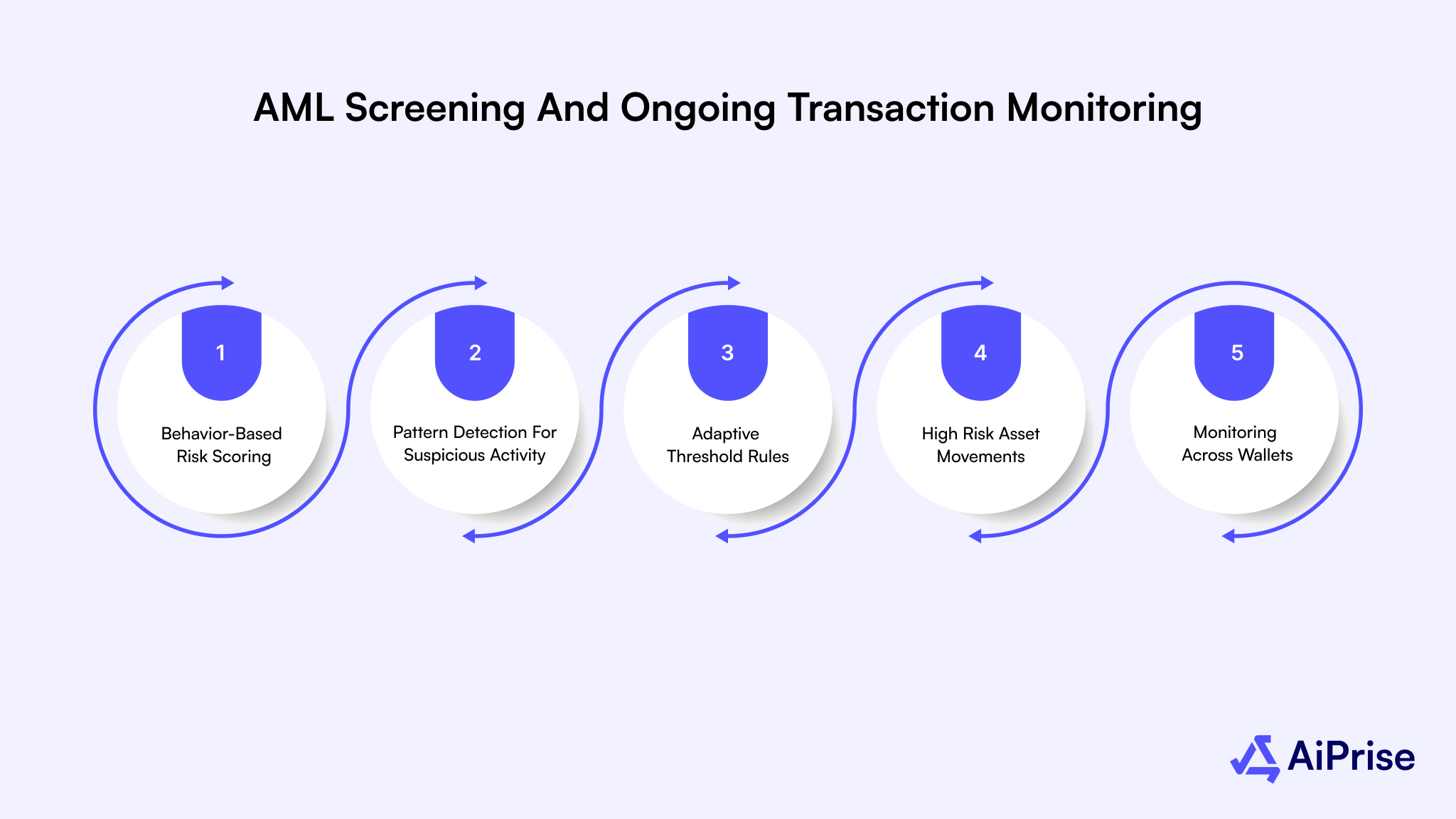
Below are the monitoring functions your STO should support:
- Behavior-Based Risk Scoring: Monitoring tools should evaluate transaction frequency, funding paths, and wallet interactions. A sudden spike in micro transactions from a new participant can trigger a deeper review.
- Pattern Detection For Suspicious Activity: Algorithms can flag repeated transactions routed through high-risk networks. This helps reduce exposure to illicit flows without manual tracking.
- Adaptive Threshold Rules: Dynamic rules allow your system to scale based on user activity. High-volume users may need tighter thresholds during peak trading windows.
- Flags For High Risk Asset Movements: Transfers involving privacy-focused tokens or obscure exchanges can indicate risk. Automated alerts guide compliance teams before issues escalate.
- Continuous Monitoring Across Wallets: Activity should be tracked throughout the investor lifecycle. This supports consistent oversight even when participants use multiple wallets.
3. Investor Accreditation Verification Tools
Accreditation rules determine which participants qualify for certain STO exemptions, and inaccurate checks can expose issuers to compliance gaps. Automated accreditation tools help validate income, net worth, or professional criteria without slowing down your onboarding rhythm.
These systems also reduce the burden on your team by removing manual review steps and ensuring that every investor meets the standards tied to your chosen issuance route.
They highlight the capabilities that support precise accreditation checks:
- Income and Net Worth Validation: Verification tools can assess supporting documents like tax filings or brokerage statements. A high-earning applicant may submit encrypted financial proof that the system validates without exposing sensitive details.
- Professional Accreditation Checks: Some jurisdictions allow participation based on licenses or industry roles. Automated validation can confirm credentials for individuals like registered financial professionals.
- Dynamic Logic For Regional Standards: Accreditation thresholds differ across markets. Tools that adapt to US, UK, or APAC rules help avoid mismatches during onboarding.
- Expiration and Refresh Controls: Accreditation status may require periodic updates. Automated reminders help keep investor eligibility current throughout the offering cycle.
- Secure Evidence Handling: Systems must store uploaded documents with strong privacy safeguards. This reduces risk while supporting audit readiness.
4. Smart Contract Governance and Audit Controls
Tokenized securities rely on smart contracts that carry real financial and compliance obligations, which means weak governance can expose your issuance to operational or regulatory risk.
A reliable framework ensures that contract logic aligns with legal requirements and that updates follow controlled procedures. Audit-friendly design also helps reassure institutional partners that your token behavior is predictable, secure, and reviewable.
Below are the controls that support trustworthy smart contract operations:
- Formal Review and Approval Workflows: Contract changes, parameter updates, and feature additions must follow documented approvals. An STO adjusting transfer restrictions, for example, should only deploy updates after multi-party review.
- Independent Security Audits: Third-party assessments help detect flaws, privilege issues, or unintended behaviors. Regular audits strengthen your platform’s reliability and reduce operational surprises.
- Failsafe Mechanisms and Emergency Controls: Governance frameworks should include tools to pause transfers or freeze activity during abnormal events. This protects investors if a vulnerability emerges.
- Version Control and Deployment Tracking: Every contract iteration should have traceable metadata. Clear logs help auditors understand how logic changed across the issuance lifecycle.
- Permissioned Access Management: Only authorized roles should interact with sensitive contract functions. Fine-grained controls prevent accidental or unauthorized modifications.
5. Secure Custody Standards for Tokenized Assets
Custody infrastructure plays a central role in protecting tokenized securities, especially as regulators tighten expectations around safekeeping. Weak custody controls can limit banking access, slow exchange approvals, or expose investors to loss if private keys are compromised.
Strong custody design signals that your STO is built for institutional trust and long-term asset protection. It also gives your investors confidence that their holdings are safeguarded throughout the lifecycle of the offering.
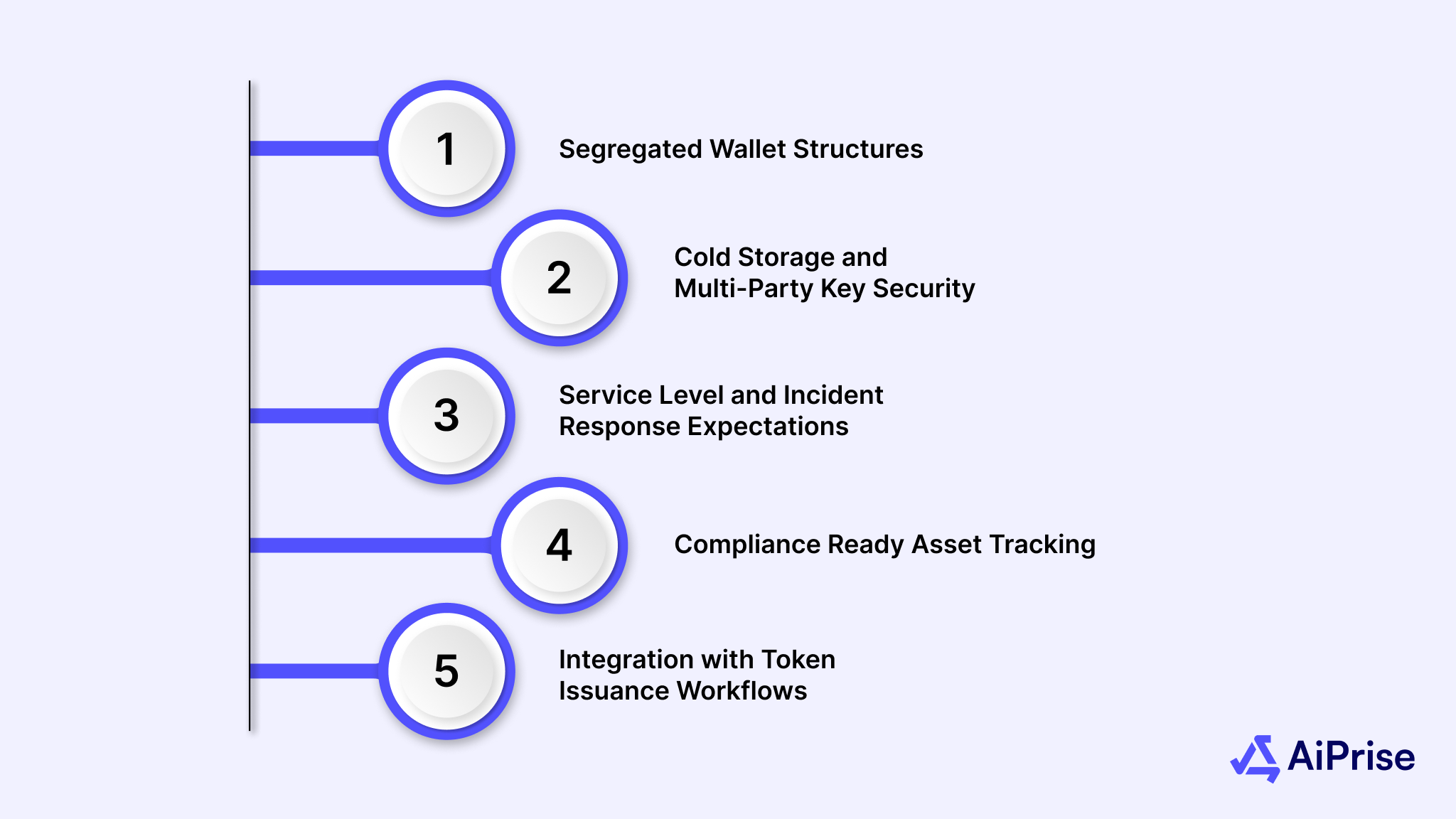
Below are the custody standards that support safe asset management:
- Segregated Wallet Structures: Assets should be separated by investor or offering type. A structured segregation model simplifies reconciliation and reduces risk during audits.
- Cold Storage and Multi-Party Key Security: High-value assets benefit from cold storage environments with distributed key control. This limits exposure to operational errors or targeted attacks.
- Service Level and Incident Response Expectations: Custody partners must provide clear uptime commitments and rapid response protocols. A fast-acting agent reduces disruption if abnormal activity occurs.
- Compliance Ready Asset Tracking: Custody systems should maintain accurate logs of movements and holdings. These records support regulatory reviews and internal reporting.
- Integration with Token Issuance Workflows: Custody must connect seamlessly with your onboarding and distribution processes. Smooth integration helps maintain consistency throughout the token lifecycle.
6. Automated Reporting and Regulatory Filings
Regulators increasingly expect STO platforms to produce accurate, timely reports that reflect investor activity, asset movements, and compliance actions. Manual reporting creates delays and increases the chance of errors, which can put your offering under scrutiny.
Automated filing tools help maintain consistency across jurisdictions and reduce the burden on your compliance and legal teams.
Below are the reporting capabilities that strengthen compliance operations:
- Real-Time Compliance Dashboards: Dashboards consolidate key metrics like investor status, transaction patterns, and outstanding reviews. This supports quick decision-making during audits.
- Template-Based Regulatory Reports: Automated templates align with local filing formats. A U.S.-based issuer can use predefined structures for periodic updates without manual formatting.
- Scheduled Submission Workflows: Filing deadlines vary by jurisdiction. Automated reminders and timed submissions reduce the risk of missed obligations.
- Data Integrity Controls: Validation checks help ensure that reported data matches on-chain activity and internal systems. Accurate records prevent reconciliation issues.
- Secure Document Delivery: Reports must be transmitted through secure channels. Automated encryption protects sensitive regulatory filings during transfer.
7. Blockchain Analytics for Fraud Prevention
STO environments generate granular on-chain data that can help detect suspicious behavior long before traditional systems would catch it. Analytics tools let you analyze wallet histories, transaction flows, and network relationships to identify actors that pose compliance or operational risks.
With regulators paying closer attention to digital asset market integrity, strong analytics capabilities demonstrate that your platform is proactive rather than reactive.
Below are analytics functions that improve fraud detection:
- Wallet Risk Profiling: Analytics tools can assign risk scores based on past interactions, links to flagged wallets, or activity patterns. A wallet with ties to multiple high-risk addresses may require additional review.
- Flow Analysis For Abnormal Movements: Monitoring large or rapid token transfers helps detect behaviors associated with layering or obfuscation. Early detection supports faster escalation.
- Network Graph Investigations: Visualizing transaction paths reveals hidden connections between participants. This is useful when multiple wallets appear unrelated but show coordinated patterns.
- Historical Behavior Benchmarks: Comparing new transactions to typical investor activity helps identify deviations. A sudden shift in trading style can signal emerging risk.
- Automated Alerts For Red Flag Indicators: Systems can notify compliance teams when activity exceeds predefined indicators. This reduces manual oversight and speeds up decision-making.
Are emerging fraud patterns and unclear risk signals creating uncertainty in your STO operations? AiPrise improves oversight with its Compliance Co-Pilot, offering intelligent monitoring, alerts, and assisted reviews across your compliance stack.
After identifying the essential compliance features, it becomes clear what challenges STO issuers face in 2026, and which solutions can address them.
Compliance Challenges STO Issuers Face in 2026 with Solution
The STO scene in 2026 brings new regulatory expectations, faster investor onboarding demands, and rising scrutiny over how digital securities are managed. Issuers aiming for global reach must balance rapid execution with frameworks that satisfy auditors, regulated partners, and regional authorities.
These pressures often surface during scale, when manual processes cannot keep up with complex workflows.
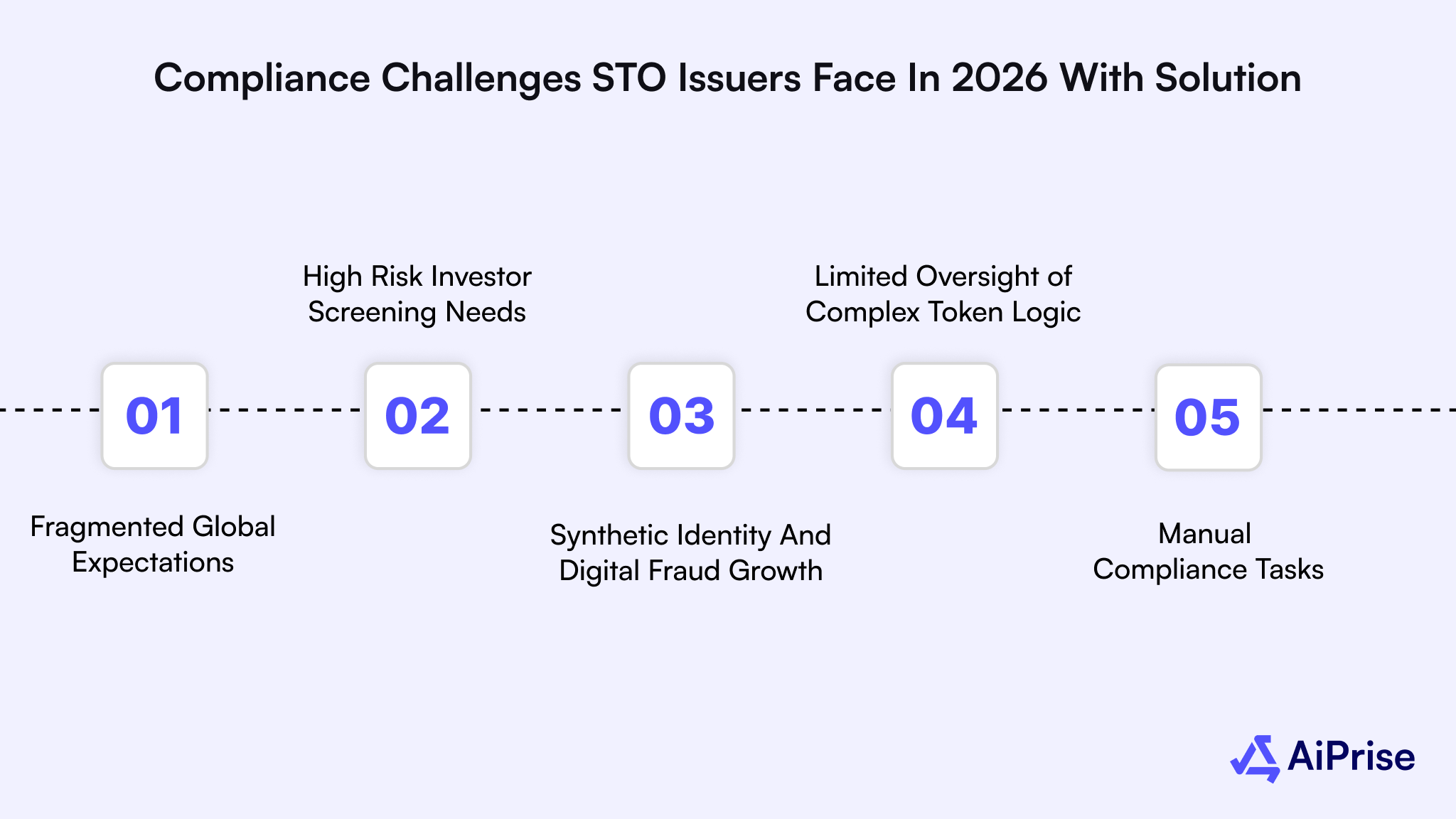
Below are key challenges and practical solutions:
- Fragmented Global Expectations: Regulations change at different speeds across regions, creating uncertainty during cross-border rollout.
- Solution: Build modular compliance workflows that adapt rules based on jurisdiction, reducing rework when launching in new markets.
- High Risk Investor Screening Needs: Growing participation from emerging markets increases exposure to risky profiles.
- Solution: Adopt advanced verification engines that score investors dynamically and trigger automated reviews for higher risk Case Management.
- Synthetic Identity And Digital Fraud Growth: Fraudsters now use AI-generated identities to penetrate onboarding systems.
- Solution: Use layered identity proofing that combines document checks, biometrics, and behavioral analytics for stronger detection.
- Limited Oversight of Complex Token Logic: Smart contracts can behave unpredictably when not governed properly.
- Solution: Implement structured governance with independent audits, version control, and restricted admin access.
- Operational Bottlenecks From Manual Compliance Tasks: Manual filings, reviews, and escalations slow down fundraising and investor access.
- Solution: Automate reporting, monitoring, and eligibility checks so your team stays focused on high-value decisions.
Understanding these challenges and solutions sets the foundation for building a complete, practical STO compliance framework.
Building a Complete STO Compliance Framework
A strong STO compliance framework aligns technology, legal requirements, and operational oversight into one cohesive system. As regulators sharpen expectations around digital securities, issuers that rely on fragmented processes struggle to maintain consistency or scale.
A complete framework helps you demonstrate preparedness during audits, attract institutional partners, and maintain investor trust throughout the token lifecycle.
Below are the foundational elements of a complete compliance framework:
- Pre-Issuance Controls and Documentation Standards: Clear policies for disclosure, risk statements, investor eligibility, and smart contract governance set a strong foundation. A globally focused STO often develops region-specific documentation to satisfy local authorities.
- Token Distribution and Investor Screening Alignment: Issuance workflows must match eligibility criteria and regional guidelines. Automated checks reduce manual errors and preserve a consistent compliance trail.
- Post Issuance Oversight And Monitoring: Continuous supervision of investor behavior, token transfers, and smart contract activity helps maintain long-term compliance readiness. Regular internal audits improve confidence during regulatory reviews.
- Integrated Technology And Compliance Systems: Verification, custody, analytics, and reporting tools should work together without manual bridging. Unified infrastructure supports smoother scale as participation grows.
- Crisis Response and Exception Handling Playbooks: Clear action plans help your team manage anomalies such as regulatory inquiries or abnormal trading spikes. Defined playbooks keep operations stable during unexpected events.
Once a full compliance framework is established, the next step is selecting the right technology to bring it to life.
Choosing the Right STO Compliance Technology
Selecting compliance technology influences how efficiently your STO operates, how confidently you can expand into new regions, and how well you protect investors from shifting risks.
Many issuers focus on token infrastructure but underestimate the importance of screening depth, data accuracy, and workflow automation. Strong technology choices also position your platform as a credible partner for institutions evaluating digital securities.
Below are the factors to consider when evaluating compliance technology:
- Coverage and Data Source Breadth: Tools must access reliable identity, business, and risk data across multiple regions. For example, an STO targeting US and UK investors benefits from solutions that query both markets without manual switching.
- Screening Depth and Accuracy: Technology should detect subtle anomalies in identity, business structure, and transactional behavior. Advanced engines reduce false positives and support faster approvals.
- API Reliability and Integration Fit: Seamless connectivity helps your onboarding and issuance workflows stay synchronized. Stable APIs reduce downtime and improve investor experience.
- Adaptability to Regional Regulations: Compliance requirements shift frequently. Systems that update screening logic automatically help reduce the burden on your legal and technical teams.
- Pricing Models That Support Scale: Transparent pricing helps you predict long-term operational costs. STOs expecting rapid growth often prefer usage-based structures that expand with investor volume.
Also read: Compliance in Business in Singapore: What’s Changing.
With the right technology criteria defined, you can clearly see how AiPrise delivers end-to-end STO compliance support.
How AiPrise Supports End-to-End STO Compliance
The STO ecosystem demands verification accuracy, global coverage, and automation across every stage of investor and issuer lifecycle management. AiPrise delivers these capabilities through unified KYC, KYB, AML, and fraud risk solutions designed for regulated digital asset environments.
Each feature strengthens compliance readiness, reduces operational load, and supports seamless cross-border workflows that STO teams rely on when scaling. Below are the key features:
- Global KYC and KYB for Investor and Issuer Verification: Verification across individuals, businesses, and complex ownership structures becomes faster and more reliable when AiPrise validates identities through global data sources, automated checks, and adaptive workflows. This helps STO issuers confirm eligibility with precision while maintaining a consistent experience for every participant.
- Automated AML Screening and Continuous Monitoring: Real-time checks against sanctions lists, risk indicators, and behavioral patterns become part of the onboarding flow and ongoing lifecycle when AiPrise powers screening logic. This strengthens fraud defenses, supports regulatory expectations, and simplifies escalations for compliance teams.
- Multi-Jurisdiction Compliance Coverage: Regional variations in rules for identity data, investor criteria, and business verification are easier to manage with AiPrise updating logic and data sources in line with jurisdiction-specific expectations. This helps STO platforms expand internationally without redesigning compliance processes for every new market.
- API First Workflows For STO Platforms: Integration across onboarding, verification, monitoring, and reporting becomes more efficient when AiPrise connects these operations through stable APIs. This supports four core compliance operations in one: identity checks, risk screening, document evaluation, and continuous oversight, helping issuers maintain accuracy while reducing manual effort.
Seeing how AiPrise supports the full STO compliance process brings everything together and leads naturally to the conclusion.
Final Thoughts
STO regulation is moving toward higher oversight, clearer expectations, and stronger investor protections, which means issuers that invest early in structured compliance gain a meaningful advantage. A mature framework not only reduces regulatory friction but also strengthens investor confidence, speeds up onboarding, and positions your offering for institutional participation.
AiPrise helps you meet these rising expectations through global verification, automated risk screening, and adaptable compliance workflows built specifically for regulated digital asset environments. With unified KYC, KYB, AML, and monitoring capabilities, AiPrise equips your STO with the operational strength needed to scale across jurisdictions while maintaining full audit readiness.
Book A Demo to see how AiPrise can streamline your compliance operations and support your STO from pre-issuance to long-term lifecycle governance.
FAQs
1. What is the difference between an STO and an ICO in terms of investor protection?
An STO is regulated, which means investor rights, disclosures, and oversight follow securities laws. An ICO typically lacks these safeguards, creating a higher risk. STOs offer clearer standards, audited structures, and verified participants, which makes them more suitable for institutions and regulated financial environments seeking transparent and compliant fundraising models.
2. How do STOs compare to traditional securities in regulatory complexity?
STOs mirror many rules applied to traditional securities but add new layers due to blockchain-based issuance and trading. Issuers must align token mechanics with securities law, data privacy rules, and digital asset governance. This creates a hybrid compliance environment that blends finance, technology, and jurisdiction-specific requirements.
3. What benefits do STOs offer for companies seeking alternative fundraising options?
STOs allow companies to raise capital efficiently while offering programmable rights and broader investor access. Digital issuance reduces operational friction and supports transparent distribution. Companies can also explore fractional ownership models and potential secondary liquidity, which can attract global participants who prefer regulated digital investment products with clear legal backing.
4. Which industries are adopting STOs most rapidly and why?
Real estate, private credit, fintech, and asset management firms are leaning into STOs due to improved liquidity, lower issuance costs, and transparent ownership records. These sectors benefit from tokenization because it supports fractional participation, standardized reporting, and global distribution, all while maintaining the regulatory protections required for institutional engagement.
5. How safe are STOs for retail investors compared to other digital asset offerings?
Safety depends on regulatory structure, issuer credibility, and platform controls. STOs offer stronger safeguards than unregulated offerings because eligibility checks, disclosures, and governance rules reduce exposure to fraud. Retail investors gain clarity about what they are buying and how their rights are protected throughout the lifecycle of the investment.
You might want to read these...



















AiPrise
11 mins read
How Compliance Copilot is Revolutionizing Risk Management and Compliance Monitoring
Discover how Compliance Copilot, an AI-powered platform, is transforming risk management and compliance monitoring. Learn how it proactively detects risks, automates tasks, and keeps businesses compliant with real-time regulatory updates across global jurisdictions



AiPrise’s data coverage and AI agents were the deciding factors for us. They’ve made our onboarding 80% faster. It is also a very intuitive platform.

Head of Operations



See your full compliance picture in one place
Use AI agents and global data to review businesses and users faster and more accurately
