

AiPrise
18 min read
December 17, 2025
Cutting the Cost of AML Compliance for 2026

Key Takeaways

Anti-money laundering (AML) compliance is no longer a checkbox cost hidden deep in your operational budget. Global financial crime continues to drive losses of up to $2 trillion annually, highlighting the importance of strong AML programs for banks, payment providers, fintechs, and crypto platforms.
But here’s the problem you face as a compliance or risk leader: tighter regulations, expanding crypto and cross-border requirements, and more sophisticated fraud schemes are pushing AML compliance costs higher every year. Traditional manual reviews, fragmented tech stacks, and rising false positives sap your team’s time and inflate expenses, making it challenging to stay both compliant and cost-efficient.
In this blog, we break down what’s driving the cost of AML compliance in 2026, explore where hidden expenses lurk, and show practical ways you can reduce costs while strengthening your AML program.
Key Takeaways - At a Glance
- AML costs rise due to scaling verification needs, alert volumes, global expansion, and industry-specific risk patterns.
- Direct and indirect expenses combine technology spend, analyst time, data acquisition, training, and operational coordination.
- Cost differences are significant across banks, fintechs, crypto platforms, and PSPs, especially where transaction velocity and complexity increase.
- The most effective savings come from automation, stronger screening models, workflow consolidation, and targeted verification approaches.
- AiPrise reduces total AML spend by unifying compliance operations, improving alert accuracy, automating KYC and KYB, and supporting global verification with lower manual effort.
What Is Driving the Cost of AML Compliance in 2026?
As you plan your 2026 compliance budget, you are likely feeling pressure from new expectations around speed, accuracy, and cross-channel risk visibility. Regulators want tighter controls, customers expect seamless onboarding, and Fraud networks are moving faster across borders.
These combined forces are reshaping how you spend on AML. You need clarity on what is pushing your costs upward so you can plan smarter investments and avoid unnecessary spending.
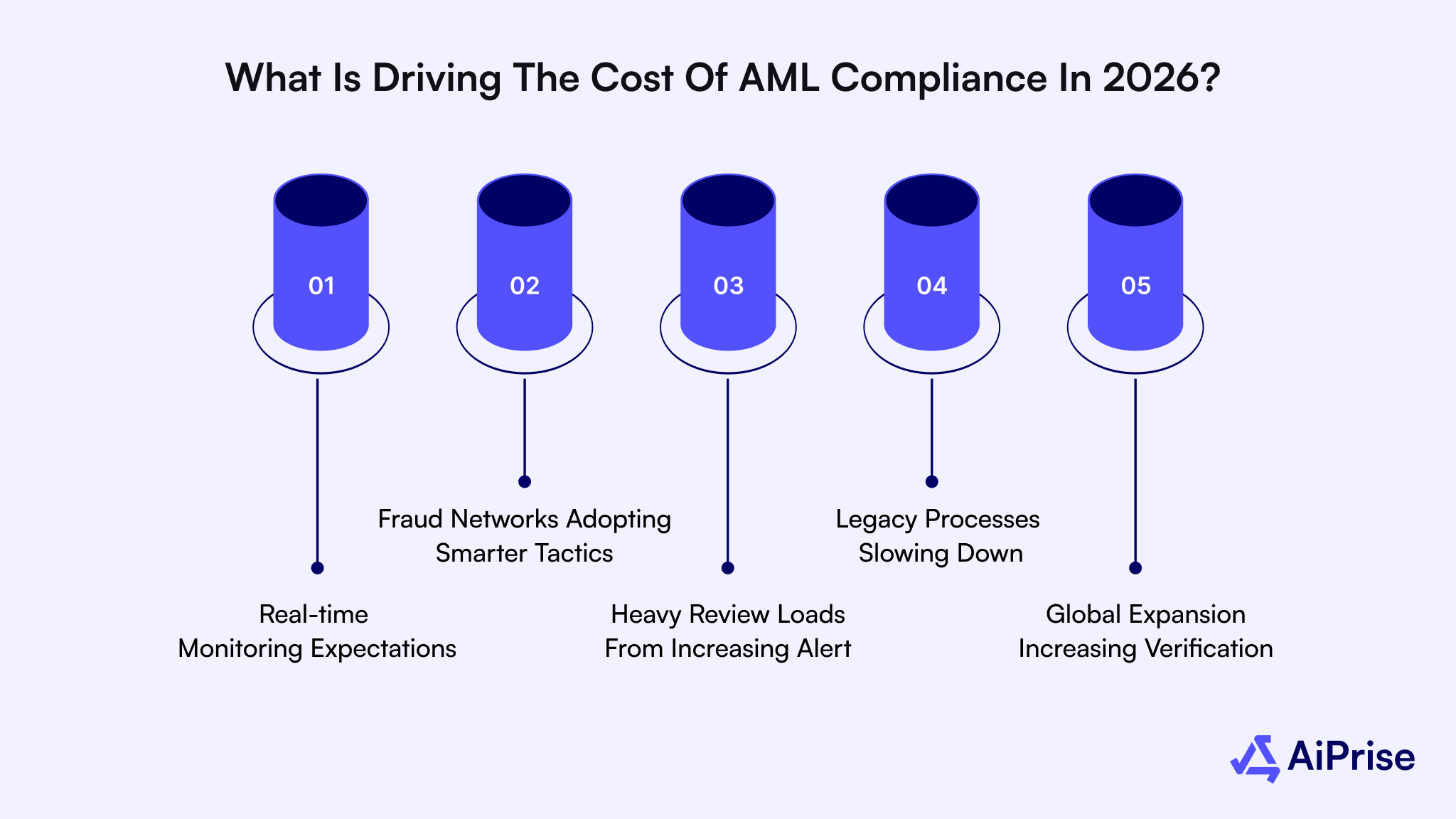
Below are the key rivers influencing your AML costs this year.
- Real-time Monitoring Expectations: You are expected to identify suspicious activity at the moment it occurs. This creates higher data processing demands and requires tools that can surface anomalies across user behavior, device usage, and transaction trails. For example, if you operate in payments, your systems must scan thousands of micro transactions instantly without slowing down your throughput.
- Fraud Networks Adopting Smarter Tactics: You now deal with coordinated fraud rings using synthetic identities, deepfake elements, and multi-platform movement. This forces you to expand your detection logic and high-velocity sources, which naturally raises operational overhead.
- Heavy Review Loads From Increasing Alert Volumes: High alert traffic often pushes your team into reactive mode. As a result, you spend more on review hours, investigations, and escalation steps. If you serve high-velocity sectors like neobanking or crypto, alert volumes multiply and inflate your analyst workload even further.
- Legacy Processes Slowing Down Your Compliance Cycle: Systems built for static rule sets cannot support modern risk environments. When you rely on outdated screening or case handling processes, you spend more time reconciling mismatched data and troubleshooting gaps that interrupt your workflow.
- Global Expansion Increasing Verification Complexity: If your business is onboarding users or merchants across several regions, you must handle multiple data formats, risk profiles, and local guidelines. This variety increases the cost of maintaining accurate checks and consistent oversight across all markets.
Understanding the factors driving the cost of AML compliance sets the context for examining how much organizations typically spend to meet these requirements.
How Much Does AML Compliance Typically Cost?
Understanding the cost of AML compliance starts with recognizing how wide the spending range can be when you operate in a regulated environment. As your transaction volumes rise and your risk surface expands, your compliance budget often grows in ways that are not immediately visible.
Here is how the upcoming sections break down these cost components in detail.
Breakdown of Direct and Indirect Costs
AML spending often expands across more categories than you initially budget for. Direct expenses show up clearly in your financial planning, but indirect costs accumulate quietly as your compliance workload grows.
These hidden layers of effort often influence your total cost far more than software licenses or analyst salaries do.
Below are the major direct and indirect cost components to consider.
- Technology Licensing and Infrastructure: Platforms that support screening, Monitoring, and case handling often require ongoing subscription or usage-based pricing. For example, scaling transaction volumes in a payment platform can increase monthly tool costs significantly.
- Specialized Compliance Staff: Skilled analysts, investigators, and quality reviewers add substantial labor investment. Complex businesses like crypto exchanges often need deeper expertise, which affects hiring budgets.
- Operational Time Lost To Investigations: Time consumed in clarifying unclear alerts or gathering missing context slows overall throughput. A surge in onboarding requests or merchant reviews can amplify this drain.
- Cross-Functional Coordination Costs: Collaboration with legal, fraud, and engineering teams pulls additional hours into the compliance cycle. Each dependency extends workflow duration and increases the cost of maintaining consistent oversight.
- Data Acquisition and Maintenance: Accessing updated sources for screening or behavioral analysis requires ongoing spending. Expanding into new regions often increases the need for additional data providers, each with its own pricing model.
Cost Variation by Industry: Banks, Fintech, Crypto, PSPs
AML expenses do not scale evenly across industries because each business model attracts different behaviors, risk patterns, and regulatory expectations. Your cost structure depends heavily on how fast users transact, how complex your onboarding flows are, and how broad your geographic footprint is.
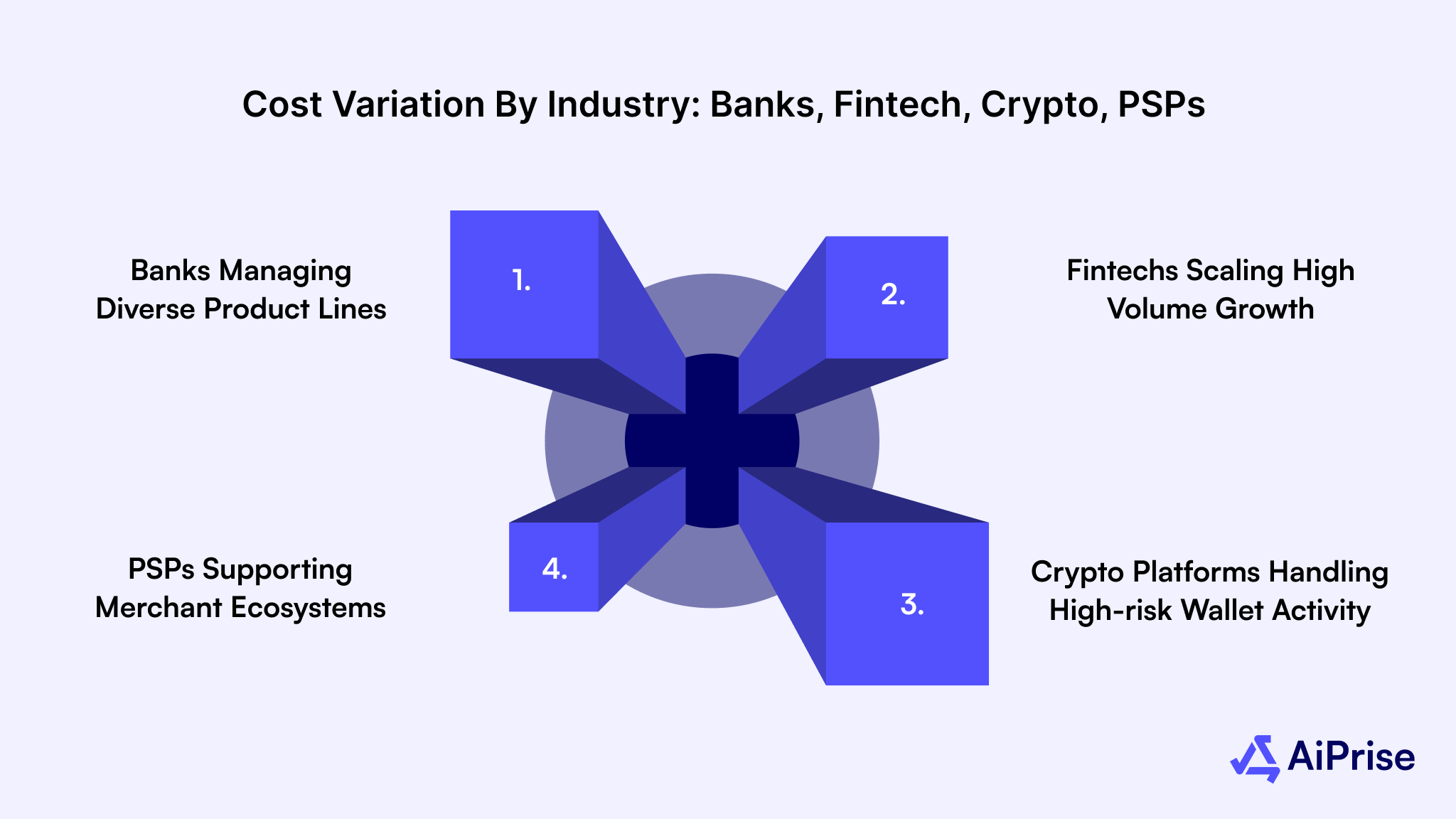
Below are the differences in AML cost drivers across key sectors.
- Banks Managing Diverse Product Lines: Multiple account types, lending products, and fast-moving rails require a deeper screening layer. For example, deposit accounts, credit products, and remittance services each introduce separate monitoring needs.
- Fintechs Scaling High Volume Growth: Rapid onboarding and instant payments create continuous screening activity. Fast-moving user acquisition often increases verification demand and raises your cost per user.
- Crypto Platforms Handling High-risk Wallet Activity: Wallet tracing, chain analytics, and source of funds checks add specialized expenses. Sudden spikes in asset movement can inflate monitoring requirements.
- PSPs Supporting Merchant Ecosystems: Each merchant category carries a unique risk pattern. High-risk verticals like gaming or ticketing require more frequent checks and tighter oversight, which increases monitoring and review costs.
Global vs Local Compliance Cost Differences
Local-only ending shifts significantly when your operations expand across borders. Regulatory expectations, data access rules, language differences, and verification requirements vary by region, which changes how much time and technology your team needs to stay compliant.
Local-only operations often rely on fewer data sources and smaller review cycles, while global businesses must maintain broader coverage to manage higher exposure.
Here is a simple comparison of how costs differ across global and local compliance environments.
Once baseline AML compliance costs are clear, it becomes easier to identify the less visible expenses that accumulate within ongoing compliance programs.
What Are the Hidden Costs of AML Compliance Programs?
Many of your true AML expenses do not show up in your initial budgeting cycle because they live inside daily workflows, vendor dependencies, and operational slowdowns.
These hidden costs grow as your user base expands, your product lines diversify, and your risk exposure becomes more dynamic. Identifying these less visible drivers helps you prevent unnecessary spend that builds up quietly across your compliance stack.
Below are the hidden areas that often inflate AML program costs.
- Context Gathering For Unclear Alerts: Analysts spend an additional minute stitching together user history, device pattern, or merchant activity when key details are missing. For example, incomplete onboarding data can trigger repeated checks that increase overall review time.
- Training Cycles For Evolving Risk Scenarios: Your team must stay current on new laundering tactics and reporting expectations. Frequent updates require ongoing training hours that slow down routine operations.
- Tool Switching Across Fragmented Systems: Moving between screening portals, monitoring dashboards, and CRM tools drains productivity. Each switch adds friction that compounds across hundreds of daily reviews.
Also read: How to Check a UAE Company’s Trade License Online
After understanding typical cost of AML compliance, the focus shifts to practical strategies companies can use to reduce this spending without weakening controls.
Top 7 Ways Companies Can Reduce AML Compliance Costs
Reducing AML costs in 2026 requires shifting your approach from reactive review cycles to smarter, integrated risk management. Many of your expenses rise because your data, workflow, and decision layers operate in separate tracks.
When these systems work together, you cut repeat checks, shorten investigation time, and improve the accuracy of your alerts. Cost savings often come not from lowering standards, but from redesigning how your compliance engine functions as your business grows.
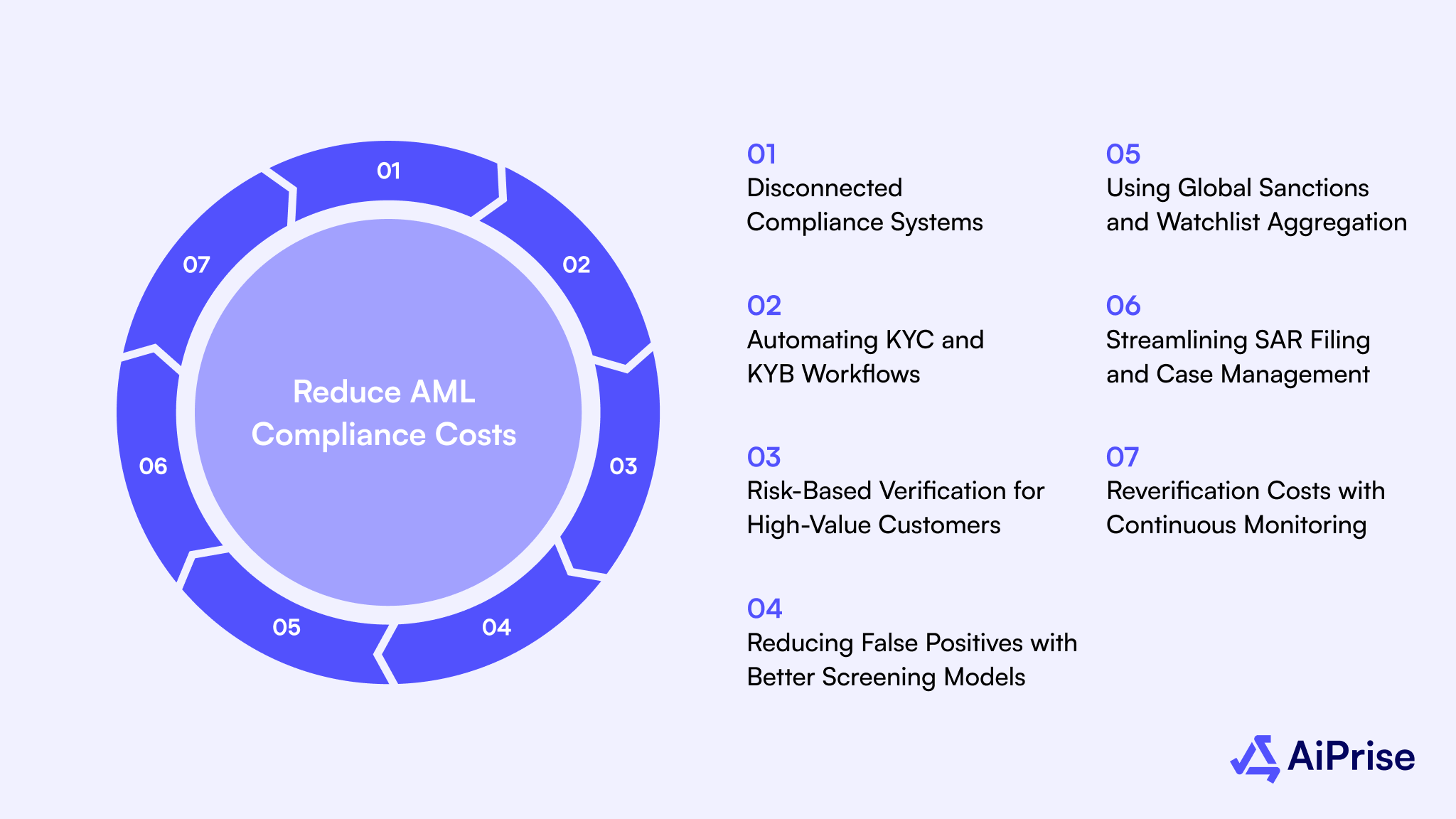
Below are the most effective strategies to reduce your AML spending.
Consolidation of Disconnected Compliance Systems
Managing AML tasks through several standalone tools often forces your team into repetitive checks, duplicated data pulls, and uneven risk decisions. Consolidating your systems gives you a single view of user behavior, transaction patterns, and case activity, which reduces friction and lowers your operational spend.
Below are the core advantages of Consol, integrating fragmented compliance tools.
- Stronger Data Continuity Across Workflows: Shared records eliminate gaps between onboarding details, screening results, and transaction histories. For example, investigators no longer chase missing context spread across different dashboards.
- Lower Analyst Time Spent On Administrative Tasks: A single platform backed and forthasted on switching tabs, exporting data, or reconciling mismatched fields. This frees more hours for actual risk evaluation.
- Clear, Risk Interpretation For Faster Decisions: Unified scoring models help your team review alerts with consistent logic. This reduces back-and-forth discussions and improves decision speed.
- Simplified Vendor Management And Maintenance: Fewer systems mean fewer contracts, updates, and integration issues. This stability lowers the ongoing cost of running your compliance environment.
Automating KYC and KYB Workflows
KYC and KYB checks often become one of your highest recurring compliance expenses when verification steps depend heavily on an analyst's judgment. Automation helps you reduce this load by routing users through high-impact checks that match their risk profile and by validating documents, identities, and business information without slowing down your onboarding flow.
Below are the key benefits of automating KYC and KYB workflows.
- Faster Verification Outcomes: Automated matching and data extraction speed up approval decisions. For example, business onboarding that once required multiple back-and-forth emails becomes a single streamlined flow.
- Low-risk Error Rates In Doclight-Touching: Automating higher-risk operations prevents inconsistencies caused by manual data entry or misread fields. This creates more reliable records for future monitoring.
- Adaptive Review Paths For Different Risk Segments: Rules-based routing ensures low-risk users move through a light-touch flow while higher risk users receive deeper checks. This helps you allocate analyst time where it matters.
Do you face higher onboarding costs as verification demand grows? AiPrise reduces manual effort by automating identity checks through its KYC platform, helping your team lower review time while keeping decision quality strong.
Using Risk-Based Verification for High-Value Customers
High-value customers introduce deeper financial exposure, but not every user within this segment carries the same risk. A risk-based verification model helps you apply the right amount of scrutiny without inflating your operational spending.
Instead of pushing all high-value accounts through identical risk-based identification, intensity aligns with behavior patterns, funding channels, and transaction characteristics.
Below are the advantages of applying risk-based verification.
- Targeted Checks For Higher Sensitivity Cases: Activity involving high-value transfers or unusual funding routes can trigger layered verification, while routine movement stays in a lighter flow.
- Reduced Analyst Overload In Busy Cycles: Prioritizing cases with clearer risk indicators prevents unnecessary review spikes during peak onboarding periods.
- Better Resource Use in Enterprise Onboarding: Business customers with predictable transaction patterns can follow streamlined paths, while new or irregular profiles receive deeper assessment.
Reducing False Positives with Better Screening Models
High false positive rates often inflate your AML budget because your analysts spend time clarifying alerts that do not represent real risk. Better screening models help refine your detection logic, so alerts trigger for the right reasons, at the right time.
Below are the ways stronger screening models help reduce costs.
- Improved Match Precision Through Contextual Data: Adding behavioral details, merchant categories, or transactional nuances helps your ekeep separate real threats from normal activity. To reduce recurring small value transfers tied to predictable customer behavior, no longer trigger confusion.
- Adaptive Rules That Learn From Past Decisions: Historical reviewer actions inform updated thresholds, which keep your screening aligned with evolving risk patterns and reduce repetitive noise.
- Cleaner Alert Queues For Faster Turnaround: When irrelevant hits disappear, analysts spend more time on meaningful reviews that protect revenue and reduce unnecessary delays.
Using Global Sanctions and Watchlist Aggregation
Sanctions and watchlist screening become more expensive when your team relies on several disconnected data feeds that require separate checks and manual reconciliation. Aggregating global lists into a unified source gives you broader reach, cleaner results, and a more predictable cost structure.
A consolidated feed helps you spend less time validating the accuracy of matches and more time assessing genuine risk.
Below are the benefits of aggregated sanctions and watchlist coverage.
- Consistent Screening Across All Jurisdictions: A single dataset applies the same criteria to each user, reducing variation across markets. For example, international merchants can be evaluated with one standardized workflow.
- Lower Time Spent Resolving Incomplete Records: Aggregated sources remove gaps that appear when separate lists hold conflicting or outdated entries, which often slows down your review cycles.
- Greater Coverage Without Higher Workflow Load: Broader datasets increase detection strength but do not require additional tool switching or parallel searches, keeping operational effort stable.
Streamlining SAR Filing and Case Management
SAR filing often becomes one of your most time-consuming compliance activities when case details live across scattered systems or require repeated clarification. Streamlining this workflow reduces the effort required to assemble narratives, attach supporting evidence, and ensure your reports meet regulatory expectations.
A cleaner process not only lowers cost but also helps your team avoid bottlenecks during peak investigation periods when time-consuming surges.
Below are the core advantages of improving your SAR and case handling processes.
- Centralized Case Records For Faster Compilation: All relevant user actions, transaction notes, and prior reviews sit in one place, which shortens the time needed to build a complete SAR narrative.
- Consistent Templates That Reduce Rework: Standardized layouts help your analysts present findings clearly and minimize follow-ups. For example, recurring merchant fraud cases can follow structured formats that save hours of rewriting.
- Better Traceability Across Review Stages: Each step of the case lifecycle is easy to audit, which helps you move cases through queue stages with fewer delays and less manual coordination.
Minimizing Reverification Costs with Continuous Monitoring
Reverification expenses grow quickly when customer risk changes happen in the background, and your systems only detect them during scheduled review cycles.
Continuous monitoring helps you catch shifts in behavior, ownership, or transaction activity the moment they occur, which prevents unnecessary repeat checks and lowers your annual verification load.
Below are the advantages of adopting continuous monitoring.
- Earlier Detection Of Risk Shifts: Sudden velocity changes, new counterparties, or unusual spending categories surface instantly, which helps you avoid deep reverification across your entire user base.
- Reduced Dependence on Calendar-Based Reviews: Automated triggers eliminate fixed interval checks that often inflate your workload during certain months.
- Lower Verification Spend For Predictable Users: Customers with consistent profiles remain in a passive monitoring track, which limits the need for repeated identity or business validation.
Now, let us have a look at the role of technology in lowering AML costs.
What Role Does Technology Play in Lowering AML Costs?
Technology has become the biggest multiplier in lowering your AML spending because it reshapes how your team processes data, interprets risk signals, and executes investigations. When your systems move from rule-based checks to adaptive intelligence, your alerts become cleaner, your reviews become faster, and your reliance on manual effort decreases.
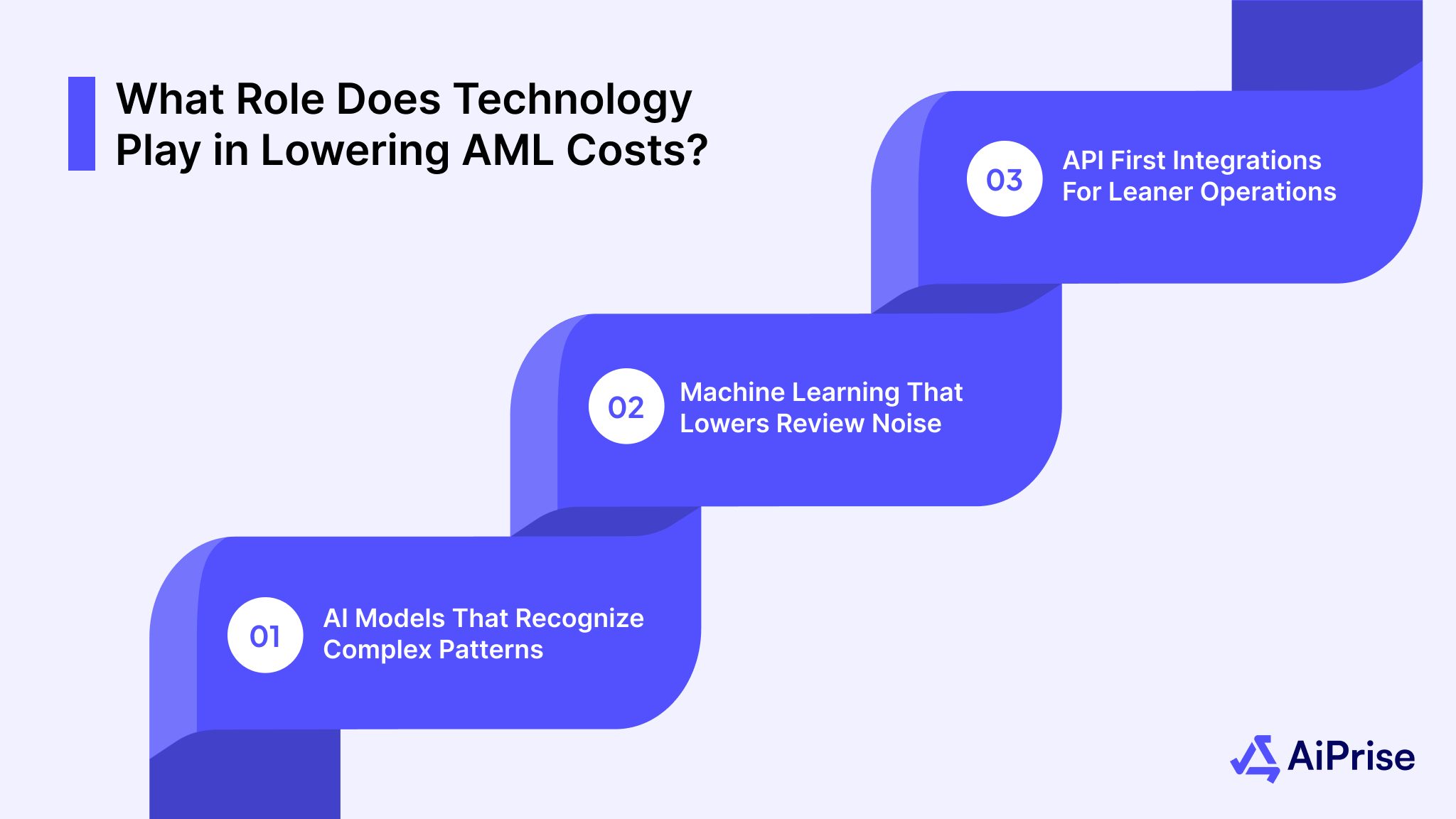
Below are the ways technology helps reduce AML costs.
- AI Models That Recognize Complex Patterns: Layering advanced detection on transaction streams uncovers hidden relationships that static rules might miss. This sharpens your focus on genuine threats.
- Machine Learning That Lowers Review Noise: Feedback from past decisions helps refine thresholds and reduce unnecessary alert volume, which directly saves analyst time.
- API First Integrations For Leaner Operations: Modular connections allow your compliance stack to expand without heavy engineering work. For example, adding new data sources or screening layers becomes a quick configuration instead of a long build cycle.
These cost-reduction approaches naturally lead to the question of how AML teams should prioritize spending to achieve the greatest impact.
How Should AML Teams Prioritize Spending?
Prioritizing AML spending requires a clear understanding of which activities actually reduce exposure and which simply absorb operational capacity. As your business adds new products, geographies, or user segments, the distribution of your budget should evolve to match the risk patterns you face.
Effective allocation helps you avoid overspending on low-impact layers while ensuring critical safeguards never fall behind regulatory expectations. A structured approach also ensures your analysts work on the areas that deliver the highest risk reduction.
Below are the spending priorities that matter most.
- Invest in Controls That Protect Core Revenue Flows: Channels with the highest transaction velocity or largest value movement deserve deeper oversight. For example, payout rails or merchant settlements often require stronger monitoring.
- Balance Resources Across Screening and Ongoing Assessment: Allocating everything to onboarding leaves gaps in post-onboarding behavior tracking. A split investment ensures early checks stay strong while ongoing surveillance remains reliable.
- Use Outsourcing Selectively For Specialized Tasks: Activities that require niche expertise, such as complex tracing or regulatory reporting in certain markets, can be delegated to reduce internal strain while maintaining quality.
Clear spending priorities help AML teams avoid common mistakes that unnecessarily drive up compliance costs.
What Mistakes Increase AML Compliance Costs Unnecessarily?
Avoidable mistakes often inflate your AML budget because they create extra work, introduce unnecessary checks, and slow down investigations. Many of these issues arise when processes are built for past risk conditions rather than the environment you operate in today.
Updating your approach helps you redirect resources toward meaningful risk reduction activities that drain capacity without improving outcomes.
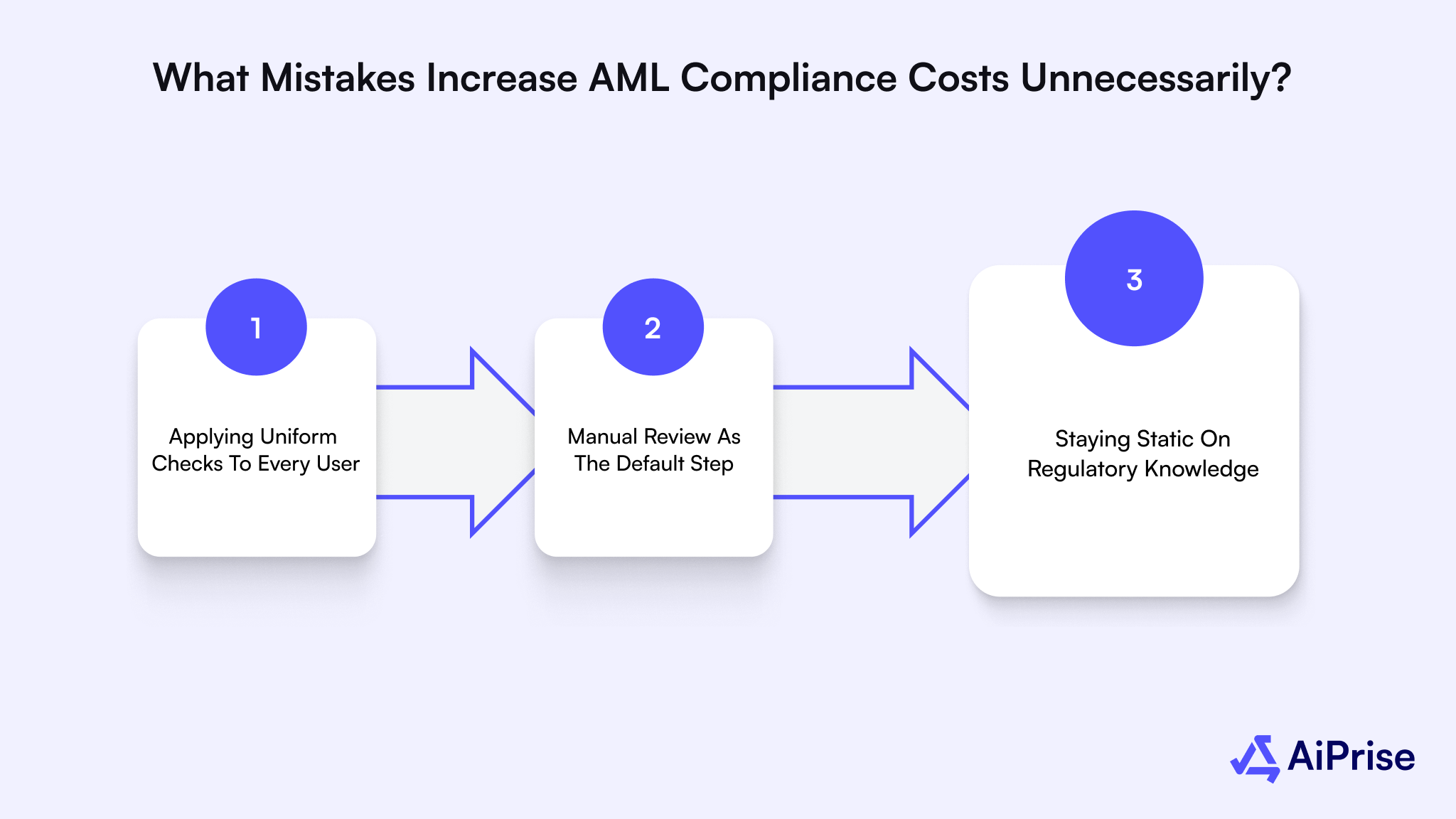
Below are common mistakes along with practical fixes.
- Applying Uniform Checks To Every User: Treating all customers as high-sensitivity cases increases workload. Introduce calibrated verification paths that reflect actual exposure levels.
- Relying On Manual Review As The Default Step: Human evaluation adds quality, but should not handle every alert. Use automated filters to remove low-relevance hits before analysts engage.
- Staying Static On Regulatory Knowledge: Outdated interpretations lead to unnecessary repeat checks. Build a routine update cycle that refreshes your understanding of new rules and guidance across your active markets.
Are the investigations slowing down because your analysts jump between several systems to complete reviews? AiPrise fixes this with its Compliance Co Pilot, a unified workspace that centralizes screening, monitoring and case handling for smoother, cheaper compliance operations.
Identifying costly mistakes highlights the need for a structured AML cost optimization checklist to prevent inefficiencies.
What Should an AML Cost Optimization Checklist Include?
An effective AML cost optimization checklist helps you understand where your compliance spending delivers the most value and where operational waste may belong. As regulatory pressure rises and product lines expand, your checklist should give you a clear snapshot of the efficiency and scalability of your program.
This framework helps you evaluate whether your controls match real risk drivers and whether your workflows support long-term growth without unnecessary cost accumulation.
Below are the essential elements to include in your checklist.
- Quality of Risk Categorization: Accurate segmentation ensures resources stay aligned with exposure levels. For example, merchant types with higher variability may require deeper evaluation.
- Efficiency of Verification Flows: Smooth transitions between checks reduce friction during onboarding or case handling and help you maintain predictable operational effort.
- Reliability of Data Sources: Consistent and up-to-date records prevent gaps that force additional review steps or secondary validations.
- Scalability Across Growth Markets: Your tools and workflows should expand easily as you enter new regions or add user segments without multiplying your cost per review.
Also read: Deepfake Selfie Verification in Identity Checks
A well-designed AML cost optimization checklist sets the stage for exploring how AiPrise can help streamline compliance and reduce associated costs.
How Can AiPrise Help Reduce AML Compliance Costs?
AiPrise helps reduce AML costs by replacing fragmented processes with unified, automated, and intelligence-driven verification flows. The platform is built for regulated industries that need fast onboarding, accurate screening, and efficient learning without increasing operational load.
Each capability is designed to lower manual effort, improve alert quality, and give compliance teams a clear, real-time understanding of real risk signals across customers, merchants, and transactions.
Below are the ways AiPrise supports learner AML operations.
- Automated KYC and KYB That Cuts Manual Review Hours: Identity and business verification steps become faster through smart extraction, real-time validation, and adaptive routing. AiPrise fits into this workflow by handling documenAI-driven registry lookups and profile scoring in one place, which reduces investigation cycles and lowers staffing needs.
- AI-Based Screening That Lowers False Positives: Detection models improve match accuracy by incorporating behavioral data. AiPrise applies AI-driven logic to refine alerts, shrink noise, and highlight only the cases that require deeper inspection, which keeps analyst time focused on meaningful risk.
- Global Coverage For Faster And Cheaper Verification: Expanded datasets support cross-border onboarding without the burden of maintaining regional sources separately. AiPrise connects these sources into a unified pipeline that simplifies checks for global merchants, remote users, and multi-region entities, reducing the cost of operating across several jurisdictions.
- Unified Compliance Workflows Covering All Four Core Operations: Screening, monitoring, Case Management, and reporting run within a single environment. AiPrise brings these layers together so analysts can access complete histories, risk insights, and decision tools in one platform, which eliminates redundant steps and accelerates resolutions.
- Predictive Risk Scoring For Smarter Resource Allocation: Insights from past decisions and behavioral patterns help identify accounts that need closer attention. AiPrise uses predictive scoring to surface higher probability risks early, which reduces downstream investigations and makes operational planning more efficient.
By demonstrating how AiPrise reduces AML compliance costs, you can draw a clear conclusion on its value for efficient, effective compliance management.
Conclusion
Managing AML costs in 2026 requires more than trimming operational tasks. It demands a program that adapts to shifting risk patterns, supports rapid growth, and uses technology that sharpens every decision your team makes. Stronger models, unified workflows, and smarter allocation help reduce unnecessary spend while keeping your risk posture solid across all channels.
AiPrise helps you build this balance by centralizing verification, strengthening screening accuracy, and reducing the manual workload that inflates compliance budgets. With global coverage, automated KYC and KYB, AI-driven Screening, and unified case handling, the platform reduces cost while improving the reliability of your AML program.
Explore how AiPrise can support your compliance strategy and cost goals. Book A Demo to see the platform in action and evaluate the impact on your workflows.
FAQs
1. How do AML compliance costs differ between small and large financial institutions
Smaller institutions usually face higher cost pressure because fixed compliance expenses stretch across fewer customers. Larger institutions manage bigger budgets but deal with higher alert volumes, broader product lines, and more complex oversight. Scale helps reduce cost per user, but operational burdens grow significantly with increased transaction activity.
2. What are the main components included in AML compliance budgeting
AML budgets typically include screening tools, monitoring systems, analyst staffing, data sources, training cycles, audits, and reporting requirements. Additional spend often goes toward system maintenance, integration work, and external advisory support. Budget planning must consider growth in onboarding, transactions, volume, and geographic expansion to avoid unexpected cost spikes.
3. How much does technology investment typically contribute to overall AML compliance costs
Technology spending forms a major portion of AML costs because modern programs rely on automated screening, monitoring, and case handling systems. Pricing grows with transaction volumes and data usage. Strong tools ultimately reduce manual workload, but initial and recurring investments must be planned carefully to match operational and compliance needs.
4. Are regulatory fines and penalties included in calculating AML compliance costs
Regulatory fines are not part of routine compliance budgets but represent potential financial exposure. Institutions factor them into overall risk planning because non-compliance can trigger significant penalties, legal action, or remediation requirements. Preventing fines through consistent controls, strong oversight, and timely reporting is essential to maintaining predictable cost structures.
5. How do ongoing AML audits affect a company’s compliance spend
Routine AML audits add costs through preparation work, documentation efforts, and remediation tasks. Teams spend time gathering evidence, validating procedures, and updating policies. External auditors may introduce additional expenses. These reviews ensure controls remain strong but require dedicated resources that increase both direct and indirect compliance spend each year.
You might want to read these...



















AiPrise
11 mins read
How Compliance Copilot is Revolutionizing Risk Management and Compliance Monitoring
Discover how Compliance Copilot, an AI-powered platform, is transforming risk management and compliance monitoring. Learn how it proactively detects risks, automates tasks, and keeps businesses compliant with real-time regulatory updates across global jurisdictions



AiPrise’s data coverage and AI agents were the deciding factors for us. They’ve made our onboarding 80% faster. It is also a very intuitive platform.

Head of Operations



See your full compliance picture in one place
Use AI agents and global data to review businesses and users faster and more accurately
