

AiPrise
12 min read
March 4, 2026
Theft & Identity Fraud Trends in 2026: What You Must Watch

Key Takeaways

Your customer's stolen identity could cost you more than their trust; it could cost you millions. As we move through 2026, fraudsters are utilizing AI and deepfakes at unprecedented scales, making traditional security measures obsolete.
You need to understand these evolving threats before they infiltrate your business. In 2024 alone, U.S. consumers lost $47 billion to identity fraud and scams, with 18 million victims impacted by traditional identity theft, according to the Javelin Strategy & Research Identity Fraud Study.
This blog breaks down the most critical identity fraud trends shaping 2026, reveals where your vulnerabilities lie, and equips you with actionable prevention strategies to protect your customers and your bottom line.
Key Takeaways
- AI-driven attacks, deepfakes, and synthetic identities are driving the fastest-growing fraud in 2026.
- Risk-based KYC and behavioral monitoring detect high-risk users early and prevent automated attacks.
- Fraud can occur long after onboarding, so full account lifecycle monitoring is essential.
- Manipulated device, session, and behavioral signals can bypass static fraud controls if not verified.
- Integrated platforms like AiPrise combine verification, real-time risk scoring, monitoring, and compliance for effective protection.
What Identity Fraud Really Means in 2026
Identity fraud isn't just about someone stealing your Social Security number anymore. In 2026, it's evolved into something far more complex and dangerous for your business.
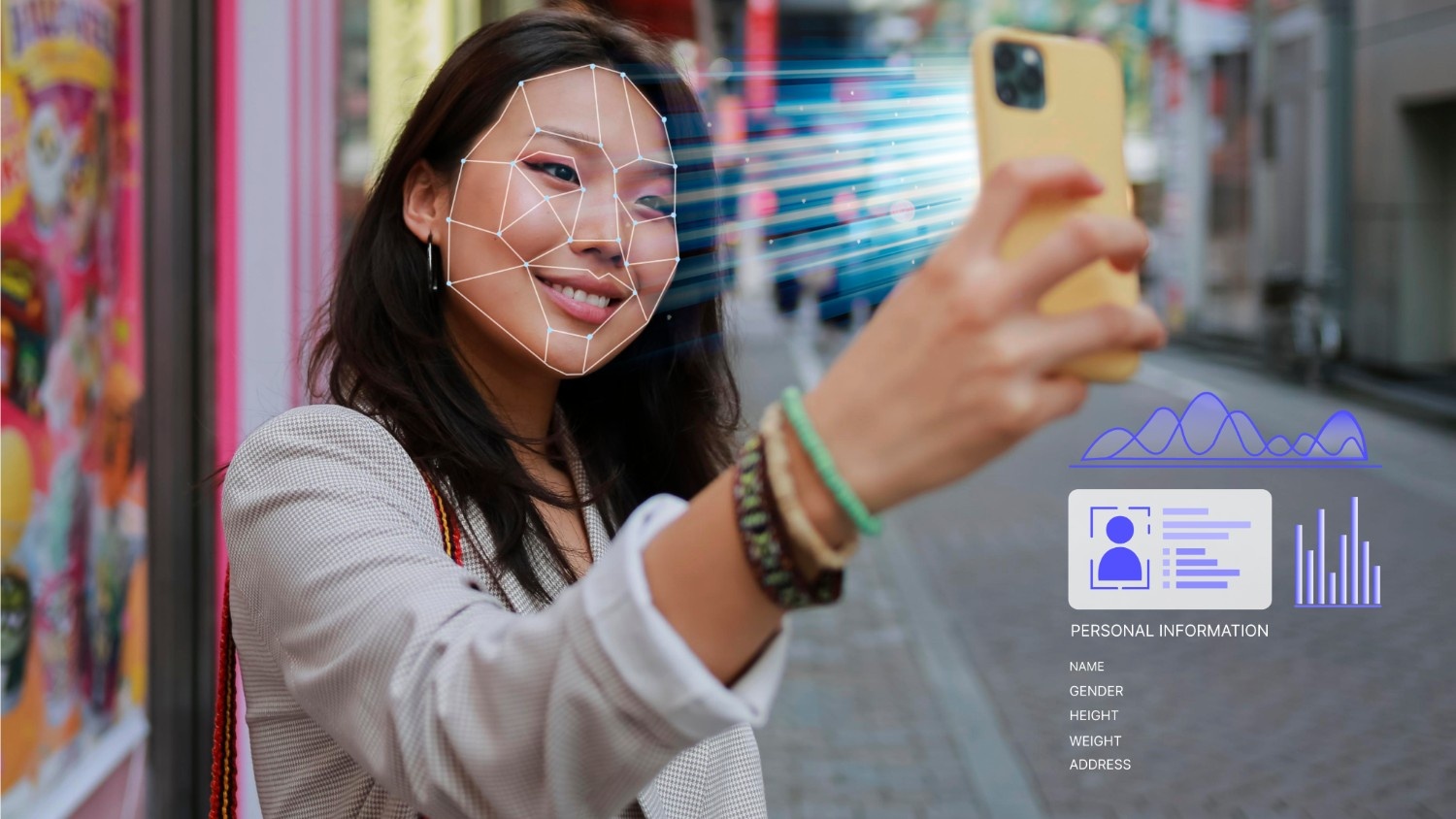
At its core, identity fraud happens when someone wrongfully obtains and uses another person's personal information, like their name, address, Social Security number, or financial details, to commit fraud or deception, typically for financial gain.
But what makes 2026 different is how fraudsters are weaponizing this stolen information.
Here's something you need to understand: identity theft and identity fraud aren't the same thing, even though people often use these terms interchangeably.
Identity theft is the first step, it's when criminals steal or obtain someone's personal data.
Identity fraud is what comes next. It's when those criminals actually use that stolen information to deceive your business, open fraudulent accounts, make unauthorized transactions, or gain access to resources they shouldn't have.
Here’s what identity fraud looks like in practice today:
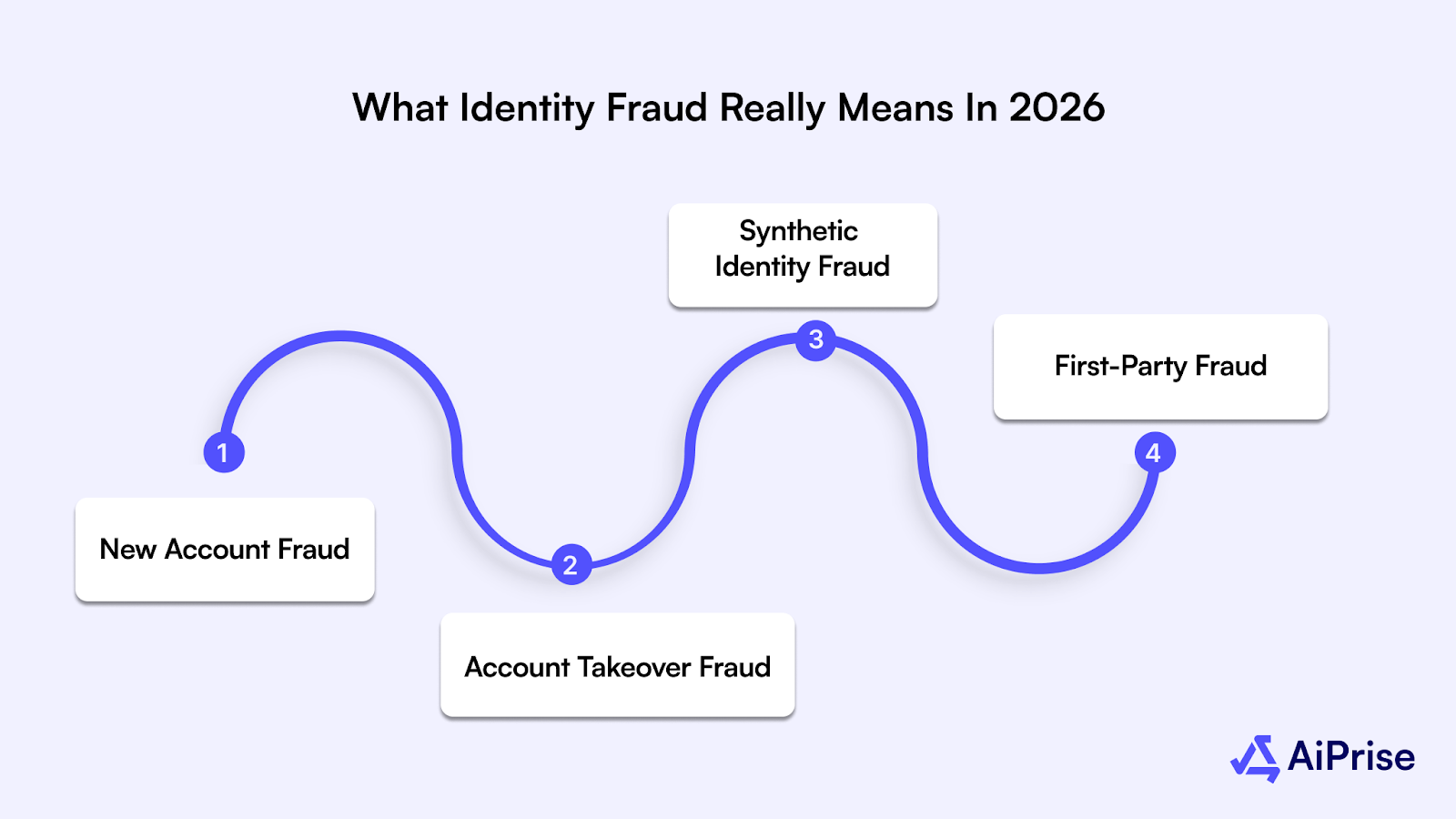
- New Account Fraud: Fraudsters use stolen or fabricated personal data to open multiple accounts across platforms. The goal is speed and scale, extracting value before detection systems flag the activity.
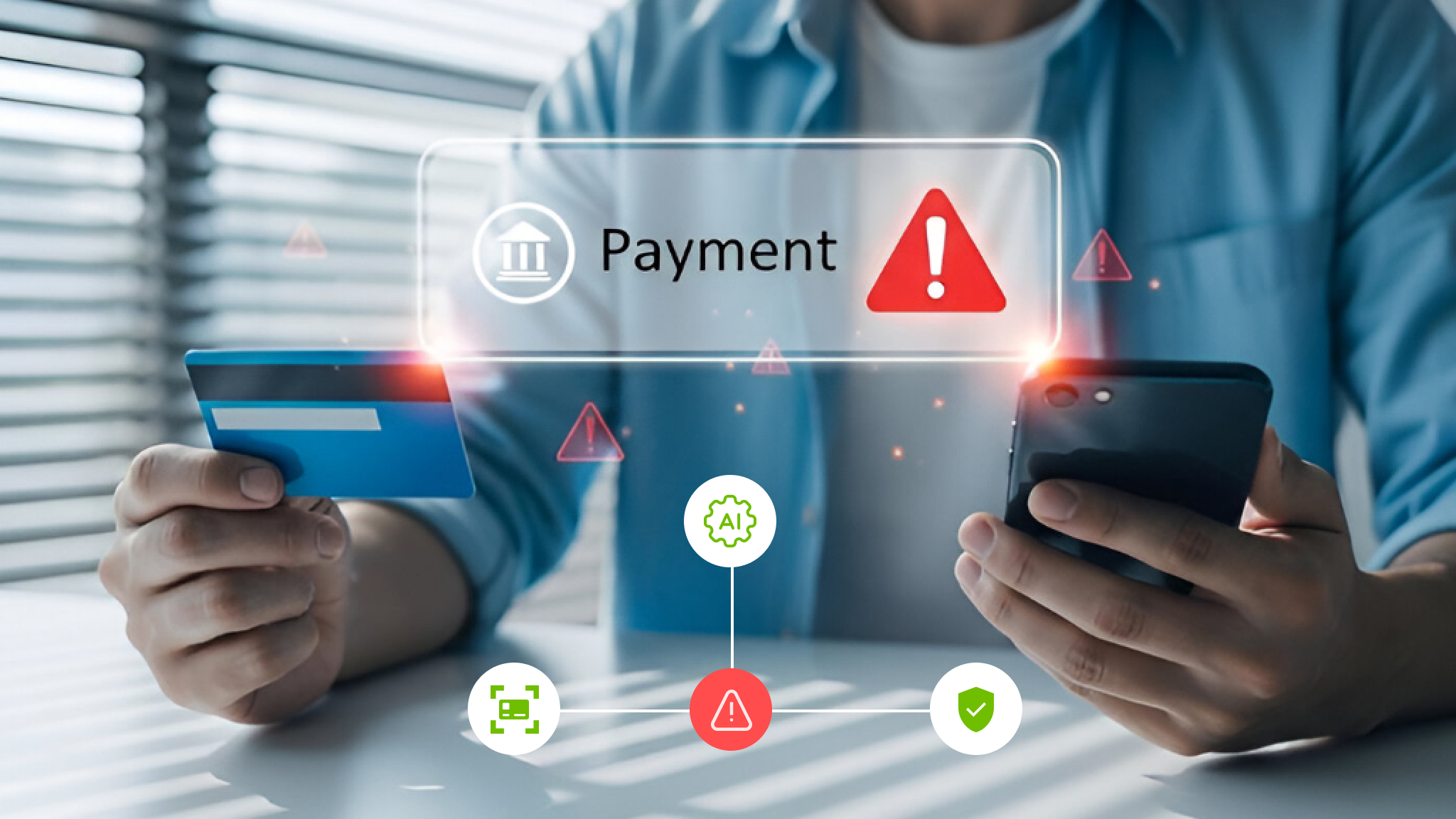
- Account Takeover Fraud: Criminals hijack legitimate customer accounts, change credentials, lock out real users, and carry out unauthorized transactions. By the time you spot it, financial and trust damage is already done.
- Synthetic Identity Fraud: Fraudsters combine real data, often a valid Social Security number, with fake names and details to create new identities. These synthetic profiles build credit over time before being exploited.
- First-Party Fraud: Here, individuals use their real identity but misrepresent financial details to obtain goods or services they never intend to repay, making detection especially difficult.
Suggested Read: How to Spot a Fake Identity: A Guide to Combating Synthetic Fraud
Now that you understand what identity fraud is, let's look at the numbers that reveal just how serious this problem has become.
2026 Identity Fraud Landscape: Key Stats and Data
Identity fraud is measurable, rapidly evolving, and directly impacting customers and businesses. The statistics surrounding identity fraud in 2026 paint a picture that should concern every business leader.
These aren't just numbers on a page; they represent real financial losses, compromised customer trust, and businesses scrambling to protect themselves against increasingly sophisticated attacks.
Let's start with the number that should grab your attention:
- The global cost of identity fraud exceeded $50 billion in 2025. Early indicators suggest 2026 will surpass that figure significantly as fraudsters continue refining their tactics.
- But here's where it gets personal for your business. Experian has recently released its UK Fraud and Financial Crime Report for 2025, which offers a look at the frontline of this evolving battle, revealing a sharp rise in AI-related fraud from 23% in 2024 to 35% in early 2025.
- Identity theft continues to be the fastest-growing crime in the United States. In 2024, the FTC recorded more than 1.1 million identity theft reports, with total losses surpassing $12.7 billion, a 23% increase year over year.
- In the first half of 2025, there were $12.7 billion, a 23% increase, putting 2026 on track to exceed prior records. This total already outpaces first-half figures from 2024.
Your Fraud Prevention Budget Might Not Be Enough
- Nearly 60% of businesses reported increased fraud losses in 2025, and over 70% boosted their fraud prevention budgets in response.
- Some sectors now face a growing expectation from consumers: 80% of customers want stronger online safeguards from companies they interact with.
AI-Enabled Fraud Is Driving Costs Through the Roof
- Impersonation fraud, where attackers pose as legitimate users, now accounts for over 85% of fraudulent attempts in some datasets.
- Fraud losses facilitated by generative AI technologies are predicted to escalate to $40 billion in the United States by 2027.
The rise of AI-powered deepfakes represents one of the most dangerous developments in identity fraud. The growth trajectory is what should really alarm you.
Deepfakes and injection attack tactics alone surged, with deepfake usage increasing by 58% in biometric fraud attempts and injection attacks up 40% year-over-year.
AiPrise detects fraud before losses occur, using continuous monitoring and AI-driven fraud and risk scoring to spot suspicious behavior, transaction anomalies, and early mule activity, so your team can intervene quickly and prevent costly losses.
The numbers tell you fraud is growing, but understanding the specific tactics fraudsters are using right now is what helps you stop them.
The Most Critical Identity Fraud Trends in 2026
Fraud in 2026 isn't about volume anymore; it's about sophistication. Fraudsters have shifted from high-volume, low-effort attacks to fewer, smarter attempts that are exponentially harder to detect. Here are the trends reshaping the threat landscape.
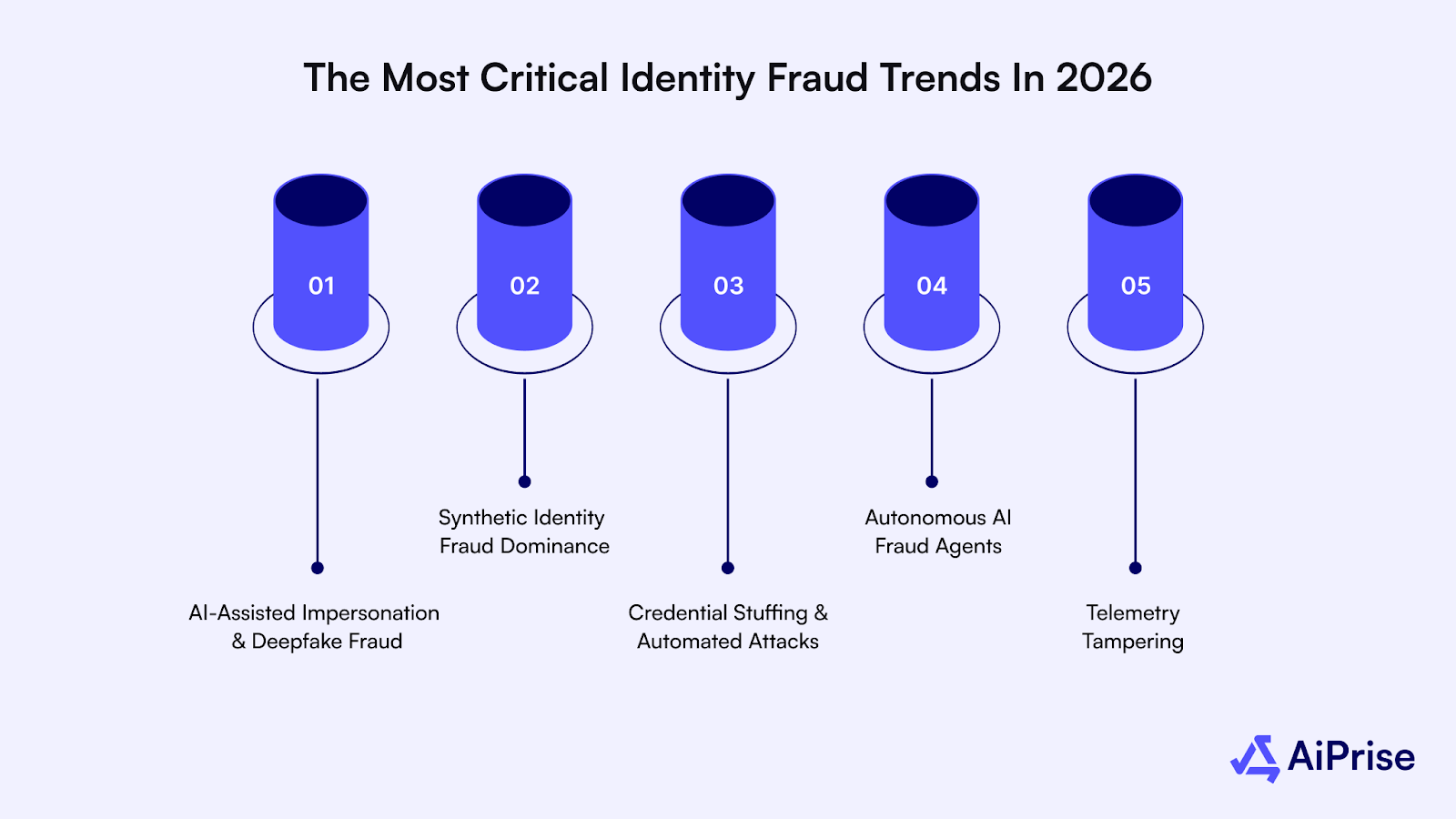
AI-Assisted Impersonation & Deepfake Fraud
Deepfake technology has become democratized and accessible to anyone with the right tools, with the UK government predicting 8 million deepfakes shared in 2025, up from 500,000 in 2023.
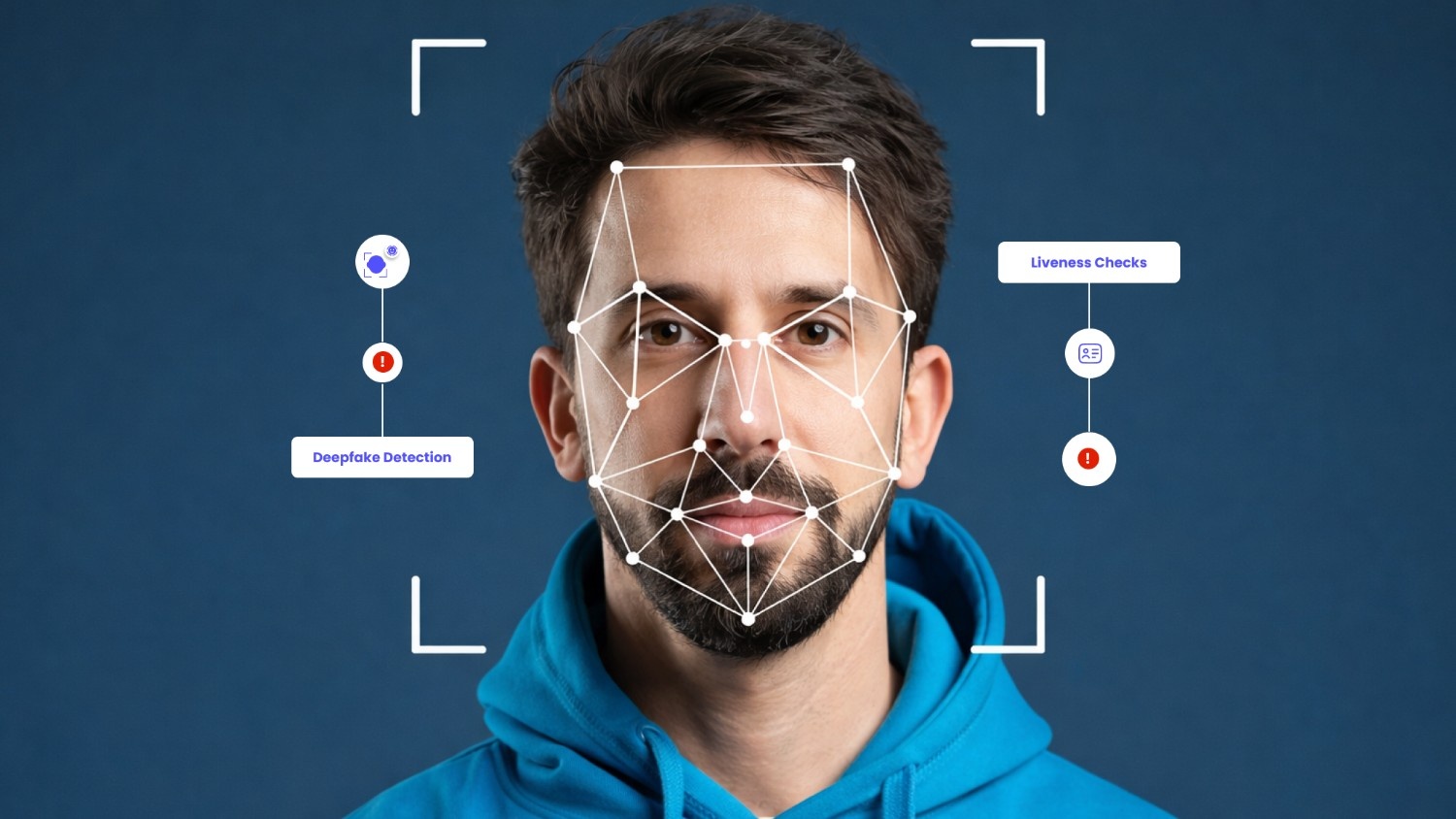
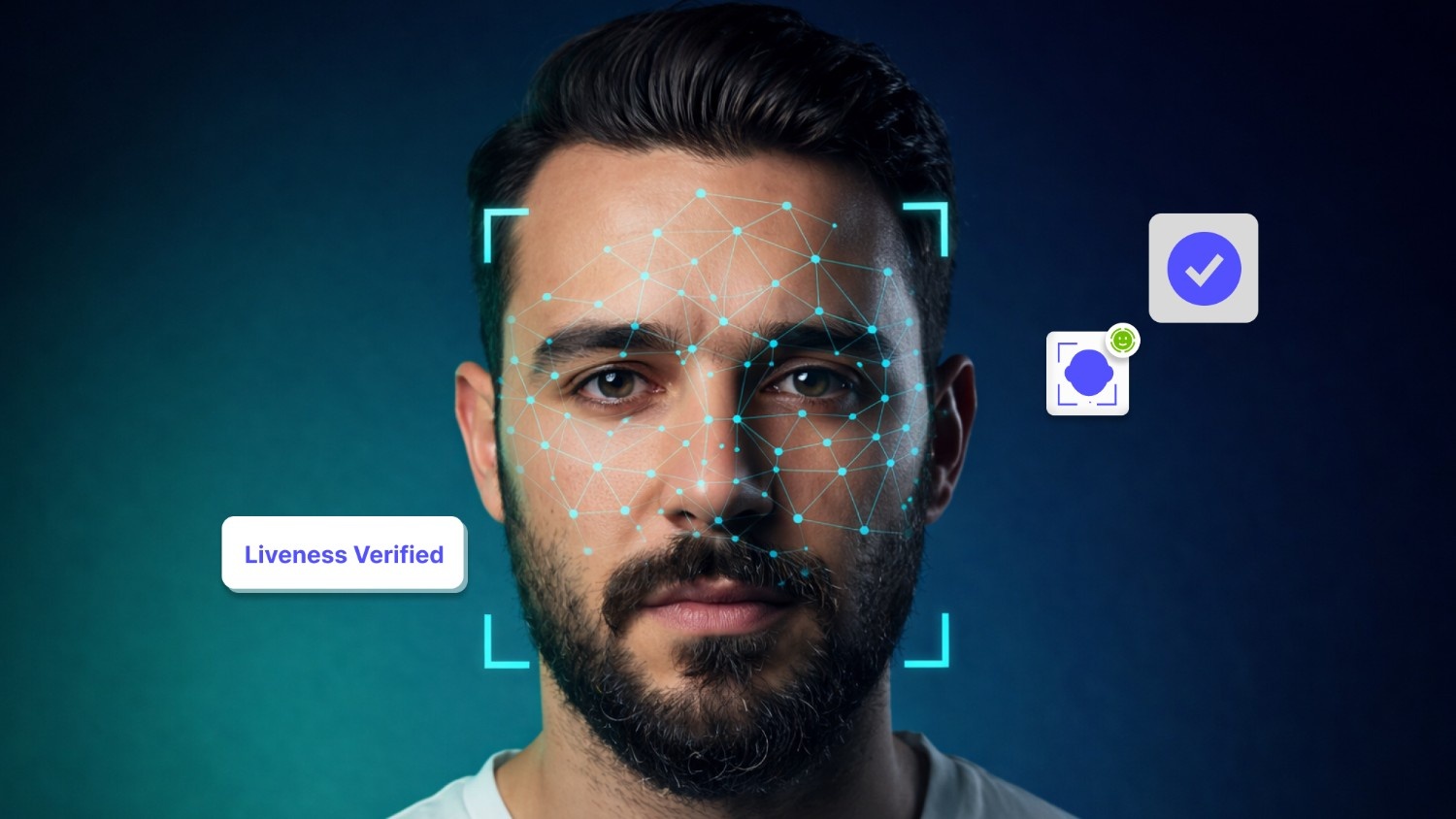
Fraudsters now use AI to convincingly replicate real people at scale. Deepfake images, voice clones, and synthetic videos are designed to defeat traditional identity verification tools that rely on static signals.
The result is:
- Static biometric and liveness checks struggle to tell real users from AI-generated identities.
- Fraudsters scale attacks without needing stolen credentials, lowering cost and increasing reach.
Synthetic Identity Fraud Dominance
Synthetic identity fraud has become one of the hardest threats to detect in 2026. Fraudsters assemble credible identities by blending real data, often a valid Social Security number (SSN), with fabricated names and background details.
These identities don’t trigger immediate alerts; instead, they slowly build trust by opening accounts, making small payments, and establishing credit before being exploited at scale. Businesses lose an estimated $20–$40 billion globally to synthetic identity fraud each year. The impact is:
- No real victim exists to report fraud, delaying detection.
- Losses grow quietly over time, often surfacing only after significant exposure.
Credential Stuffing & Automated Attacks
Credential abuse has surged as password reuse and single-sign-on expand across platforms. Fraud bots now automatically test massive volumes of leaked credentials, exploiting even a single successful login to gain full account access. Unlike traditional fraud, these attacks don’t rely on fake identities, only on reused passwords.
Autonomous AI Fraud Agents
Autonomous AI fraud agents are self-directed systems that execute identity fraud end-to-end with little to no human involvement. Instead of manually launching attacks, fraudsters deploy AI models that automatically probe defenses, test identities, adjust tactics, and repeat successful methods across thousands of targets.
These agents learn from every attempt. When one path works, such as bypassing an identity check or exploiting a weak onboarding flow, the system refines the approach and scales it instantly.
What this means for your business:
- Fraud volume increases suddenly, without obvious early warnings.
- Human-led reviews and rule-based controls can’t keep up with machine-speed attacks.
Telemetry Tampering
Telemetry tampering is a fraud technique where attackers deliberately manipulate the behavioral and device data that security systems use to assess risk. Instead of attacking controls directly, fraudsters poison the inputs, making malicious activity indistinguishable from legitimate user behavior.
By altering signals such as device fingerprints, session consistency, typing patterns, or navigation flows, attackers ensure fraud passes through automated checks unnoticed. The impact is:
- Fraud bypasses detection because tools trust corrupted signals.
- Risk decisions are made on manipulated telemetry, increasing false confidence and losses.
Fraud doesn't hit every industry the same way; knowing where your sector stands helps you prioritize your defenses.
Industry-Specific Fraud Trends You Need to Know
Different industries face dramatically different fraud risks in 2026. Attackers tailor their methods to exploit the weakest points in each industry’s workflows, user behavior, and verification gaps. The 10/80‑10 rule highlights that roughly 10% of fraudsters are highly sophisticated, 80% follow predictable patterns, and 10% are opportunistic, helping businesses prioritize defenses against both high-risk and common attacks.
Understanding your sector's vulnerabilities helps you build targeted defenses instead of generic protections that leave critical gaps.
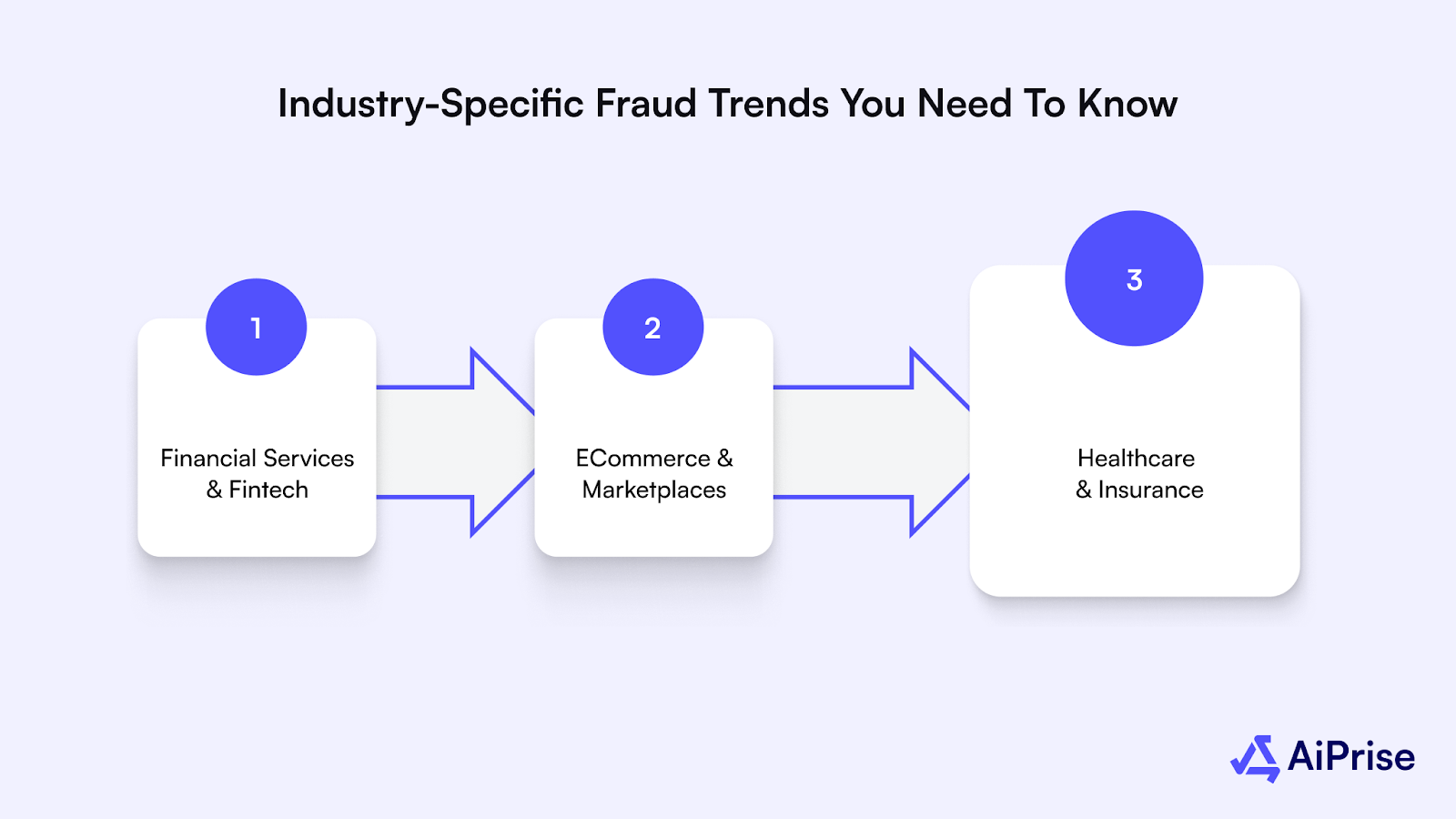
Financial Services & Fintech
Banks, lenders, and fintech platforms are among the most targeted industries because they provide direct access to money, credit, and payment infrastructure. Fraud in this sector is increasingly front-loaded at onboarding and amplified through account access.
Here’s how fraud plays out in this sector:
- Synthetic identities are used to open accounts, gradually build credit profiles, and qualify for loans or credit lines before disappearing.
- Account takeover attacks target users with high balances, frequent transactions, or access to instant payment features like real-time transfers.
- Fraud remains hidden longer because synthetic identities don’t belong to real individuals who can flag suspicious activity.
Also Read: How Banks Utilize Machine Learning For Fraud Detection
eCommerce & Marketplaces
eCommerce platforms are prime targets because fraudsters can monetize stolen access quickly and repeatedly. Speed, automation, and weak checkout controls make this sector especially vulnerable.
Let's break down how these attacks unfold in practice:
- Credential stuffing leads to large-scale account takeovers, enabling payment fraud and loyalty point theft.
- Fraudsters exploit guest checkout, promo abuse, and refund workflows to extract value with minimal friction.
- AI-generated buyer and seller profiles bypass basic identity checks on marketplaces.
Healthcare & Insurance
In healthcare, identity fraud isn’t just a financial crime; it’s a risk to patient safety. Unlike other industries, fraud here often hides inside legitimate care and insurance workflows, making it harder to detect and more damaging over time. Here's exactly what this looks like:
- Stolen identities are used to receive medical treatment, obtain prescriptions, or submit insurance claims under someone else’s name.
- Fraudulent activity blends into routine patient and provider interactions, allowing it to continue unnoticed.
- Data breaches expose highly sensitive personal and medical information, which is then reused for broader identity theft across industries.
Industry trends show you where fraud hits hardest, but understanding the actual dollar impact tells you why you need to act now.
The Financial Impact of Identity Fraud on Your Business
Identity fraud doesn’t just create operational headaches; it hits your bottom line directly, sometimes in multiple ways at once. These days, attacks are more automated, larger in scale, and increasingly harder to detect, amplifying financial exposure.
Identity fraud impacts your business in two layers: the losses you can measure immediately and the costs that surface weeks or months later.
Direct Financial Losses
When fraud hits, cash leaves the business fast.
- Account takeovers and unauthorized payments trigger chargebacks, refunds, and dispute fees, reversing legitimate revenue.
- Synthetic identities drive loan defaults and credit write-offs, inflating non-performing assets without an obvious early signal.
- Subscription abuse and loyalty fraud quietly reduce margins by exploiting free trials, promo codes, and reward programs at scale.
Indirect Costs
Beyond direct losses, fraud strains internal operations.
- Security, support, and finance teams spend significant time investigating incidents, resolving disputes, and restoring accounts.
- Customer trust weakens after fraud events, increasing churn, support volume, and lifetime value loss.
- Regulatory obligations add further pressure; missed controls or delayed reporting can result in audits, penalties, and legal exposure.
Here’s a quick snapshot of financial risk by fraud type:
Fraud costs are devastating, but regulatory penalties for non-compliance can shut you down entirely, here's what you need to know to stay operational.
Regulatory Responses: What Identity Fraud Compliance Really Demands?
Compliance is no longer just about meeting baseline requirements. Regulators now expect businesses to proactively prevent identity fraud, detect it early, and prove that controls work in real time.
Regulatory bodies across regions are shifting focus from post-incident reporting to preventive accountability. Organizations are expected to demonstrate strong identity verification at onboarding, not just during transactions.
Below are given key compliance areas that businesses must address:
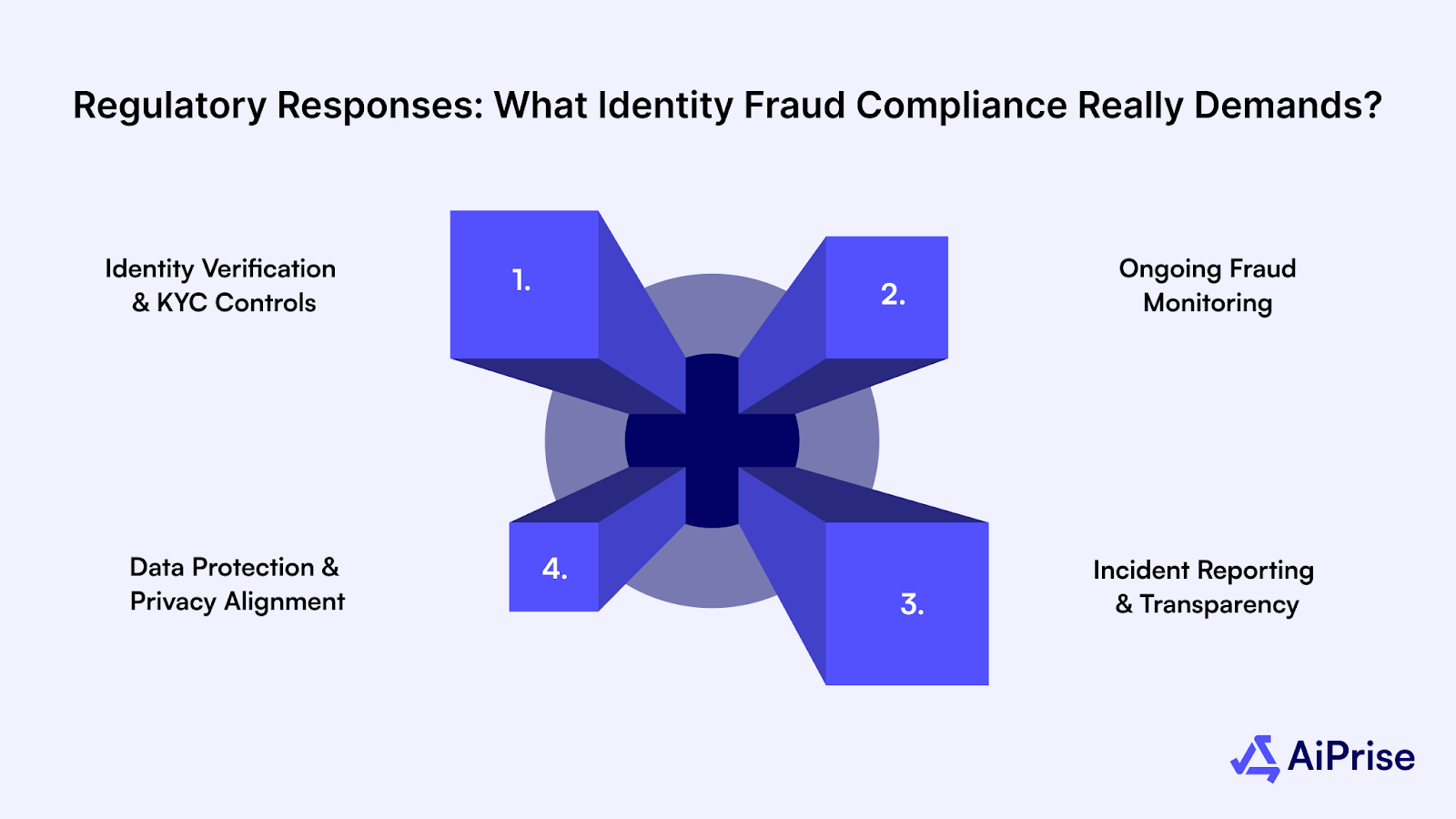
- Identity Verification & KYC Controls
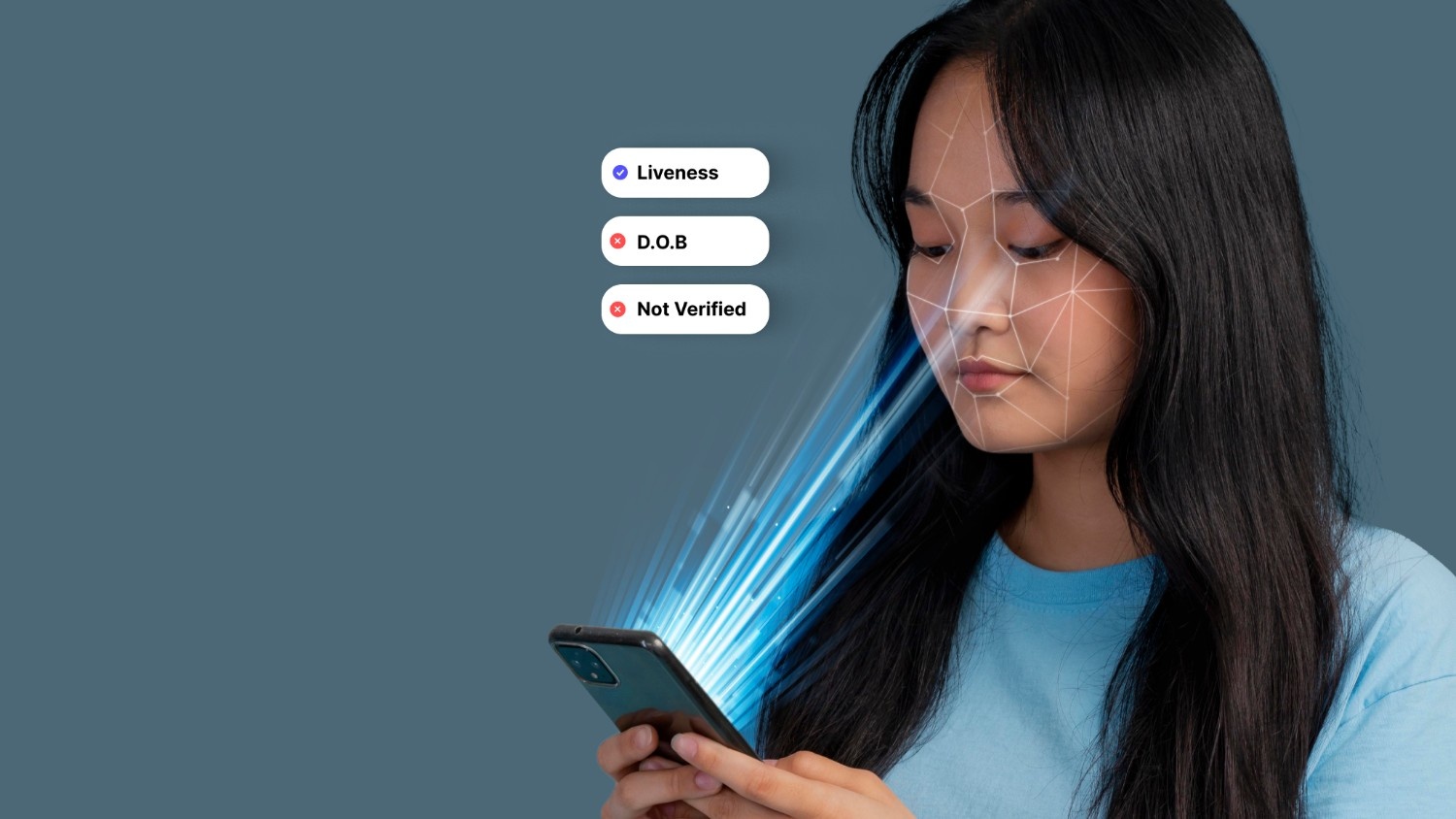
In 2026, regulators expect identity checks that confirm a real, present user, not just valid documents. Static onboarding flows are no longer acceptable for high-risk scenarios. Verification must dynamically increase when risk signals like device mismatch, velocity, or identity reuse appear.
Stop high-risk identities at onboarding with AiPrise’s user verification that adapts in real time to device, behavior, and fraud signals.
- Ongoing Fraud Monitoring
Fraud oversight is shifting from scheduled reviews to continuous behavioral analysis. Businesses must detect account takeovers, synthetic identities, and abnormal activity as it happens. Controls that react only after financial loss are considered non-compliant.
- Incident Reporting & Transparency
Regulators now enforce shorter timelines for reporting fraud and security incidents. Delayed, incomplete, or vague disclosures signal weak internal controls. Clear timelines, impact assessments, and remediation steps are expected by default.
- Data Protection & Privacy Alignment
Fraud prevention systems must protect personal and biometric data throughout collection, processing, and storage. Over-collection of identity data increases both privacy and fraud risks. Regulators assess whether security controls comply with data minimization and lawful use principles.
Understanding risk is easy. Stopping identity fraud in 2026 requires defenses that adapt faster than attackers.
A Practical Defense Framework for Identity Fraud in 2026
Identity fraud exploits static checks, slow reviews, and blind spots after onboarding. Effective protection focuses on adaptability, behavior, and continuous risk assessment.
Below are the steps you should take to protect your business against identity fraud:
- Use risk-adaptive identity verification: Escalate checks only when live risk signals appear, using device, behavior, and session context, not documents alone.
- Prioritize behavioral intelligence: Monitor how users interact, not just what they submit. Sudden shifts in behavior expose fraud early.
- Monitor the full account lifecycle: Detect risk at login, credential changes, transactions, and recovery, not just at signup.
- Design for automation: Detect bots, rate-limit by behavior, and flag non-human interaction patterns.
- Protect your telemetry: Validate sessions continuously and cross-check signals to prevent data manipulation.
- Align with compliance: Document risk logic, monitoring processes, and response timelines.
When fraud becomes smarter, your defenses must too, and that’s where AiPrise steps in.
How AiPrise Protects Your Business Against Identity Fraud
AiPrise is a unified fraud and identity verification platform built to stop modern attacks at the point of entry, during onboarding, and across the user lifecycle. Instead of piecing together multiple vendors, AiPrise consolidates fraud prevention, risk scoring, and compliance into one intelligent solution.
Here’s how AiPrise protects against identity theft fraud:
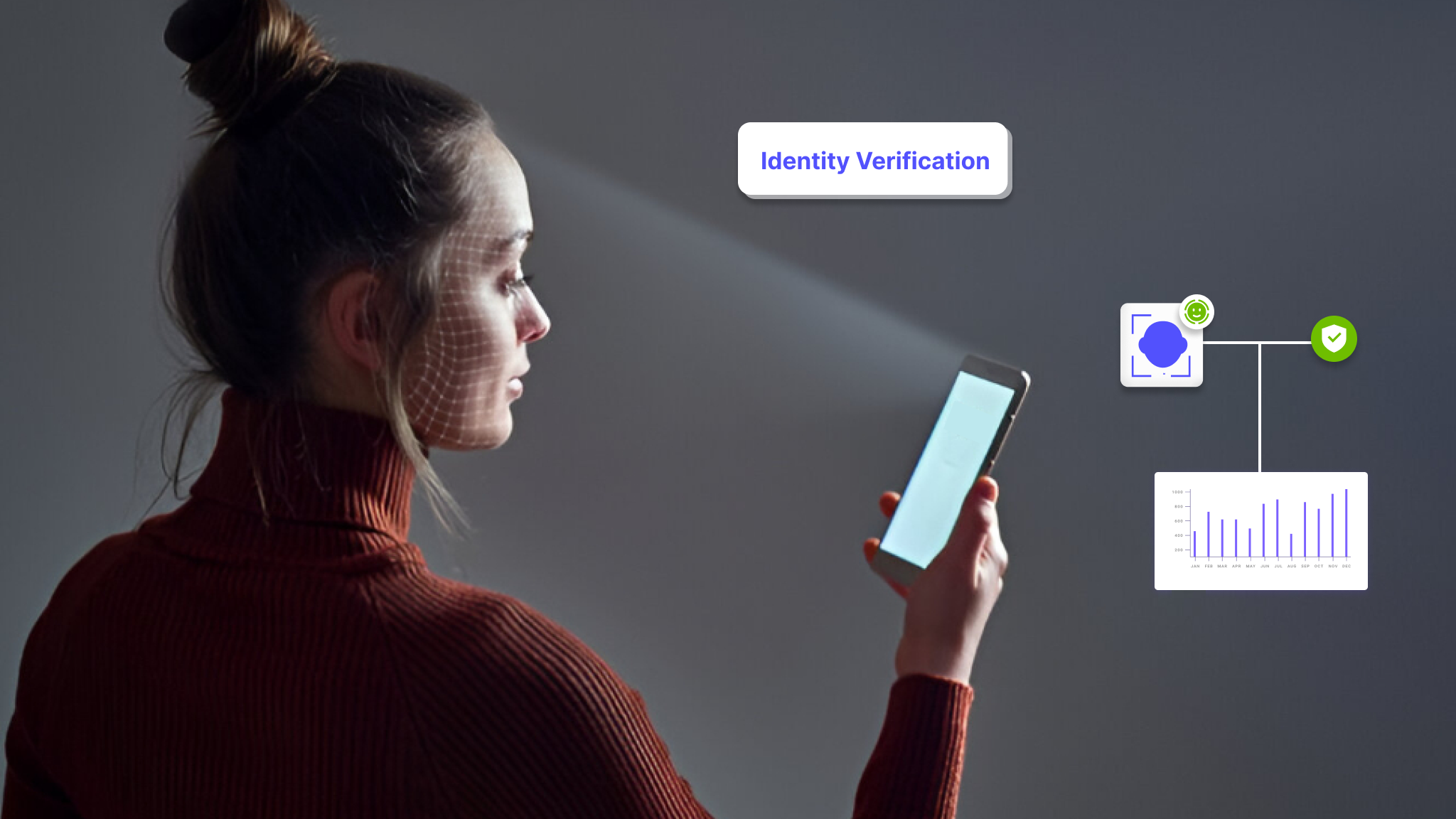
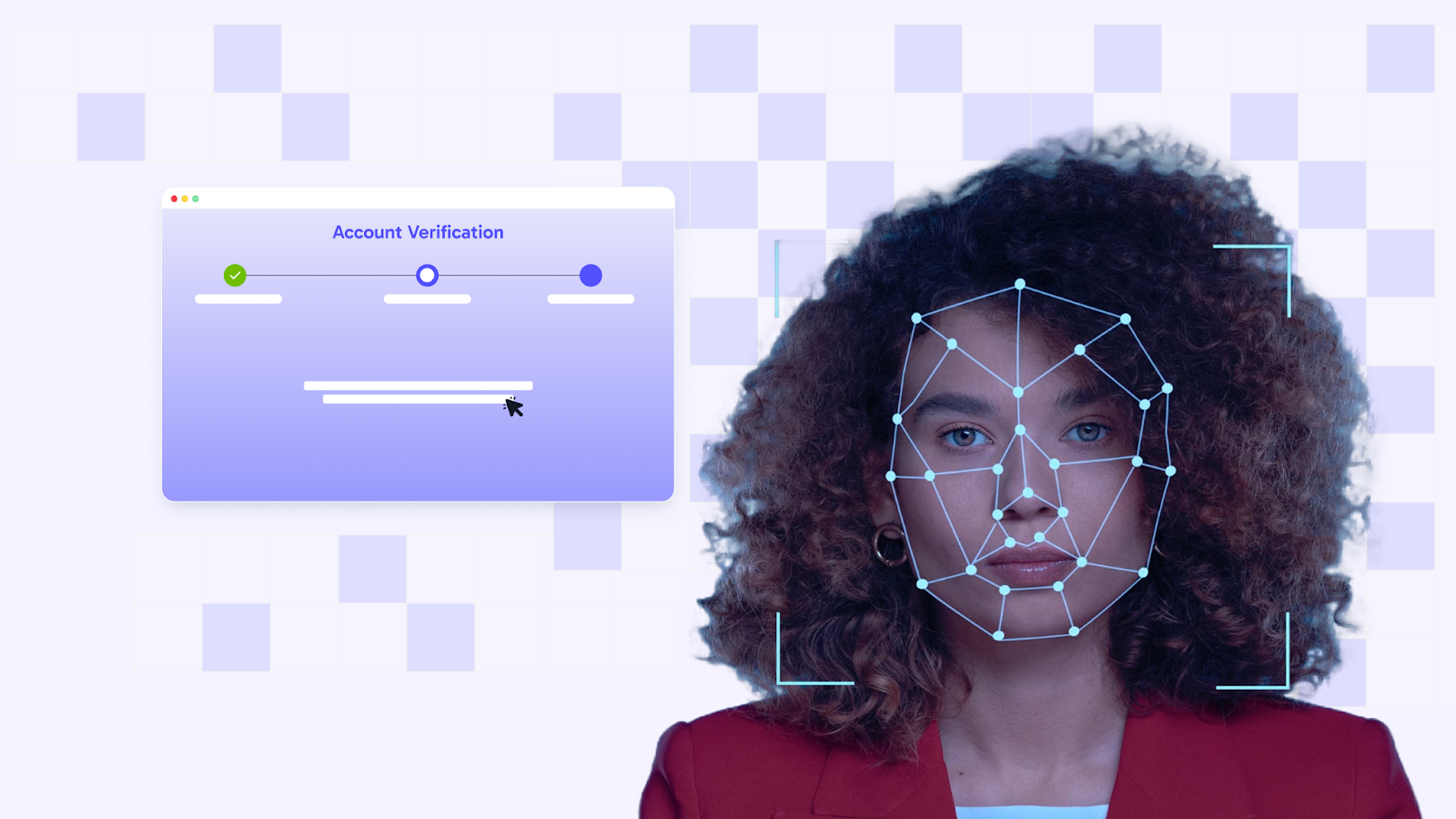
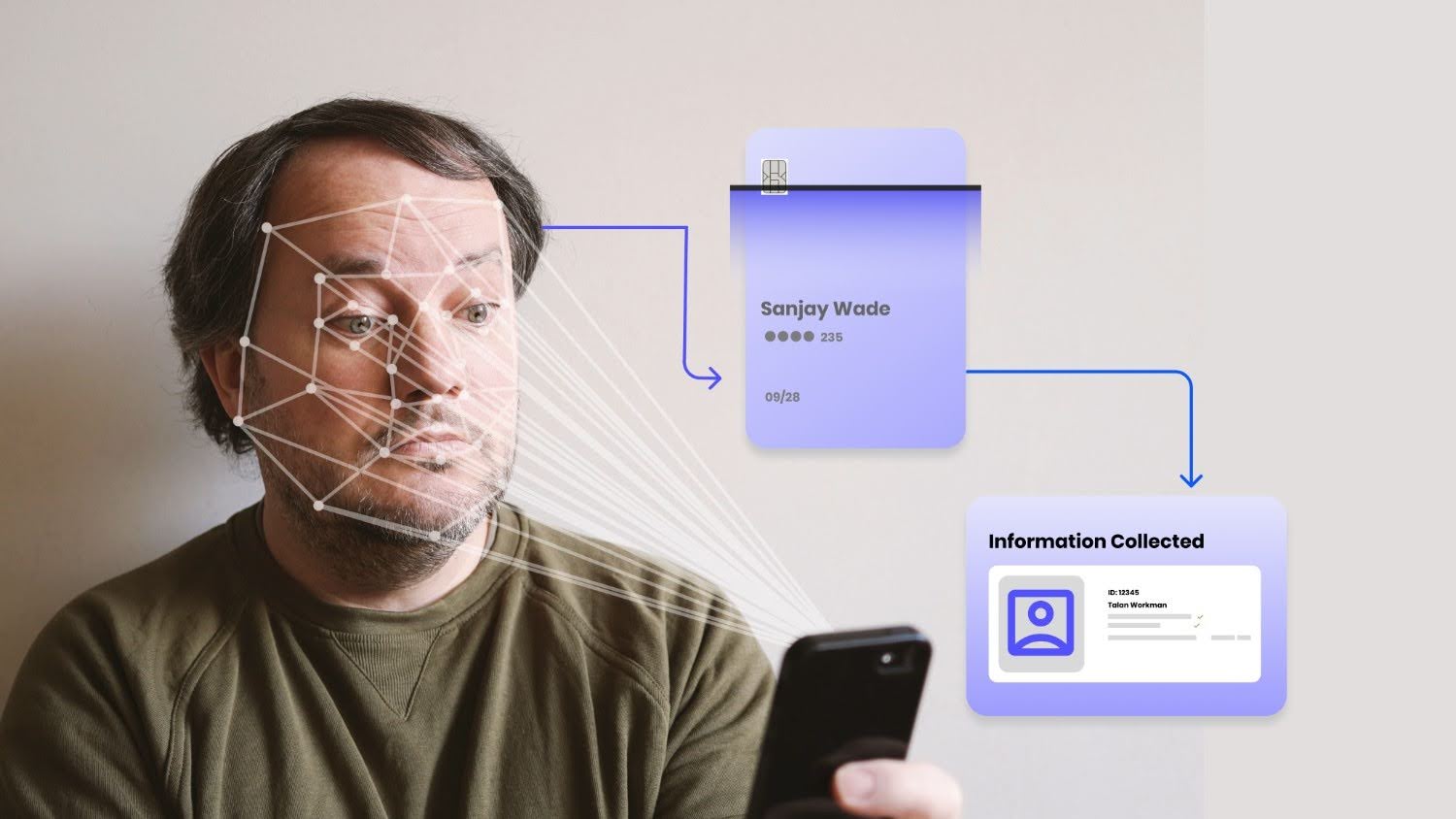
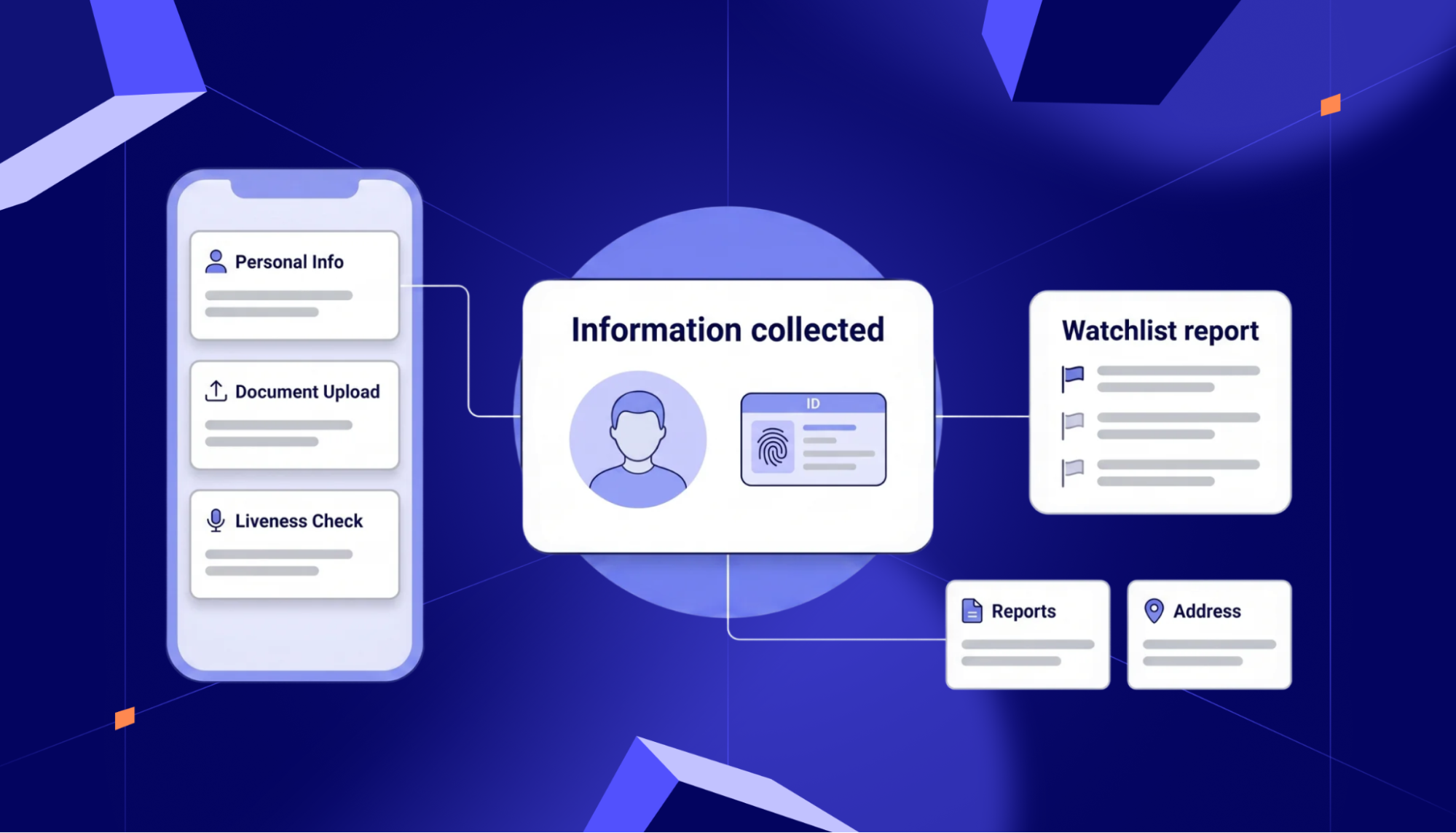
- Identity Verification: Verify real users globally with AI-driven document checks, biometric liveness, face matching, and deepfake/spoof prevention—beyond basic ID scans.
- Fraud & Risk Scoring: Analyze email, phone, device, and behavioral signals with real-time alerts and customizable risk models to stop fraud before it hits.
- Continuous Monitoring: Ongoing automated checks detect account takeovers, synthetic identities, and credential abuse throughout the user lifecycle.
- Compliance & Audit-Ready Controls: Stay KYC/AML compliant with watchlist screening, audit trails, and a unified dashboard for regulator-ready reporting.
- Seamless Integration: Deploy via SDKs or no-code workflows, manage cases efficiently, and maintain high accuracy with minimal engineering effort.
Protect your business today, visit AiPrise to explore full fraud prevention solutions and see how it works in real time.
Wrapping Up
Identity fraud in 2026 is faster, smarter, and more automated than ever. Businesses that rely on static checks or delayed monitoring risk significant financial loss, regulatory penalties, and reputational damage. By adopting risk-adaptive verification, behavioral intelligence, lifecycle monitoring, and AI-driven fraud protection, you can stay ahead of threats while ensuring compliance and operational efficiency.
Secure your business against modern fraud. Book a Demo with AiPrise today and experience real-time protection in action.
FAQs
1. What types of identity fraud are growing fastest in 2026?
A: Impersonation fraud dominates modern schemes, accounting for over 85% of fraudulent attempts, as attackers increasingly use AI and automation to mimic real users and bypass basic checks.
2. How does AI change the way identity fraud is carried out?
A: AI enables fraudsters to generate deepfake media, automate attacks, and create synthetic identities at scale, making traditional document checks and static defenses less effective.
3. Is identity fraud still increasing, or has the trend plateaued?
A: Although overall fraud volumes have stabilized, the complexity and sophistication of attacks, especially AI‑assisted and multi‑stage schemes, continue to rise, making prevention harder.
4. Which industries face the highest identity fraud risk in 2026?
A: E‑commerce platforms and financial services see the highest fraud rates due to large transaction volumes and valuable accounts, with e‑commerce approaching nearly 5× the global fraud average.
5. Can deepfake technology defeat biometric verification?
A: Yes, deepfakes and injection attacks are increasingly used to fool liveness and face‑match systems, with one in five biometric fraud attempts involving manipulated media.
You might want to read these...








AiPrise
6 min read
KYB Compliance: 2026 Regulations You Should Know About
As organizations expand globally and face tighter regulations, adherence to Know Your Business (KYB) standards has become one of the most critical compliance layers for fintech, online marketplaces, and other companies that need to verify business customers before letting them perform financial transactions.








.png)

.jpg)













.png)








.png)
.png)
.png)














.png)

AiPrise’s data coverage and AI agents were the deciding factors for us. They’ve made our onboarding 80% faster. It is also a very intuitive platform.

Head of Operations



See your full compliance picture in one place
Use AI agents and global data to review businesses and users faster and more accurately
