

AiPrise
11 min read
January 30, 2026
Deepfake Detection vs. Liveness Checks in Modern Security
Key Takeaways

Digital identity has become the primary control layer for financial institutions, payment providers, and cryptocurrency platforms, yet it is increasingly targeted by synthetic media attacks. Deepfake fraud has surged rapidly, with documented losses from deepfake-enabled incidents exceeding $200 million in the first quarter of 2025 alone. This shift reflects how AI-generated impersonation has moved from experimental misuse to organized financial crime, overwhelming traditional manual review and identity verification processes.
For organizations governed by the Bank Secrecy Act, FinCEN AML rules, FATF guidance, and biometric privacy laws, AI-driven impersonation creates significant regulatory and financial risk. Deepfake-enabled social engineering and synthetic identities directly weaken KYC, KYB, and ongoing due diligence controls. As a result, the choice between deepfake detection vs. liveness checks now shapes onboarding architecture, fraud prevention, and compliance automation.
This guide examines deepfake detection vs liveness checks work, where each succeeds or fails, and how regulated organizations can combine them to reduce fraud risk while maintaining operational efficiency at scale.
Key Takeaways
- Liveness detection confirms live human presence, complementing deepfake detection for stronger identity verification.
- Both technologies are essential for KYC, KYB, AML, and fraud risk management in regulated industries.
- Passive liveness enables low-friction verification, improving onboarding adoption and reducing abandonment rates.
- ISO-30107 Level 1 and 2 compliance ensures protection against both simple and sophisticated spoofing attacks.
- Future-proof security requires integrating real-time decisioning, AI explainability, and scalable API-based deployments.
What Is Deepfake Detection?
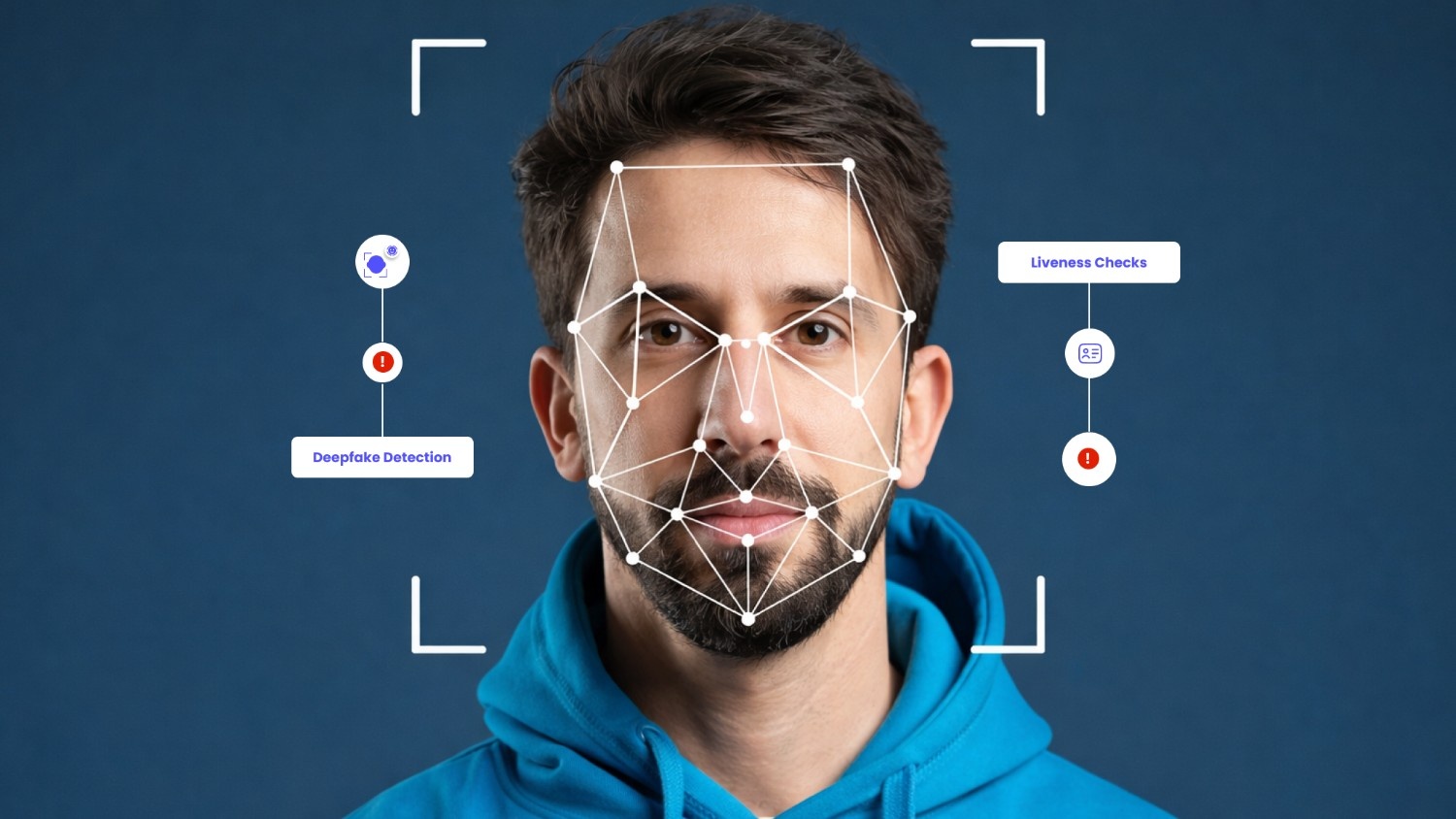
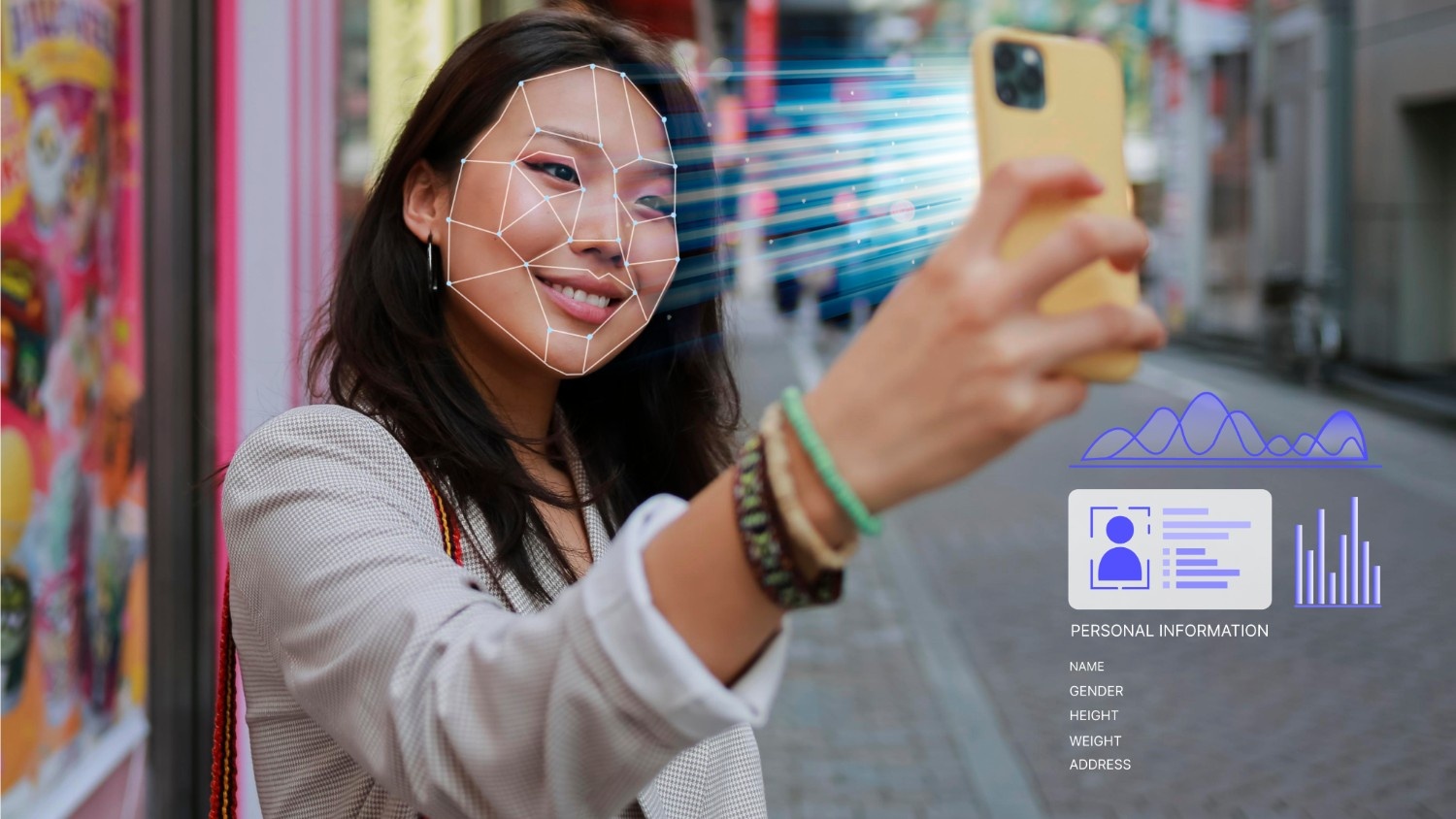
Deepfake detection uses machine learning models to identify AI-generated or manipulated audio, video, and images by analyzing biometric inconsistencies, pixel artifacts, and behavioral anomalies that evade human review. For financial institutions and payment providers, deepfake detection strengthens KYC and KYB controls by flagging synthetic media before it is used to bypass identity verification or authorize transactions.
Detection models now support BSA and FinCEN expectations by reducing false acceptance rates and triggering enhanced due diligence, though they cannot alone confirm a live human presence, which is central to the discussion on deepfake detection vs liveness checks.
Now, let’s examine why liveness checks are needed to validate real human presence.
Why Liveness Checks Matter
Deepfakes enable attackers to inject synthetic media directly into identity and authentication workflows, bypassing traditional verification controls. The following points explain how injection attacks exploit gaps in security architectures and why they matter in regulated environments.
- Proof of Human Presence: Liveness detection confirms that a real person is present during identity verification, blocking replayed videos, static images, and AI-generated deepfakes from passing KYC and KYB checks.
- Protection Against Synthetic Identity Fraud: By verifying live biometric responses, liveness checks disrupt synthetic identity creation used to open mule accounts, a growing concern highlighted in FinCEN fraud advisories.
- Regulatory Alignment: Liveness verification supports risk-based identity assurance under FATF recommendations and strengthens compliance with the Bank Secrecy Act by reducing false identity acceptance.
- Operational Efficiency: Automated liveness checks reduce manual review queues, accelerate onboarding decisions, and improve straight-through processing in high-volume payment and crypto platforms.
- Core Control in Modern Security Stacks: As deepfake fraud surged over 1,300% in 2024, liveness detection has become a foundational safeguard in the broader evaluation of deepfake detection vs liveness checks.
Deepfake detection and liveness checks address different stages of identity fraud and are often deployed together in modern security architectures. The table below highlights how each approach functions, where it excels, and its role in regulated identity verification.
Also Read: 10 KYC Onboarding Challenges and Best Practices to Fix Them
Understanding liveness detection leads us to explore the types of attacks it protects against.
Deepfakes, Injection, and Presentation Attacks
.png)
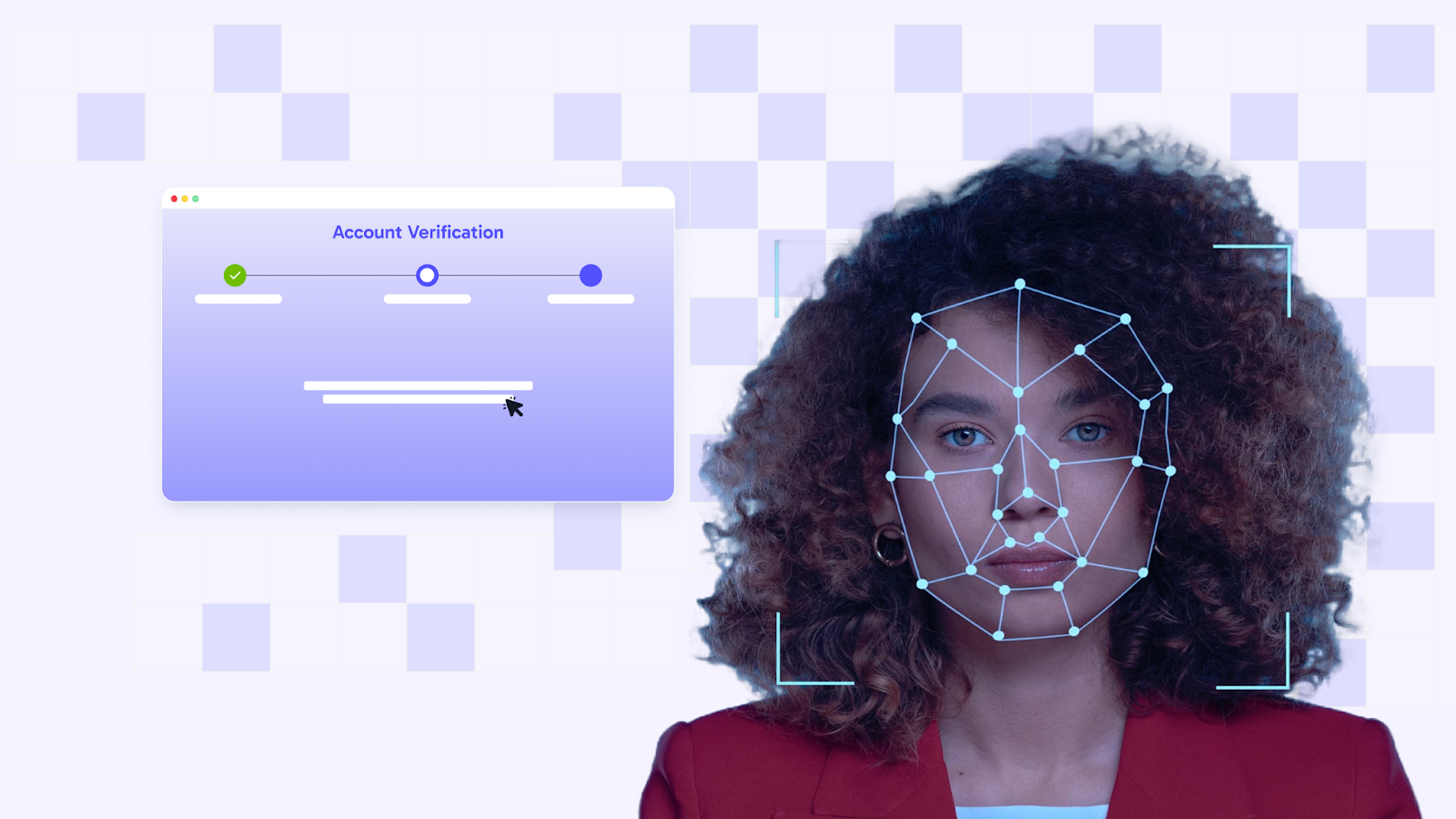
Deepfake-driven fraud increasingly combines media injection and physical spoofing techniques to exploit weaknesses in remote identity systems. The following points explain how these attack vectors bypass traditional controls and why they present a greater risk for regulated institutions.
- Synthetic Media Injection at Source: Attackers inject pre-generated deepfake video or audio directly into verification pipelines, bypassing live camera and microphone capture layers.
- Replay, Mask, and Screen-Based Spoofing: Presentation attacks rely on printed photos, screen replays, silicone masks, or recorded videos to impersonate legitimate users during onboarding or authentication.
- Failure of Static Verification Controls: Image matching and document-only checks cannot reliably detect injected or replayed media, allowing deepfakes to pass KYC without triggering risk signals.
- Compliance and Audit Exposure: Successful spoofing undermines customer due diligence obligations under FATF Recommendation 10 and weakens audit defensibility under BSA and FinCEN AML requirements.
- Limits of Human Review: With only 0.1% of people able to consistently identify deepfakes, manual oversight cannot scale against these attack vectors.
- Architectural Implications: These attacks reinforce why confirming live human interaction remains central in evaluating deepfake detection vs liveness checks.
- Escalated Risk in Remote Onboarding: Non-face-to-face verification workflows used by banks and crypto platforms are prime targets for these attacks due to limited environmental validation.
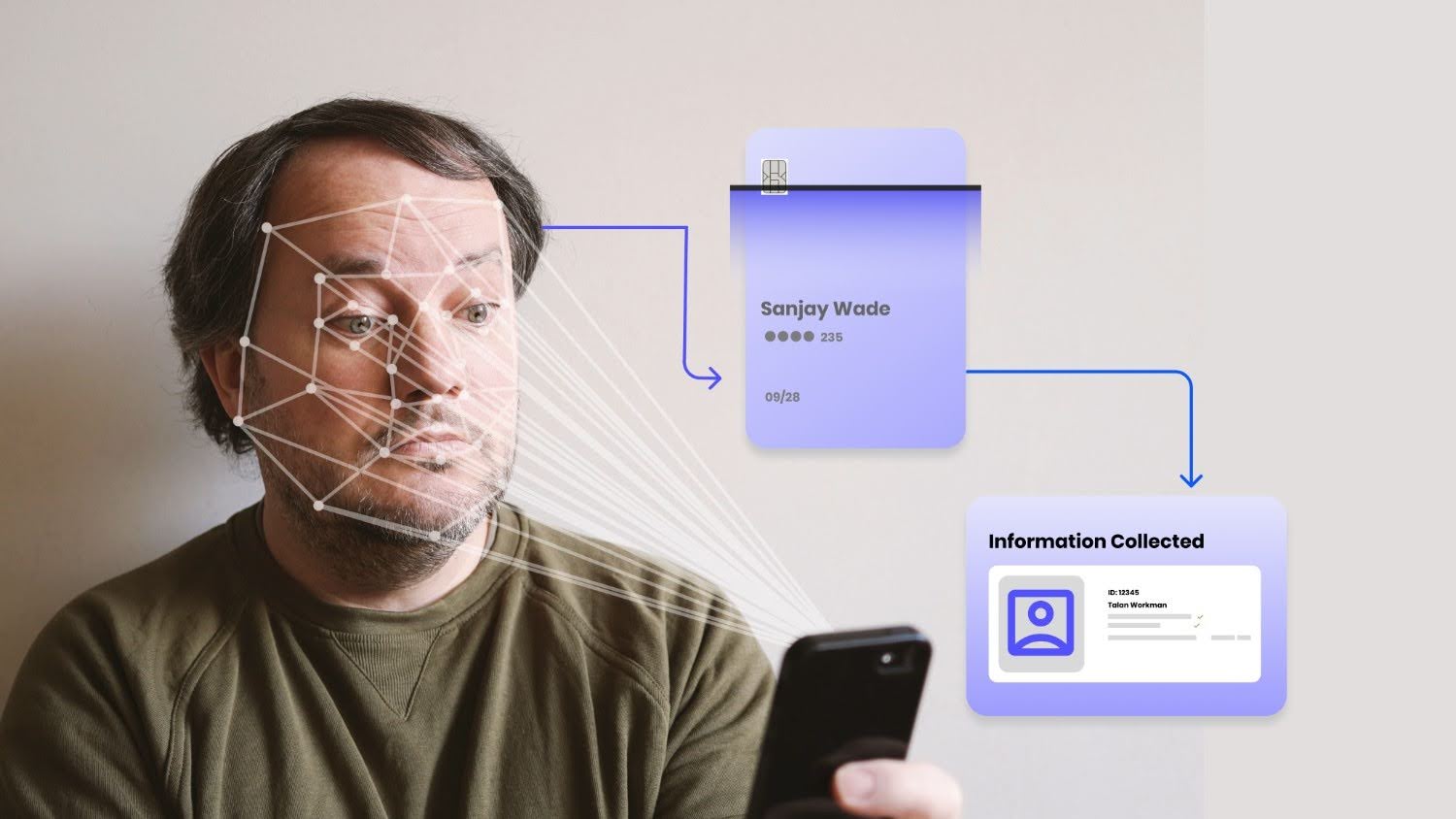
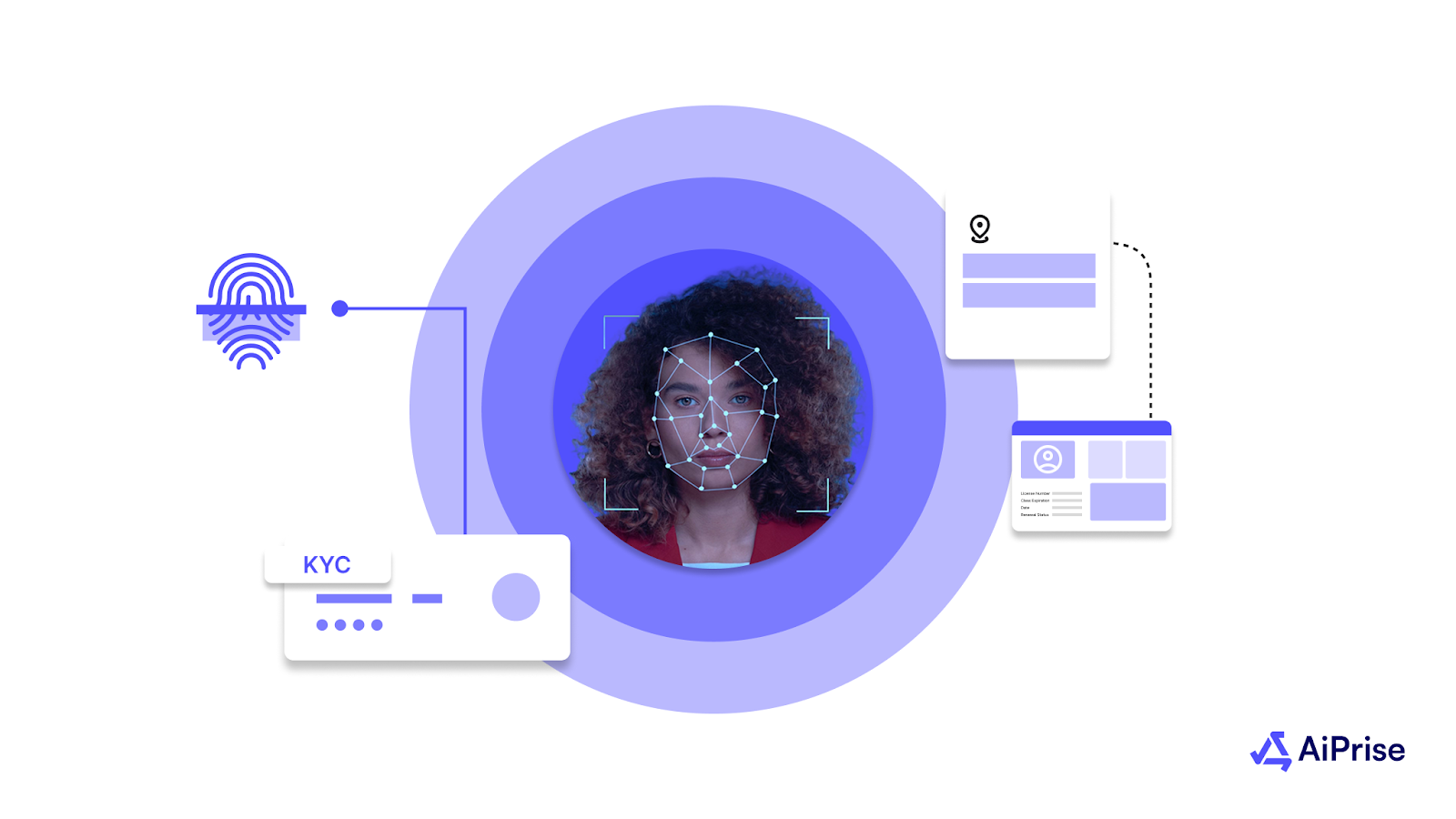
As deepfake attacks increasingly target digital onboarding, AiPrise helps validate real human presence by combining User Verification with face liveness, document verification, and fraud & risk scoring to block synthetic identities at the first interaction.
With attack types defined, it’s important to review the different liveness detection methods.
Types of Liveness Detection
Liveness detection methods are designed to verify real human presence during identity verification and authentication workflows. The following points outline the two primary approaches used in regulated security architectures.
Also Read: What GENIUS Act Stablecoin Compliance Requirements Mean for Issuers
Once we know the methods, let’s see how liveness checks specifically prevent deepfake-enabled fraud.
How Liveness Checks Help Detect Deepfakes
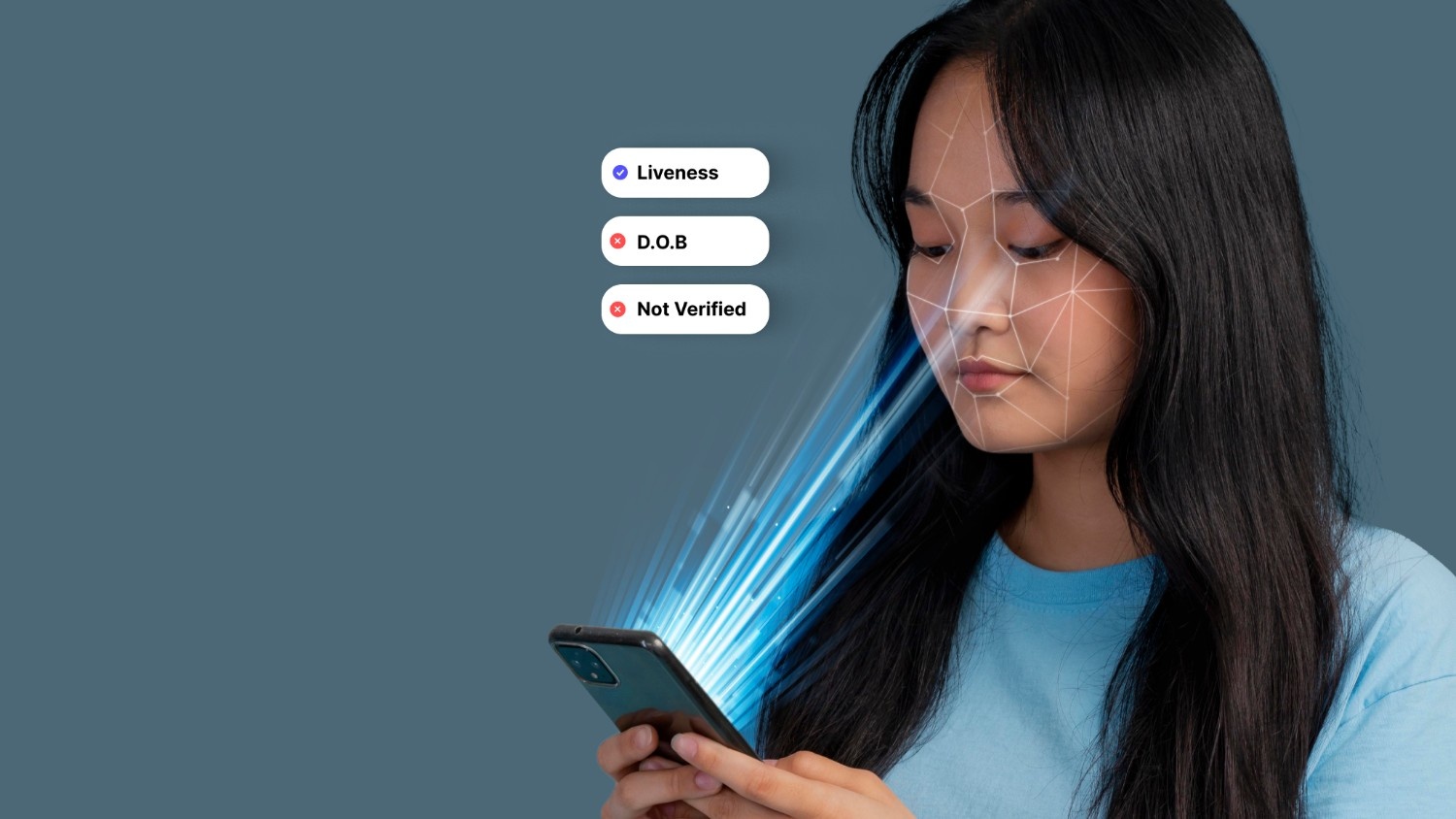
Liveness checks act as a real-time verification layer that deepfake detection alone cannot provide, ensuring that a human is physically present during onboarding or authentication. Here’s how liveness verification strengthens identity assurance and fraud prevention in regulated environments:
- Blocking Replay and Injection Attacks: Verifies that pre-recorded videos or AI-generated content cannot bypass identity systems, protecting KYC and KYB processes.
- Preventing Presentation Spoofing: Detects masks, printed photos, and screen-based impersonations in both active and passive workflows.
- Automating Compliance Controls: Integrates with AML and KYC workflows to reduce manual intervention while maintaining auditability and regulatory alignment under FATF and FinCEN guidance.
- Mitigating Bot and Deepfake Attacks: Confirms live human interaction, reducing the success of automated attack campaigns and synthetic identity fraud
Having covered their benefits, let’s discuss the metrics used to benchmark liveness detection solutions.
How Liveness Detection Is Benchmarked
Liveness systems are measured using specialized biometric metrics to evaluate performance, reliability, and resilience against attacks. The key metrics used by regulated institutions to assess liveness detection are:
- APCER – Attack Presentation Classification Error Rate: Measures the rate at which a system fails to detect a spoof or malicious presentation, similar to False Accept Rate (FAR).
- BPCER – Bona Fide Presentation Classification Error Rate: Measures the rate at which a system incorrectly rejects a legitimate user, analogous to False Reject Rate (FRR).
- APNRR – Attack Presentation Non-Response Rate: Captures instances when the system fails to respond at all to an attack presentation.
- BPNRR – Bona Fide Presentation Non-Response Rate: Captures instances when the system fails to provide any response for a legitimate, bona fide user.
Also Read: What Is a PEP Review? Screening Process, Challenges and Best Practices
Now, we can identify the key features to evaluate in a liveness solution.
What to Look for in a Liveness Detection Solution
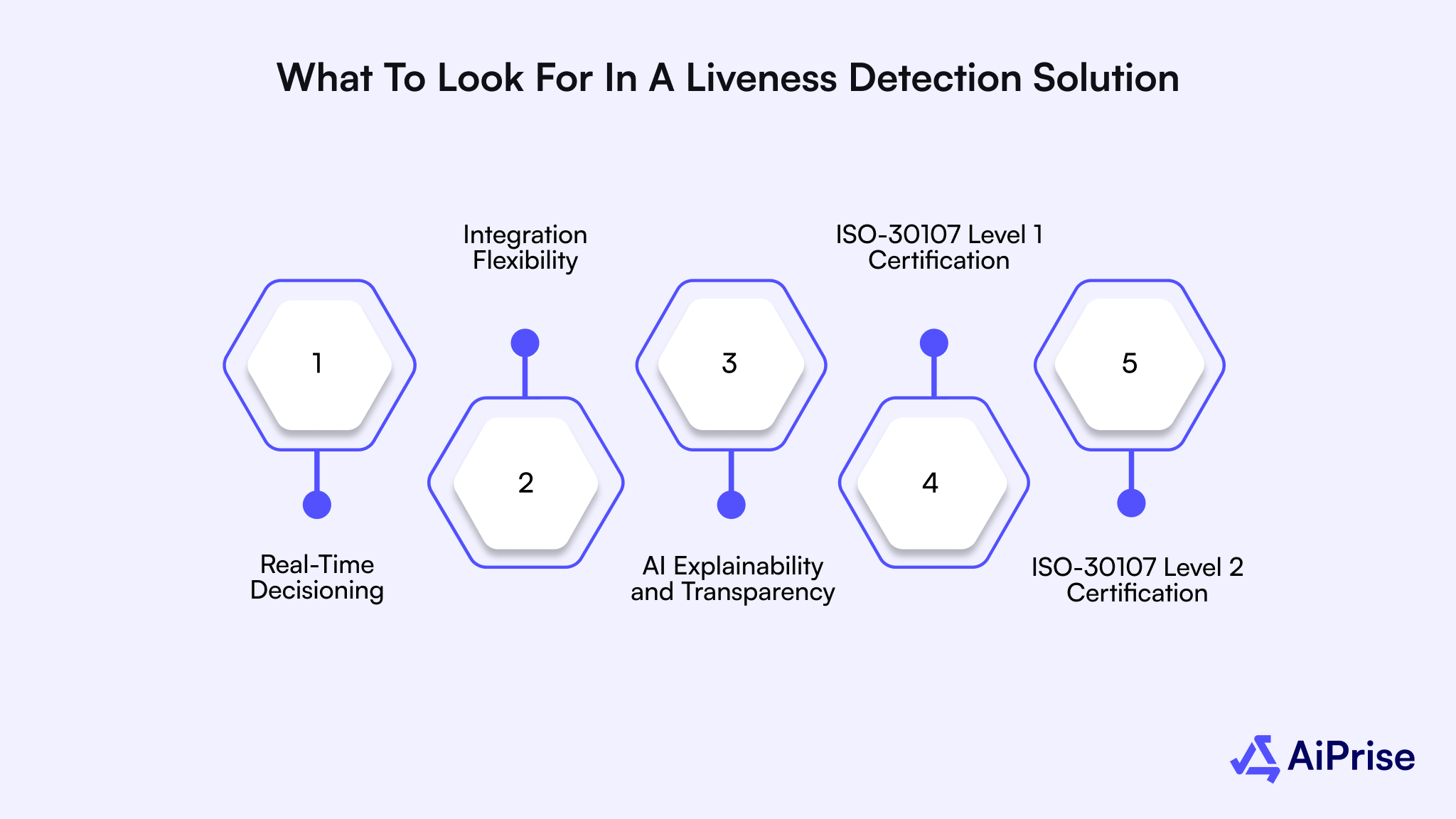
Selecting a liveness detection solution requires careful evaluation to ensure strong fraud prevention without compromising compliance or user experience. Key attributes for regulated institutions, payment providers, and crypto platforms include:
- Real-Time Decisioning: Immediate fraud detection prevents repeated attack attempts and reduces exposure to synthetic identity and deepfake-based fraud.
- Integration Flexibility: Ability to plug into existing identity verification, onboarding, or fraud prevention systems without major infrastructure changes.
- AI Explainability and Transparency: Ensures that model decisions can be audited and understood, meeting regulatory expectations in heavily supervised industries.
- ISO-30107 Level 1 Certification: Confirms the system can detect common 2D attack vectors, including paper or digital photos and simple masks.
- ISO-30107 Level 2 Certification: Validates detection against advanced threats like lifelike 3D mannequin heads, realistic masks, and deepfake videos.
With criteria in mind, let’s explore real-world applications where liveness detection adds value.
Real-World Applications of Liveness Detection
Liveness detection is being widely adopted in regulated industries to prevent identity fraud and secure digital onboarding. The examples below illustrate how institutions apply liveness checks to strengthen compliance and reduce operational risk.
- Remote Onboarding for Financial Institutions: Ensures that new customers are real humans, protecting KYC and AML workflows from deepfake or synthetic identity attacks.
- Cryptocurrency Platform Account Verification: Confirms live user presence during wallet creation or high-value transaction authorization, reducing the risk of account takeover.
- Digital Payment Platforms: Enables instant verification for cross-border transfers and peer-to-peer payments, reducing fraud exposure while maintaining operational efficiency.
- High-Security Step-Up Authentication: Used for high-value transactions or access to sensitive data, ensuring the person initiating the action is genuine.
- Call Center and Customer Support Verification: Reduces fraud risk in voice or video interactions by verifying the liveness of the participant during sensitive service interactions.
Also Read: Automating Sanctions Screening for Compliance Professionals
These applications show that liveness detection is not just a technical safeguard but a regulatory and operational necessity for any institution handling digital identities at scale.
Given this, let's examine future trends shaping liveness detection technologies.
Future of Liveness Detection Technology
Liveness detection is advancing to counter more sophisticated attacks while meeting regulatory and operational requirements. The following are the emerging trends shaping next-generation identity verification and fraud prevention solutions.
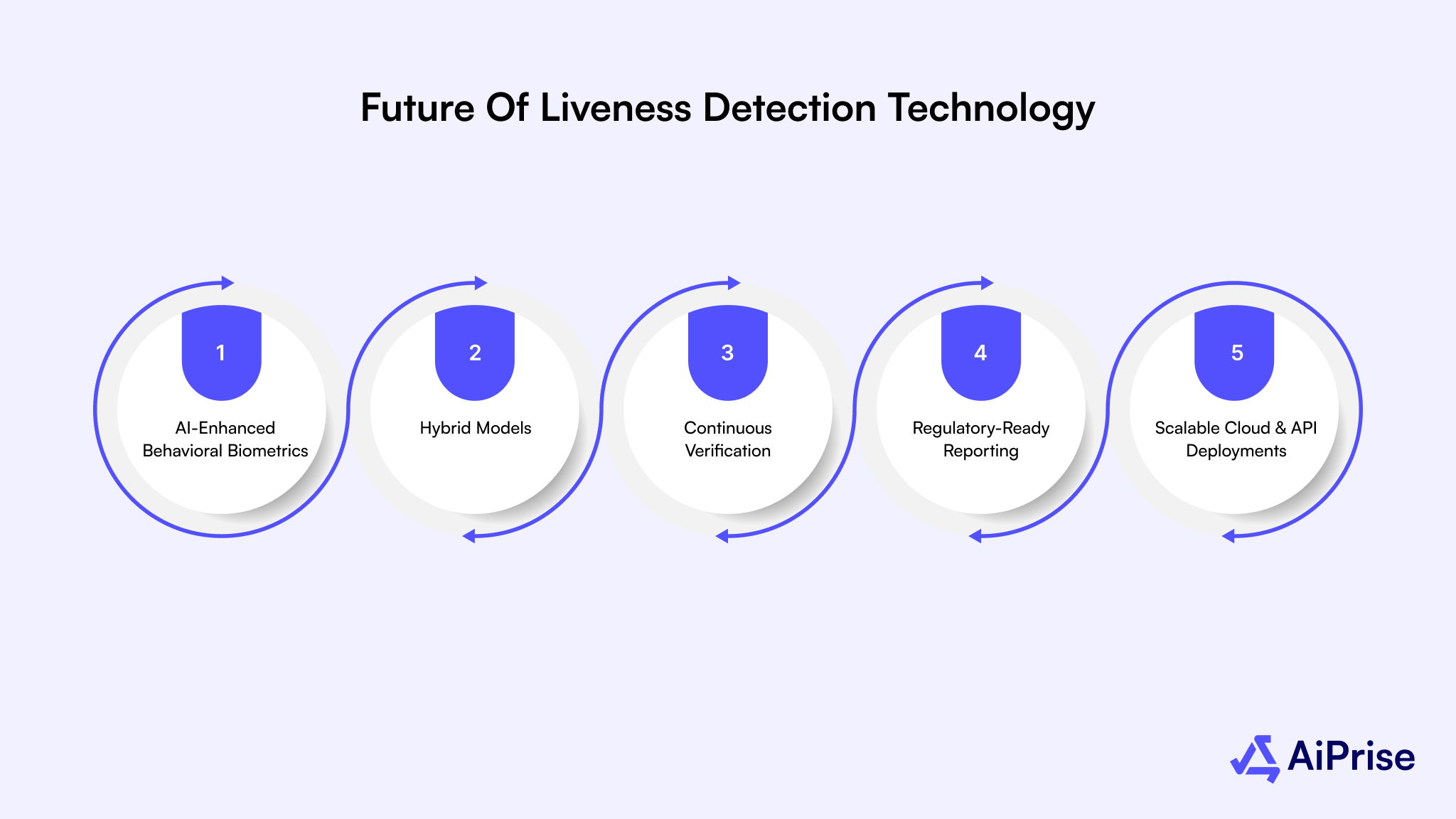
- AI-Enhanced Behavioral Biometrics: Future systems will combine micro-movement, gesture, and eye-tracking analytics for higher precision against deepfakes and presentation attacks.
- Hybrid Models: Integration of active and passive liveness approaches will allow institutions to balance security, frictionless onboarding, and fraud mitigation.
- Continuous Verification: Beyond onboarding, liveness may be applied for ongoing monitoring in high-value accounts and recurring transaction flows.
- Regulatory-Ready Reporting: Liveness systems will increasingly provide explainable, auditable logs to satisfy FATF, FinCEN, and ISO compliance requirements.
- Scalable Cloud and API Deployments: Cloud-native solutions will support global institutions handling high-volume, cross-border identity verification without performance trade-offs.
Adoption will accelerate as organizations recognize the rising cost of digital identity fraud and the increasing mainstream threat posed by deepfakes.
Also Read: What Is 314a FinCEN? Compliance Guide for Handling Law Enforcement Requests
Once we understand the trends, let’s see how AiPrise utilizes liveness detection to strengthen identity security.
Strengthening Identity Security Against Deepfakes with AiPrise
As deepfake attacks move from novelty to operational risk, security teams must go beyond surface-level detection and validate real human presence with confidence. Modern liveness checks, paired with intelligent fraud controls, are now central to compliant digital onboarding and account protection.
How AiPrise supports liveness-driven security strategies:
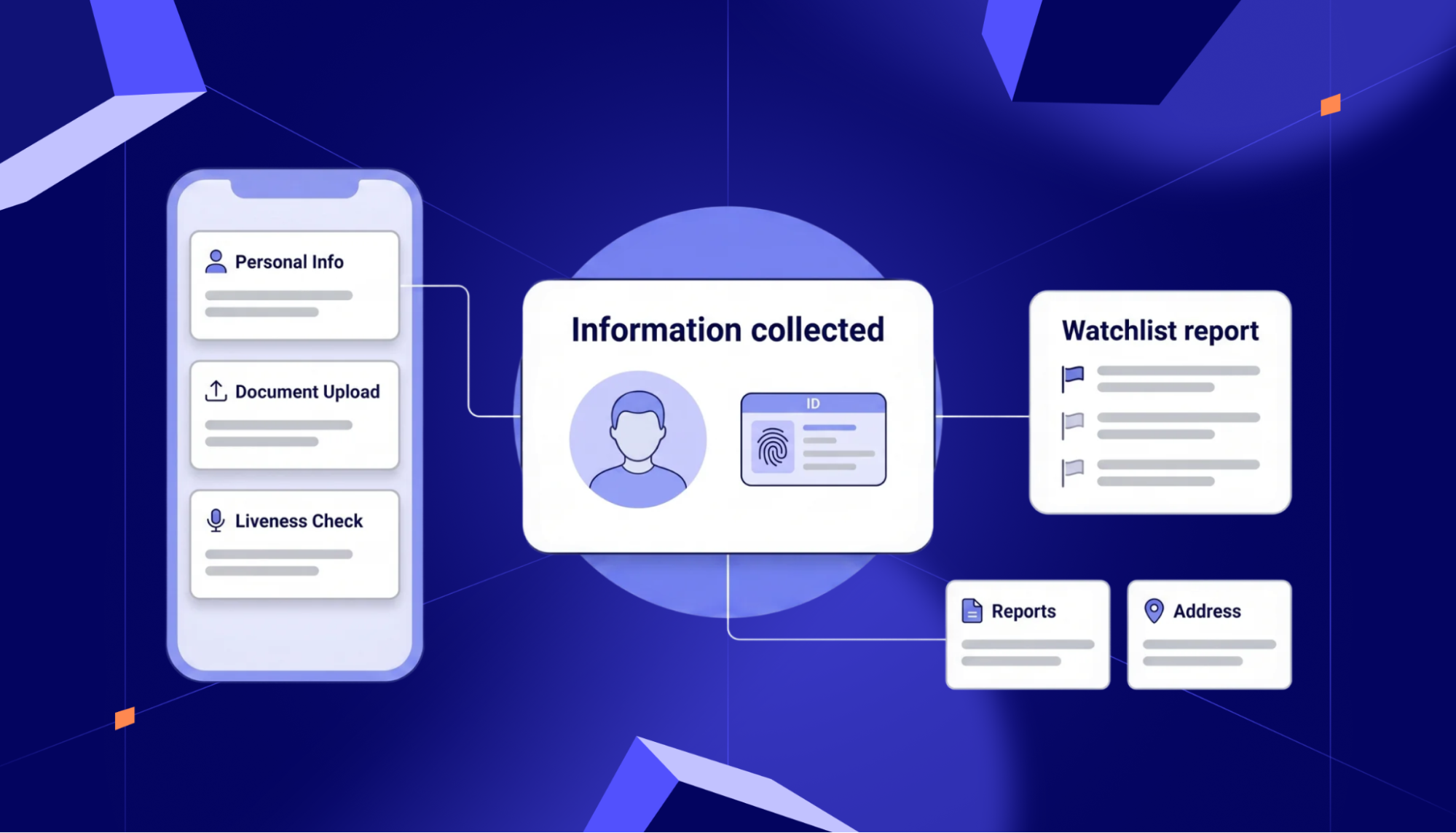
- User Verification with Face Liveness: Combines document verification, biometric liveness checks, AML screening, and fraud detection to block deepfake-driven impersonation during onboarding and re-verification.
- Fraud & Risk Scoring: Applies advanced rule engines and behavioral signals to identify spoofing, injection attacks, and anomalous activity linked to synthetic identities.
- Reverification for High-Risk Events: Triggers liveness checks during sensitive actions like withdrawals, device changes, or credential resets to prevent account takeover.
- Watchlist Screening: Ensures identities passing liveness checks are also screened against global sanctions and criminal lists, closing compliance gaps.
- Case Management & Workflows: Centralizes investigation of suspected deepfake or spoofing attempts, enabling faster decisions and consistent audit trails.
- Onboarding SDK: Embeds passive and active liveness checks directly into apps and web flows with minimal engineering overhead.
By combining liveness detection with risk scoring and automated compliance, AiPrise helps organizations move from reactive deepfake defense to proactive identity assurance at scale.
Read this case study to explore how Zumrails unified KYC, KYB, and risk management on a single platform.
Wrapping Up
Deepfake detection vs liveness checks is a significant framework: deepfake detection identifies AI-manipulated media, while liveness verification confirms real-time human presence.
Together, they strengthen KYC, KYB, and AML workflows, reduce operational risk, and meet regulatory expectations under FATF, FinCEN, and ISO-30107 standards. For financial institutions, payment platforms, and crypto operators, integrating both approaches is now essential to maintain trust, compliance, and scalable security.
For ongoing protection beyond onboarding, AiPrise applies reverification, watchlist screening, and case management workflows to detect spoofing attempts during high-risk actions while maintaining compliance and operational efficiency.
Book a Demo to see how AiPrise uses liveness checks, risk scoring, and automated verification workflows to defend against deepfake-driven identity fraud.
FAQs
1. Can liveness detection prevent fraud in video call-based transactions?
Yes, it confirms a live participant during remote interactions, blocking spoofed or AI-generated videos from bypassing KYC, KYB, and fraud controls in real time.
2. How do deepfake detection systems integrate with existing onboarding platforms?
Detection APIs can plug into identity verification workflows, automatically flagging manipulated media for review without disrupting AML, KYC, or customer experience processes.
3. Are deepfake detection and liveness checks mandatory under regulations?
While not explicitly mandated, FATF, FinCEN, and ISO-30107 guidance expect layered identity verification to prevent fraud, particularly in high-risk and remote onboarding contexts.
4. How effective are these solutions against AI-generated audio deepfakes?
Combined liveness verification and deepfake detection can identify inconsistencies in voice patterns, lip-sync, and biometric cues, reducing fraud in voice-based onboarding or support interactions.
5. Can liveness detection scale for high-volume transactions without impacting UX?
Yes, passive liveness and AI-driven decisioning allow real-time verification across millions of transactions, minimizing friction while maintaining compliance and fraud prevention efficiency.
You might want to read these...



AiPrise
KYB Compliance: 2026 Regulations You Should Know About
As organizations expand globally and face tighter regulations, adherence to Know Your Business (KYB) standards has become one of the most critical compliance layers for fintech, online marketplaces, and other companies that need to verify business customers before letting them perform financial transactions.








.png)

.jpg)












.png)







.png)
.png)
.png)













.png)
.png)







AiPrise’s data coverage and AI agents were the deciding factors for us. They’ve made our onboarding 80% faster. It is also a very intuitive platform.

Head of Operations



See your full compliance picture in one place
Use AI agents and global data to review businesses and users faster and more accurately
