

7 min read
September 21, 2026
What Full-Lifecycle KYB Actually Means (And Why One Platform Beats Five Vendors)
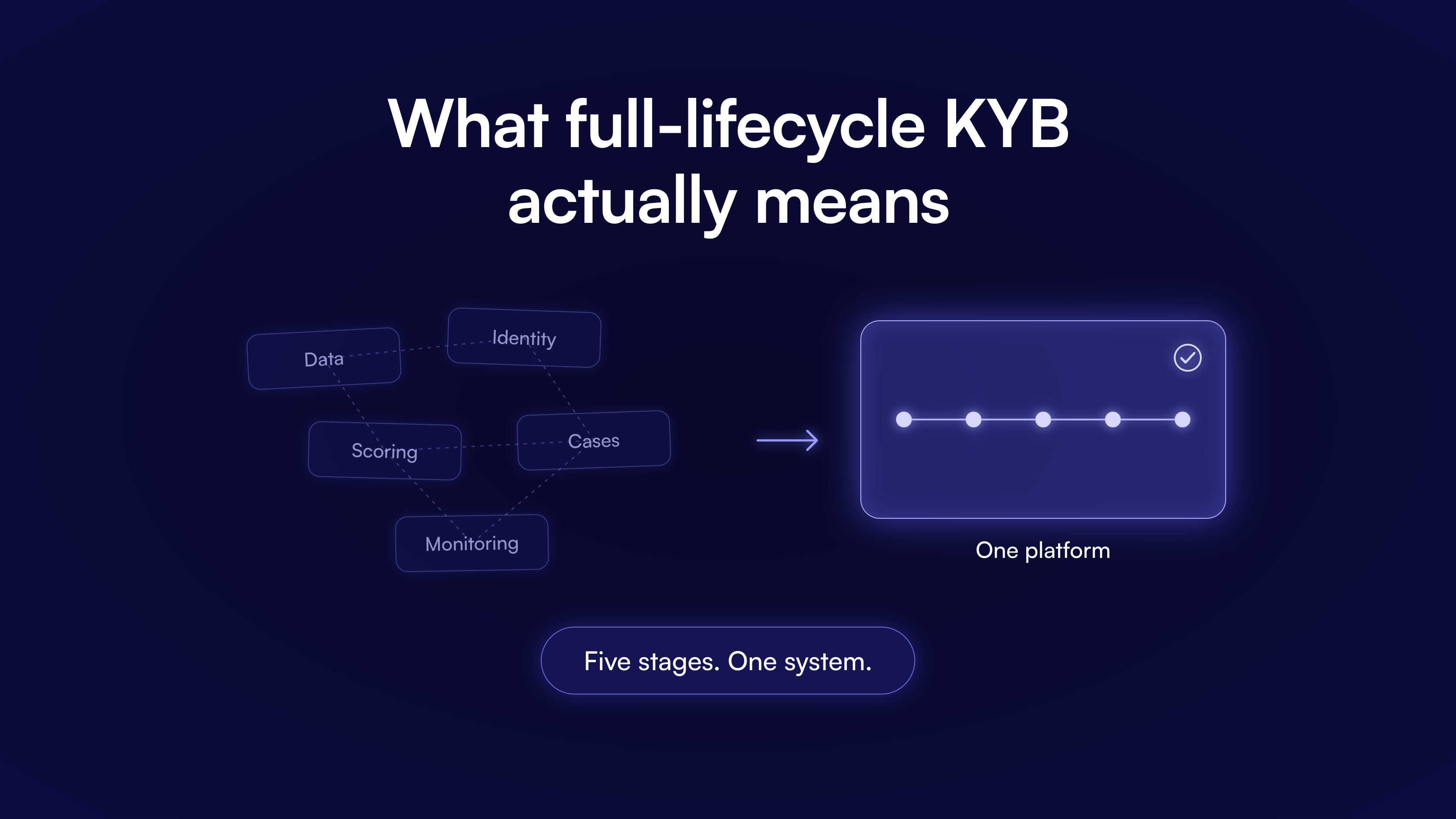
Key Takeaways

Full-lifecycle KYB covers five stages: collection, verification, risk scoring, decisioning, and ongoing monitoring. Most vendors sell one or two of them.
The market splits into data vendors, identity checkers, orchestration layers, and case tools. Each solves a slice, and the buyer inherits the job of stitching the slices together.
The stitching has a price: separate contracts and DPAs, glue code someone maintains, analysts working across portals, and an audit trail scattered across systems.
When the lifecycle runs as one system, data flows forward instead of being re-entered, monitoring feeds back into risk scores, and one audit trail covers the whole story.
Five questions at the end of this piece will pressure-test any vendor's end-to-end claim, including ours.
The Claim Everyone Makes
Every KYB vendor's homepage says some version of end-to-end. The words are doing different jobs on different sites. Sometimes they mean the vendor covers data plus a dashboard. Sometimes they mean the API has many endpoints. Occasionally they mean what a compliance leader actually needs them to mean: the whole lifecycle of a business relationship, from the first onboarding form to a sanctions alert two years later, handled in one system.
This piece is about what the words have to mean, and how to check.
The Five Stages, Briefly
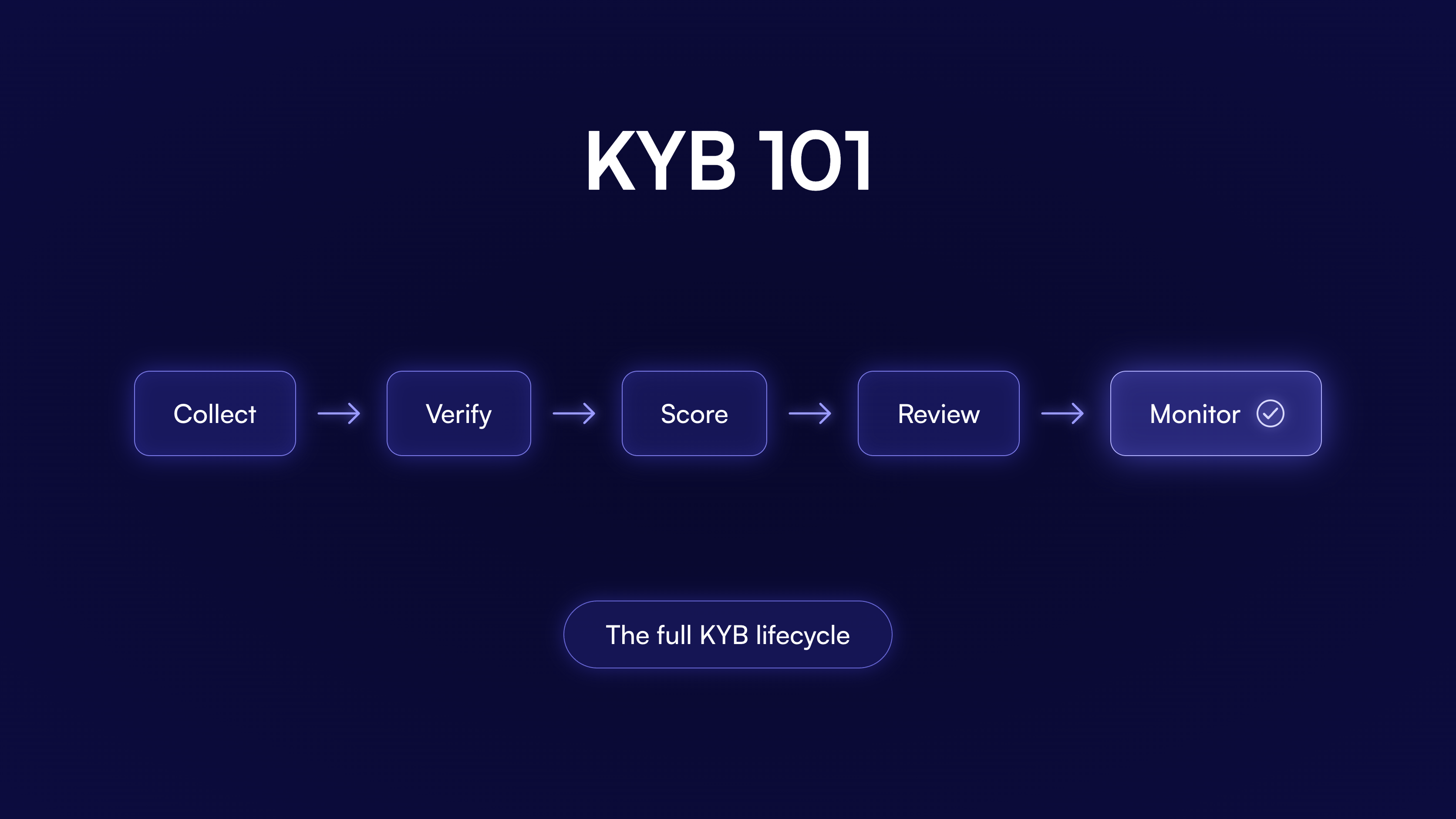
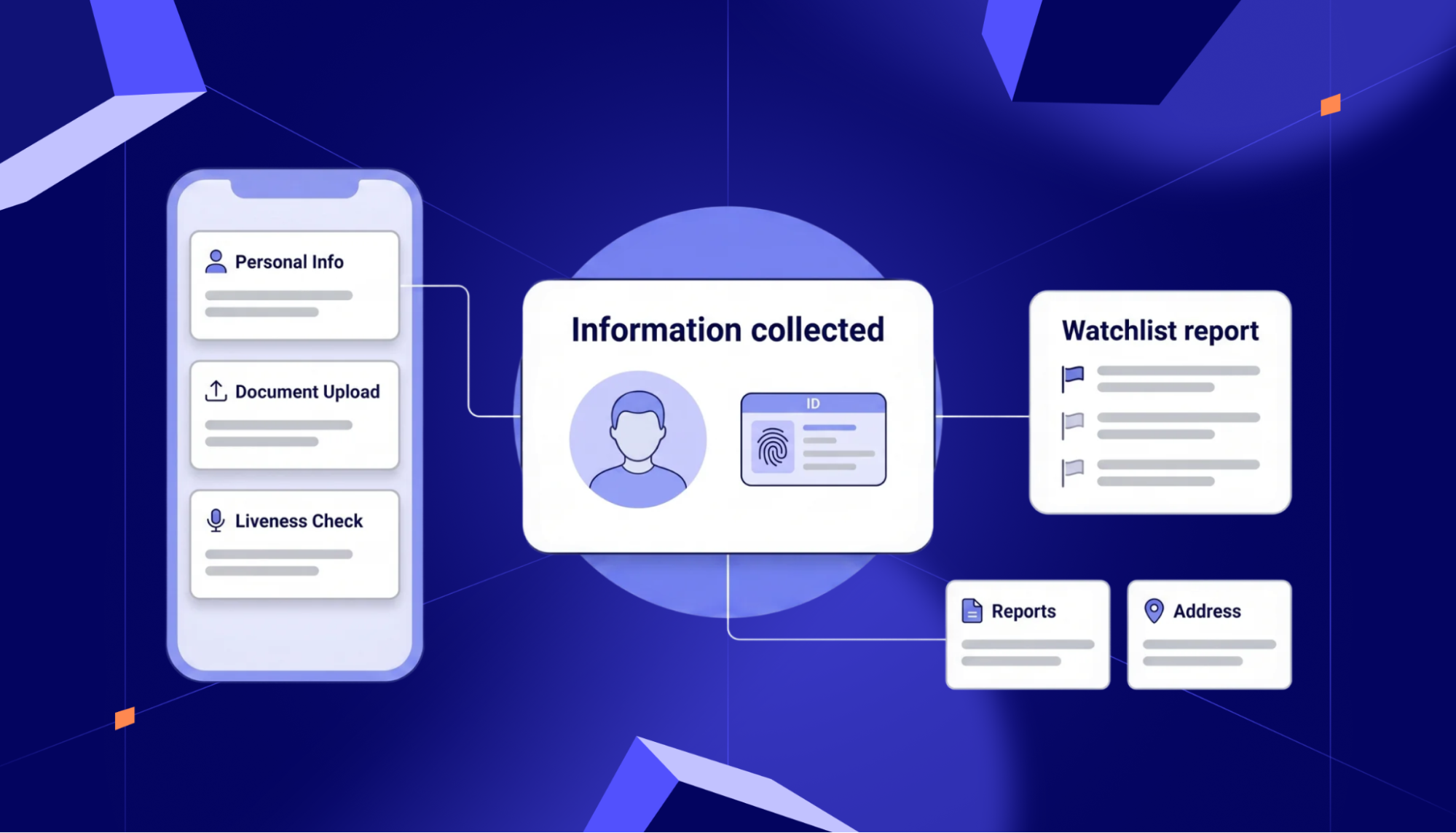
We cover the full lifecycle in KYB 101, so here is the short version. Collection: the business submits its details and documents. Verification: those claims get checked against registries and data sources. Risk scoring: verified data becomes a decision path. Review and decisioning: humans handle what needs judgment, with documentation. Monitoring: the profile stays under watch, because ownership, sanctions status, and registry standing all change after day one.
A business relationship runs through all five. A point-in-time check covers two.
How the Market Actually Sells It
Four kinds of vendors show up in most KYB evaluations.
Data vendors. Deep registry and firmographic data, delivered by API or file. Strong at stage two, silent on the rest. You build the collection flow, the scoring, the review queue, and the monitoring.
Identity checkers. Document and biometric verification, sometimes with a business lookup attached. Built for stage two of KYC, stretched to cover KYB.
Orchestration layers. A decision engine that routes between data vendors you contract with separately. Powerful if you already own the vendor relationships. It coordinates the stack, it is not the stack.
Case and workflow tools. Queues, assignments, and audit notes for stage four, expecting verification to arrive from somewhere else.
None of these are bad products. The problem is what happens between them, because that is where your team lives.
The Integration Tax
Stitching the slices together costs more than the invoices show. Each vendor is a contract, a DPA, a renewal, and a support relationship. The connections between them are glue code your engineers wrote, and the stack you stitched is a product you now maintain, with no roadmap and no support team. Analysts swivel between portals and paste findings from one system into another. And the audit trail, the thing a regulator actually asks for, lives in fragments: the data pull in one system, the decision in another, the monitoring alert in a third, reconciled by hand when the exam letter arrives.
Teams run this way for years. It works until volume grows, a market gets added, or an examiner asks a question that crosses three systems.
What Changes When the Lifecycle Is One System
Data flows forward instead of being re-entered. What the business submitted at collection is what verification checks, what scoring weighs, and what the reviewer sees, one record, not four copies.
Monitoring feeds back. A registry status change or a new watchlist hit does not open a fresh investigation from zero. It updates the existing profile, re-scores the risk, and lands in the same queue with the history attached.
One audit trail covers the whole story. When someone asks why a business was approved and what has been watched since, the answer is one timeline with sources and reasoning on every step.
Policy changes become configuration. A new rule updates the platform. It does not open an engineering ticket across three integrations.
How AiPrise Built It
AiPrise covers all five stages in a single API and dashboard: onboarding flows that adapt by country and entity type, verification against 200+ countries and 100+ data sources with 800+ business data points per entity, explainable risk scoring, review and case management with reasoning captured on every decision, and continuous monitoring of registry status, ownership, watchlists, and website signals. AI agents do the first pass on documents, websites, and screening hits. Straightforward checks complete in 3 to 5 minutes, and customers automate up to 80% of verification workflows.
The outcomes show up where the stitching used to be. Conduit cut business onboarding from 3 weeks to 72 hours running the lifecycle through one platform. BlindPay automated 90% of its KYC and KYB checks in its first month.
Pressure-Test Any End-to-End Claim
Five questions, and they work on us too:
- Where does collection happen? If the answer involves your own form and a file transfer, stage one is yours.
- Can a risk score change after onboarding without anyone re-running a check? If not, monitoring is a rerun button, not a stage.
- When policy changes, who does the work? Configuration means the platform owns the lifecycle. A statement of work means you do.
- Show one business's full audit trail. If it takes exports from more than one system, the lifecycle is stitched, whoever's logo is on it.
- What happens to a case the automation cannot decide? A real stage four has a queue, an owner, and reasoning captured, not an email.
For how the leading platforms compare on these, our top KYB providers breakdown does the side-by-side, with market-specific versions for the US and Canada.
Frequently Asked Questions
Is orchestration the same as a full-lifecycle platform?
No. Orchestration coordinates vendors you contract with separately, which solves routing and leaves you owning the stack: the contracts, the gaps, and the reconciliation. A lifecycle platform is the stack.
What is the difference between periodic review and ongoing monitoring?
Periodic review is calendar-driven: re-check every account every N months, which mostly means re-checking accounts where nothing changed. Monitoring is event-driven: the system watches continuously and surfaces the accounts where something actually happened.
Can you migrate to a lifecycle platform gradually?
Yes, and most teams do: verification first, then monitoring, then collection and review as contracts with incumbent vendors run out. The audit-trail benefit arrives in full once decisioning moves over.
See the Full Lifecycle Run
Bring one business you onboarded last quarter. We will run it end to end, collection through monitoring, and show you the single audit trail at the finish. Book a demo.
You might want to read these...



AiPrise
KYB Compliance: 2026 Regulations You Should Know About
As organizations expand globally and face tighter regulations, adherence to Know Your Business (KYB) standards has become one of the most critical compliance layers for fintech, online marketplaces, and other companies that need to verify business customers before letting them perform financial transactions.








.png)

.jpg)















.png)








.png)
.png)
.png)










.png)
.png)



AiPrise’s data coverage and AI agents were the deciding factors for us. They’ve made our onboarding 80% faster. It is also a very intuitive platform.

Head of Operations



See your full compliance picture in one place
Use AI agents and global data to review businesses and users faster and more accurately
