

10 min read
September 14, 2026
Best KYB Solutions for the US Market (2026)
Key Takeaways

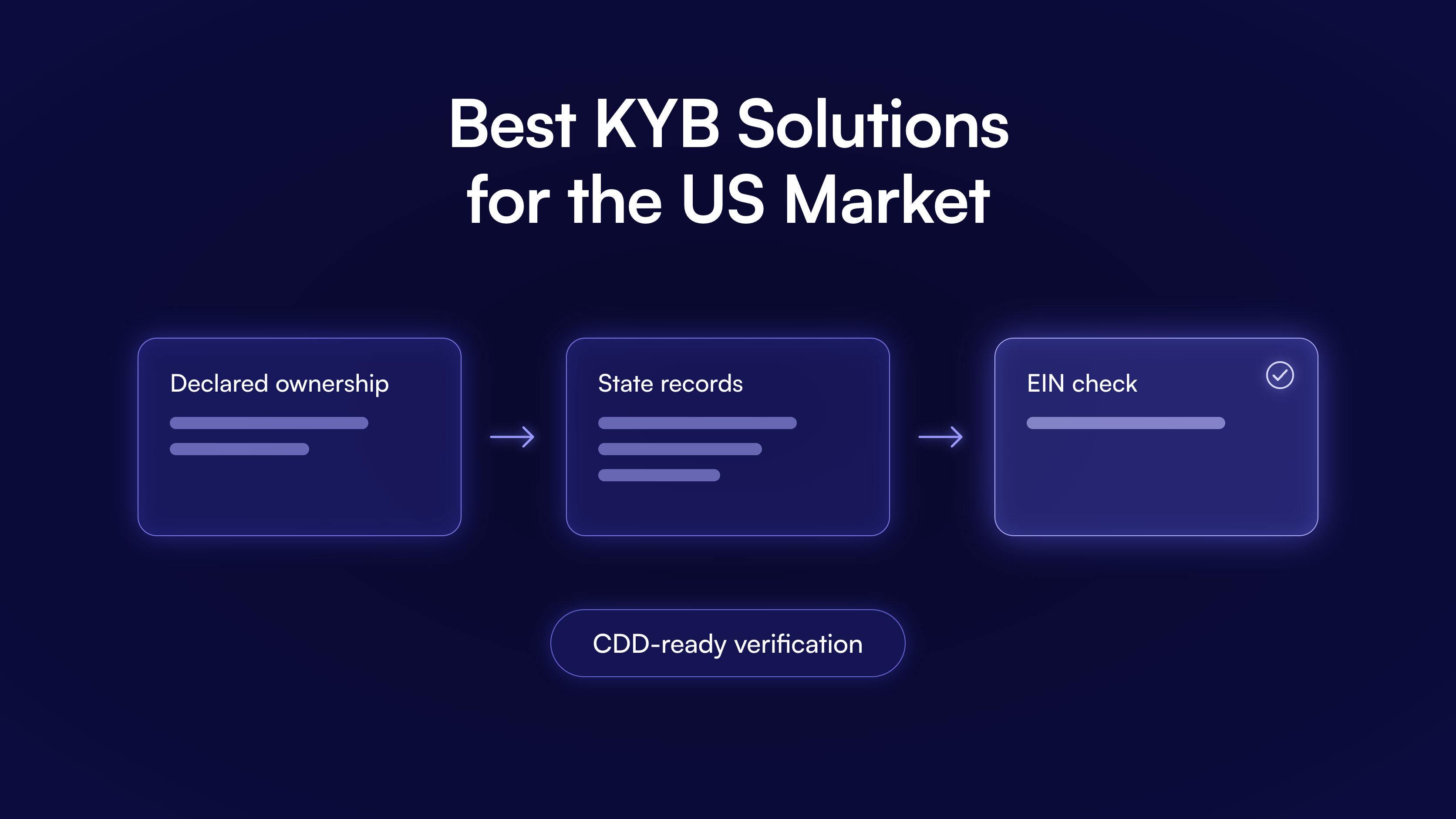
KYB in the US is anchored by the Bank Secrecy Act and FinCEN's Customer Due Diligence (CDD) Rule: identify beneficial owners at the 25% ownership threshold plus at least one individual who controls the company, regardless of ownership.
In August 2026, FinCEN permanently exempted US companies from beneficial ownership reporting. There is no federal ownership database to check, so the ownership picture is yours to build and verify.
The US has no federal business registry: verification means routing across 50+ state registries with wildly different data quality, plus EIN validation through the IRS.
Financial institutions' CDD obligations did not loosen with the BOI repeal, and sponsor banks are pushing KYB requirements onto every fintech they work with.
The best KYB solution for the US combines multi-state registry coverage, ownership construction without a government database, fraud signals beyond documents, and audit trails built for examiners and bank partners.
Why KYB in the US Is Its Own Problem
The US is the largest market most platforms onboard businesses from, and one of the trickiest to verify them in. Five reasons.
The CDD Rule has two prongs, and most content only mentions one. FinCEN's Customer Due Diligence Rule requires covered financial institutions to identify and verify beneficial owners of legal entity customers under an ownership prong (every individual with 25% or more equity) and a control prong (at least one individual with significant managerial control, like a CEO or CFO, regardless of ownership). A company with no 25% owner still has a beneficial owner under the rule. Programs built only around the 25% test have a compliance gap by design.
There is no federal ownership database, as of 2026, on purpose. In August 2026, FinCEN issued a final rule permanently exempting US companies from beneficial ownership reporting under the Corporate Transparency Act, and said it will delete previously reported domestic data. Only foreign companies registered to do business in the US remain in scope. The practical consequence: if you need to know who owns a US business, no government database will tell you. You build the picture yourself, from registry records, filings, and data sources, and you verify what the customer declares against it.
There is no federal business registry either. US companies incorporate state by state, through 50+ Secretary of State systems with different records, formats, data quality, and access. A Delaware C-corp, a Wyoming LLC, and a California sole proprietor leave completely different paper trails. Verifying "a US business" means routing to the right state and knowing what that state's record can and cannot tell you.
US business fraud is industrializing. EIN spoofing, shelf companies with clean-looking histories, and AI-manufactured businesses (registration-style documents, a website, invoices, and synthetic identities behind them) are all rising. Document review alone misses this class of fraud, because the documents are increasingly perfect. Catching it requires primary-source checks and cross-signal analysis: does the state record, the EIN, the website, and the ownership story agree.
Bank partners have become regulators of first resort. Every US fintech running on a sponsor bank inherits that bank's due diligence expectations, and after several years of consent orders in banking-as-a-service, those expectations are specific: documented KYB programs, defensible decisions, and audit trails on demand. Even businesses outside FinCEN's direct scope end up running examiner-grade KYB because their bank requires it.
What Changed in 2026, and What It Means for Your Program
The BOI repeal is the headline, but the operational takeaway is subtler: obligations on financial institutions did not move. The CDD Rule still requires identifying and verifying beneficial owners at account opening. What disappeared is the prospect of a government database to lean on. The US and Canada now sit at opposite poles, and if you onboard businesses in both, you are running two different programs: in Canada, verify against the public registry and reconcile discrepancies; in the US, construct and verify ownership yourself. We cover the mechanics in our US KYB walkthrough.
What to Look For in a KYB Solution for the US
Six criteria separate solutions built for the US from solutions that list it on a coverage page. If you are comparing beyond the US, our top KYB providers breakdown does the global side-by-side.
- Multi-state registry coverage. Direct reach into Secretary of State records across the states your businesses actually incorporate in, with routing logic per entity, not a single aggregated snapshot of unknown freshness.
- Ownership construction, not just collection. With no federal database, the platform must build the ownership picture from registry data, filings, and data sources, verify declared owners against it, and cover the control prong, not just the 25% test.
- EIN and identity validation. Employer Identification Number checks against IRS records, plus KYC on the humans behind the business, because a real company with a synthetic owner is still fraud.
- Fraud signals beyond documents. Website analysis, digital footprint, cross-entity patterns, and document forensics, because AI-manufactured businesses pass single-artifact checks.
- Entity-type flexibility. A Delaware C-corp, a single-member LLC, and a sole proprietor need different confirmation paths; one rigid flow produces false rejections at the thin end and false comfort at the top.
- Examiner-grade audit trails. Every decision documented with sources and reasoning, producible on demand, because both examiners and sponsor banks will ask.
The Best KYB Solutions for the US Market
| Provider | Known for | Fit for the US |
|---|---|---|
| AiPrise | Full-lifecycle KYB and KYC across 200+ countries with AI agents | Fintechs and platforms that need CDD-grade verification in the US and the same rigor in every other market |
| Alloy | Identity risk orchestration across multiple data vendors | US financial institutions orchestrating several data sources into one decision engine |
| LexisNexis Risk Solutions | Deep US public-records data and risk analytics | Large enterprises and banks anchored on incumbent US data depth |
| Persona | Configurable identity workflows with KYB and KYC combined | Product teams composing custom verification flows |
| Sumsub | All-in-one KYC, KYB, and AML verification flows | Crypto companies standardizing global onboarding |
1. AiPrise
AiPrise is the AI-powered global compliance platform: KYB, KYC, AML screening, and AI agents in a single API and dashboard, covering 200+ countries with 100+ data sources and 800+ business data points per entity. Three things make it the strongest fit for US verification specifically.
Post-BOI, the ownership picture is yours to build, and that is what the platform does. With no federal database to check, ownership verification in the US means constructing the picture from state records, filings, and data sources, then verifying what the applicant declared against it. AiPrise structures ownership across multi-layer entities from 800+ business data points, covers the control prong alongside the 25% ownership test, and runs KYC on every identified individual, so the output is a verified ownership picture, not a collected one.
Registry-first verification, with the routing the US actually requires. A document can be forged, but the state record either exists or it does not. AiPrise verifies against primary sources across US state registries, validates EINs, and then cross-checks the signals that manufactured businesses cannot fake in combination: does the registry record, the EIN, the website, and the ownership story agree. That cross-signal posture is what catches the fraud class that is currently growing fastest.
US platforms onboard globally, and the platform goes where they do. The moment a US fintech onboards a merchant in Mexico, a seller in Nigeria, or a partner in Singapore, the US-only vendor becomes the first of several. AiPrise covers the US and 200+ other markets through the same integration, which is why cross-border operators run on it: Bridge (a Stripe company) made onboarding decisions 80% faster running verification through AiPrise.
Operationally: straightforward KYB checks complete in 3 to 5 minutes, customers automate up to 80% of verification workflows, and AI agents do the first pass on documents, websites, and screening with audit-ready reasoning on every decision, which is what an examiner or a sponsor bank asks you to produce.
2. Alloy
Alloy orchestrates identity and risk decisions across many third-party data vendors and is well established with US banks and fintechs. It is strongest where a team wants one decision engine across several data sources it already trusts. The consideration: orchestration presumes vendor relationships to orchestrate, so verification depth depends on which data partners you connect, and total cost includes those underlying contracts.
3. LexisNexis Risk Solutions
LexisNexis brings decades of US public-records depth and risk analytics, and remains a default at large banks and enterprises. The consideration: it is an enterprise data and analytics stack more than a modern onboarding platform, so integration weight, contract structure, and workflow build-out are significant, and global business verification outside the US is not its center of gravity.
4. Persona
Persona offers highly configurable identity infrastructure where teams compose their own verification flows, combining business and individual checks with strong developer ergonomics. The consideration: the US specifics (state registry routing, control-prong coverage, EIN validation) are yours to configure and validate rather than defaults you inherit.
5. Sumsub
Sumsub packages KYC, KYB, and AML into configurable onboarding flows with a single dashboard, a common choice for crypto companies standardizing global verification. The consideration: the US is covered as part of a broad global footprint rather than as a specialization, so state-level registry depth and CDD-specific mechanics deserve close inspection in an evaluation.
How to Run the Evaluation
Test with real US entities, not demo data: one Delaware C-corp with layered ownership, one single-member LLC formed in the last 90 days, one sole proprietor, and one foreign company registered in a US state (the one category still in BOI scope). Measure four things: did the platform find the right state record, did it produce a verified ownership picture including the control-prong individual, how much manual work remained, and what does the audit trail look like when you are done. The brand-new LLC and the sole proprietor are the cases that break single-flow platforms, and they are most of what high-volume platforms actually onboard.
Frequently Asked Questions
Is KYB legally required in the US?
For banks and covered financial institutions, yes, under the BSA and FinCEN's CDD Rule. For fintechs and platforms outside direct scope, KYB is typically required by sponsor banks and payment partners, and prudent regardless.
Do US companies still have to file beneficial ownership reports with FinCEN?
No. As of the August 2026 final rule, US companies are permanently exempt from BOI reporting under the Corporate Transparency Act. Only foreign companies registered to do business in the US remain in scope. Financial institutions' own duty to identify and verify beneficial owners under the CDD Rule is unchanged.
What is the beneficial ownership threshold in the US?
The CDD Rule uses two prongs: every individual owning 25% or more of the entity, plus at least one individual who exercises significant managerial control, regardless of ownership.
How do you verify a business's EIN?
EINs are validated against IRS records through TIN-matching, typically via a verification platform, since EINs are not publicly searchable. An EIN that does not match the legal name on file is one of the most common early fraud signals in US onboarding.
Verify US Businesses With AiPrise
AiPrise verifies businesses across all 50 states and 200+ markets beyond through one API: registry-first checks, ownership construction covering both CDD prongs, EIN validation, screening, continuous monitoring, and AI agents doing the first pass with audit-ready reasoning on every decision. Book a demo to see a US entity verified end to end.
You might want to read these...



AiPrise
KYB Compliance: 2026 Regulations You Should Know About
As organizations expand globally and face tighter regulations, adherence to Know Your Business (KYB) standards has become one of the most critical compliance layers for fintech, online marketplaces, and other companies that need to verify business customers before letting them perform financial transactions.








.png)

.jpg)














.png)







.png)
.png)
.png)











.png)
.png)



AiPrise’s data coverage and AI agents were the deciding factors for us. They’ve made our onboarding 80% faster. It is also a very intuitive platform.

Head of Operations



See your full compliance picture in one place
Use AI agents and global data to review businesses and users faster and more accurately
