

AiPrise
9 min read
January 29, 2026
Identity Verification Match Rates and Metrics Explained
Key Takeaways

When identity verification match rates drop, fraud slips through, genuine users fail onboarding, and your compliance decisions become harder to justify. Modern digital onboarding demands accuracy and speed, yet poor match metrics often leave legitimate users frustrated and compliance teams overwhelmed.
In the United States, enhanced identity verification efforts have helped prevent over $1 billion in federal student aid fraud since January 2025, highlighting how bad actors exploit weak verification systems. Measuring match rates accurately empowers you to balance fraud risk with customer experience rather than guessing what works.
When match metrics are misinterpreted, you may incur higher operational costs and increased regulatory scrutiny without realizing it. Gaining clarity on these metrics helps your team reduce false rejects, improve approval accuracy, protect revenue, and enhance trust across digital interactions.
Quick Overview
- Identity verification match rates measure how often submitted identity data correctly matches authoritative records during onboarding checks.
- False matches increase fraud losses, while false non-matches reject legitimate users and lower approval conversion.
- Pass rate and accuracy reveal how verification friction, data quality, and thresholds affect onboarding outcomes.
- Consistent improvement depends on clean input data, risk-based thresholds, multi-attribute checks, and ongoing metric review.
What Are Match Rates in Identity Verification?
Identity verification match rates measure how often submitted identity data successfully matches trusted databases, documents, or authoritative records during verification. A high match rate indicates that customer information aligns accurately with verified sources, reducing onboarding friction and fraud exposure. Understanding this metric helps you evaluate verification performance, optimize approval decisions, and maintain regulatory compliance without sacrificing customer experience.
Why Match Rates in Identity Verification Matter?
This section explains why identity verification match rates play a critical role in protecting revenue, ensuring compliance, and sustaining scalable growth.
Here are the key reasons match rates deserve close attention across regulated onboarding and risk workflows.
- Strong match rates improve onboarding efficiency by reducing manual reviews and accelerating customer approvals.
- Accurate match rates help prevent fraud by limiting unauthorized access and reducing downstream financial losses.
- Consistent match performance supports regulatory compliance by demonstrating reliable and auditable verification decisions.
- Balanced match rates protect customer experience by minimizing unnecessary rejections and onboarding abandonment.
- Improved match rates lower operational costs by decreasing support escalations and compliance intervention workloads.
- Reliable match metrics enable data-driven risk strategies aligned with evolving fraud patterns and regulatory expectations.
Also read: Online Identity Verification Methods: 7 Different Types
Knowing why match rates matter sets the stage for understanding how these figures are calculated and interpreted in day-to-day operations.

Match Rate Calculations Explained
This section explains how identity verification match rates are calculated and why consistent calculation methods matter for reliable business decisions.
Here is how match rate calculations work in practice and what you should evaluate while interpreting the results.
How Match Rates Are Calculated
- Match rate is calculated by dividing successful identity matches by total verification attempts within a defined onboarding period.
- Only verifications meeting predefined data, document, or database confidence thresholds should be counted as successful matches.
- Calculations must be segmented by geography, data source, and verification type to avoid misleading performance conclusions.
Match Rate Calculation Example
- If you process 10,000 identity verification attempts and 8,500 meet verification confidence thresholds, the match rate equals 85%.
- When calculated separately, document verification may show higher match rates than biometric or database checks due to data consistency differences.
- Segmenting this example by region or user type helps you identify whether match rate drops stem from fraud attempts or data quality gaps.
Match rates alone don’t tell the full story, which is why teams rely on additional metrics to assess verification performance accurately.
Key Identity Verification Metrics You Should Track
This section breaks down the most important identity verification metrics that influence fraud risk, compliance accuracy, and onboarding performance across regulated industries.
Here are the core metrics you should consistently track to evaluate verification effectiveness and make data-driven risk decisions in the U.S. market.
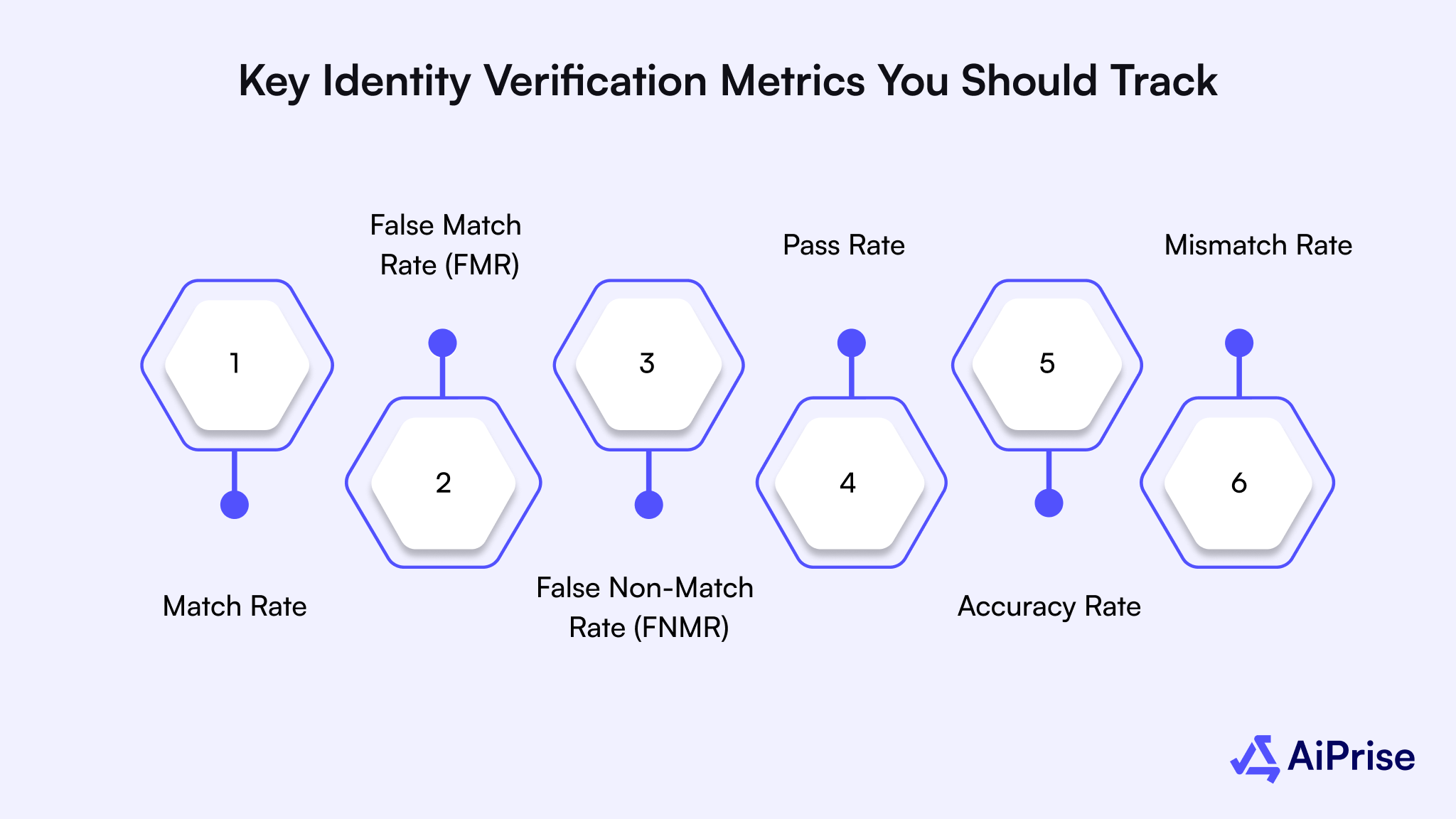
Match Rate
- Match rate measures how often submitted identity data successfully aligns with trusted databases, documents, or authoritative U.S. records.
- A strong match rate indicates reliable data sources, optimized verification logic, and smoother customer onboarding experiences.
- Low match rates often signal poor data quality, outdated records, or verification thresholds misaligned with real-world user behavior.
False Match Rate (FMR)
- False match rate represents how often fraudulent or incorrect identities are mistakenly approved as valid matches.
- High FMR increases exposure to financial crime, regulatory penalties, and downstream fraud losses.
- Monitoring FMR helps you fine-tune verification thresholds without compromising security or compliance obligations.
False Non-Match Rate (FNMR)
- False non-match rate tracks how often legitimate users are incorrectly rejected during identity verification checks.
- Elevated FNMR leads to onboarding drop-offs, customer dissatisfaction, and lost revenue opportunities.
- Reducing FNMR requires balancing risk tolerance with user experience, especially in high-volume onboarding environments.
Pass Rate
- The pass rate shows the percentage of users who successfully complete the full identity verification process.
- This metric reflects the combined impact of match accuracy, document acceptance, and overall verification flow design.
- Declining pass rates often indicate excessive friction, unclear instructions, or overly strict validation rules.
Accuracy Rate
- Accuracy rate measures how effectively the verification system correctly identifies both legitimate users and fraudulent attempts.
- High accuracy depends on managing false matches and false rejections together rather than optimizing a single metric.
- Tracking accuracy over time helps you assess system reliability as fraud patterns and regulatory expectations evolve.
Mismatch Rate
- Mismatch rate highlights how frequently submitted identity attributes fail to align with verified or expected records.
- Common causes include outdated address data, formatting inconsistencies, or incomplete user submissions.
- Persistent mismatches increase manual review costs and slow onboarding, especially for U.S. compliance-driven industries.
Also read: What Is Business Identity Verification?
Once these metrics are tracked consistently, the next step is understanding how they directly influence measurable business results.
How Do Identity Verification Metrics Affect Business Outcomes?
This section connects identity verification metrics to specific business KPIs, showing how measurement quality directly impacts growth, risk, and compliance performance.
Here is how these metrics influence concrete outcomes across onboarding efficiency, fraud losses, regulatory exposure, and operational costs.
- Higher match rates shorten onboarding time, increase approval throughput, and directly improve customer acquisition costs across regulated digital channels.
- Lower false match rates reduce downstream fraud incidents, chargebacks, and remediation expenses tied to regulatory investigations and financial crime reviews.
- Reduced false non-match rates prevent unnecessary customer drop-offs, protecting conversion rates and long-term revenue from legitimate applicants.
- Optimized pass rates signal friction-balanced verification flows that satisfy compliance requirements without inflating abandonment or support ticket volumes.
- Strong accuracy rates strengthen audit defensibility by proving consistent, explainable decisions during regulatory examinations and internal risk assessments.
- Lower mismatch rates cut manual review workloads, operational overhead, and onboarding delays caused by data quality inconsistencies or outdated records.
Interpreting outcomes becomes more practical when you can compare your numbers against commonly observed industry ranges.
Identity Verification Match Rate Benchmarks and What They Indicate
This section provides practical benchmark ranges to help you interpret identity verification metrics and identify potential risk or performance gaps.
Here are commonly observed benchmark ranges and what they typically signal for business outcomes in regulated environments.
Also read: Understanding Electronic Identity Verification (eIDV)
Benchmarks provide direction, but improving results depends on applying the right operational practices consistently.
Best Practices to Improve Match Rates
This section outlines practical, proven actions that help you improve identity verification match rates without increasing fraud or onboarding friction.
Here are the best practices that directly address data quality, user experience, and verification logic effectiveness.
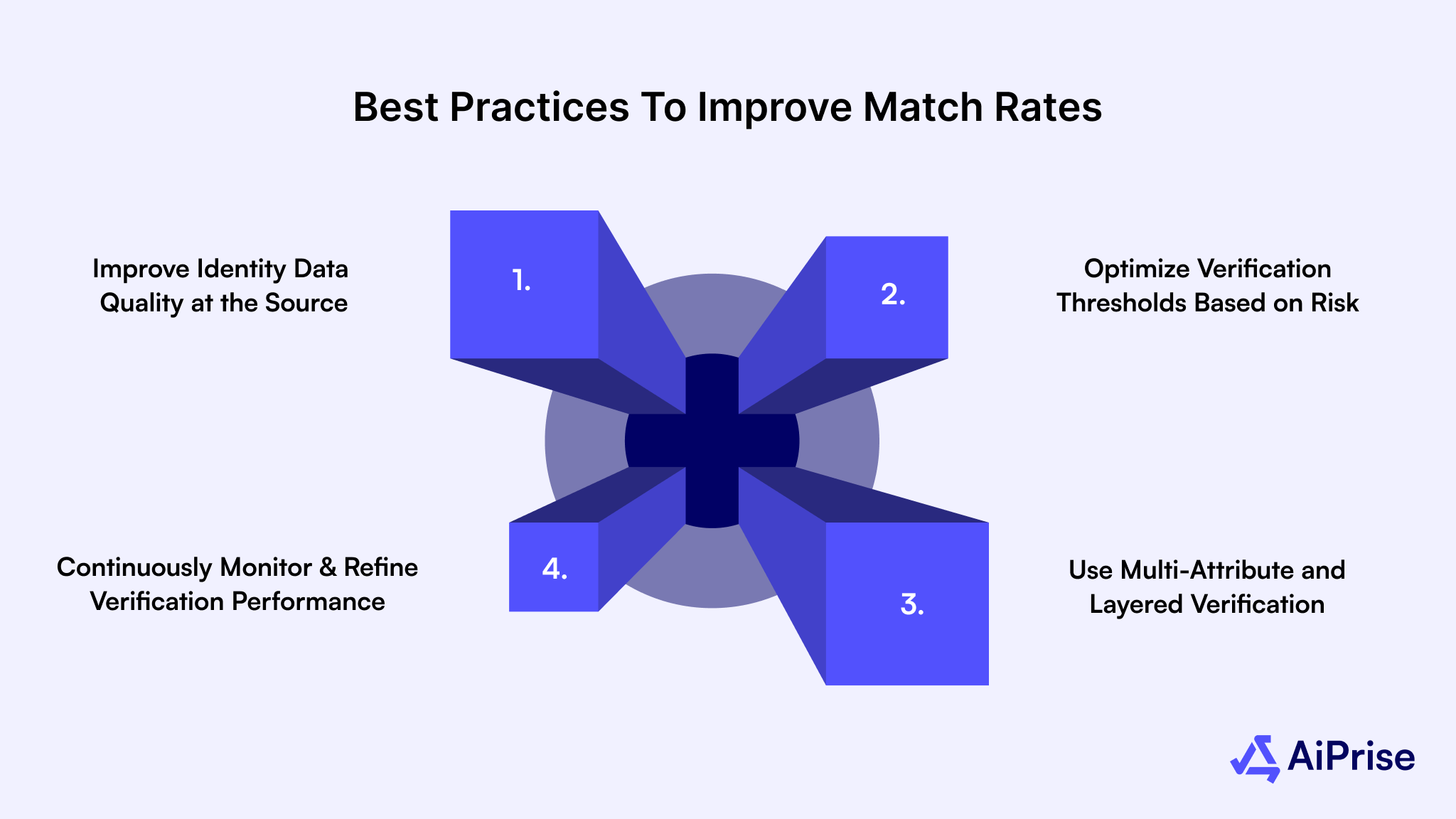
1. Improve Identity Data Quality at the Source
Accurate match rates begin with clean, standardized user inputs collected through well-designed onboarding forms and validation rules. Inconsistent formats, outdated addresses, or incomplete fields significantly reduce successful matches across authoritative verification databases. Improving data capture reduces rework, lowers mismatch rates, and strengthens overall verification reliability.
2. Optimize Verification Thresholds Based on Risk
Overly strict thresholds increase false rejections, while lenient thresholds raise fraud exposure and regulatory risk. Adjusting thresholds based on customer segment, geography, and transaction value improves match rates without compromising compliance. Risk-based calibration allows you to balance security requirements with smoother onboarding experiences.
3. Use Multi-Attribute and Layered Verification
Relying on a single identity attribute limits accuracy and creates blind spots in verification decisions. Combining document checks, database validation, and biometric signals improves confidence in identity matches. Layered verification increases match reliability while reducing dependence on any single data source.
4. Continuously Monitor and Refine Verification Performance
Match rates change as fraud patterns, user behavior, and data sources evolve over time. Ongoing performance monitoring helps you identify metric drift before it impacts onboarding or compliance outcomes. Regular refinement ensures your verification process remains accurate, efficient, and aligned with regulatory expectations.
Applying these practices becomes easier when supported by verification systems designed to measure and improve performance continuously. With AiPrise, you improve match rates using AI-driven verification, automated risk controls, and compliance-ready workflows across onboarding.
How AiPrise Helps with Identity Verification Metrics?
AiPrise enables you to improve identity verification performance by increasing match accuracy, reducing errors, and maintaining consistent compliance outcomes at scale.
Here is how AiPrise supports stronger identity verification metrics across regulated onboarding and risk workflows.
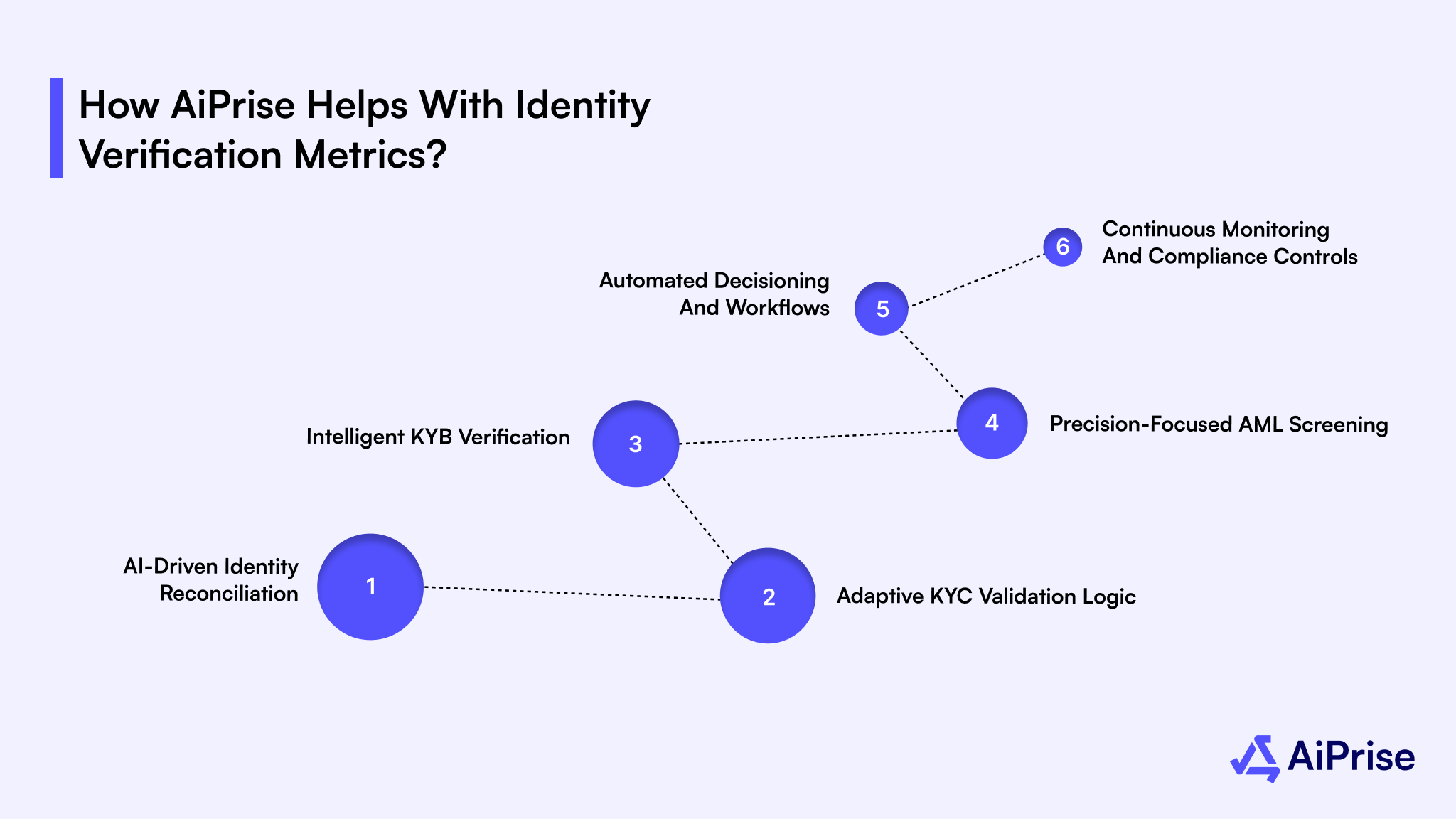
- AI-driven identity reconciliation improves match rates by resolving data inconsistencies across documents, databases, and digital signals.
- Adaptive KYC validation logic lowers false non-match rates by accounting for real-world data variations without weakening verification confidence.
- Intelligent KYB verification strengthens business identity accuracy by validating entities, ownership, and risk indicators across authoritative sources.
- Precision-focused AML screening reduces false match rates by filtering irrelevant alerts and prioritizing genuinely high-risk identities.
- Automated decisioning and workflows improve pass rates by minimizing manual reviews and accelerating compliant onboarding outcomes.
- Continuous monitoring and compliance controls help maintain stable verification metrics as fraud patterns and regulatory requirements evolve.
This brings the discussion to how a dedicated verification platform supports better metric control across compliance workflows.
Wrapping Up
Understanding identity verification match rates empowers you to reduce fraud exposure, improve onboarding decisions, and strengthen compliance confidence across operations. When you track the right metrics correctly, you gain clarity that helps balance customer experience, risk tolerance, and regulatory expectations. AiPrise helps you optimize these identity verification metrics through intelligent automation, accurate matching, and compliance-ready verification workflows.
Book A Demo to see how improving identity verification match rates can directly enhance approval accuracy, reduce risk, and streamline onboarding.
FAQs
1. What is a good identity verification match rate?
A good identity verification match rate typically falls above ninety percent, indicating reliable data quality and effective verification processes.
2. How is the identity verification match rate calculated?
Identity verification match rate is calculated by dividing successful identity matches by total verification attempts within a defined timeframe.
3. Does a higher match rate always mean lower fraud risk?
A higher match rate alone does not guarantee lower fraud risk without balanced false match and false non-match controls.
4. Why do identity verification match rates vary by region?
Match rates vary by region due to differences in data availability, document standards, and authoritative database coverage.
5. How can businesses improve low identity verification match rates?
You can improve low match rates by enhancing data quality, optimizing thresholds, and using layered verification methods consistently.
You might want to read these...











AiPrise
6 min read
KYB Compliance: 2026 Regulations You Should Know About
As organizations expand globally and face tighter regulations, adherence to Know Your Business (KYB) standards has become one of the most critical compliance layers for fintech, online marketplaces, and other companies that need to verify business customers before letting them perform financial transactions.









.png)

.jpg)














.png)








.png)
.png)
.png)















AiPrise’s data coverage and AI agents were the deciding factors for us. They’ve made our onboarding 80% faster. It is also a very intuitive platform.

Head of Operations



See your full compliance picture in one place
Use AI agents and global data to review businesses and users faster and more accurately
