

AiPrise
8 min read
December 18, 2025
Role Of ACRA Incorporation In Singapore Business Verification

Key Takeaways

Starting a business in Singapore sounds exciting, but have you considered the legal hoops you must clear first? Without proper registration, you risk fines, delays, or even rejection of your business operations.
That’s where an ACRA incorporation comes in. It’s more than just paperwork. It gives your company legal recognition, allowing you to open bank accounts, sign contracts, and operate confidently within Singapore’s regulatory framework.
In this blog, we break down everything you need to know about ACRA incorporation, from registration requirements to key filings. Read along to learn these essentials and keep your business compliant and confident from day one.
Key Takeaways:
- ACRA incorporation legally registers your business in Singapore, providing recognition, credibility, and operational authority.
- ACRA’s core functions include business registration, compliance oversight, accounting standards, and public information access.
- Obtain a Certificate of Incorporation through BizFile+, with electronic, hard, or certified copies available for official use.
- Filing requirements involve submitting annual returns, financial statements, and updating company details to stay compliant.
- Verify your Certificate of Incorporation using PDF QR codes, OpenAttestation files, or the BizFile+ portal for authenticity.
What Is ACRA And How Does It Work?
If you work with Singapore-based clients or partners, you’ll come across ACRA often. It stands for the Accounting and Corporate Regulatory Authority.
ACRA is Singapore’s national regulator for businesses, public accountants, and corporate service providers. It keeps the country’s corporate environment organized, transparent, and easy to verify, which matters a lot when you’re running KYC, KYB, or AML checks.
What ACRA Handles:
- Registers and records all new businesses
- Maintains Singapore’s official corporate database
- Oversees annual filings and statutory updates
- Monitors compliance with company and accounting laws
- Regulates public accountants and sets accounting standards
- Provides verified business information for risk checks
Now that you know what ACRA does, let’s look at why one of its core documents plays such a big role in risk checks.
Also Read: How to Spot a Fake Singapore Company: A Guide to Identifying Business Scams
Why Does The Certificate Of Incorporation Matter In Singapore?
The ACRA incorporation acts as the official proof that a company is legally formed. Without it, most institutions won’t complete onboarding or approve any type of financial activity. Here’s why it’s important:
Since the certificate depends on proper registration, let’s see who actually needs to register with ACRA.

Who Must Register Their Business With ACRA?
Starting a business in Singapore involves meeting clear rules, and one of the first is ACRA registration. If you plan to conduct any form of commercial activity in the country, registration usually becomes mandatory.
You must register if you’re running:
- A sole proprietorship: When you're operating the business alone under your own name or a trade name.
- A partnership or LLP: When two or more people run a business together, with LLPs offering limited liability protection.
- A private or public company: A separate legal entity where ownership is divided into shares and liability is limited.
Registration gives the business legal recognition and a Unique Entity Number (UEN), which is required for most regulatory and financial activities.
Ensure every director, shareholder, and partner is verified before registration. AiPrise helps you confirm identities and compliance quickly, reducing risk and simplifying your ACRA incorporation process.
ACRA’s Core Functions For Business Owners In Singapore
When your company is active in a regulated industry, you rely on clear and predictable oversight. ACRA provides this by managing several core responsibilities that keep Singapore’s business environment structured and transparent.
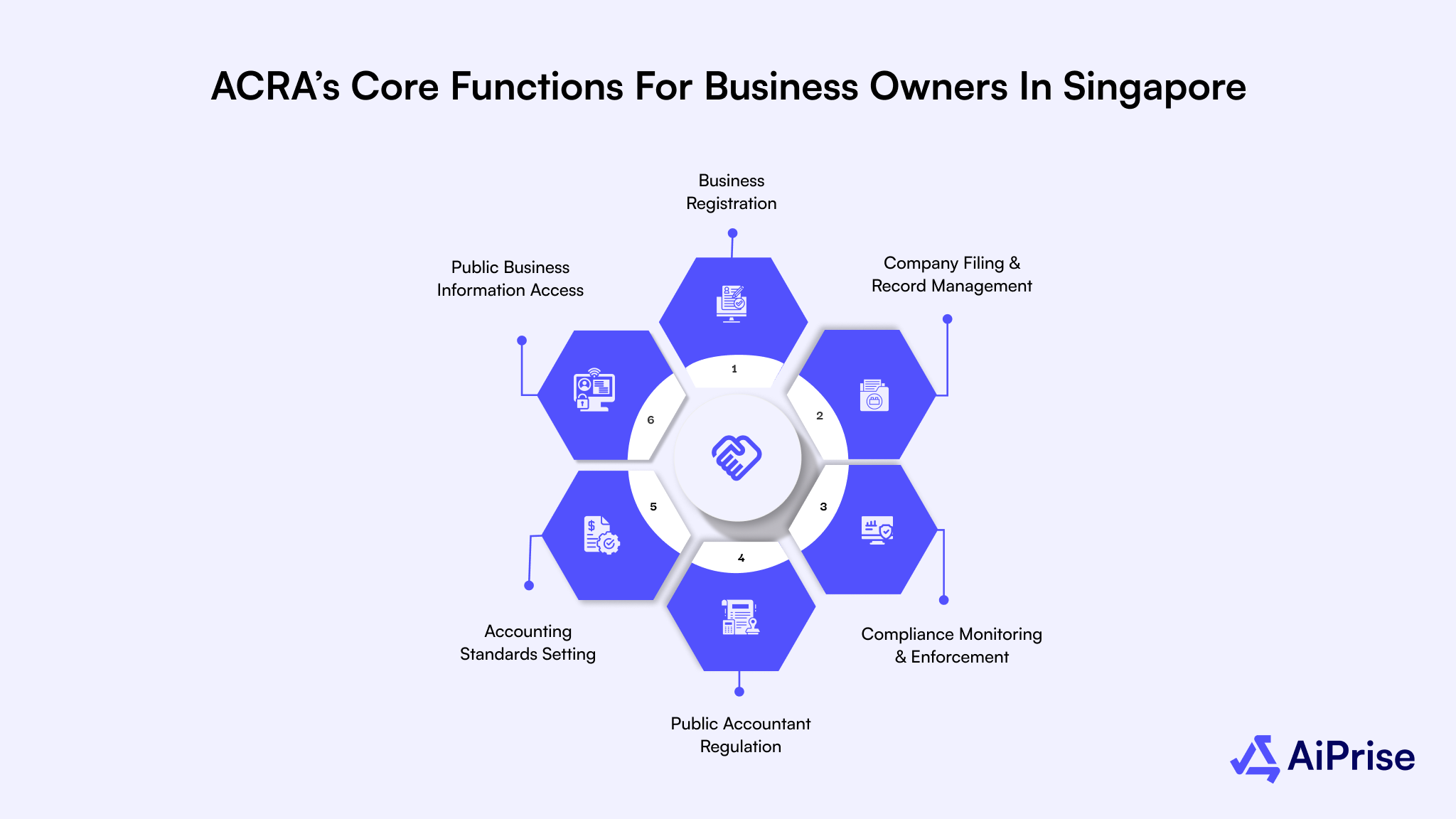
Here are its main functions:
- Business Registration
ACRA registers new entities through BizFile+ and provides each business with a Unique Entity Number. This UEN becomes your official identifier for banking, invoicing, and government transactions.
- Company Filing & Record Management
It oversees essential filings such as annual returns, shareholder updates, and director changes. This ensures your company’s information stays accurate and publicly accessible.
- Compliance Monitoring & Enforcement
ACRA enforces the Companies Act and takes action when businesses fail to meet regulatory requirements. This keeps the corporate landscape fair and reduces risks for stakeholders.
- Public Accountant Regulation
It regulates the licensing and quality standards of public accountants. This ensures financial reporting remains trustworthy and consistent across Singapore.
- Accounting Standards Setting
ACRA develops and implements national accounting and auditing standards. These standards help companies maintain transparent and comparable financial statements.
- Public Business Information Access
ACRA provides verified company data for due diligence, business verification, and onboarding. Businesses rely on this information to assess credibility and reduce operational risks.
For onboarding teams, ACRA’s data helps confirm company structure, filing history, and legitimacy, all of which matter for risk assessments.
What Details Are Listed In The Certificate Of Incorporation?
When you receive a Certificate of Incorporation in Singapore, it’s more than just a piece of paper. It’s your company’s official proof of registration and compliance, and it contains key details that are crucial for verification, banking, and business operations. Here’s what you’ll typically find:
- Company Name: The official name as registered with ACRA. This is how clients, partners, and authorities recognize your business.
- Unique Entity Number (UEN): A unique identifier for your business used in all official transactions with government agencies.
- Date of Incorporation: The exact date your company was officially registered, important for anniversaries and regulatory records.
- Former Company Names: If your business has changed names, up to five previous names may be listed for transparency.
- Company Structure: Details whether your company is a private limited, public limited, or limited liability partnership, determining your legal obligations.
Now that you understand the essentials of the certificate, let’s see how to actually obtain one so your business can start operating legally.
How Can You Obtain A Certificate Of Incorporation In Singapore?
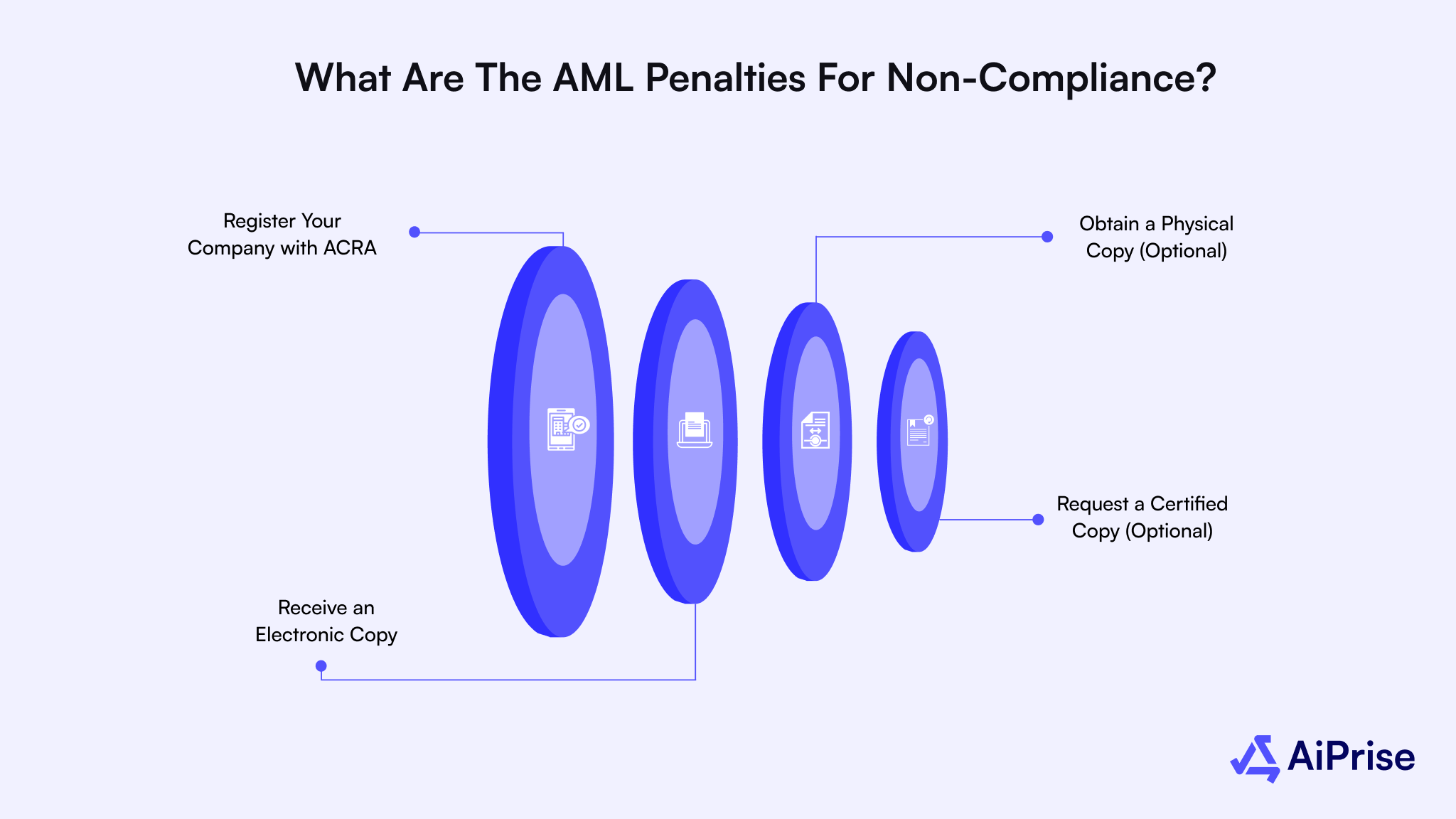
Obtaining a Certificate of Incorporation is straightforward if you follow the proper steps. The process uses ACRA’s digital portal and includes options for electronic, physical, and certified copies. Here’s a practical guide to get you started.
Step 1: Register Your Company with ACRA
- Use the BizFile+ portal to submit your application.
- Provide proposed company name, structure, directors, shareholders, and registered office address.
- Pay the registration fee to complete the application.
Step 2: Receive an Electronic Copy
- ACRA issues a PDF version of the certificate by email.
- This electronic certificate is sufficient for most purposes, such as opening bank accounts or contracts.
Step 3: Obtain a Physical Copy (Optional)
- Request in-person collection at ACRA or opt for postal delivery.
- While optional, it’s useful for official presentations or legal formalities.
Step 4: Request a Certified Copy (Optional)
- Certified copies are officially verified and signed, suitable for government filings or international transactions.
- Download e-certified copies instantly or request physical delivery via BizFile+ for a fee.
Once your certificate is in hand, it’s important to keep up with ACRA’s filing requirements to stay compliant and avoid penalties.
Also Read: Understanding UBO Registry And Beneficial Ownership Compliance
ACRA Filing Requirements For Businesses
Staying on top of ACRA’s filing requirements is essential for compliance, transparency, and maintaining trust with partners, regulators, and financial institutions. Here’s how the requirements break down:
Information and Documents
ACRA requires companies to submit specific information and supporting documents to ensure accurate registration and reporting.
- Financial statements: Up-to-date statements for regulatory compliance.
- Company information: Business activities, registered office, and director details.
- Personal information: Names, identification numbers, and details of directors and shareholders.
- Annual returns: Mandatory submissions covering company updates and financials.
Compliance Requirements
Companies must meet certain statutory obligations to operate legally and maintain credibility.
- Company registration: Complete ACRA registration to establish legal presence.
- Disclosure updates: Notify ACRA of changes in structure, directors, or business activities.
- Financial reporting: Submit accurate statements as per ACRA standards.
- Data protection: Follow regulations for safeguarding personal information.
ACRA Fees and Penalties
Failing to comply with ACRA’s rules can result in fees or penalties.
- Service fees: Charges for annual returns, updates, and name reservations.
- Penalties for non-compliance: Fines, suspension, or removal from the corporate register.
- Avoid risks: Timely filings prevent operational and reputational setbacks.
Understanding these obligations is key, but how can you verify that your certificate is authentic? Let’s break that down.
How Do You Verify A Certificate Of Incorporation?
Verifying your certificate ensures you’re working with an authentic document issued by ACRA and not a counterfeit, protecting your business from compliance risks.
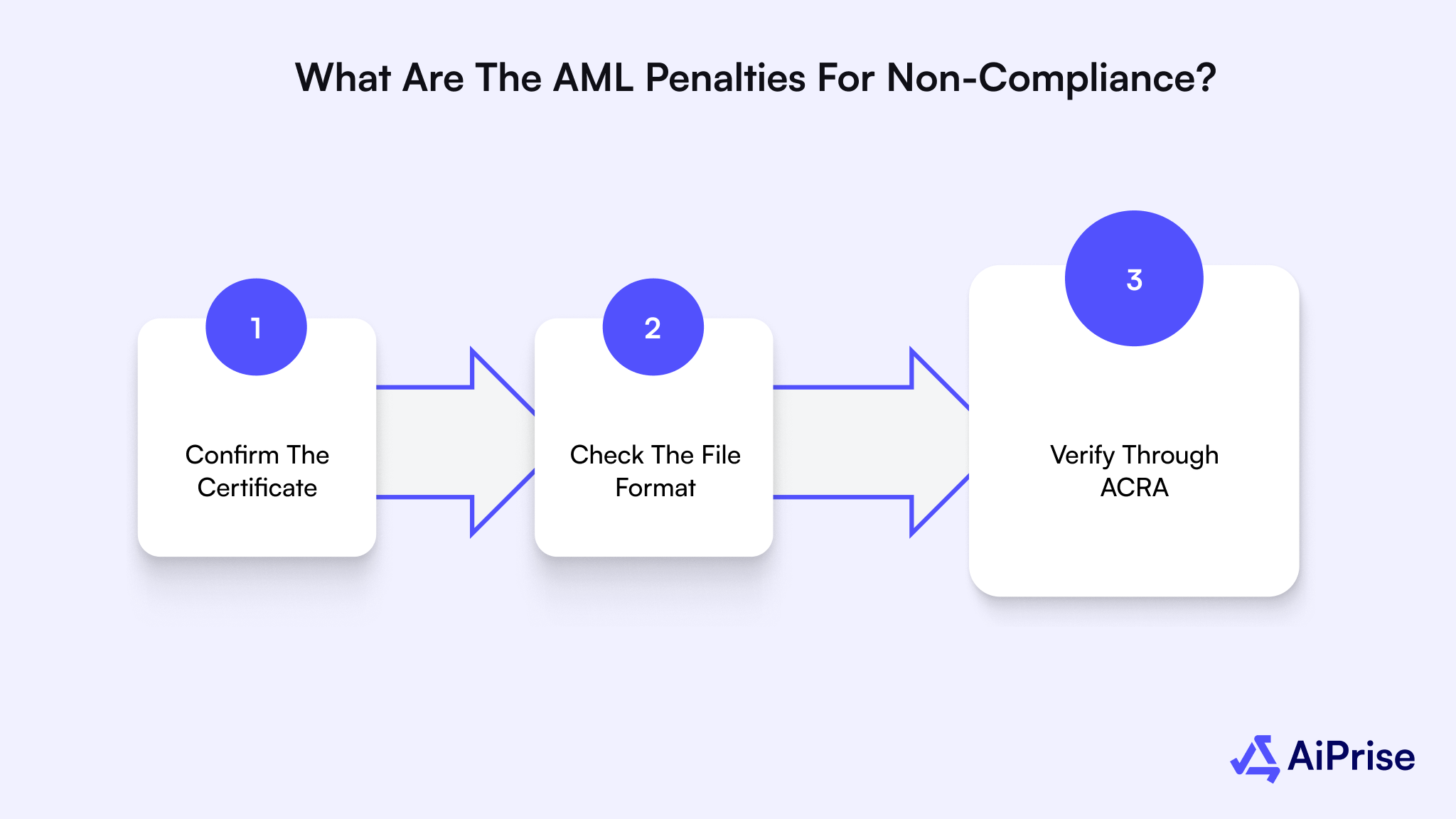
Step 1: Confirm the Certificate
- Ensure the certificate includes the company name, UEN, and incorporation date.
- Missing information or an unofficial format is a red flag.
Step 2: Check the File Format
- All certificates issued via BizFile+ come in PDF and OpenAttestation (OA) formats.
- Ensure the PDF has a QR code and verification link, and the OA file is available.
Step 3: Verify Through ACRA
- Scan the QR code or use the verification link in the PDF.
- Upload the OA file to BizFile+ to confirm the certificate’s authenticity.
Following these steps protects your business, ensures regulatory compliance, and maintains credibility with partners.
Also Read: Guidelines For Beneficial Ownership And UBO Reporting
How AiPrise Supports Smarter ACRA Proof And Verification
Verifying company information and ACRA incorporation can be complex, especially when regulatory compliance is crucial. AiPrise makes this process seamless, helping you confirm authenticity and reduce risk efficiently.
Our platform is built for financial institutions, payment providers, crypto platforms, and other sectors that rely on accurate business verification.
Key features:
- Global KYB Verification: Validate company names, UEN, directors, and ownership worldwide.
- Document Authenticity Checks: Ensure certificates and business records match official registries.
- Continuous Monitoring: Stay updated on ownership, structure, and compliance changes automatically.
- Fraud & Risk Detection: Spot high-risk entities before onboarding or engaging in transactions.
With AiPrise, verifying business credentials and ensuring compliance becomes effortless, giving your team confidence in every transaction.
Final Thoughts
Understanding acra incorporation helps you see how Singapore recognizes businesses and why the Certificate of Incorporation matters for compliance-heavy industries. It’s a key document that supports trust, clarity, and proper onboarding.
When you know how ACRA works, it becomes easier to assess business legitimacy, verify ownership, and detect gaps before they turn into risks. Clear processes mean stronger decisions and smoother operations for your team.
For added confidence, AiPrise helps you verify company records, monitor updates, and maintain compliance effortlessly. Book A Demo today to simplify your verification process and protect your business.
FAQs
1. What is the purpose of ACRA?
ACRA regulates companies, public accountants, and corporate service providers in Singapore. It ensures compliance with corporate laws and promotes a trusted, transparent business environment.
2. What is the difference between ACRA and BizFile+
ACRA is the regulatory authority, while BizFile+ is its online platform for company registration, filings, and accessing official business records.
3. Is ACRA only in Singapore?
Yes, ACRA operates exclusively in Singapore as the national authority for corporate regulation and business registration.
4. What are the minimum requirements for Company Incorporation in Singapore?
You need at least one resident director and a local business address. A company secretary must be appointed within six months. Moreover, at least one shareholder is required, along with the company details submitted to ACRA.
You might want to read these...





.png)



AiPrise’s data coverage and AI agents were the deciding factors for us. They’ve made our onboarding 80% faster. It is also a very intuitive platform.

Head of Operations



See your full compliance picture in one place
Use AI agents and global data to review businesses and users faster and more accurately
