

AiPrise
17 min read
December 17, 2025
Identity Verification Protocols in 2026: Everything Enterprises Need

Key Takeaways

Identity verification is no longer a back-office checkbox; it’s become a front-line shield for every business that operates online. In 2024 alone, there were an estimated 75 billion identity verification checks worldwide, and that number is expected to climb even higher in 2026 as fraud and compliance demands increase.
If you are responsible for risk, compliance, customer onboarding, or platform security, you already know the stakes: a weak verification protocol can expose you to financial loss, regulatory penalties, and reputational damage. You need systems that stop bots, spoofed documents, and fake accounts before they infiltrate your business.
In this blog, you will explore what identity verification protocols are, why they matter, how they work across industries and borders, the threats they face, and best practices you can adopt now.
Key Takeaways - At a Glance
- Identity verification protocols guide how you assess trust, manage risk, and align with regulatory expectations across markets.
- Core protocol elements include identity proofing, document checks, biometrics, screening layers, and risk decisioning.
- Global standards such as NIST, eIDAS, FIDO2, OAuth, KYC, KYB, and FATF shape how modern verification should operate.
- Common challenges include uneven data quality, friction, scaling constraints, and limited real-time risk visibility.
- AiPrise strengthens your verification stack with global checks, AML screening, AI-driven Fraud defense, automated workflows, and enterprise-ready integrations.
What Are Identity Verification Protocols and Why Do They Matter?
When you operate in a high-risk environment like finance, payments, crypto, or regulated services, you rely on identity signals to decide who you can trust. Identity verification protocols give you a structured way to evaluate these signals so you can admit real customers and stay aligned with evolving regulatory expectations.
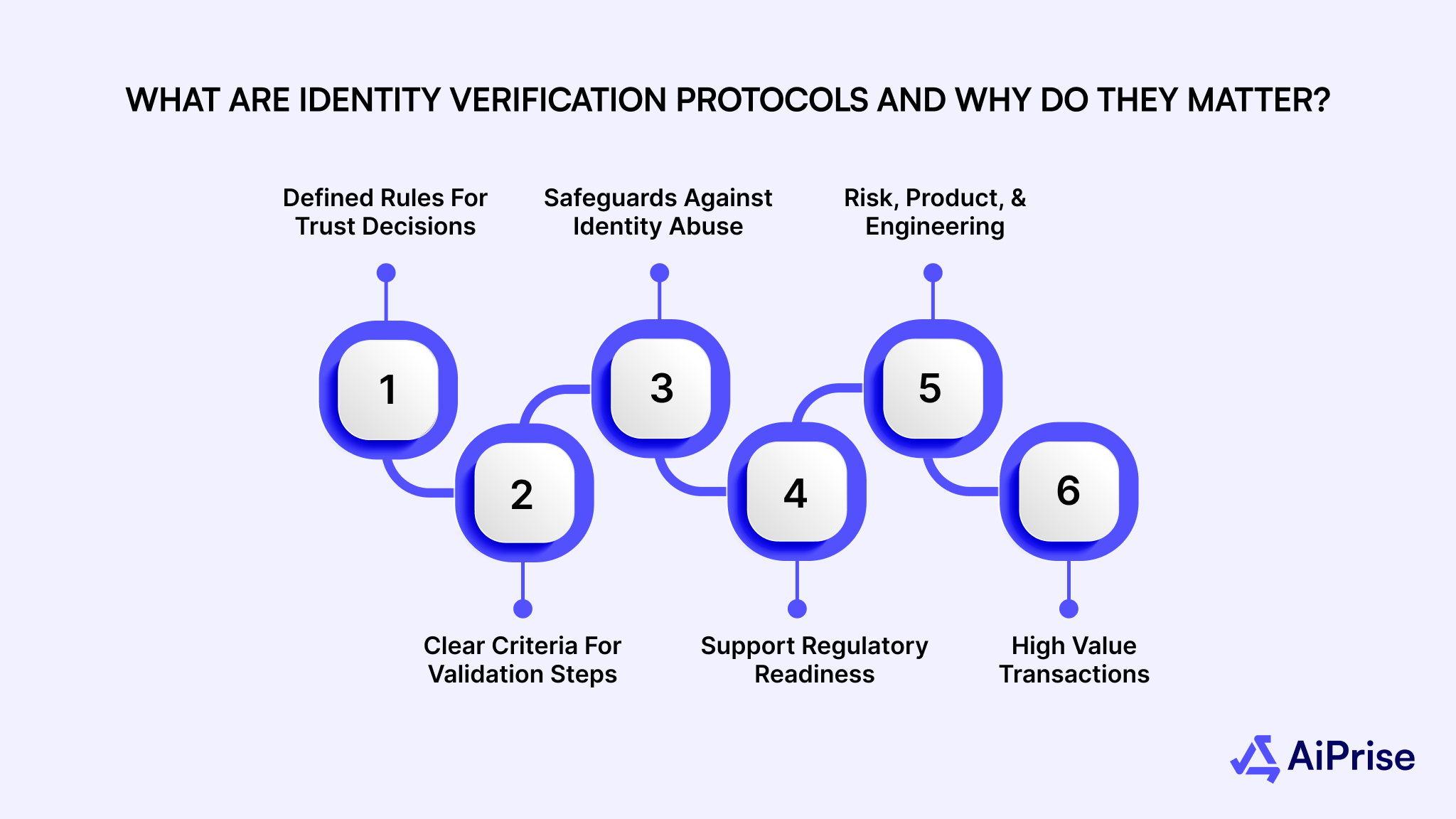
Here are the essentials you need to understand.
- Defined Rules For Trust Decisions: These protocols give you a uniform way to judge identities across products, markets, and risk categories. If you run global onboarding or compliance workflows, this consistency helps you avoid fragmented standards.
- Clear Criteria For Validation Steps: You get predefined checks that tell you exactly what evidence to collect from a user. This keeps your risk teams aligned with product, engineering, and compliance when designing verification flows.
- Safeguards Against Identity Abuse: Protocols outline how you should respond when signals look suspicious. For example, a crypto exchange might escalate users who show velocity spikes or mismatched device intelligence.
- Frameworks That Support Regulatory Readiness: With well-defined procedures, you avoid improvisation when auditors ask for proof of your verification logic. This is especially helpful if you operate across multiple jurisdictions.
- A Common Language For Risk, Product, And Engineering: When your teams refer to the same protocol, you move faster. You cut down on debate about what qualifies as sufficient verification and focus on strengthening coverage.
- Stronger Defenses For High Value Transactions: In industries where users move money or access sensitive records, protocols guide you on when and how to introduce deeper checks without breaking the user flow.
Understanding the key elements of identity verification helps clarify why these protocols are essential for secure, compliant onboarding.

What Are the Core Components of Modern Identity Verification Protocols?
To protect your platform from advanced fraud and stay aligned with regulatory expectations, you need verification components that can interpret identity signals with speed and accuracy.
Modern protocols combine evidence, behavior, and intelligence so you can decide if a user is trustworthy before granting access or enabling transactions. Each layer supports a different part of your decision-making, which is essential when you manage onboarding for high-velocity or high-value environments.
Below are the components that shape strong verification protocols.
- Identity Proofing Foundations: You confirm whether a user can present legitimate personal attributes that match trusted data sources. If you run onboarding for fintech or credit products, this helps you reduce entry points for fabricated profiles.
- Document Authentication Logic: You rely on signal checks like texture patterns, font consistency, chip data, and hologram behavior to judge if an ID document is genuine. This is useful when you onboard users from regions with varied document formats.
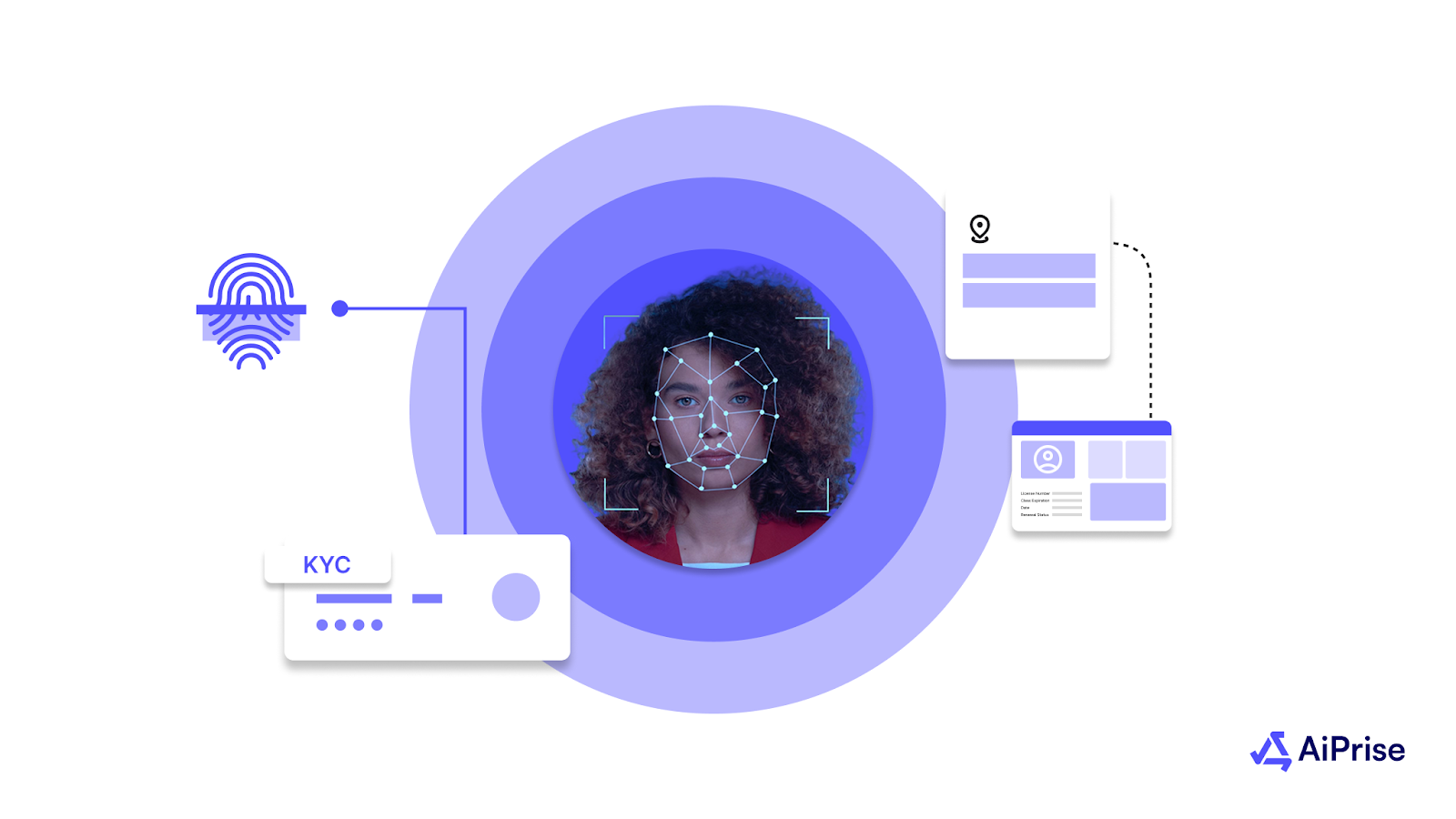
- Biometric Validation Signals: You verify that the person interacting with your system matches the individual shown in the document. This layer helps you avoid approving users who try to pass screenshots, masks, or edited images as real identities.
- Sanctions and PEP Alert Controls: You screen users against sensitive lists to decide whether you can legally or ethically engage with them. This is essential when you operate in regulated segments such as payments or virtual asset services.
- Risk Scoring And Decision Logic: You translate all incoming signals into a single risk indicator so your teams can determine what action to take. If a user exhibits irregular patterns or inconsistent attributes, you can choose to escalate or decline without manual back and forth.
Facing gaps in how your protocols handle changing regulations or risk signals? AiPrise Compliance Co Pilot helps you maintain updated verification rules, consistent decisions, and audit ready workflows across markets.
Exploring the core components sets the stage for understanding the most widely adopted identity verification protocols globally.
Top Identity Verification Protocols Used Worldwide
Identity frameworks across the world are evolving as regulators push for stronger protections and fraudsters adopt more advanced tactics. You now operate in an environment where global standards influence how you structure verification, what evidence you collect, and how your systems validate identity signals.
These frameworks shape how fast you can onboard users and how resilient your platform becomes against coordinated attacks.
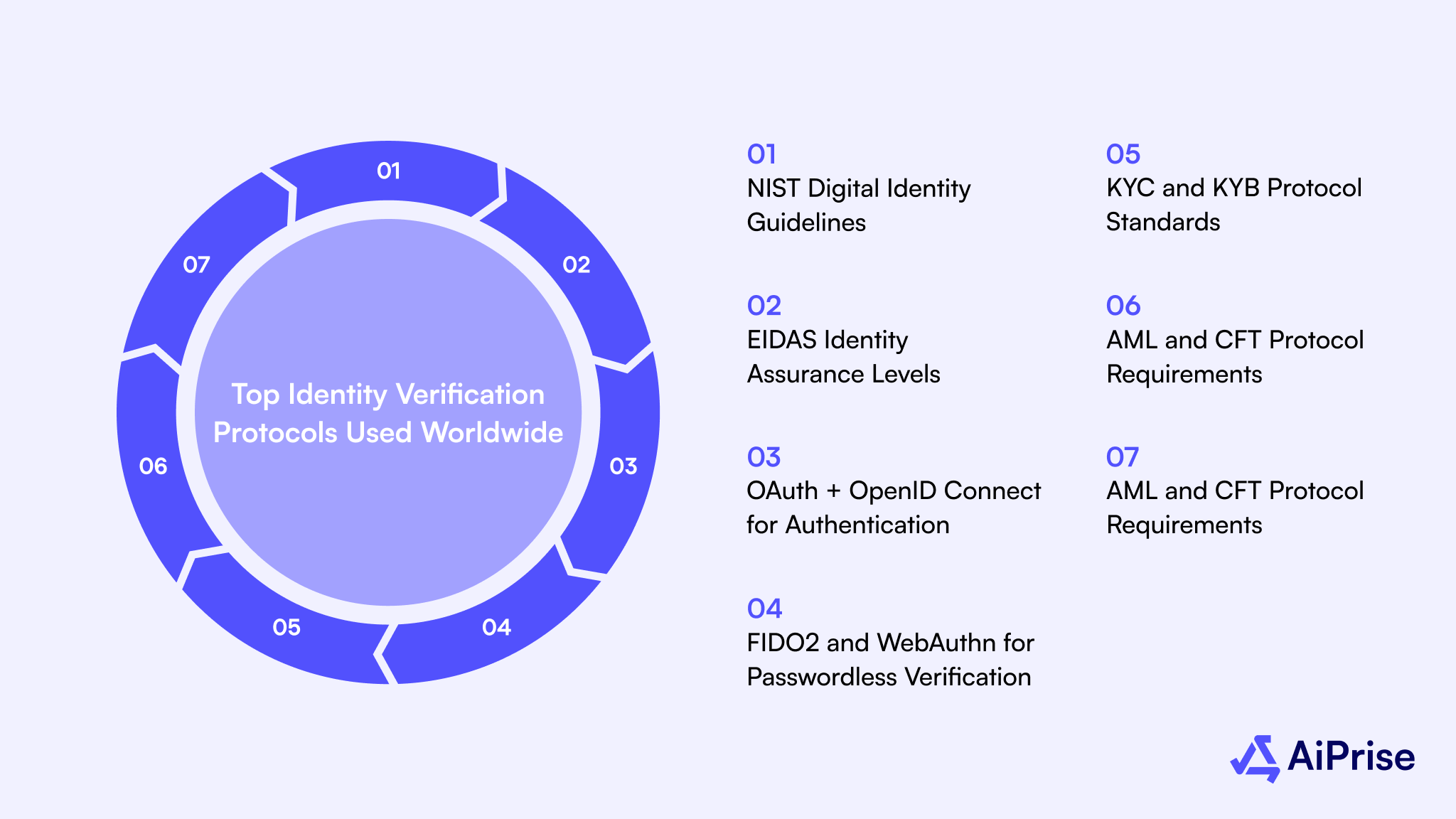
Below are the major protocols you should be familiar with.
NIST Digital Identity Guidelines (NIST 800-63)
NIST 800-63 gives you a structured framework to judge digital identity assurance in a way that aligns with US expectations for high security environments. Financial institutions, payment providers, and crypto platforms rely on these guidelines because they define how strong your identity proofing, authentication, and lifecycle management should be for different risk levels.
Following NIST helps you justify your verification standards to auditors and reduce uncertainty when handling large transaction volumes or sensitive customer data.
Below are the key elements that matter for your operations.
- Defined Assurance Levels: Different levels allow you to match verification strength to the risk of the interaction. A fintech lending product, for example, may require higher assurance than a low-exposure wallet account.
- Clear Authentication Requirements: The guidelines outline what evidence is suitable for proving identity in digital channels. This helps you avoid mismatched authentication standards across teams or products.
- Structured Identity Proofing Rules: NIST clarifies what data, checks, and validation steps qualify as acceptable proofing. These rules support consistent trust decisions when onboarding users from varied regions.
- Lifecycle Integrity Controls: Identity does not end at onboarding. NIST offers guidance for account changes, credential updates, and recovery events so you can maintain strong identity assurance throughout the customer journey.
- Alignment With High Security Use Cases: If you support sectors that demand strict verification, these guidelines offer a credible foundation for policy creation and internal governance.
eIDAS Identity Assurance Levels (EU)
eIDAS gives you a harmonized way to evaluate user identities across the European Union, which becomes essential when you operate in multiple EU markets or support customers who transact across borders. The framecross-country understands how much trust you can place in a user based on the strength of their identity attributes and how those attributes were validated.
By aligning with eIDAS, you reduce ambiguity when handling cross-country onboarding and create a verification posture that fits EU regulatory expectations without slowing down user flows.
Below are the elements that shape how eIDAS works in practice.
- Tiered Assurance Categories: Each level reflects the reliability of the identity evidence presented. A higher tier is often required when you manage high-exposure financial transfers or regulated access.
- Standardized Validation Criteria: You get clear benchmarks for assessing identity attributes. This helps you build consistent flows across EU markets even when the underlying document types vary.
- Cross-Border Trust Compatibility: Verification performed in one EU country can be recognized in another. This is valuable if you support users who move funds or assets across regions.
- Support for Electronic Signatures: Many EU workflows rely on verified signatures. Using eIDAS-aligned identity assurance lets you include these capabilities in your product offerings.
- Alignment With Supervisory Expectations: Regulators across the EU view eIDAS as a trusted model for digital identity assurance. Adopting its standards helps you defend your operational decisions during compliance reviews.
Also read: Deepfake Selfie Verification in Identity Checks
OAuth + OpenID Connect for Authentication
OAuth and OpenID Connect give you a structured way to confirm that a user trying to access your system is truly the account holder. These protocols help you offload sensitive credential handling to trusted identity providers while still maintaining strong oversight of your authentication workflow.
Below are the elements that make these protocols valuable for your environment.
- Token-Based Access Control: Access is granted through time-bound tokens rather than static credentials. This lowers your exposure if a session or device becomes compromised.
- Separation of Identity and Authorization: OpenID Connect handles who the user is, while OAuth focuses on what they can access. This split lets you design cleaner workflows for both onboarding and ongoing access.
- Support for Trusted Identity Providers: You can let users authenticate through established providers. This shortens login steps and reduces pressure on your internal credential systems.
- Flexible Integration Across Apps: These protocols support web, mobile, and API based products. If your platform spans multiple channels, you keep authentication aligned without building custom logic for each route.
- Reduced Risk Of Credential Abuse: With standardized token flows, you limit opportunities for attackers to reuse stolen passwords or replay captured sessions.
FIDO2 and WebAuthn for Passwordless Verification
FIDO2 and WebAuthn allow you to move away from passwords and rely on cryptographic authentication tied to a user’s device or biometric input. This shift is important when you operate in sectors where credential theft, phishing, and account takeovers can directly impact financial exposure or regulatory scrutiny.
Below are the elements that make FIDO2 and WebAuthn effective for your authentication strategy.
- Device Bound Cryptographic Keys: Credentials stay on the user’s device and cannot be extracted easily. This setup removes a major attack path for credential harvesting.
- Built-in Resistance to Phishing: Authentication only works when initiated from the legitimate domain. This protects your users from spoofed login pages and social engineering attempts.
- Support for Biometric Inputs: Users can authenticate with fingerprints or facial recognition. This improves convenience and reduces friction during repeated access events.
- No Shared Secrets To Store: Since you are not holding password databases, your liability drops. A breach of your systems does not expose user credentials.
- High Suitability For Regulated Workflows: Passwordless verification strengthens your access controls for environments that handle monetary transactions or sensitive records.
KYC and KYB Protocol Standards
KYC and KYB protocols guide how you validate individuals and businesses before enabling financial activity. These standards matter when you handle onboarding for products that involve fund movement, credit exposure, merchant acceptance, or high-value transactions.
Strong KYC and KYB frameworks help you detect hidden ownership structures, identify mismatched business attributes, and flag users that present elevated financial crime risk.
Below are the core elements you should understand.
- Defined Identity Evidence Requirements: Protocols outline what personal or business information must be collected to make a reliable identity assessment. This reduces guesswork for your compliance and onboarding teams.
- Structured Business Verification Steps: You gain clarity on how to validate a company’s legitimacy, such as checking registration data, beneficial owners, and business purpose. This is crucial when onboarding merchants or corporate clients.
- Risk Aligned User Classification: Standards help you categorize users based on exposure. A merchant with high chargeback potential or complex ownership may require deeper review.
- Enhanced Due Diligence Triggers: Protocols highlight when you should request additional evidence. For example, a business with cross-border operations or unclear ownership may need further investigation.
- Ongoing Monitoring Expectations: KYC and KYB are not one-time checks. These standards show you when to revisit user or business attributes, especially if flagged activity appears.
AML and CFT Protocol Requirements (FATF)
FATF guidelines shape how you identify, assess, and respond to financial crime risks across your user base. These expectations matter when you operate in sectors where illicit fund movement or terrorist financing decision-making leads to severe penalties or licensing consequences.
Below are the essential elements that influence your AML and CFT posture.
- Risk-Based Controls: FATF expects you to adjust scrutiny based on user or transaction exposure. A high-velocity trading account, for example, may require deeper checks than a low-activity wallet.
- Clear Screening Expectations: Protocols outline when to screen users or entities against sensitive datasets. This helps you avoid gaps that could lead to regulatory escalation.
- Structured Transaction Review Logic: You are encouraged to flag patterns that deviate from normal activity. Sudden value spikes or unfamiliar counterparties are common triggers.
- Enhanced Measures For Higher Threat Profiles: If a user or business shows attributes linked to elevated crime risk, FATF expects additional verification steps or closer monitoring throughout their lifecycle.
- Documented Compliance Governance: Clear internal policies and audit trails help you prove consistent decision-making during regulator interactions or external reviews.
AML and CFT Protocol Requirements (FATF)
FATF sets the global benchmark for how you should identify and respond to financial crime risks across your user and transaction ecosystem. These expectations are particularly important when you operate in environments where money movement, asset conversion, or merchant activity can attract misuse from organized networks.
Below are the elements that influence how you operationalize these requirements.
- Threat Exposure Profiling: FATF encourages you to understand the financial crime pressures specific to your business model. A payment aggregator, for example, faces different laundering risks compared to a lending platform.
- Screening Threshold Expectations: You gain clarity on when to activate checks for sensitive entities or prohibited activities. This helps your risk team avoid inconsistent decisions across product lines.
- Pattern-Based Transaction Detection: Protocols emphasize behavior-driven insights. If a user suddenly crosses-border known merchants or shows round-trip transfers, your systems should highlight that activity.
- Heightened Oversight For Red Flag Scenarios: When certain indicators appear, such as complex routing or rapid cross-border flows, FATF expects stronger scrutiny or additional evidence before it allows continuity.
- Internal Governance And Reporting Rigor: Structured documentation, clear escalation steps, and accurate reporting help you maintain credibility during audits or supervisory reviews.
Knowing the major global protocols makes it easier to see how fraudsters attempt to exploit identity verification systems today.
How Are Fraudsters Targeting Identity Verification Systems Today?
Identity attacks are evolving faster than many verification stacks can adapt, which puts real pressure on you when onboarding users or approving sensitive actions. Fraudsters now rely on automation, manipulated media, and coordinated networks to slip through weak points in your verification flow.
These tactics are designed to exploit any gap in your signals, especially when your systems process high volumes or support fast decision cycles.
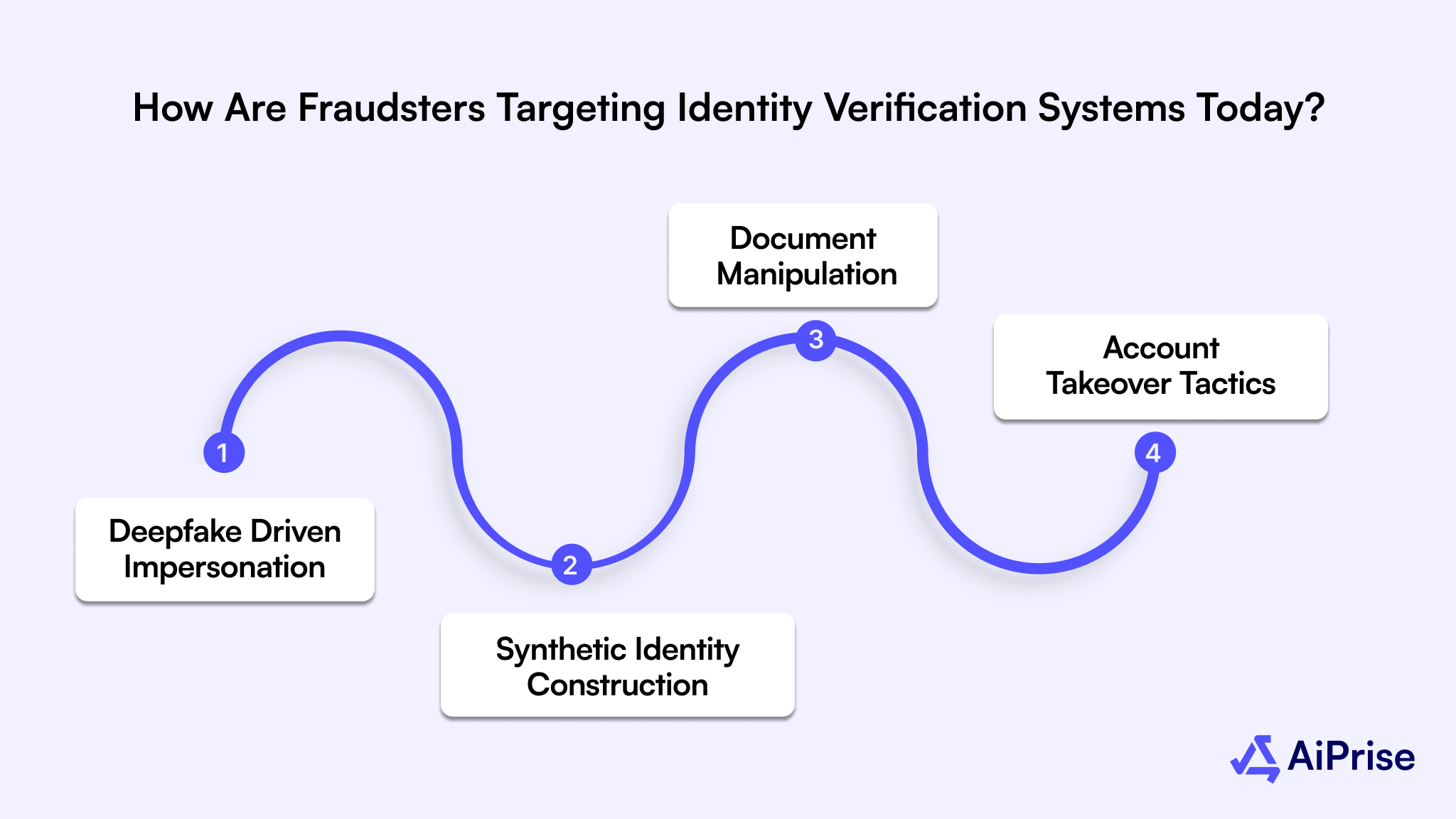
Below are the tactics Yin-persono should be aware of.
- Deepfake Driven Impersonation: Fraudsters use face swaps and AI-generated videos to imitate real users during selfie checks. This is common in platforms that allow remote verification without in-person oversight.
- Synthetic Identity Construction: Attackers combine real and fabricated user attributes to create convincing profiles that pass simple checks. This is a major risk for credit-issuing products where identity depth matters.
- Document Manipulation Techniques: Edited templates, altered text fields, and digitally modified security elements are used to bypass systems that rely only on basic image checks. This often targets markets with diverse ID formats.
- Account Takeover Tactics: Criminals gather exposed credentials and pair them with device spoofing tools to access legitimate accounts. This is especially damaging in environments where users hold transferable value.
Struggling to catch deepfakes, synthetic identities, or abnormal user behavior before onboarding completes? AiPrise Fraud Risk Scoring delivers real time AI analysis that flags manipulated media, risky behavior patterns, and identity inconsistencies.
Understanding current fraud tactics highlights the challenges businesses encounter when implementing effective identity verification protocols.
What Challenges Do Businesses Face When Implementing Identity Verification Protocols?
Rolling out strong identity verification protocols often feels more complex than expected, especially when your teams must balance security, conversion, compliance, and scale. Each layer of verification introduces new operational requirements, data dependencies, and user experience considerations.
If these parts do not work together, you risk inconsistent regulatory tension or onboarding friction that pushes good users away.
Below are key challenges along with practical solutions.
- Inconsistent Data Quality Across Regions: Verification becomes harder when ID formats, document clarity, or metadata vary by market.
- Solution: Build flexible parsing and validation rules that adapt to regional formats and use localized data sources for better mlow-riskuracy.
- Balancing Security With User Effort: Strong checks can introduce friction that slows onboarding.
- Solution: Use adaptive verification so only users with elevated exposure face additional steps, while low-risk users move through faster flows.
- Operational Stress During High Volume Spikes: Manual reviews or slow systems can create backlogs during peak onboarding.
- Solution: Automate key decision points and introduce prioritization logic that routes high-confidence users straight to approval.
- Limited Visibility Into Real-Time Risk Signals: Isolated verification steps can miss patterns that indicate misuse.
- Solution: Combine device intelligence, behavioral indicators, and historical activity into a unified risk layer that updates instantly.
Identifying implementation challenges helps shape a comprehensive checklist for effective enterprise identity verification protocols.
What Should an Enterprise Identity Verification Protocol Checklist Include?
Large enterprises handle complex user journeys, multiple regulatory obligations, and diverse risk categories, which means your verification protocols must offer clarity, consistency, and operational control.
A strong checklist helps you evaluate whether your systems can defend against sophisticated identity threats while supporting smooth onboarding and efficient compliance workflows.

Below are the essential items your enterprise checklist should cover.
- Regulatory Alignment Requirements: Your protocol should map to the specific obligations of each market you operate in. This gives your compliance team confidence that onboarding routes satisfy local expectations without custom rewriting.
- Depth of Fraud Detection Signals: You need multi-angle checks that include behavioral indicators, device intelligence, and media validation. For example, if you onboard users through mobile apps, device-level insights can reveal early signs of misuse.
- Scalability and Throughput Expectations: Verification systems should handle sudden spikes in onboarding volume without review delays. This is crucial when you support time-sensitive products like trading or real decision-making.
- Integration Fit With Existing Architecture: Your protocol should connect cleanly with internal systems such as risk engines, CRM tools, or case management platforms. A poor fit leads to inconsistent decision-making and delays in operational workflows.
Also read: How to Check a UAE Company’s Trade License Online
A well-designed checklist ensures all verification steps are covered before exploring how AiPrise enhances protocol efficiency and security.
How Does AiPrise Strengthen Identity Verification Protocols?
The verification demands faced by financial institutions, payment platforms, and crypto businesses require technology that can assess identity signals with accuracy, speed, and global consistency.
AiPrise supports this standard by delivering capabilities that unify verification, fraud prevention, and compliance into a single, scalable workflow. Each feature is designed to help you close risk gaps, improve onboarding quality, and maintain regulatory alignment across markets.
- Global KYC and KYB Verification: Strong identity evaluation becomes easier when AiPrise connects your work with high-value worldwide data sources and document checks. This helps you validate individuals and businesses across regions with reliable match accuracy, stronger ownership visibility, and faster onboarding decisions for high-value users.
- Multi-layer AML Screening: Financial audit-ready can be identified early when AiPrise enriches your checklists with sanctions data, watchlists, and ongoing alerts. This helps your risk and compliance teams react quickly to potential exposure, maintain audit-ready documentation, and avoid regulatory scrutiny tied to missed signals.
- AI-Based Fraud Detection and Anti-Spoofing: Advanced attacks become easier to counter when AIPrise analyzes user media, behavioral indicators, and device-level patterns. This helps your platform detect synthetic identities, manipulated documents, deepfake attempts, and unusual session activity before they impact account integrity.
- Verification Workflow Automation: Operational efficiency improves when Ailow-risktomates branching logic, escalations, and high-exposurection inside your verification journey. This helps your teams reduce manual review load, maintain consistent decisions, and shorten onboarding time for low-risk users while applying targeted friction to high-exposure cases.
- API First Architecture For Enterprise Scale: Integration challenges are reduced significantly when AiPrise connects directly with your existing systems, such as risk engines, Case Management tools, and CRM environments. This helps your product and engineering teams deploy verification at scale, maintain low latency across traffic spikes, and adapt quickly to new markets or regulatory requirements.
AiPrise enhances identity verification protocols through global compliance, real-time fraud detection, and automated onboarding, ensuring secure and efficient verification processes.
Conclusion
Identity verification protocols continue to evolve as fraud tactics grow more advanced and regulatory demands expand across borders. Strong frameworks help your teams make faster trust decisions, reduce false approvals, and support secure onboarding in environments where even small gaps can create financial or compliance exposure.
AiPrise strengthens this foundation by giving your business a unified verification engine that supports global KYC, KYB, AML screening, fraud detection, and automated decision workflows. This helps your compliance, risk, and product teams operate with clarity and confidence as you scale into new markets or support more complex user journeys.
Book A Demo to see how AiPrise can elevate your identity verification protocols and help your organization stay ahead of fraud and regulatory pressure.
FAQs
1. What is the difference between identity authentication and identity verification?
Identity verification confirms who a user is by validating their information and documents, while authentication checks if the same verified user is accessing your system during login or transactions. Verification establishes trust at onboarding. Authentication protects ongoing access. Both layers work together to maintain secure user journeys and prevent misuse.
2. How do real-time identity verification systems improve fraud prevention?
Real-time systems analyze identity signals the moment a user interacts with your platform. This helps you block suspicious activity before accounts are created or transactions start. Immediate feedback reduces manual review load, stops coordinated attacks faster, and enhances onboarding efficiency without compromising your compliance or security posture.
3. Can identity verification be done without government-issued documents?
Some verification models use alternative data sources like credit files, utility records, telecom data, or trusted digital identities. This approach helps reach users who lack formal documents. Strong risk controls are essential because alternative data varies by region. It works best when paired with biometrics or device intelligence for added assurance.
4. What are common biological and behavioral signals used in identity verification?
Biological signals include facial features, fingerprints, and voice patterns. Behavioral signals include typing rhythm, motion patterns, navigation habits, and device interaction style. These signals help you detect mismatches between the presented identity and actual user behavior. They also provide frictionless identity layers that enhance security without slowing down onboarding or login flows.
5. How does two-factor authentication support identity verification processes?
Two-factor authentication adds a second proof point, like a code, push notification, or biometric input. This reduces reliance on passwords and prevents unauthorized access even if credentials leak. It supports your verification framework by ensuring that only the genuine user continues using the account after initial identity checks are complete.
You might want to read these...




.png)



AiPrise’s data coverage and AI agents were the deciding factors for us. They’ve made our onboarding 80% faster. It is also a very intuitive platform.

Head of Operations



See your full compliance picture in one place
Use AI agents and global data to review businesses and users faster and more accurately
