

AiPrise
9 min read
February 5, 2026
Anti-Money Laundering Compliance: Proven Strategies for 2026

Key Takeaways

Financial crime rarely announces itself, yet one weak anti-money laundering gap can quietly expose your entire business overnight. Criminal networks hid roughly $7.1 billion in suspicious transactions reported under U.S. AML requirements through late 2025, showing real systemic risk. As a bank, payment provider, or crypto platform, weak anti-money laundering compliance can suddenly expose you to costly financial crime losses.
Manual monitoring, slow reporting, and fragmented controls make staying compliant feel like chasing threats you barely detect in time. Regulators increasingly expect stronger AML compliance management and accurate AML regulatory reporting, meaning you must modernize beyond basic internal rules.
Understanding anti-money laundering fundamentals helps you reduce risk exposure, improve detection, and keep regulators confident in your controls. Mastering practical compliance strategies now positions your organization to stay ahead of enforcement pressure and operational disruption in 2026.
Key Takeaways
- Anti-money laundering focuses on preventing illegal funds from entering financial systems through verified identities, monitored transactions, and accurate regulatory reporting.
- Banks, fintechs, payment providers, and crypto platforms must follow AML laws enforced through the BSA, PATRIOT Act, and federal oversight.
- Most AML failures come from outdated rules, manual reviews, reporting delays, and disconnected KYC and transaction systems.
- Scalable AML programs rely on risk-based monitoring, integrated reporting, reliable documentation, and continuous customer due diligence.
What Is Anti-Money Laundering for Modern Business?
Anti-money laundering for modern businesses refers to the policies, controls, and monitoring processes you use to detect, prevent, and report illicit financial activity. In practical terms, AML helps you verify customers, monitor transactions, meet AML laws, and file accurate regulatory reports while protecting your business from financial crime exposure. For banks, payment providers, and crypto platforms, AML is not just a legal requirement; it is a core risk management function that safeguards revenue, reputation, and operational continuity.
Who Is Legally Required to Follow AML Regulations?
Businesses that handle customer funds or facilitate transactions must prevent misuse under U.S. anti-money laundering laws.
Here are the organizations legally required to maintain an AML compliance program in the United States.
- Banks and credit institutions must follow AML laws, monitor accounts, and file suspicious activity reports with regulators.
- Payment processors and fintech platforms are required to maintain AML compliance to detect fraud and unlawful transaction patterns.
- Cryptocurrency exchanges must apply AML and KYC controls to meet federal financial crime prevention standards.
- Money services businesses must implement AML programs to monitor transfers, remittances, and prepaid instruments.
- Companies processing high-risk or high-volume transactions face stricter AML regulatory scrutiny and reporting obligations.
- Regulated financial entities must document AML compliance programs to satisfy audits and ongoing supervisory reviews.
Also read: 6th Anti Money Laundering Directive: Key Changes and Compliance
Understanding who must comply only matters when you also know which laws and authorities enforce these obligations.
AML Laws and Enforcement Businesses Must Prepare For
U.S. regulators enforce anti-money laundering laws through multiple statutes that directly shape how your compliance program operates.
Here are the key AML laws and enforcement frameworks your business must actively prepare for.
- The Bank Secrecy Act sets core AML obligations
- The Bank Secrecy Act requires you to maintain AML programs, monitor transactions, and file suspicious activity reports.
- Regulators assess whether your AML controls function effectively across customers, products, and transaction channels.
- The USA PATRIOT Act expands AML and KYC expectations
- The USA PATRIOT Act strengthened customer identification, due diligence, and information-sharing requirements for financial institutions.
- You must verify customer identities and understand ownership structures to prevent terrorist financing and money laundering.
- The Anti-Money Laundering Act of 2020 raises enforcement standards
- The AML Act of 2020 increased penalties and expanded FinCEN’s authority to evaluate program effectiveness.
- Regulators now expect risk-based AML compliance management aligned with real operational exposure.
- FinCEN enforces AML compliance through reporting accuracy
- FinCEN closely reviews suspicious activity reports for completeness, timeliness, and consistency across reporting periods.
- Weak AML regulatory reporting often triggers deeper examinations and enforcement actions.
- The Department of Justice targets systemic AML failures
- The DOJ increasingly pursues enforcement when weak controls enable repeated or large-scale financial crime.
- Senior management accountability increases when AML program deficiencies reflect governance or oversight failures.
- Regulators focus on how AML operates in practice
- Manual monitoring gaps, alert backlogs, and outdated rules frequently appear in enforcement findings.
- AML programs must evolve with transaction volume, payment complexity, and emerging financial crime typologies.
Even with clear laws in place, many organizations struggle because compliance rarely works as expected in real environments.
Where AML Compliance Programs Fail in Practice?
Many AML programs fail because daily operational realities rarely match regulatory expectations or evolving financial crime behaviors.
Here are the most common AML compliance breakdowns that expose businesses to enforcement, financial loss, and reputational damage.
- AML monitoring rules are outdated and fail to reflect current transaction patterns, products, and emerging financial crime typologies.
- Manual review processes create alert backlogs, causing delayed investigations and missed suspicious activity reporting deadlines.
- AML compliance programs operate in silos, disconnected from KYC, payments, and broader financial crime controls.
- Poor data quality leads to incomplete customer profiles, inaccurate risk scoring, and unreliable AML regulatory reporting.
- Teams rely on static AML policies that are not aligned with real business models or transaction behavior.
- Lack of automation increases operational costs while reducing the accuracy and consistency of AML controls.
- Compliance teams struggle to scale AML processes as transaction volumes grow across digital and cross-border channels.
- Weak governance and oversight prevent early detection of systemic AML failures before regulators identify them.
Also Read: Comprehensive Guide to AML Compliance in FinTech
Identifying failures is only useful when paired with practical ways to fix them without adding unnecessary operational strain.
Practical AML Compliance Strategies That Scale
Scalable AML compliance focuses on controlling risk efficiently as transaction volumes, customers, and regulatory expectations continuously increase.
Here are the practical strategies businesses use to strengthen AML programs without slowing operations or increasing compliance overhead.
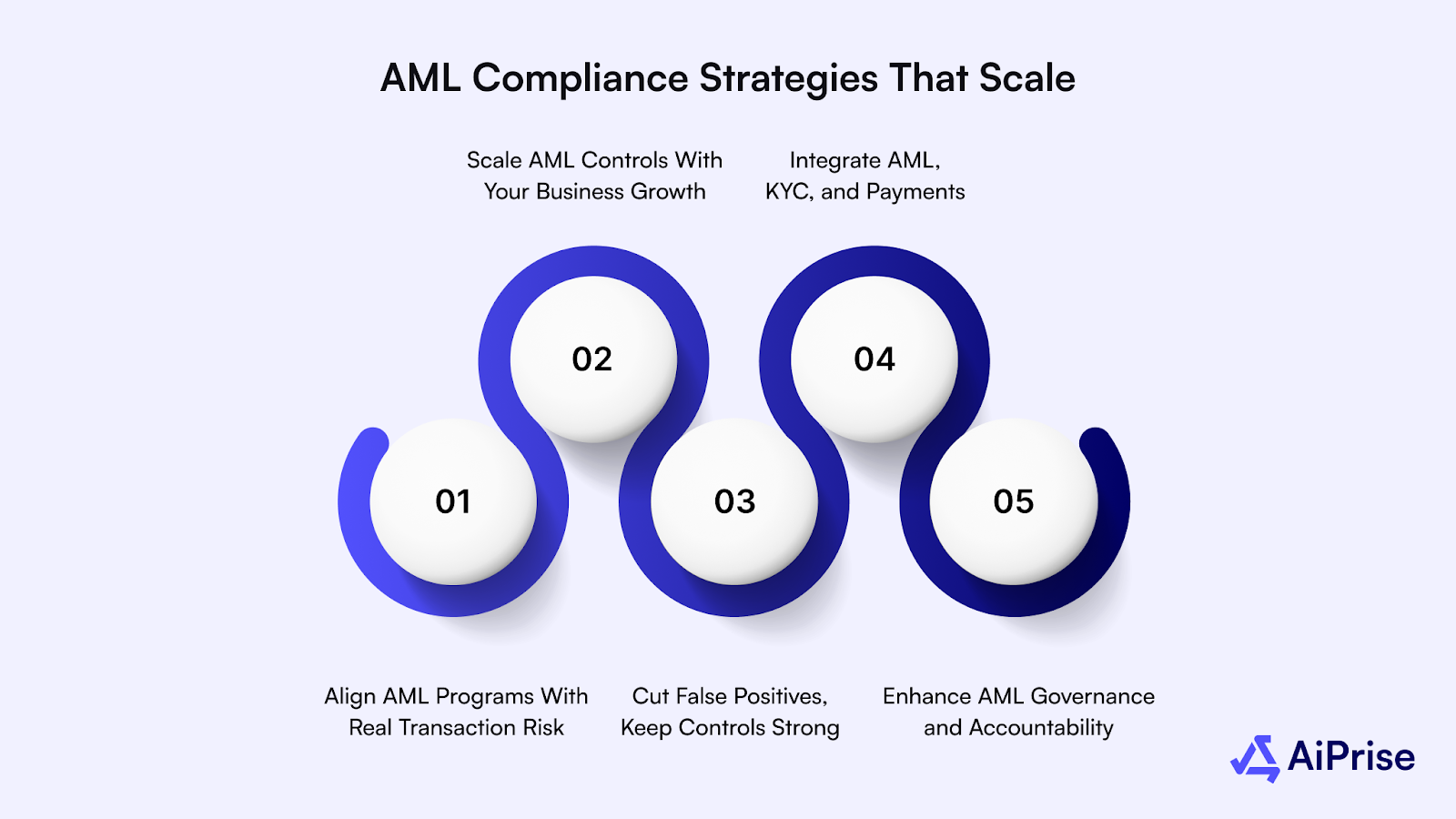
1. Align AML Programs With Real Transaction Risk
Your AML strategy must reflect how funds actually move across customers, products, and payment channels every day. Generic risk models often miss transaction velocity, geographic exposure, and misuse patterns that regulators closely examine. Risk-aligned AML controls reduce blind spots and improve detection accuracy without creating unnecessary operational friction.
2. Build AML Controls That Scale With Business Growth
AML programs often break when transaction growth outpaces monitoring capacity and investigation resources.
You need controls that automatically adjust as customer volumes, payment flows, and risk exposure expand. Scalable AML compliance prevents alert backlogs while maintaining consistent oversight across high-growth financial environments.
3. Reduce False Positives Without Weakening Controls
Excessive false positives overwhelm compliance teams and delay investigations into genuinely suspicious financial activity. Refined AML rules using behavioral indicators help separate legitimate transactions from higher-risk patterns. Lower false positives allow faster reporting and more effective use of limited compliance resources.
4. Integrate AML With KYC and Payment Systems
AML programs perform better when directly connected to onboarding, identity verification, and transaction processing systems. Disconnected workflows create gaps between customer risk profiles and real-time financial behavior. Integrated systems enable faster risk assessment and more reliable suspicious activity reporting across customer lifecycles.
5. Strengthen AML Governance and Internal Accountability
AML compliance weakens when ownership is unclear across compliance teams, leadership, and operational stakeholders. Clear governance ensures accountability for monitoring effectiveness, reporting accuracy, and regulatory communication. Strong oversight helps you detect systemic AML weaknesses before audits or enforcement actions surface them.
Strong strategies still fall short if reporting gaps expose weaknesses that regulators quickly notice.
AML Regulatory Reporting and Business Risk Exposure
Regulatory reporting remains one of the most scrutinized elements of AML compliance, and poor reporting amplifies business risk exposure significantly.
Here are the key risk realities shaped by AML reporting trends and enforcement data you need to know.
- Financial institutions submitted 20.5 million currency transaction reports (CTRs), showing the sheer reporting scale your AML systems must manage.
- Late or inconsistent AML regulatory reporting continues to trigger regulatory scrutiny and deeper compliance examinations.
- Reporting backlogs often result from systems that do not scale with increasing transaction volumes across digital and cross-border channels.
- Inaccurate SARs contribute to enforcement actions and fines when regulators determine that reporting did not reflect underlying risk patterns.
- Regulatory reporting gaps slow your ability to detect high-risk behavior and protect your business from escalating financial crime exposure.
- Manual reporting processes increase compliance costs while reducing the speed and quality of submissions.
- Automated reporting tools integrated with monitoring systems help reduce delays and improve AML submission accuracy.
- Real-time data feeds enable better correlation between customer risk profiles and suspicious activity reporting needs.
- Effective AML reporting strengthens executive confidence and improves your ability to withstand regulatory reviews.
Also Read: How AI-Powered Compliance is Revolutionizing Risk Management for Businesses
How reporting is handled often depends on whether compliance relies on manual effort or automated systems.
Manual vs Automated AML Compliance Compared
The way you run AML compliance directly impacts detection accuracy, reporting speed, and your ability to scale without regulatory friction.
Here’s a clear comparison showing how manual and automated AML approaches perform in real operating environments.
AiPrise supports automated AML compliance by strengthening risk detection, simplifying reporting, and helping teams scale without increasing manual burden.
Regardless of approach, accurate identity and document verification remain the foundation of effective AML controls.
IDs and Documents Required for AML Compliance
Effective AML compliance depends on verifying identities and business legitimacy using reliable, up-to-date documentation.
Here are the key IDs and documents you must collect and maintain to meet AML requirements without slowing operations.
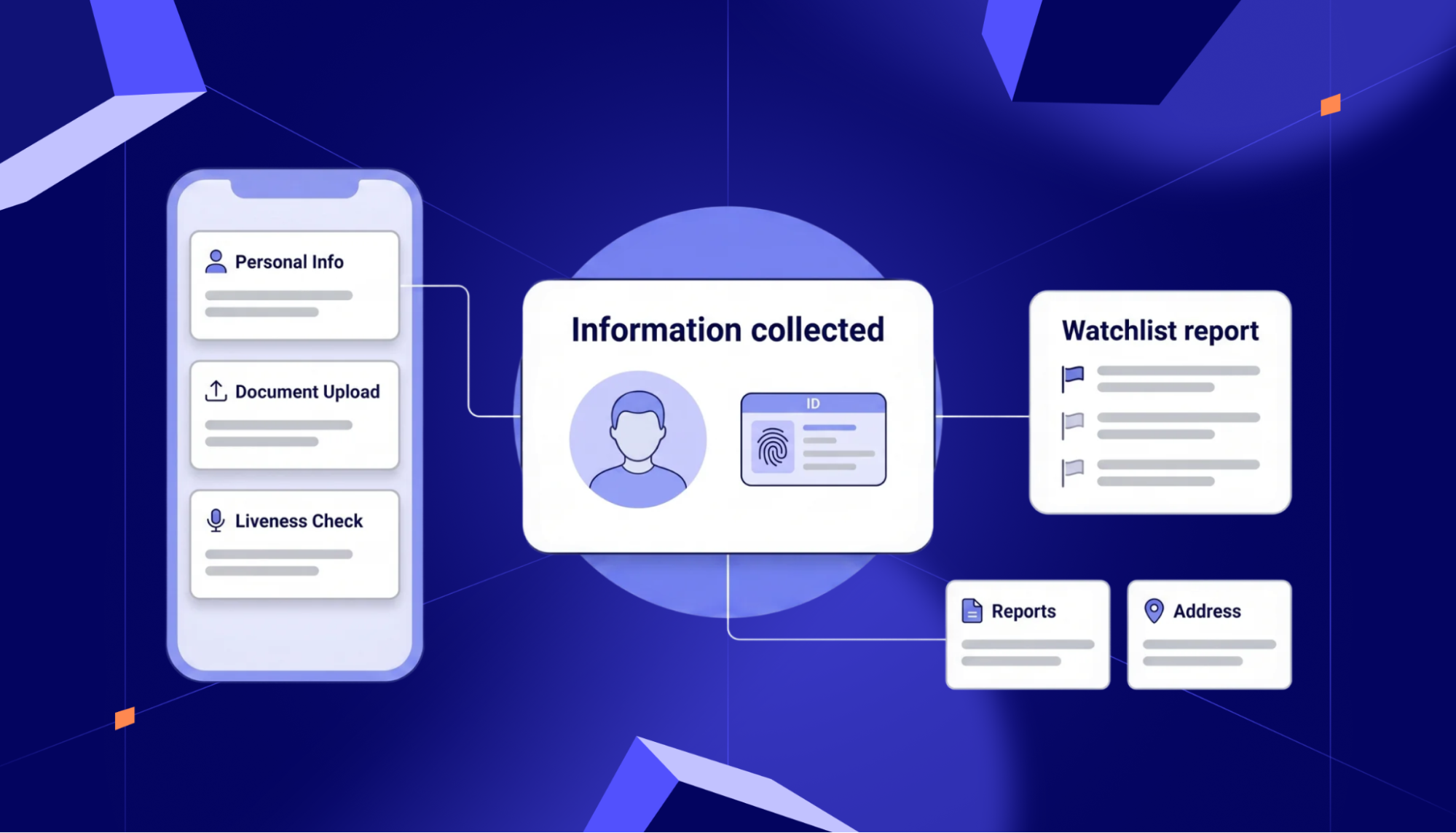
- Government-issued photo IDs, such as passports or driver’s licenses, confirm individual identity during AML and KYC checks.
- Proof of address documents, including utility bills or bank statements, help validate customer location and residency risk.
- Tax identification numbers, such as SSN or EIN, support identity verification and regulatory reporting accuracy.
- Business registration documents confirm legal existence and ownership structure for AML and KYB compliance.
- Beneficial ownership records identify individuals who ultimately control or profit from business entities.
- Financial statements provide context on business activity and help assess unusual transaction behavior.
- Transaction records support ongoing monitoring and enable accurate suspicious activity reporting.
- Sanctions and watchlist screening data ensure customers are not linked to prohibited individuals or entities.
- Updated documentation must be maintained continuously to reflect changes in ownership, control, or risk profiles.
Also read: Anti Money Laundering and Procurement Risk in Insurance Sector
Document checks alone are not enough without a deeper understanding of customer behavior and ownership risk.
How Customer Due Diligence (CDD) Reinforces AML Effectiveness?
Strong customer due diligence connects identity intelligence with transaction behavior to prevent financial crime before risks escalate.
Here’s how CDD directly strengthens anti-money laundering outcomes for regulated financial businesses.
- CDD establishes verified customer identities, reducing anonymity that criminals exploit to move illicit funds through financial systems.
- Risk-based CDD helps you classify customers accurately, ensuring higher scrutiny for profiles with elevated money laundering exposure.
- Ongoing CDD monitoring keeps customer risk assessments current as behavior, geography, or transaction patterns change.
- Enhanced due diligence supports deeper investigation into complex ownership structures and high-risk business relationships.
- Consistent CDD improves the quality and accuracy of suspicious activity reporting by linking behavior to verified identity data.
- Integrated CDD workflows reduce gaps between onboarding, monitoring, and AML regulatory reporting processes.
- AiPrise strengthens CDD through its AI-powered identity verification, enabling real-time risk assessment and continuous monitoring at scale.
Bringing all these elements together requires technology that supports scale without adding complexity.
How AiPrise Supports AML Compliance at Scale
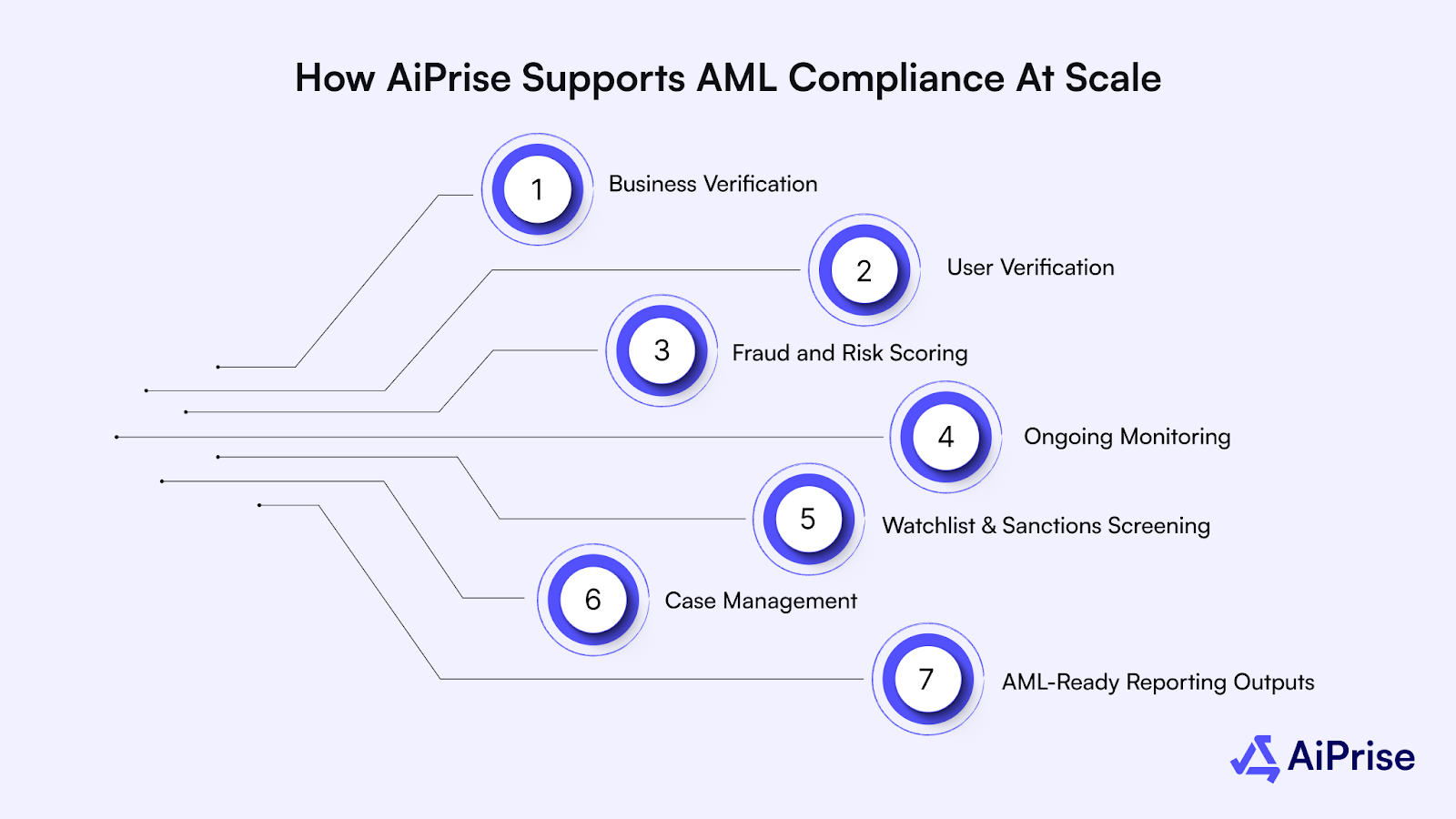
Scalable AML compliance depends on combining accurate identity verification, risk intelligence, and ongoing monitoring within a single operational framework.
Here’s how AiPrise helps you operationalize AML compliance without adding manual complexity.
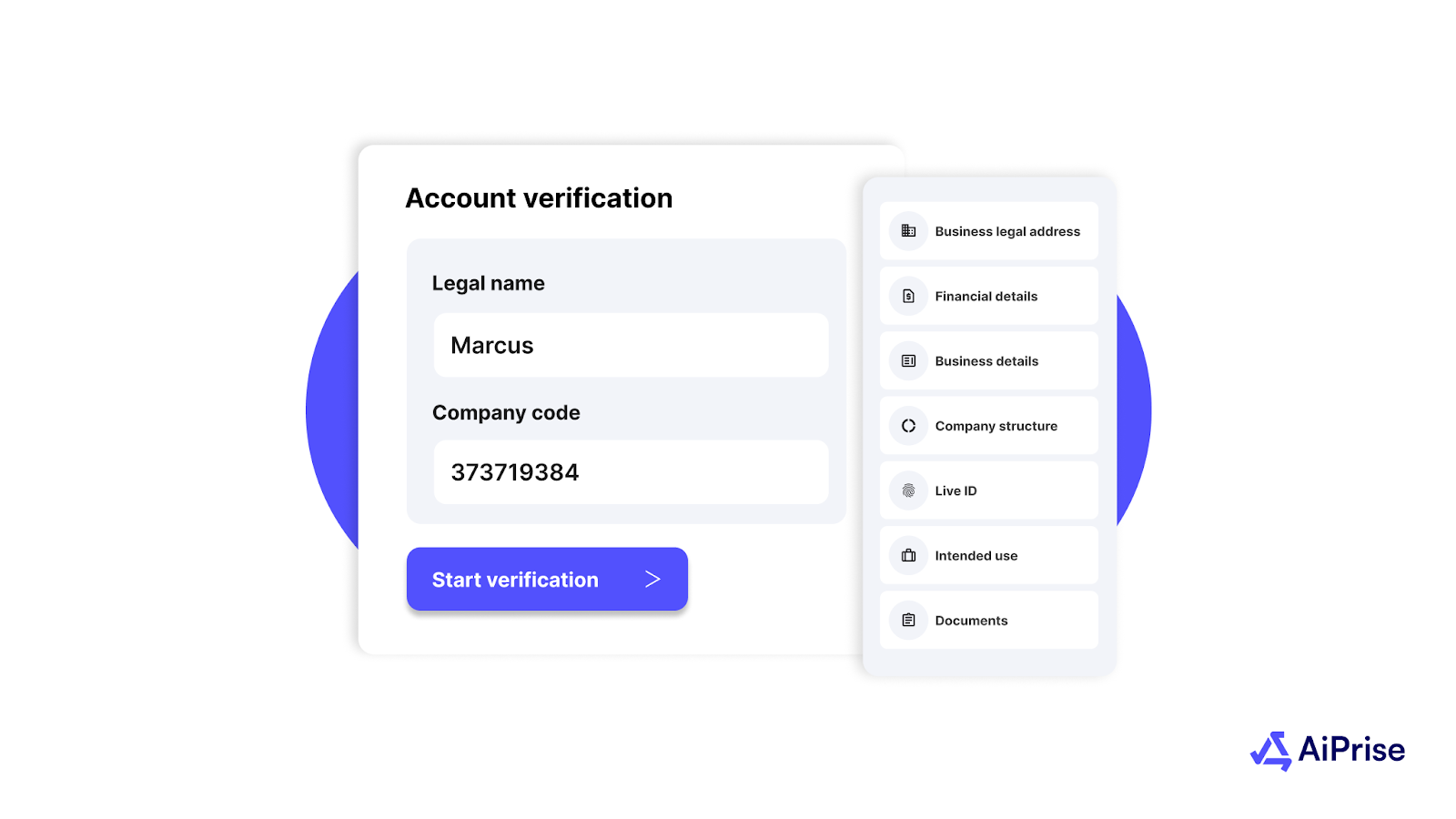
- Business Verification (KYB) validates companies against global registries, confirming legal existence, ownership structures, and beneficial owners.
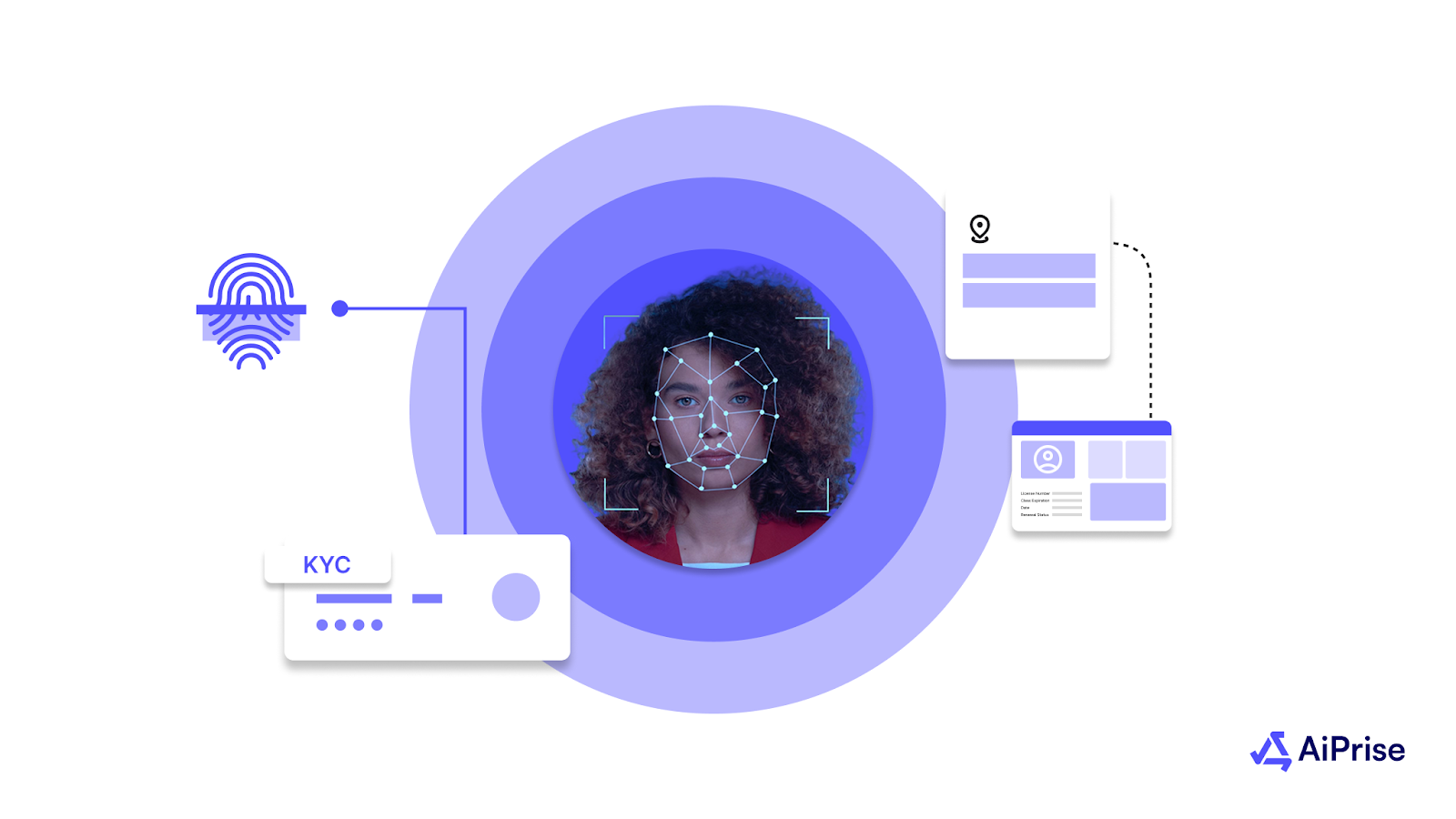
- User Verification (KYC) verifies individuals using government-backed identity checks, reducing anonymity risks during onboarding and account access.
- Fraud and Risk Scoring applies risk-based decisioning using behavioral, device, and identity signals to detect high-risk activity early.
- Ongoing Monitoring continuously tracks changes in customer behavior, ownership, or risk indicators to support dynamic AML compliance.
- Watchlist and Sanctions Screening screens individuals and businesses against global sanctions, PEPs, and adverse media lists.
- Case Management centralizes investigations, audit trails, and decisions, helping you respond faster during examinations and audits.
- AML-Ready Reporting Outputs support consistent suspicious activity reporting by linking identity data, transaction behavior, and risk decisions.
When you treat AML compliance as a scalable, risk-driven system rather than a reactive obligation, you protect growth, trust, and long-term business resilience.
Wrapping Up
Anti-money laundering compliance in 2026 is no longer about reacting to regulations but about building systems that manage risk proactively and efficiently. When you align AML strategies with real transaction behavior, reporting expectations, and scalable controls, compliance becomes a business enabler instead of a constraint.
AiPrise helps you achieve this by unifying AML, KYC, KYB, and risk intelligence into a single, scalable compliance framework.
If you’re ready to reduce AML risk, improve reporting accuracy, and scale confidently, Book A Demo to see how modern AML compliance should work.
Frequently Asked Questions (FAQs)
1. What is anti-money laundering (AML)?
Anti-money laundering refers to laws, processes, and controls designed to prevent criminals from disguising illegal funds as legitimate income.
2. Who needs an AML compliance program?
Banks, payment providers, cryptocurrency platforms, money services businesses, and regulated financial entities must maintain AML compliance programs.
3. What is an AML program?
An AML program is a structured set of policies, procedures, monitoring systems, and reporting mechanisms used to detect and prevent financial crime.
4. Why is AML compliance important for businesses?
AML compliance helps you avoid regulatory penalties, prevent fraud, protect your reputation, and maintain trust with customers and regulators.
5. What does AML mean in banking and finance?
In banking and finance, AML refers to mandatory controls that monitor transactions, verify customers, and report suspicious activity to regulators.
You might want to read these...




AiPrise
KYB Compliance: 2026 Regulations You Should Know About
As organizations expand globally and face tighter regulations, adherence to Know Your Business (KYB) standards has become one of the most critical compliance layers for fintech, online marketplaces, and other companies that need to verify business customers before letting them perform financial transactions.









.png)

.jpg)

















.png)








.png)
.png)
.png)












.png)
.png)



AiPrise’s data coverage and AI agents were the deciding factors for us. They’ve made our onboarding 80% faster. It is also a very intuitive platform.

Head of Operations



See your full compliance picture in one place
Use AI agents and global data to review businesses and users faster and more accurately
