

7 min read
September 30, 2026
Top 5 KYB Solutions for Verifying Sole Proprietors (2026)
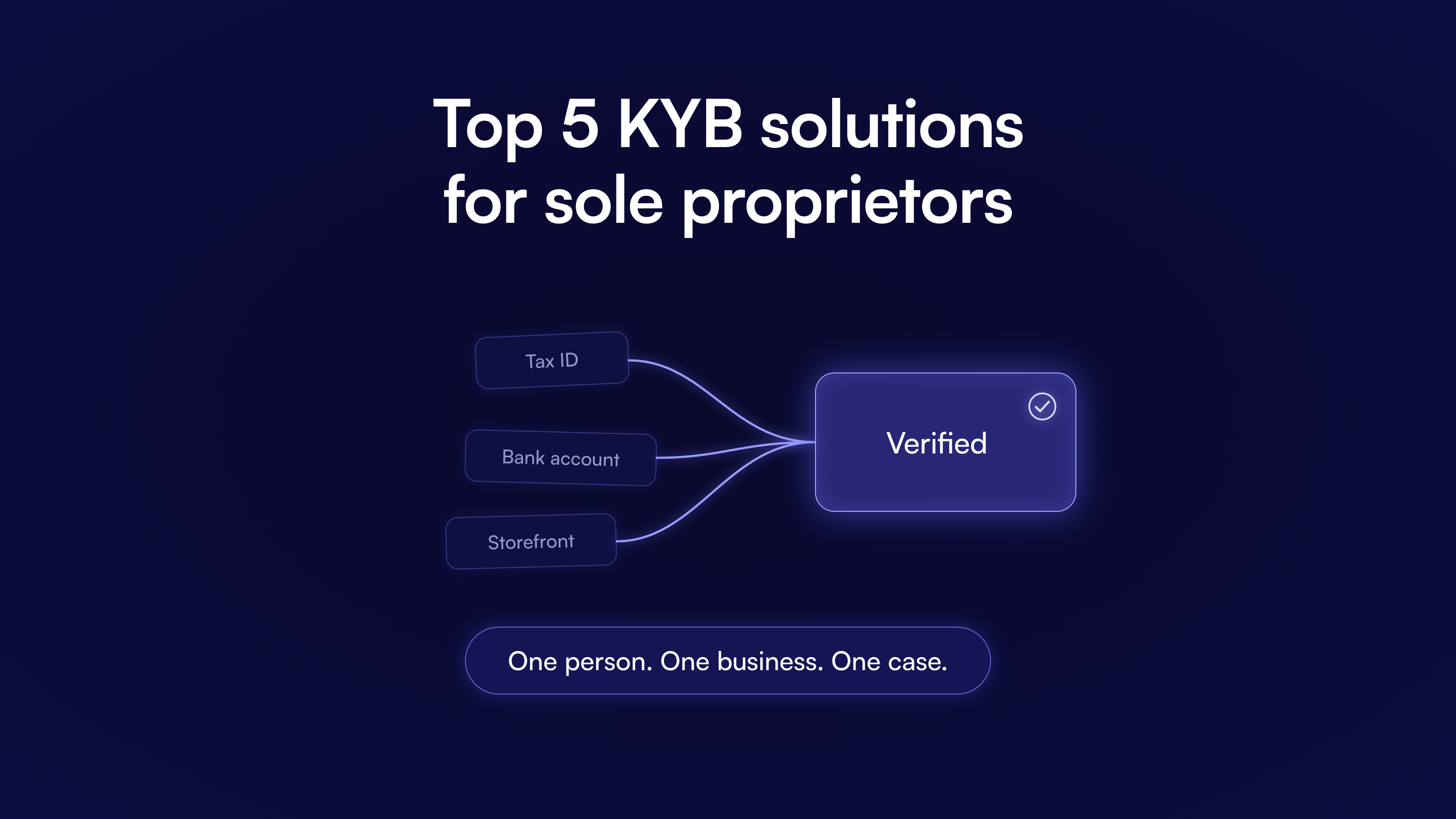
Key Takeaways

Sole proprietors are the highest-volume, thinnest-file segment in business verification: the person is the business, and the registry footprint is often a business name filing or nothing at all.
Standard KYB breaks here because there is no entity record to anchor on, and standard KYC alone misses the business half of the risk.
Synthetic sole proprietorships are cheap to manufacture, which makes cross-signal checks matter more at the bottom of the market, not less.
The platforms that work here verify the person and the business as one case, fall back to multiple data sources where registries are silent, and keep friction proportional to risk.
Test any platform with a DBA-only applicant and a gig seller whose only paper trail is a bank account.
The Smallest Businesses Are the Biggest Verification Problem
Marketplaces, payment platforms, and SMB lenders onboard sole proprietors by the thousand. Each one is small. The segment is enormous, and it is where verification programs quietly leak: good applicants abandoned by heavy flows on one side, manufactured sellers waved through on the other.
The reason is structural. A sole proprietorship is a person wearing a business name. There is often no incorporation record, no ownership filing, and no registry entry beyond a local business-name registration, if that. The usual KYB anchors are missing, and treating the applicant like a corporation produces false rejections. Treating them like a consumer misses the business half of the risk.
What Makes Sole Props Hard
The registry is silent. A Delaware C-corp leaves a paper trail by existing. A sole proprietor might have a DBA filing in one county, a tax ID, and nothing else. Verification has to be built from multiple weaker signals instead of one strong record.
The person is thin-file too. The humans behind young businesses are often young themselves, or new to the country, or unbanked until recently. Canada's regulator explicitly recognizes this with its dual-process method for exactly these cases, which we cover in our Canada KYB guide.
Fraud is cheap at this tier. Manufacturing a plausible sole proprietorship costs an afternoon: a business name, a website template, a bank account, and a synthetic identity behind it. Single-document checks pass all of it. What fails the fake is combination: does the tax ID, the person, the bank account, the website, and the stated business line agree.
Volume punishes friction. These applicants will not upload six documents or wait three days. Every extra step is measurable abandonment, so the flow has to earn each piece of friction with risk.
What to Look For in a Sole Prop KYB Solution
- Person and business in one case. KYC and KYB run as a single flow with one decision, because splitting them across tools splits the picture.
- Multi-source fallback. Where the registry is silent, verification composes from tax ID validation, bank signals, digital footprint, and document intelligence rather than failing closed.
- Thin-file identity methods. Verification paths for people without deep credit files, not just document-plus-selfie.
- Document and website intelligence. The evidence sole props do have (a utility bill, an invoice, a storefront page) read and checked automatically.
- Risk-proportional friction. Low-risk applicants sail, signals of risk earn escalation, and the flow adapts instead of applying corporate-grade demands to everyone.
- Monitoring that scales down. Small accounts change too: continuous screening cheap enough to run on a million sellers.
The Best KYB Solutions for Sole Proprietors
| Provider | Known for | Fit for sole props |
|---|---|---|
| AiPrise | Full-lifecycle KYB and KYC across 200+ countries with AI agents | Platforms onboarding sole props at volume across markets, in one flow |
| Persona | Configurable identity workflows combining business and individual checks | Product teams composing custom thin-file flows |
| Sumsub | All-in-one KYC, KYB, and AML verification flows | Crypto platforms onboarding individual traders and small entities globally |
| Trulioo | Global identity and business data aggregation | Teams needing broad person and business data, building their own flow |
| Veriff | Strong document and biometric identity verification | Identity-first stacks pairing IDV with a separate business verification layer |
1. AiPrise
AiPrise is the AI-powered global compliance platform: KYB, KYC, AML screening, and AI agents in a single API and dashboard, covering 200+ countries with 100+ data sources. Three things make it the strongest fit for the sole prop segment.
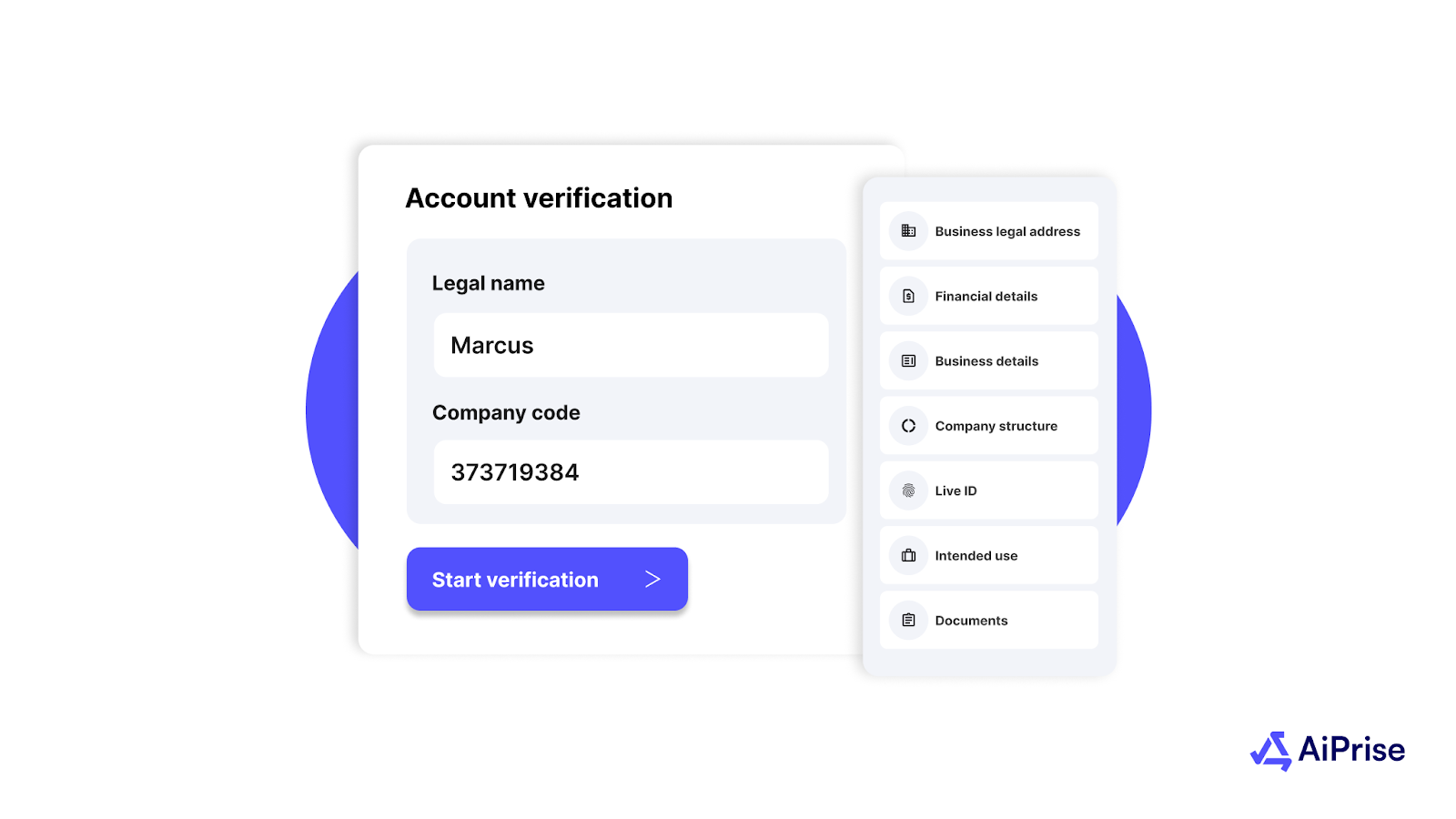
The person-business duality is native. A sole prop case runs KYC on the person and KYB on the business as one flow with one decision, and where a registry record exists, verification anchors on it directly. Where it does not, the platform composes the picture from 100+ data sources: tax ID validation, identity verification, document evidence, and digital footprint, so a silent registry degrades the check instead of killing it.
The agents read the evidence sole props actually have. The Document Insights Agent reads the utility bill, the invoice, and the bank statement and checks whether they hold up. The Website Agent reads the storefront and checks whether it matches the stated business. That cross-signal combination is what manufactured sellers fail, because faking each artifact is easy and faking their agreement is not.
It runs at onboarding speed. Verification completes in minutes, friction scales with risk, and the segment's economics hold: BlindPay cut user verification from 8 minutes to 20 seconds and automated 90% of its KYC and KYB checks in its first month with AiPrise.
2. Persona
Persona's composable infrastructure suits teams that want to design exactly how a thin-file flow behaves, with strong developer ergonomics. The consideration: the sole-prop specifics (fallback logic, risk-proportional friction, business-side checks) are yours to configure and validate rather than defaults you inherit.
3. Sumsub
Sumsub packages KYC, KYB, and AML into configurable global flows and is a common choice for crypto platforms onboarding individual traders and small entities. The consideration: sole-prop mechanics like registry-silent fallback and business-side depth deserve close inspection in an evaluation, since the footprint is broad rather than segment-specialized.
4. Trulioo
Trulioo's aggregation covers both person and business data across a very broad global footprint, useful raw material for thin-file verification. The consideration: it is a data layer, so the composition logic, decisioning, and monitoring are built and maintained by your team.
5. Veriff
Veriff is strong at the identity half: document and biometric verification with good fraud detection on the person. The consideration: the business half is thin, so Veriff typically pairs with a separate KYB layer, which reintroduces the split-picture problem this segment punishes.
How to Run the Evaluation
Bring the applicants your funnel actually contains: one DBA-only sole prop, one gig seller whose entire paper trail is a bank account, one registered sole trader from the UK, and one family business from an emerging market. Measure four things: how many completed verification without human touch, how long the completed ones took, what the flow demanded from the thin-file cases, and whether the manufactured-looking one got caught. The gig seller is the tell, because that applicant breaks every corporate-shaped flow.
Frequently Asked Questions
Is KYB legally required for sole proprietors?
It depends on jurisdiction and who is onboarding them. Financial institutions generally owe CDD on the individual, and business-level checks are driven by card network rules, banking partner requirements, and fraud economics. In practice, platforms verify both halves because the risk lives in both.
What is the tax ID situation for US sole props?
Many operate under their SSN rather than an EIN, and those with EINs cannot be looked up publicly. Validation runs through IRS TIN-matching, and a tax ID that does not match the name on file is one of the strongest early fraud signals in the segment. Our US KYB guide covers EIN verification in depth.
What documents should a sole prop flow request?
As few as risk allows. A business-name registration where one exists, a tax document, and bank verification cover most cases, with document intelligence doing the checking so a human does not have to.
How fast should sole prop verification be?
Minutes, or the funnel pays for it. The segment tolerates almost no waiting, which is why automation rates matter more here than anywhere else.
Verify Sole Proprietors With AiPrise
AiPrise verifies the person and the business as one case, composes evidence where registries are silent, and runs at the speed the segment demands, across 200+ countries through one API. Book a demo and bring your thinnest-file applicant.
You might want to read these...





AiPrise
KYB Compliance: 2026 Regulations You Should Know About
As organizations expand globally and face tighter regulations, adherence to Know Your Business (KYB) standards has become one of the most critical compliance layers for fintech, online marketplaces, and other companies that need to verify business customers before letting them perform financial transactions.











.png)

.jpg)
















.png)








.png)
.png)
.png)

















.png)


.png)




AiPrise’s data coverage and AI agents were the deciding factors for us. They’ve made our onboarding 80% faster. It is also a very intuitive platform.

Head of Operations



See your full compliance picture in one place
Use AI agents and global data to review businesses and users faster and more accurately
