

AiPrise
5 min read
April 9, 2026
Website Agent 2.0: From Website Checks to Risk Decisions
Key Takeaways

Today, we are launching Website Agent 2.0.
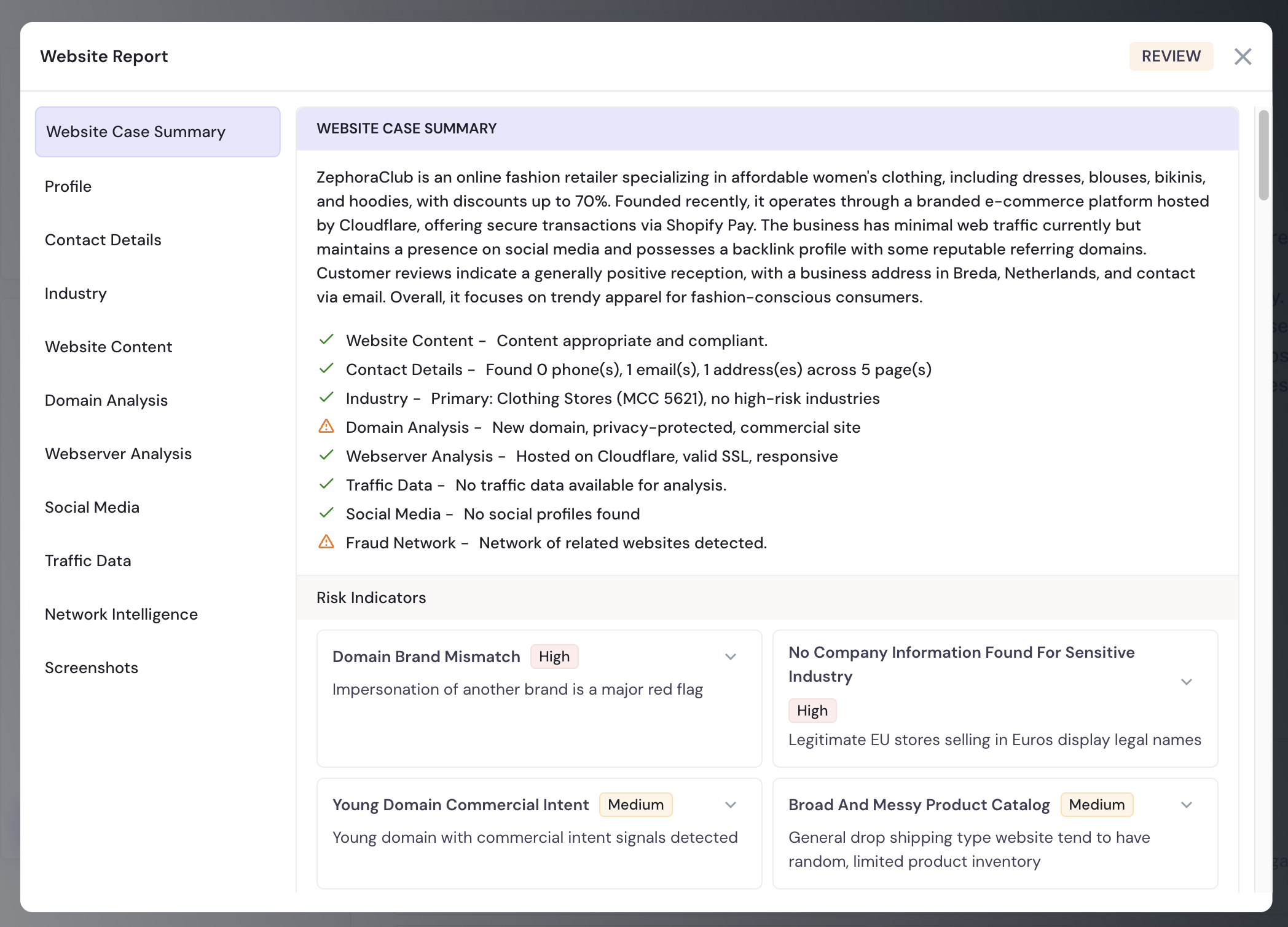
This is a major step forward from the first version of Website Agent. Instead of simply extracting information from a website and handing it to an analyst, Website Agent 2.0 goes further. It evaluates what a site is claiming, checks whether those claims hold up, and returns a clear risk decision: Approve, Review, or Reject.
That matters because website review has changed. A polished site is no longer enough to establish trust. Scam storefronts, fake financial products, and misleading merchant sites can all look credible on the surface. Compliance teams need more than a parser. They need something that reasons the way an experienced analyst would.
That is what Website Agent 2.0 is built to do.
Why website review is getting harder
The challenge is no longer whether a website exists. The challenge is whether the business behind it is real, credible, and consistent with the story the site is telling.
A site can look professional and still be risky. It can claim scale without any visible traction. It can present itself like a legitimate retailer while hiding weak business details, suspicious pricing, or connections to other domains that do not show up in a surface level review.
That is why website checks based only on extraction are no longer enough. Compliance teams need a faster way to understand what a site is really doing, whether its claims hold up, and what should happen next.
What is new in Website Agent 2.0
Website Agent 2.0 introduces three major capabilities.
1. Risk Intelligence Layer
Website agents have traditionally acted like extractors. They pull data from a site and pass it on. Website Agent 2.0 goes further. It understands the website.
That starts with website intent analysis. The agent determines what the site is trying to do and whether the story it tells holds together.
It then adds external trust signal cross referencing. The website is not treated as the source of truth. Website Agent 2.0 checks what the broader internet says through online reputation, social presence, domain history, business details, and other supporting signals.
It also applies fraud pattern detection. Unrealistic pricing. Broad and messy product catalogs. Brand mismatch. Missing company information. AI generated or templated content. These are not isolated signals. They are patterns experienced analysts recognize quickly. Website Agent 2.0 automates that pattern recognition.
And finally, it uses industry aware reasoning. A missing legal entity name on a blog is one thing. The same gap on a commercial ecommerce site selling across borders is something else. The checks change depending on the business type.
The output is simple: Approve, Review, or Reject, with a human readable explanation for every signal that fired.
.png)
2. SOP Based Policy Engine
Different teams have different policies. Some industries are prohibited. Some are high risk. Some require manual review no matter what.
Website Agent 2.0 lets customers configure their own prohibited and high risk industry lists, then checks websites against those policies automatically. For clear cut cases, the agent can make the call without analyst involvement.
That means less time spent on obvious cases and more time for the reviews that actually require judgment.
3. Related Entity Intelligence
This is the sharpest new capability.
Website Agent 2.0 surfaces domains that share critical infrastructure with the site under review. That includes shared templates, copied content, reverse image matches, certificates, hosting patterns, and other overlapping signals.
In other words, you are no longer reviewing a site in isolation. You are seeing its neighborhood.
That matters because fraud operators rarely launch one site. They launch clusters.
In one example, what looked like a single storefront turned out to be part of a broader connected network. Website Agent 2.0 surfaced related domains through shared templates, copied content, and reverse image overlap, helping analysts see the pattern much earlier.
.png)
And in larger cases, those connections scale quickly. Related Entity Intelligence can surface wide clusters of domains sharing infrastructure and visual fingerprints, giving teams a much broader view of how operators reuse the same backend across different fronts.
.png)
Why this matters for compliance teams
For compliance teams, the upside is immediate.
Most clear cut website reviews can be decided automatically. Analysts do not need to spend their time opening tabs, checking whether contact details work, comparing screenshots, or writing the same review notes over and over.
Review time drops from minutes to seconds. Analysts focus on the cases that actually need judgment.
For risk teams, Related Entity Intelligence changes the shape of the problem. Instead of dealing with suspicious websites one by one, they can start to see the broader network behind them.
And for the business, the result is simple: faster onboarding for good merchants, stronger prevention for bad ones.
Why this matters for fintech and crypto companies
Fraud in fintech and crypto is built to pass surface level review.
Sometimes it looks like a scam storefront. Sometimes it looks like a fake financial product. Sometimes it is an operator hiding behind a cluster of domains that appear independent until you connect the signals underneath.
That is exactly why website reasoning matters.
Website Agent 2.0 does not just ask whether a site exists. It asks whether the business story is coherent, credible, and consistent with the broader signals around it. That is what modern risk teams actually need.
The bigger shift
The bigger shift is not that website review is getting faster.
It is that website review is moving from manual interpretation to automated reasoning.
That does not mean replacing analysts. It means automating the checks strong analysts already know how to run, then presenting the outcome in a way a human can understand and defend.
And that is why Website Agent 2.0 matters.
If you are still reviewing websites one at a time, in isolation, as if each one exists on its own, you are missing the real picture.
Website Agent 2.0 gives compliance teams that picture.
Want to see it in action?
If you want to see how Website Agent 2.0 reasons through a website, applies policy, and surfaces connected domains, book a demo.
You might want to read these...


.png)

AiPrise’s data coverage and AI agents were the deciding factors for us. They’ve made our onboarding 80% faster. It is also a very intuitive platform.

Head of Operations



See your full compliance picture in one place
Use AI agents and global data to review businesses and users faster and more accurately
